Three ways to remake a plant, on one stamp
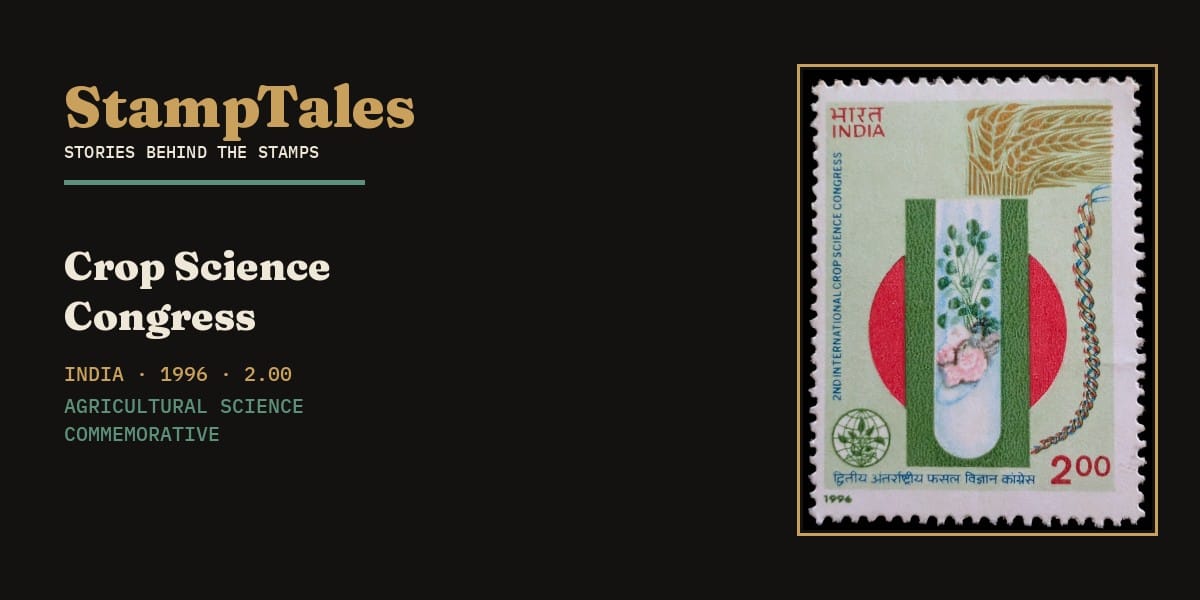
The little glass tube at the centre of this stamp is not a vase. The pink lump at its base is not a flower. What India Post drew here, in 1996, was a plant being grown from cells in a laboratory — a whole leafy plantlet coaxed out of a shapeless mass of tissue, in glass, without a seed. It is one of the least sentimental images ever to appear on an Indian stamp, and it is the quiet centre of the Crop Science Congress 1996 issue — a design that is really an argument about the future of food.
The stamp marked the 2nd International Crop Science Congress, which India hosted at New Delhi in November 1996. The first had been held four years earlier in Ames, Iowa — the American corn belt, the natural home of industrial agriculture. That the second came to India was not a courtesy. India had fed itself out of the Green Revolution a generation earlier, turning from a famine-haunted importer of American wheat into a country that grew its own surplus. By the 1990s it wanted a seat at the table where the next revolution — the molecular one — was being planned. The stamp is how the host country chose to introduce itself.
| Issue | 2nd International Crop Science Congress |
|---|---|
| Issued | 17 November 1996 |
| Denomination | 2.00 rupees |
| Country | India |
| Occasion | Congress held at New Delhi; stamp and commemorative coins released by President Shankar Dayal Sharma at Vigyan Bhavan |
| Catalogue | SG 1688 · Scott 1582 |
What the three images actually are
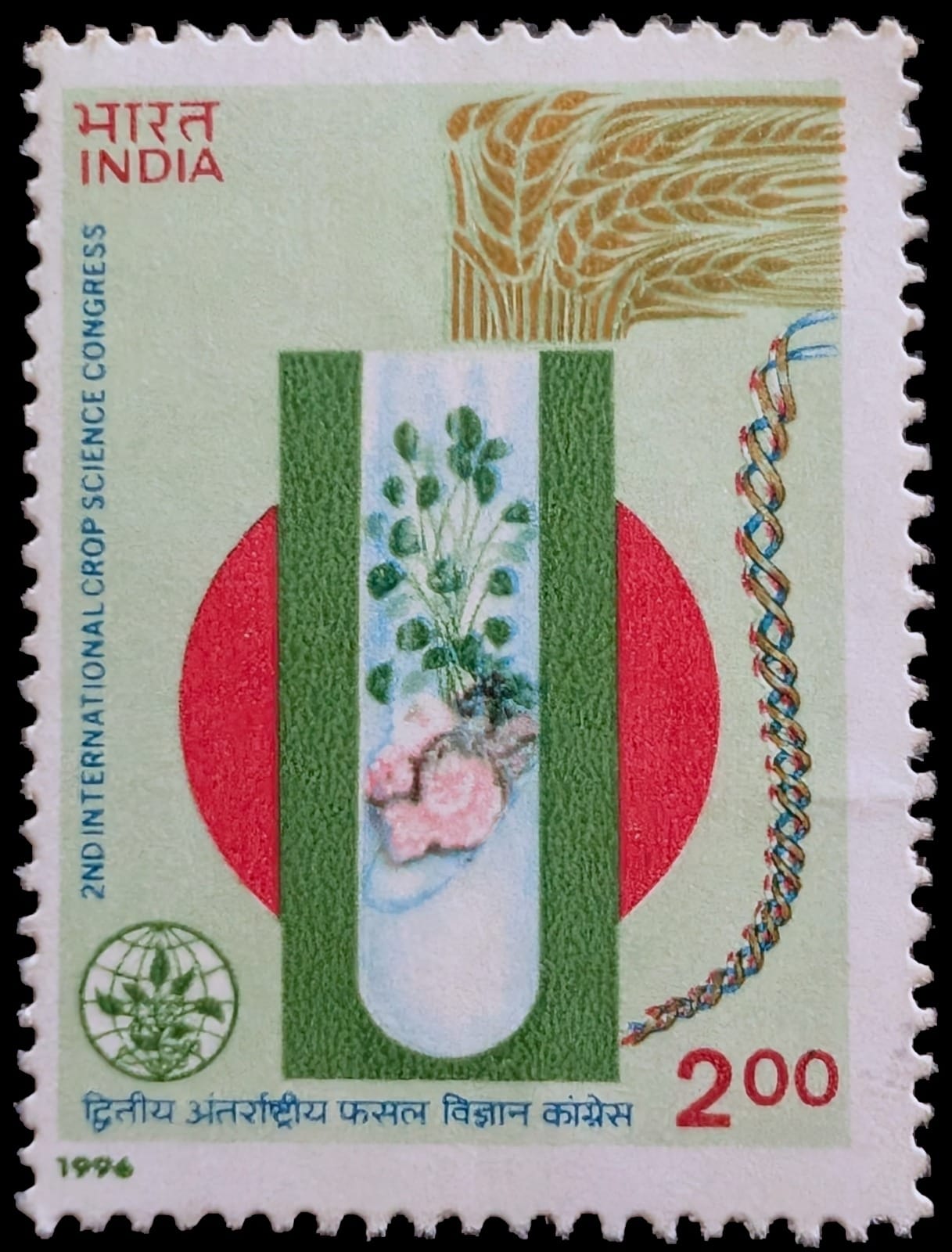
Read the stamp from top to bottom and it moves from the field to the culture tube to the molecule. In the upper right, a spray of golden wheat, drawn in the fine engraved lines of an older kind of stamp. Down the right edge, a DNA double helix twists in red, blue and gold. And between them, dead centre, the culture tube with its plantlet.
These are not three decorations. The Crop Science Congress 1996 design lays out three stages in how crop science learned to improve a plant, in the order they arrived. The wheat is classical breeding — cross the best parent plants, select their best offspring, repeat for years. That is the technology that fed India in the 1960s and 70s.
The tube is tissue culture: take a few cells from a good plant and grow thousands of identical copies in glass, skipping the seed entirely. The helix is the newest and most disruptive — molecular genetics, the reading and eventual rewriting of the plant’s own instructions. It is not itself a way of growing a plant so much as the level at which the next round of improvement would be done. The designer stacked a century of agricultural science into a single two-rupee square and trusted the viewer to feel the acceleration.
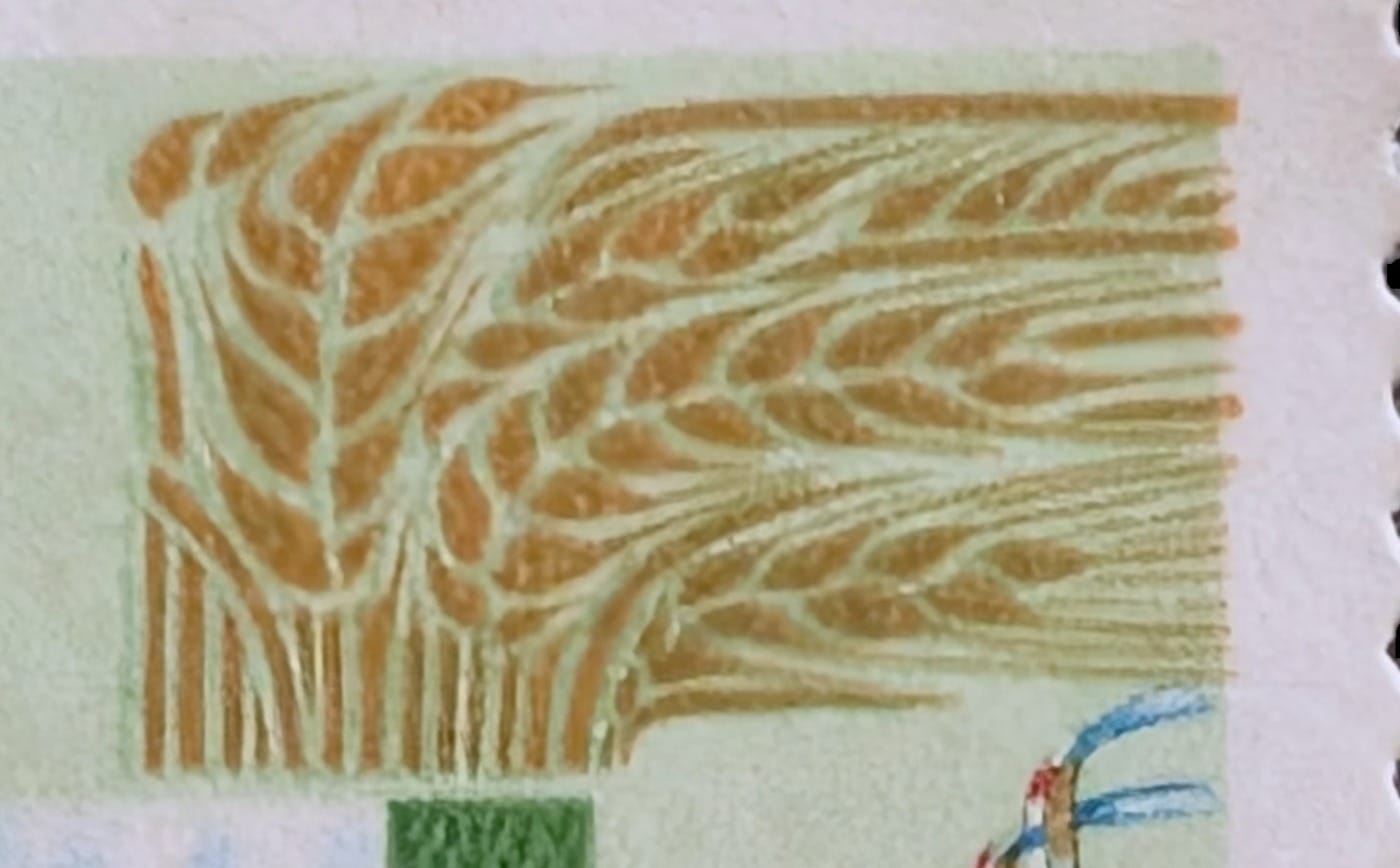
The wheat sits highest and is drawn most traditionally, which is fitting: it is the past the rest of the stamp is built on. A country that could not have hosted this congress in 1966 could host it in 1996 precisely because the wheat worked.
The plant in the glass
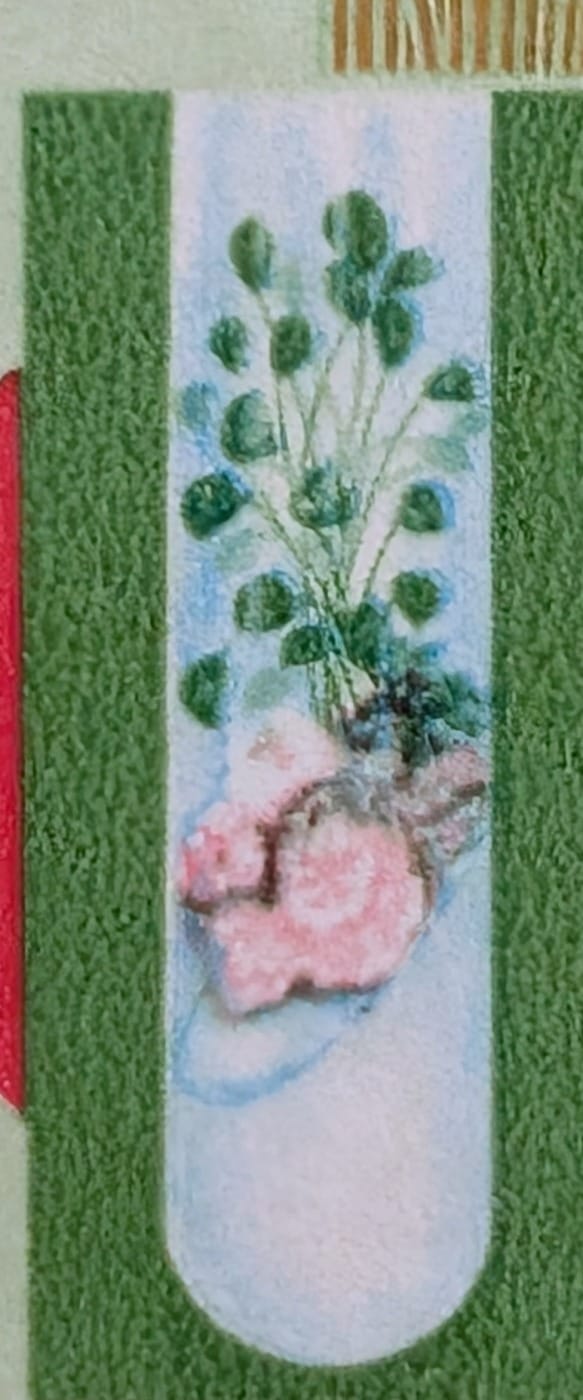
The central tube is worth slowing down for, because most people glance at it and see a sprig in a test tube. Look again at the corrected image. A green plantlet — real leaves, real stems — rises out of a lumpy pink-and-cream mass at the bottom of the tube. That mass is the point. It is callus: undifferentiated plant cells, tissue with no shape or purpose yet, the biological equivalent of raw clay. Under the right chemical cues, callus can be pushed to grow roots, shoots, whole plants. One good parent plant becomes an unlimited supply of exact copies, none of them grown from a seed, none of them varying from the original.
This is not science fiction and was not in 1996; tissue culture was decades old and India had working laboratories doing it. But putting it at the visual centre of a national stamp was a statement of where the country saw itself heading. The Green Revolution had been about better seeds. The image at the heart of this stamp is about skipping the seed altogether.
The helix that stayed silent
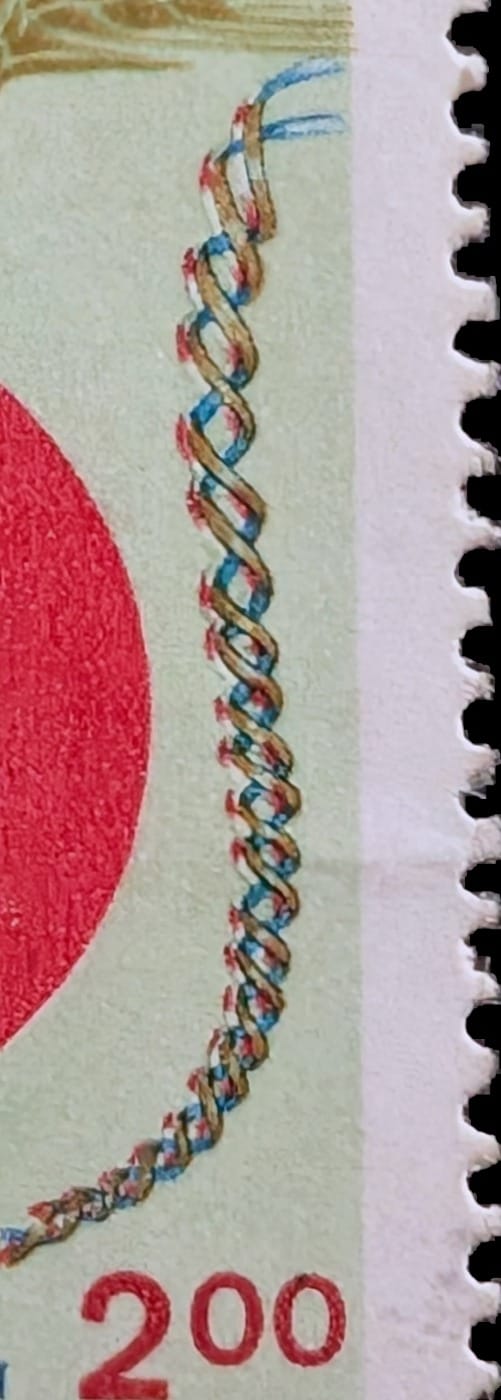
And then there is the DNA, curving down the right side like a decorative flourish. In 1996 it read as pure optimism — the double helix as a symbol of progress, the way an atom stood for progress in the 1950s. But it stood closest to a question the stamp does not touch, and that silence is the interesting part.
The timing is the whole story. India had joined the new World Trade Organization on 1 January 1995, twenty-two months before this stamp appeared. Bound up in that membership was TRIPS, the agreement that made the question of how plant varieties would receive intellectual-property protection unavoidable: every member had to protect them somehow — by patent, by a home-grown system of its own design, or by some combination of the two.
India took its time answering, and answered thoughtfully. The debate was long and serious, weighing the interests of plant breeders against those of farmers who had saved and swapped seed for millennia. India would not pass its own law until 2001, and when it did it chose a sui generis route — the Protection of Plant Varieties and Farmers’ Rights Act — rather than extending ordinary patent protection to plant varieties, and it wrote the farmer’s right to save seed directly into the statute. It was a considered piece of law, not a reluctant one.
So the serene helix on this stamp sits right beside a question that, in 1996, had no settled answer. The stamp shows the science — the elegant molecule, the plant in the glass — and says nothing about the argument over who would control what that science produced. That is not a fault in the design. A commemorative stamp is a handshake, not an editorial, and no post office was going to print the words “who owns this seed” beside a picture of a congress. But knowing what 1996 was — the year after the WTO, five years before India’s answer — turns the prettiest element on the stamp into its most quietly loaded one.
The emblem in the corner
Low on the left of the Crop Science Congress 1996 stamp sits a small globe cradling a leafy plant, the badge of the crop-science community the congress represented. It is the modest institutional signature under a grand claim: the world, held together by agriculture, convened in Delhi. Above it runs the bilingual title, and in the lower corner the value, two rupees, in the same confident red as the disc behind the tube.
The design’s instinct throughout is to show plant science as clean, hopeful and settled — wheat, glass, molecule, all arranged in serene balance on a pale green ground. What it could not show, because no one yet knew the answer, was the harder question the congress delegates were actually there to work through. A stamp can picture the science. Five years later, Indian law had to decide who could claim rights over what that science produced.
Further Reading & Links
- The Bougainvillea Mahara stamp, 1985 — a named, registered plant variety, and the other side of India’s relationship with engineered plant life.
- The 1994 Human Resource Development stamp — from the same run of liberalisation-era New Delhi conference stamps.
- The Protection of Plant Varieties and Farmers’ Rights Act, 2001 — how India finally answered the ownership question this stamp stayed silent on.
- First International Crop Science Congress, Ames, Iowa, 1992 — the American debut of the congress India hosted second.