The year India called people a resource
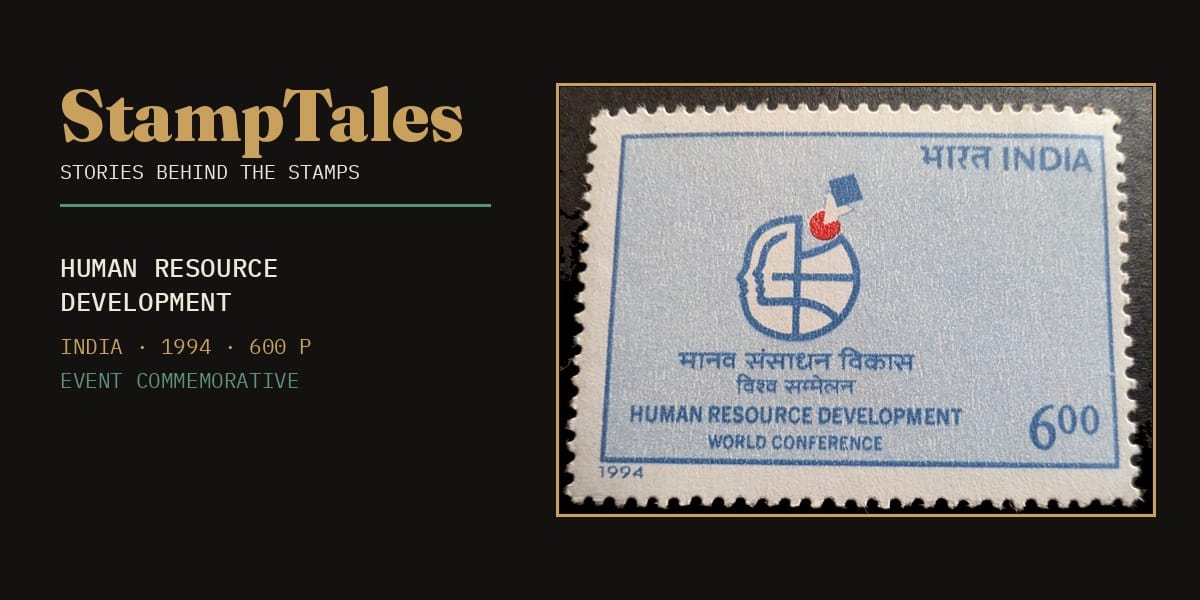
The words are printed on the stamp twice, once in Hindi and once in English, and both times they say the same strange thing: that a human being is a resource, and that a resource can be developed. India Post’s Human Resource Development 1994 issue, released on 8 November to mark a world conference in New Delhi, put that phrase in the middle of the design at a point when it had become established in the language of the Union government. The stamp is a fossil of a way of talking about people — one that India adopted with some fanfare in the 1980s and, decades later, stepped away from without much comment.
That is what makes a plain blue-and-white event stamp worth stopping on. The design is thin — an emblem, a caption, a value — but the caption carries a phrase that would eventually vanish from the name of the ministry built around it. In 1994 nobody found it odd. Read now, मानव संसाधन — mānav sansādhan, human resource — is a small marker of a phase of official thinking that has since gone out of fashion.
| Issue | Human Resource Development World Conference |
|---|---|
| Issued | 8 November 1994 |
| Denomination | 600 paise (₹6) |
| Country | India |
| Category | Event commemorative |
| Occasion | Human Resource Development World Conference, New Delhi (as inscribed) |
Where the phrase came from
India did not always speak this way. For the first four decades after Independence the department that ran schools and universities was simply the Ministry of Education, a name inherited from the British and held by Maulana Abul Kalam Azad as its first minister. That changed in 1985. Rajiv Gandhi’s government renamed it the Ministry of Human Resource Development, folded in culture, youth and sport, and handed the new portfolio to P. V. Narasimha Rao. Education was now one input among several into something larger and more instrumental — the development of the country’s people as a national asset.
The renaming was not a piece of Indian invention. “Human resource development” was the language of the World Bank, the UN development agencies and the economics faculties of the 1980s, where the older idea of “human capital” had softened into something that sounded less like accountancy and more like welfare. To adopt the term was to signal that India was thinking about its population the way the development economists did: as a stock to be trained, made healthy and made productive.
Why 1994 was the year to say it out loud

By the time this stamp appeared, the phrase sat in a changed landscape. India’s economy had been opened three years earlier, in the 1991 reforms that dismantled much of the licence system and invited foreign capital in. In the argument the country was now making about its own prospects, one of the most repeated assets was its people — young, numerous, and increasingly educated in English. Against that backdrop “human resource” reads less like a neutral bureaucratic label and more like a claim about what India had to offer. None of this proves the stamp was designed as a pitch to investors; it is an event commemorative for a conference. But a phrase adopted in 1985 landed differently in 1994, and the stamp printed it at exactly the moment the country was most inclined to think of its population as its leading resource.
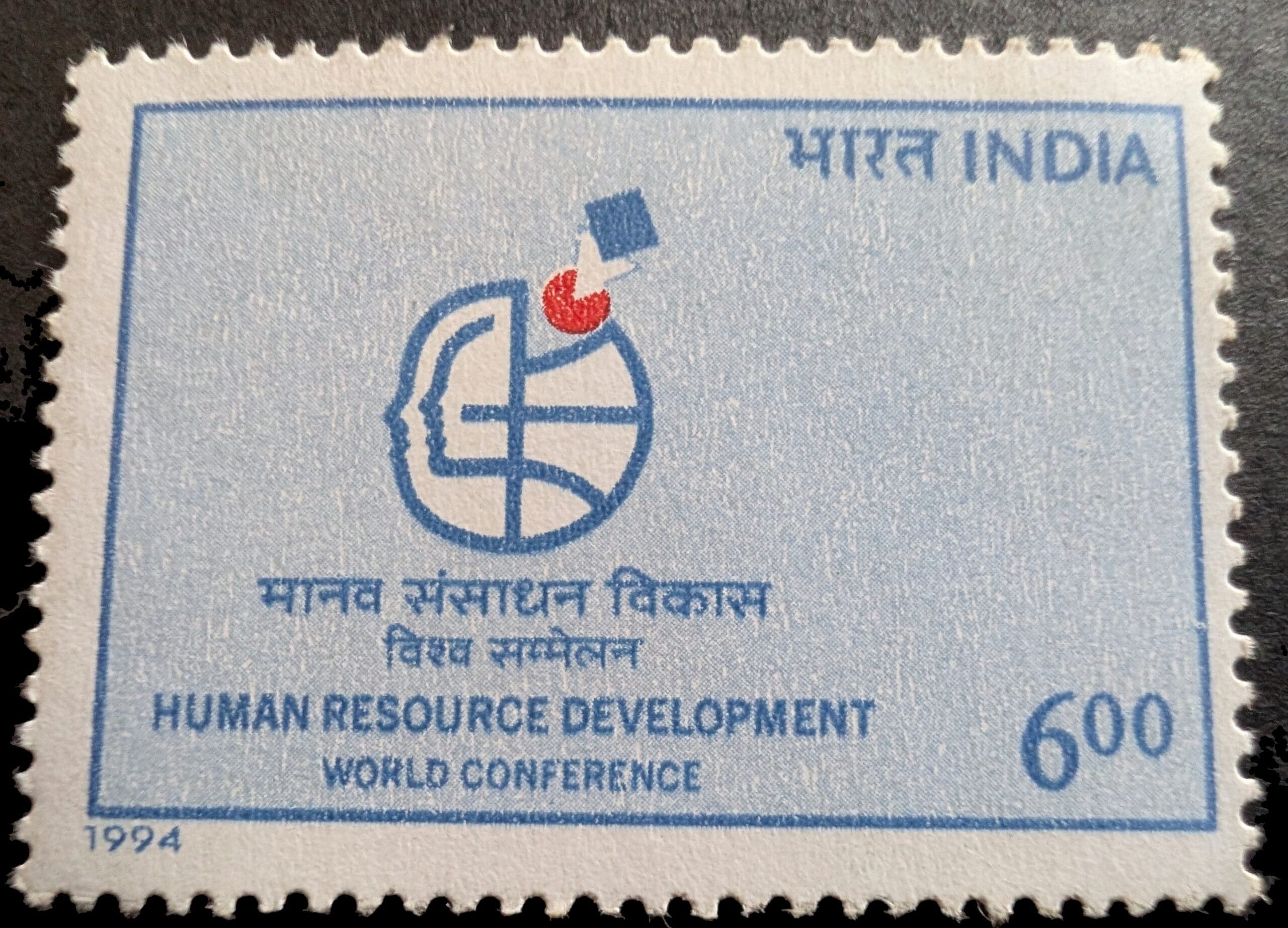
The emblem carries the idea without a word. A human head in left profile is fused with a globe, the meridians of the world running straight through the skull. It is the standard visual grammar of these conference marks — the individual and the planet made continuous — and it is doing the same work as the caption: placing the single person inside a global frame. Above the head sits the stamp’s only patch of colour.

A small blue square is thrown up and away from the figure, trailed by an open red disc. The likeliest reading is the oldest cliché of graduation photography — a mortarboard tossed in the air — with the red standing in for the aspiration the education is supposed to release. Whatever the designer intended, the object refuses to resolve into anything more specific, and it would be dishonest to claim it does. The red is the one warm note in an otherwise cool, institutional design, and the eye goes to it precisely because everything else is so restrained.
What the two scripts agree on
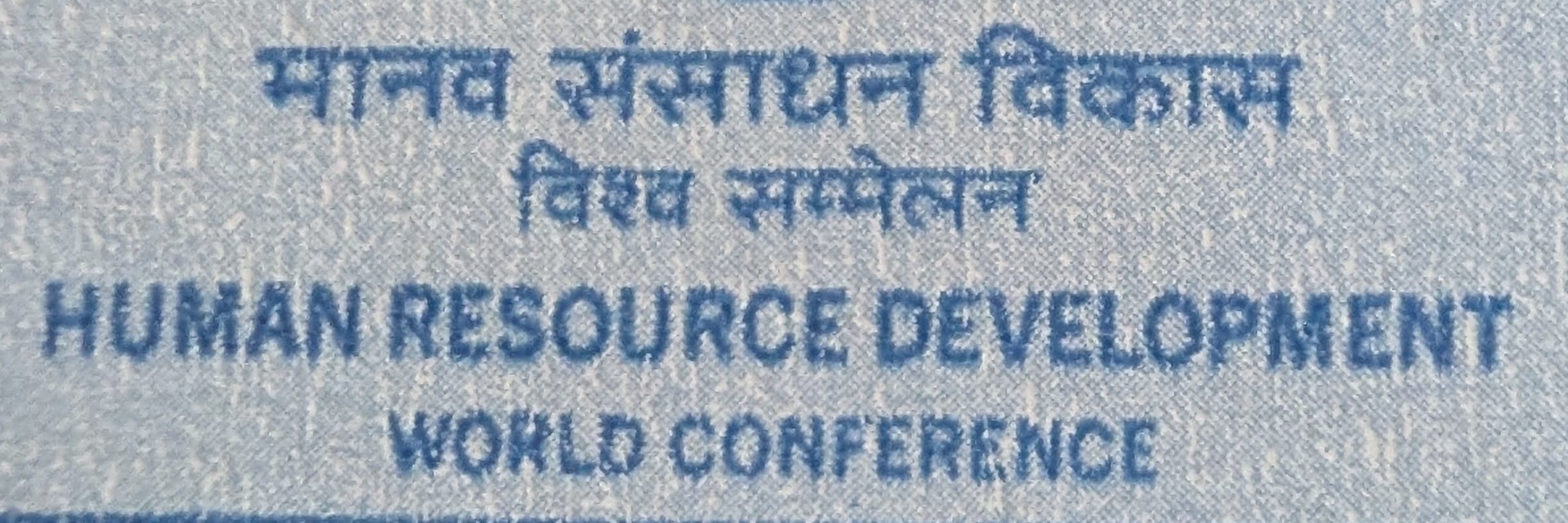
The caption is where the stamp is most itself. मानव संसाधन विकास sits above HUMAN RESOURCE DEVELOPMENT, and for once the translation is exact rather than approximate. मानव is human; संसाधन is resource — something available to be drawn upon or put to use; विकास is development. The Hindi does not soften the English or reach for a warmer indigenous idea of learning or upbringing. It commits fully to the same metaphor. Push the word and it turns hard: a person as sansādhan is a person read as stock, as material, as something you draw on.
There is nothing sinister in this. The vocabulary was well meant, and the policies it travelled with — mass schooling, adult literacy, public health — were aimed at making Indian lives longer and freer. But the word chose a side in an old argument about what people are for. To call someone a resource is to measure them by their yield. The stamp states the position plainly, in two scripts, and leaves it there.
The name at the other end of the timeline
History supplied the epilogue. In 2020 the government of the day renamed the ministry again — this time back to the Ministry of Education, on the recommendation of the National Education Policy, whose drafters argued that the focus should return to learning itself rather than the production of a workforce. The reasoning ran almost opposite to 1985: education is not merely an input into human resource development; it is the point.
That leaves this stamp in an unusual position. India carried the phrase in the name of a Union ministry for thirty-five years, from 1985 to 2020, and this square of paper falls almost exactly in the middle of that span — issued when the term was at its most self-assured, before liberalisation’s early optimism had met its limits and before the drafters of a new education policy would argue the words back out of the ministry’s name.
A stamp cannot know it will be overtaken. This one printed the language of its moment as though it were fixed. The phrase appears twice, in Devanagari and Roman script, and the repetition is the whole of the stamp’s argument: a government stating, without hedging, that its people were a resource to be developed. The words outlasted the conference they commemorated, then outlasted the ministry that bore them. What remains is the stamp and the two ministry names at either end of the timeline — Education in 1985, Human Resource Development on this issue in 1994, Education again in 2020 — and the reader can decide for themselves what the round trip was worth.
Further Reading & Links
- Our article on the 1988 Love and Care for Elders stamp — another India Post issue that folds a government idea straight into the object.
- The 1996 Crop Science Congress stamp — three stages of crop science on one stamp, from the same liberalization-era run of conference stamps.
- List of postage stamps of India (1991–2000)) — confirms the 8 November 1994 issue date and the 600-paise denomination.
- Ministry of Education (India)) — the 1985 rename to Human Resource Development and the 2020 reversal.