The flower on this stamp has a name and a maker
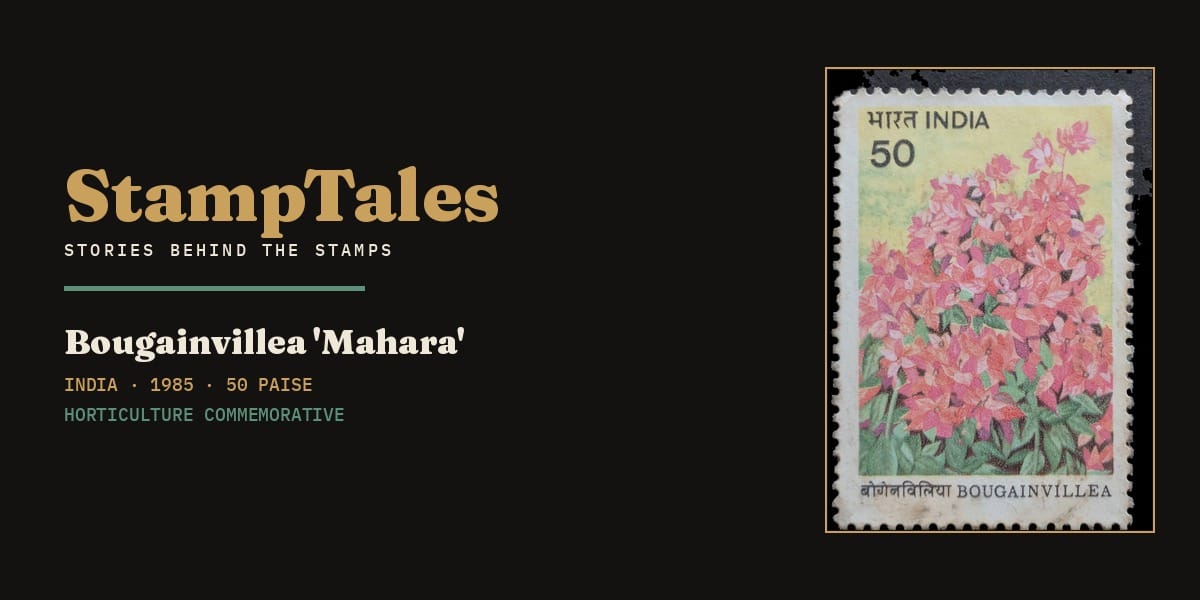
The Bougainvillea Mahara 1985 issue looks, at first glance, like a bunch of pretty flowers. It is not. The flowers on this stamp are not flowers, and the plant is not just a bougainvillea — and once you see both facts, hiding in plain sight, the stamp stops being decorative and starts being an argument.
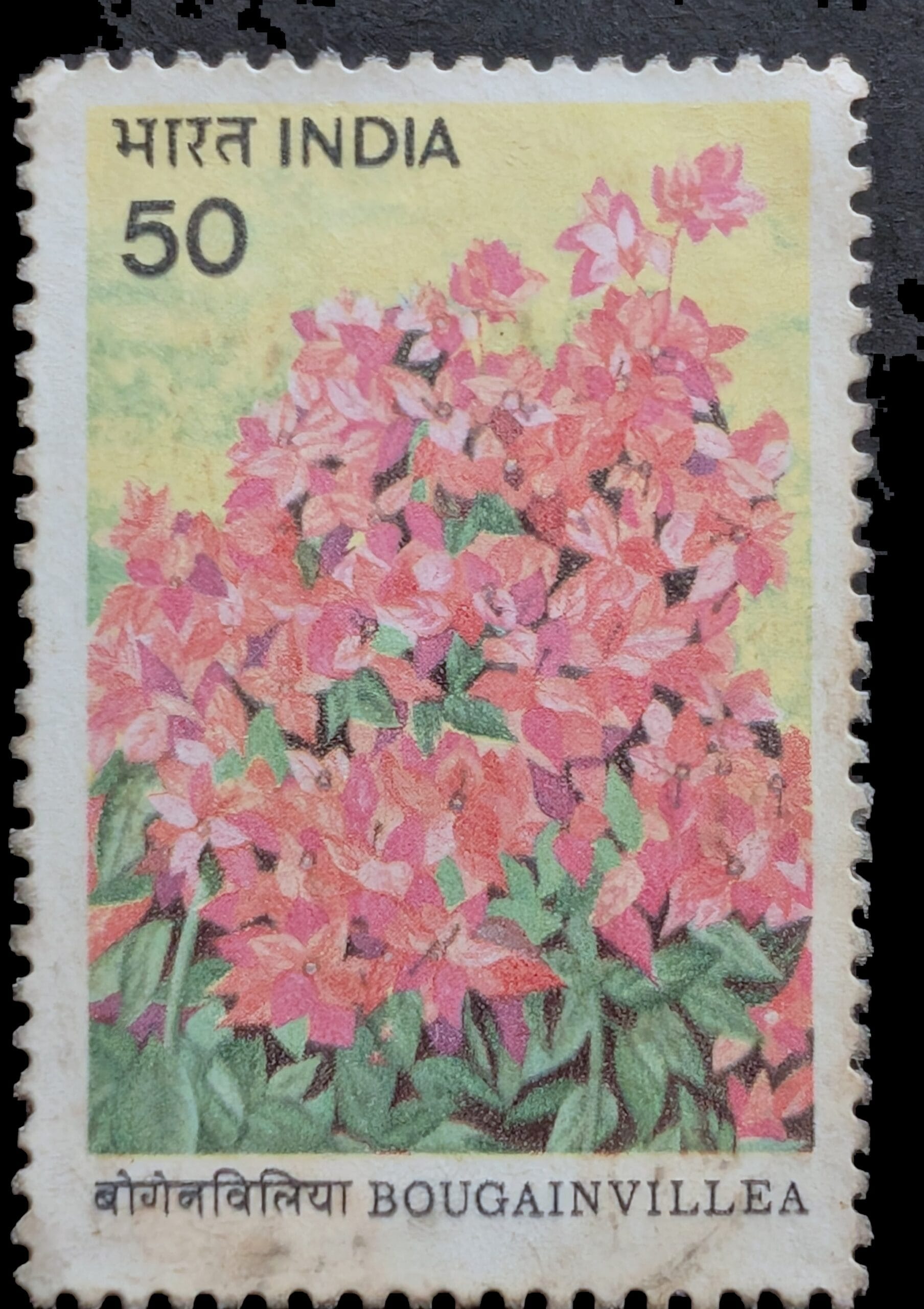
Start with the plant. India Post issued this 50-paise square in June 1985 as one of a pair, and the label along the bottom says only BOUGAINVILLEA — the genus, the thing anyone with a garden wall already knows. What the label does not say is that the specific plant painted here has a name: Mahara. It is a named cultivar — a cultivated variety selected and propagated for its carmine-red bloom and its habit of flowering for most of the year. The companion 100-paise stamp carries a second one, H.B. Singh, in mauve. These are not two wildflowers a botanist found on a hillside. They are two named varieties, each with a pedigree.
| Issue | Bougainvillea (Mahara) |
|---|---|
| Issued | 5 June 1985 |
| Denomination | 50 paise |
| Country | India |
| Designed by | India Security Press, Nashik |
| Printed by | India Security Press, Nashik |
| Colour | Multicolour |
| Set | Two values: 50 P (Mahara), 100 P (H.B. Singh) |
Why the flower on this stamp is not a flower
Look closely at the colour and you are not looking at petals. The colour comes from bracts, not flowers. The papery structures surrounding the tiny central flowers are modified leaves, and they do the visual work that petals perform in most other plants. The real flowers are the small, pale, tubular things you can just make out at the centre of each cluster of three bracts — easy to miss, and doing the quiet work while the bracts do the shouting.
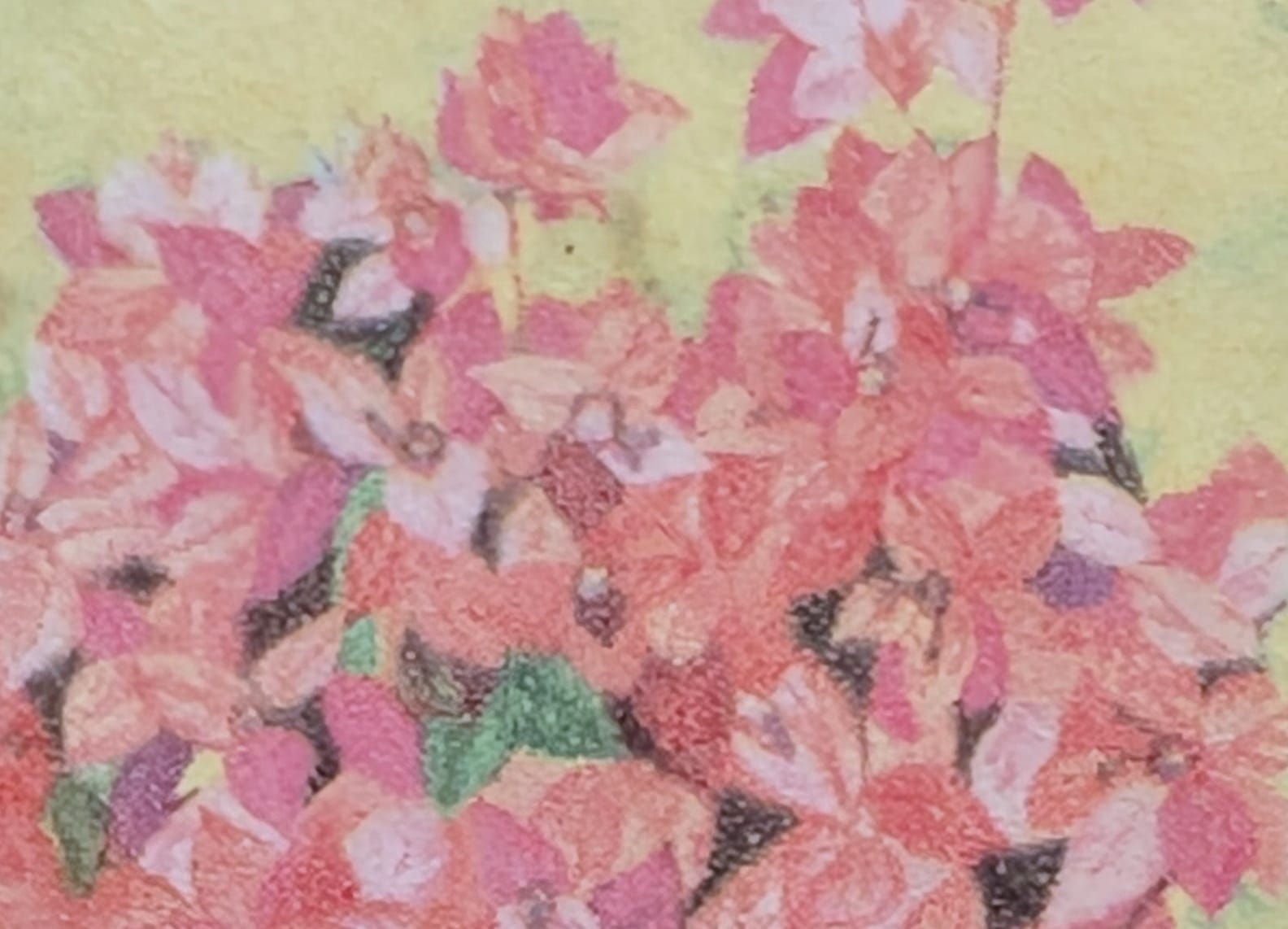
This changes what you are being shown. A rose stamp shows you a flower. This shows you a plant’s advertising, not its blooms — the loud, weather-proof, months-long colour that made bougainvillea the default climber of every tropical veranda and railway compound in India. The painter has rendered it precisely: three bracts to a cluster, thin as tissue, veined, framing the little cream trumpets. Whoever prepared the artwork drew the botany correctly rather than drawing a generic pink bush — the three-part structure is there if you look.
A name, but not the whole name

The band along the foot reads बोगेनविलिया / BOUGAINVILLEA, the genus transliterated into Devanagari and set in Latin. It names the kind of plant. It does not name the cultivar. To the person buying it at a post office counter, this is just “a bougainvillea,” the generic pink of the genus — and there is nothing wrong with that. A postage stamp is not obliged to identify the precise cultivar it depicts. BOUGAINVILLEA names the genus; only the folder names the cultivar.
But the gap is real, and it is the whole story: the stamp shows you one exact, named, registered thing and lets you read it as a wildflower. You would have to open the first-day folder to learn that this particular plant is Mahara, and that its sibling is H.B. Singh.
That folder is where the stamp’s real subject lives.
What “Mahara” actually is
A cultivar is not a species. It is a cultivated variety — a cultivated plant distinguished and maintained for particular characteristics. Mahara did not evolve under that name; it was selected, fixed, and catalogued, the way a variety of apple or a garden rose is. Naming one is not a casual act. It means someone identified the plant as distinct, stabilised those traits, proved the distinction against everything already on record, and then registered it under an agreed name — so that a “Mahara” bought in one nursery is genuinely the same variety as a “Mahara” bought in another.
Behind that word “registered” sits the part of this stamp that is genuinely surprising. By 1985 the Indian Agricultural Research Institute in Delhi served as the International Registration Authority for Bougainvillea — the global body that decides what counts as a distinct, named cultivar for the entire genus, and maintains the master list. That list had already run past three hundred entries. Many of them were Indian work: the India Post folder rattles off names like Mary Palmer, Shubra, Scarlet Queen, Begum Sikander, Spring Festival — cultivars developed in Indian gardens and research stations, each a small feat of horticultural selection.
So the reader’s path through this small square runs a long way in a short distance. You begin with what looks like a flower. You find it is a bract. You learn the bract belongs to a named cultivar called Mahara. You learn Mahara sits within an international register of more than three hundred such cultivars — one maintained, for the whole genus worldwide, through the registration authority at IARI in Delhi.
The stamp is not depicting “a bougainvillea.” It is depicting one particular horticultural object, produced and catalogued by Indian science, and it is quietly proud of it. The India Post folder is explicit about the intent: the pair was issued as a tribute to the horticulturists and botanists who propagate the plant — not to the plant itself.
How the plant got here at all
None of this is native. Bougainvillea is South American, named for the French navigator Louis Antoine de Bougainville, whose 1760s voyage round the world carried the botanist Commerson who first collected it at Rio de Janeiro. It reached India only in 1860. In little more than a century it went from foreign import to the plant you cannot keep off a compound wall — and then further, to a plant Indian institutions bred, named, registered for the world, and finally put on a stamp. That arc, from botanical guest to registered domestic product, is the reason the 1985 issue is a tribute and not just a picture.
Cultivated, then reproduced
There is a symmetry worth naming, and it is cleaner than any claim about who “made” the plant. This is not one of the issues designed at an outside studio or by a named commercial artist. According to the issue’s own description it was designed by the India Security Press at Nashik — the government works that also printed it. The state’s bank-note-and-stamp printer drew this one itself.
The plant was cultivated and named; the stamp was designed and reproduced. One process is biological, the other mechanical, but they rhyme: both take something particular and make it repeatable. A gardener fixes a chance bloom into a variety that can be grown again and again under one name; a security press fixes an image onto a cylinder and runs it off onto gummed paper again and again under one denomination. The 50 paise you paid did not buy you a picture of a flower. It bought you a reproduction of a reproduction — a named, propagated plant, turned into a named, printed object.
A bougainvillea will grow through a fence whether or not anyone names it. What this stamp records is the other impulse — the one that insists on naming it anyway, cataloguing it, holding the register for the world, and then turning the result into an image that could travel far beyond the garden it came from.
Further Reading & Links
- The 1996 Crop Science Congress stamp — India hosting the science of making new plant varieties, the other side of registering a named cultivar.
- Bougainvillea — 1985 issue details and India Post folder text (iStamp Gallery) — the two cultivars, the botanical history, the India Security Press attribution, and the IARI’s role as international registration authority.
- H.B. Singh — issue description, India Post (Indianpost.com) — confirms Mahara on the 50 P and H.B. Singh on the 100 P.
- Indian Agricultural Research Institute (IARI) — the Delhi institute that served as the International Registration Authority for the genus.
- Bougainvillea — genus, bracts and true flowers (Wikipedia) — the botany behind why the colour is a modified leaf, not a petal.