The Wild Tree and the Bred Palm – Two Indian Stamps, One Cancellation
One tree grew wild. The other was bred for better performance. A single postmark brought them together.
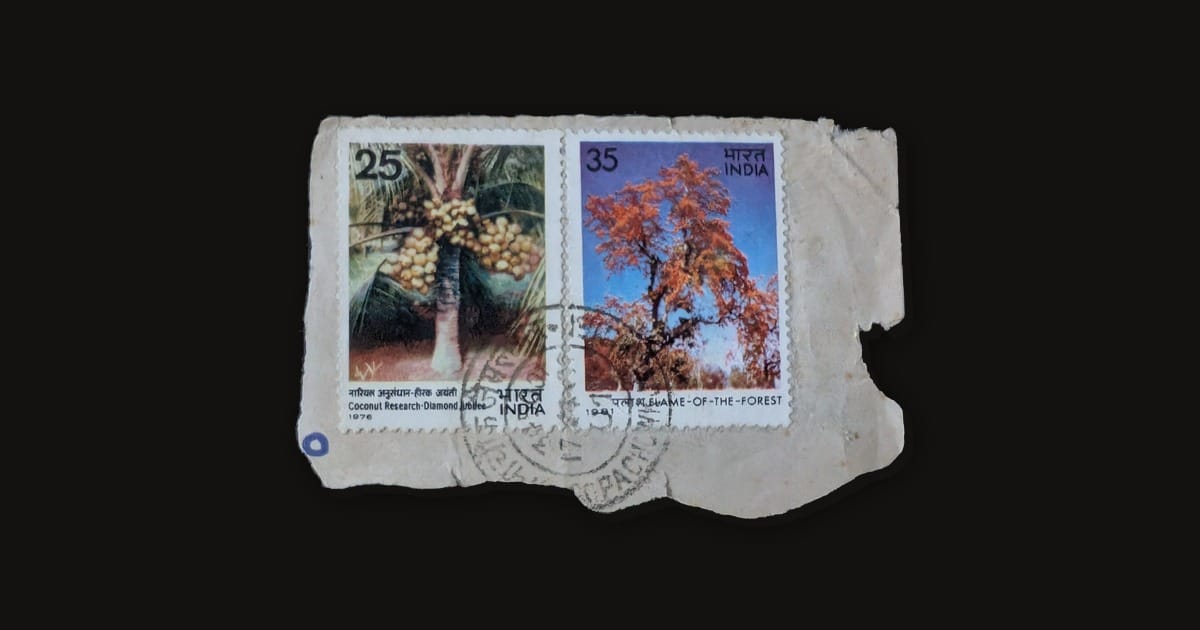
They were never meant to share a page. India issued the Flame of the Forest stamp in September 1981 and the coconut palm beside it in December 1976, five years and one denomination apart. What put them together was an accident of the post: both stamps were affixed to the same piece of mail, a common circular cancellation crosses the two stamps and the paper between them, and this torn corner is what survived. The rest of the cover is gone.
Look at the two trees, though, and the accident starts to feel like an argument.
The Stamp
| On this cover | Two used commemoratives on one torn envelope corner |
|---|---|
| Right stamp | Flame of the Forest (Butea monosperma), 35 paise |
| From | Indian Flowering Trees, a set of four — issued 1 September 1981 |
| Left stamp | Coconut Research — Diamond Jubilee, 25 paise — issued 27 December 1976 |
| Country | India — Posts & Telegraphs Department |
| Flame photograph by | K. M. Vaid |
| Condition of this copy | Postally used, tied by a common circular cancellation; torn cover edge, blue ink mark lower-left |
The Story
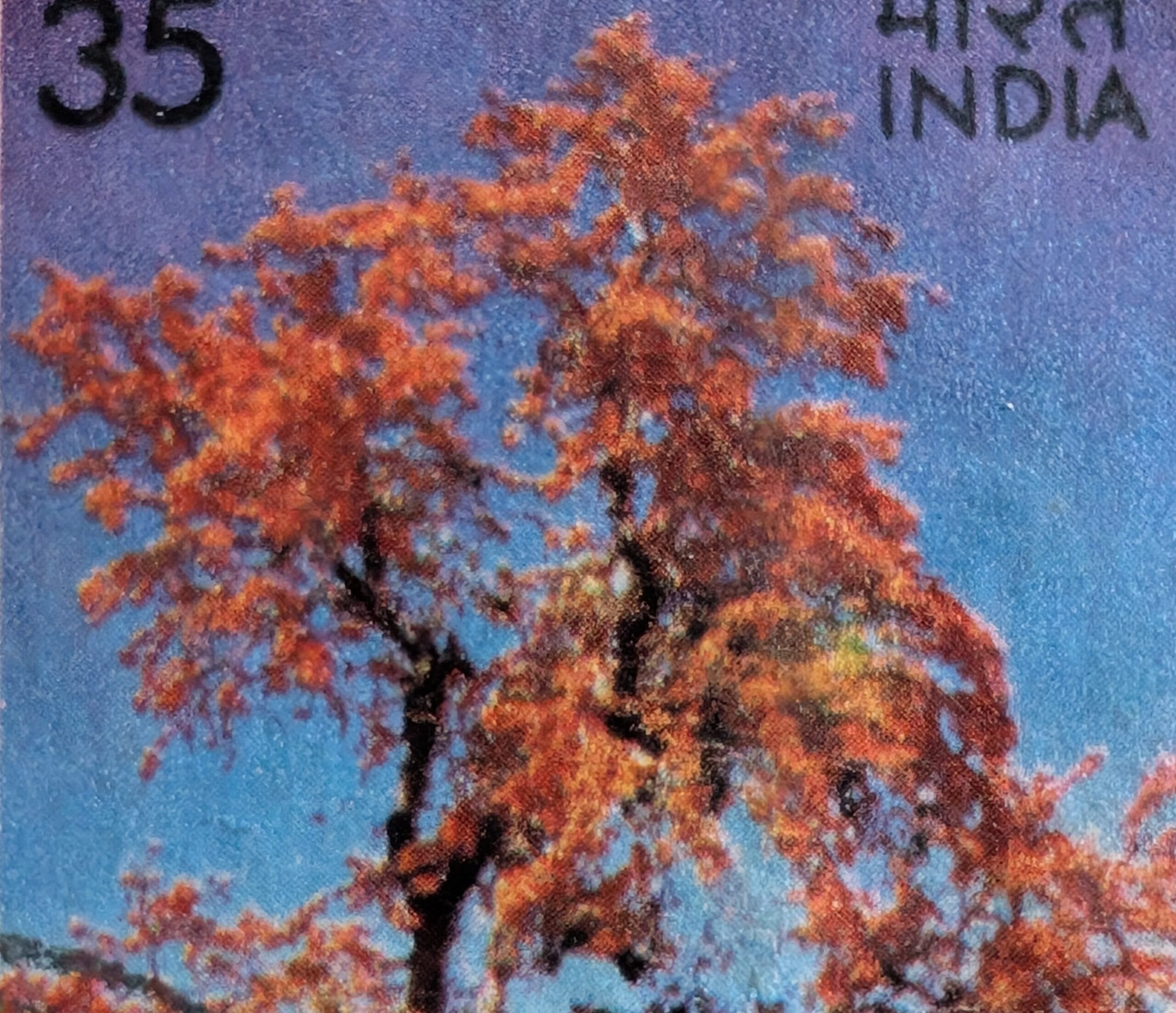
The Flame of the Forest stamp is a photograph, not a painting. That is the first thing worth knowing, and India Post said so plainly: the four trees in the 1981 set were photographed, and the flame tree was shot by a man named K. M. Vaid. What you are looking at is a real tree, its crown on fire and its branches bare underneath, because Butea monosperma flowers before it grows its leaves. It sheds by February and then, as the hot weather comes in, it detonates into orange.
That tree needs no help from anyone. It seeds itself across dry India, survives frost and drought, and grows on land that defeats better crops. It is also one of the few hosts the lac insect will breed on, which is to say it quietly underwrites the shellac trade. None of this is cultivation. It is a plant getting on with its life while people help themselves to the by-products.
And it has been watched for a very long time. The palash is named in the Yajur Veda, its branch cut and trimmed by the priest before a new-moon sacrifice, long before a post office thought to photograph it. When Khushwant Singh wanted to fix the Punjab landscape on a page, he reached for the same tree — the flame of the forest bursting into crimson and orange while the margosa still littered the ground with its leaves. It is, in every sense, a wild thing that India has simply agreed to love, and has loved long enough that the love now counts as heritage.
Now look left.
What the coconut stamp is really commemorating
The palm on the 25 paise stamp is doing something the flame tree never does: it is advertising a bureaucracy. The stamp marks the Diamond Jubilee of Coconut Research — sixty years, counted from 1916, when work began at two stations, Kasaragod and Nileshwar, in what was then the Madras Presidency and is now Kerala. By 1976 Kasaragod had become the headquarters of the Central Plantation Crops Research Institute under the Indian Council of Agricultural Research. The stamp is, in plain terms, a birthday card for an institute.
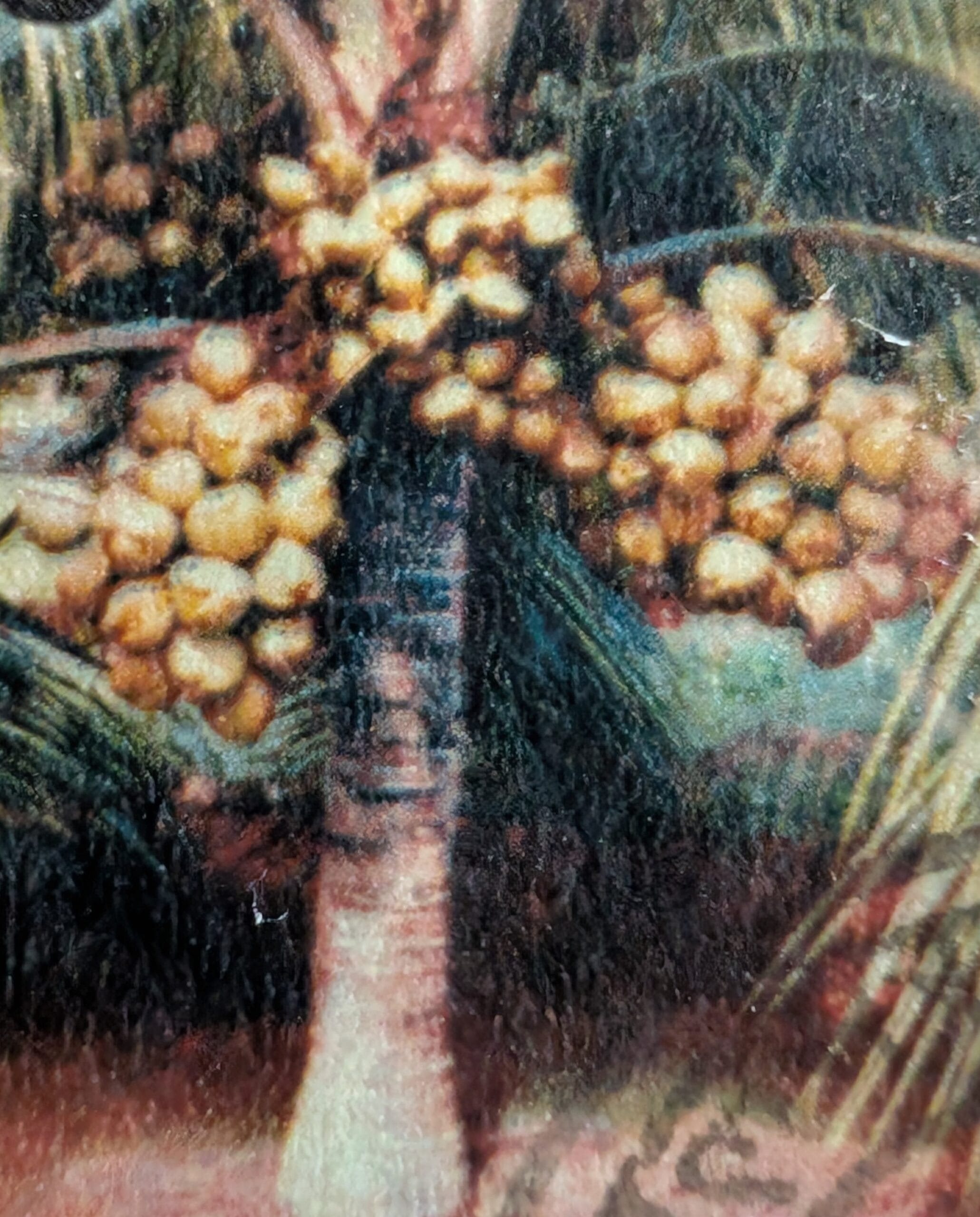
And the tree on it is not simply an example of the species. India Post’s own note gives the game away: the palm depicted is “a young hybrid between tall and dwarf forms.” It is the physical result of the breeding work the anniversary was celebrating — a palm selected to bear earlier and heavier than the tall traditional variety, and here it is, posing for its own achievement. The heavy cluster of nuts on the ringed young trunk is not the wild tree at random. It is the research programme’s output, photographed as evidence.
There is a reason the state cared so much. India Post’s brochure is blunt about the stakes: Kerala’s name literally means the land of coconuts, and a large share of the state’s people depend on the tree for a living. A crop carrying that much weight is not left to seed itself. It gets studied, improved, defended against root-wilt — and, at its Diamond Jubilee, congratulated on a stamp.
The Flame of the Forest stamp and its opposite
So the two stamps, married by accident, turn out to hold opposite ideas of what a tree is for. One is a wild thing the state photographed and admired. The other is a familiar tree reshaped through selective breeding, then photographed as evidence of what that research had achieved. The Flame of the Forest stamp honours a tree for existing; the coconut stamp honours a tree for having been improved. Between 1976 and 1981, without meaning to, India put both philosophies in the post.
Why the pairing lands
The denominations produce an accidental joke, too. The wild tree carries the higher value, 35 paise; the research-backed coconut carries 25. The values tell us nothing about botanical or economic importance — postage numbers are set by postal rates, not by what a tree does for the country. But on this scrap of mail, they leave the ornamental tree looking more expensive than the agricultural one, which is the reverse of everything the two stamps are actually about.
None of this was planned. The 1981 set was about flowering trees as spectacle — flame, crateva, golden shower, bauhinia, four bursts of colour photographed for their looks. The 1976 stamp was about agricultural science. They belong to different conversations. It took one piece of mail bearing both values, and a clerk with a canceller, to bring the wild tree and the bred one into the same frame, where they have been arguing quietly ever since.
Looking Closer at the Flame of the Forest stamp
The Flame of the Forest stamp makes one decision worth noticing. The tree is shot against a flat blue sky with the crown slightly off-centre and the lower branches left bare and dark — you can see the crooked black limbs showing straight through the blaze. An illustration could easily have filled those gaps with more orange. The photograph does not. It preserves the dark branches and the empty sky, letting the tree’s flowering habit stay visible: this tree flowers on naked wood, and the fire is thinner than it looks. The choice to photograph rather than paint is the whole design argument — it lets the tree be accurate instead of flattering.
Set that against the coconut stamp’s composition and the contrast sharpens. The palm is framed low and central, the ringed trunk rising like a column, the nut cluster placed at eye height where a portrait would put a face. It is composed the way you would photograph a prize-winner — trunk for stature, fruit for proof.
One image is a landscape; the other is a product shot. The flame tree is allowed to be a tree in a place. The coconut is made to be evidence — the same move by which a monument becomes a national symbol, as on the 1990 Charminar stamp, where a building stops being a place and starts standing for an idea. Even the palette divides the two trees: the flame tree burns warm against cool sky, while the palm sits in a muddle of greens and browns, a working tree in a working grove.
You can watch the difference collapse into two lines of type. Read the caption bands side by side and the argument is there in the wording itself.

One band says “Coconut Research·Diamond Jubilee”; the other simply says the tree’s name. One is naming an institution’s anniversary. The other is naming a species. That is the entire distance between the two stamps, printed in tiny type along their lower edges.
The join between them is its own small drama. Where the two stamps meet, a circular datestamp climbs off the cover paper and across both inner perforated edges at once, so a single postmark physically ties two issues printed five years apart.
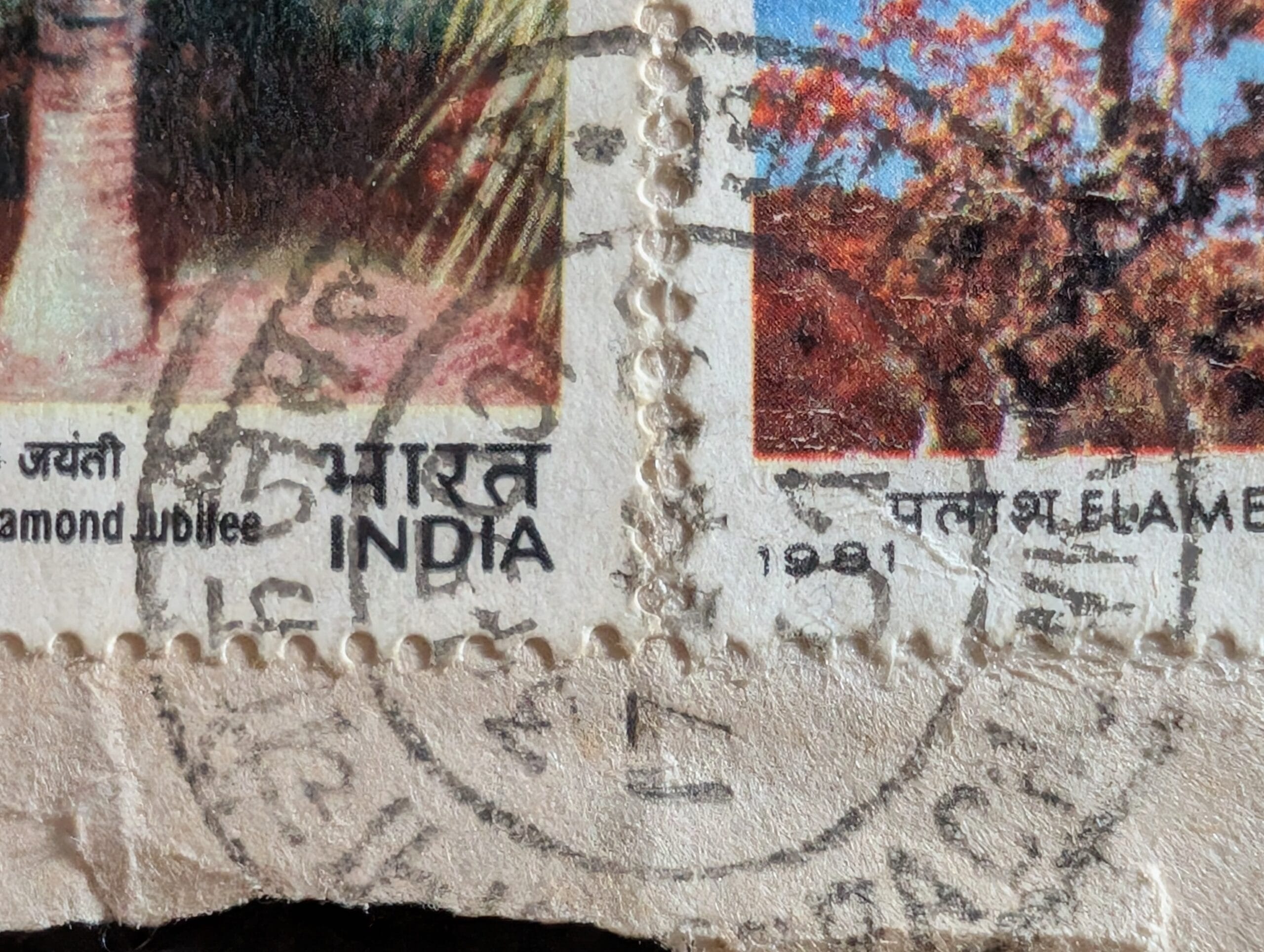
That grey ring is the only thing in the whole composition both stamps genuinely share — not a designer, not a year, not an idea, just the indifferent authority of the post office pressing down on both at the same instant. A canceller does not care which philosophy of trees it is voiding. It only cares that the postage has been used.
Closing
A wild tree and a research-bred palm, five years apart, ended up sharing one cancellation on a torn corner of mail. The flame of the forest will still be seeding itself across the dry plains long after the last hybrid palm has been superseded by a better one. Neither issue was designed to make this comparison. The post office made it anyway.
Further Reading & Links
External references
- India Post’s official note on the 1981 Indian Flowering Trees set, including the photographers and species — iStampGallery: Indian Flowering Trees 1981
- The 1976 Coconut Research Diamond Jubilee brochure, with the hybrid-palm detail and the Kasaragod research history — iStampGallery: Coconut Research 1976
- Botanical and cultural background on the palash — Wikipedia: Butea monosperma
- On the institute the coconut stamp celebrates — Central Plantation Crops Research Institute (CPCRI)
Related on StampTales
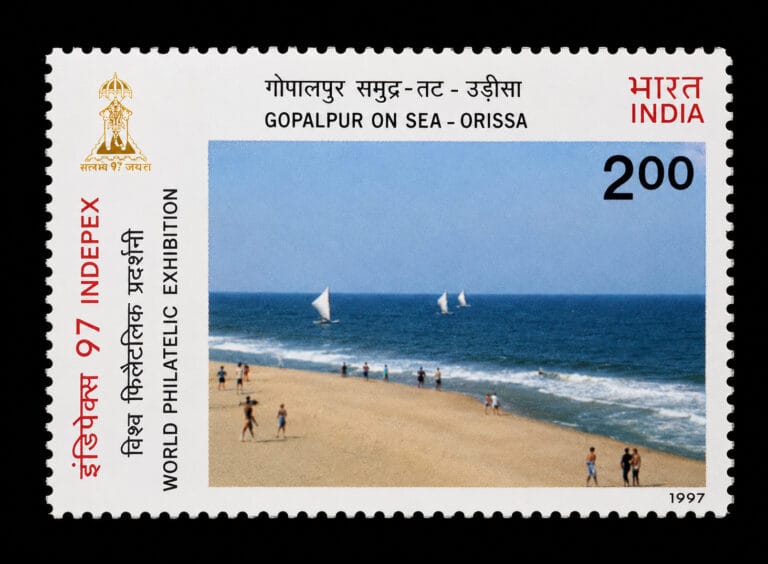
- When India mailed its coastline — the ₹6 stamp for a forgotten port — India putting its own geography on paper, the same act of the state choosing what to commemorate.
- Hungary’s 1976 Metric System stamp — a state photographing a system it imposed, the mirror image of a state photographing a tree it left wild.
(Charminar 1990 is linked contextually in Looking Closer above — not repeated here, to avoid a duplicate internal href.)