The runners with no country
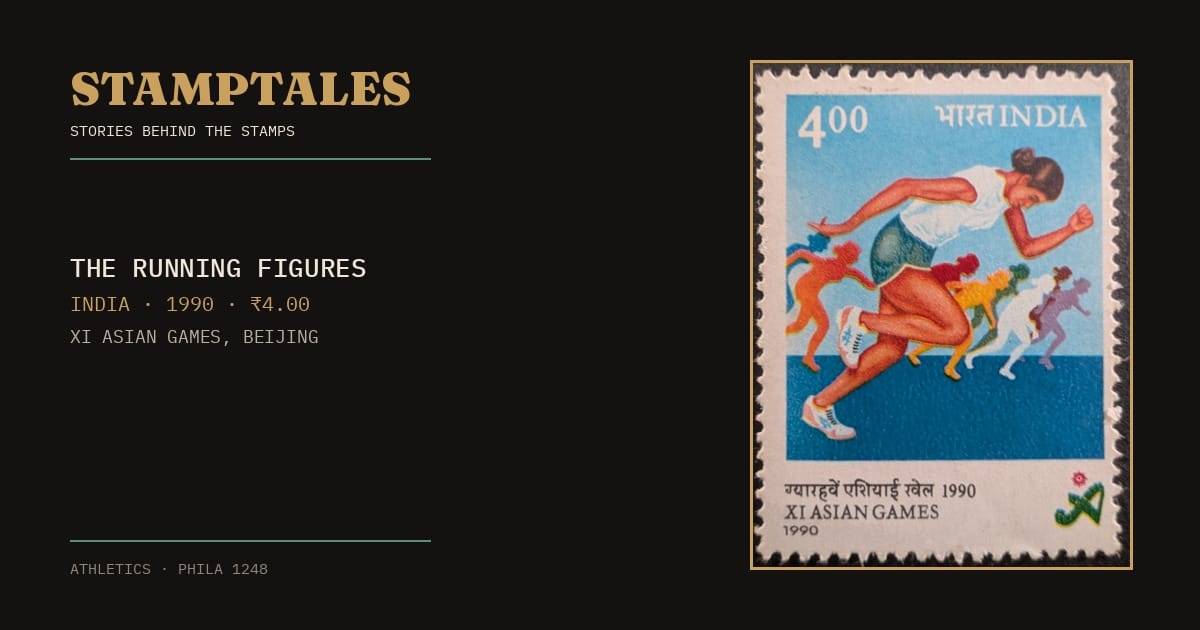
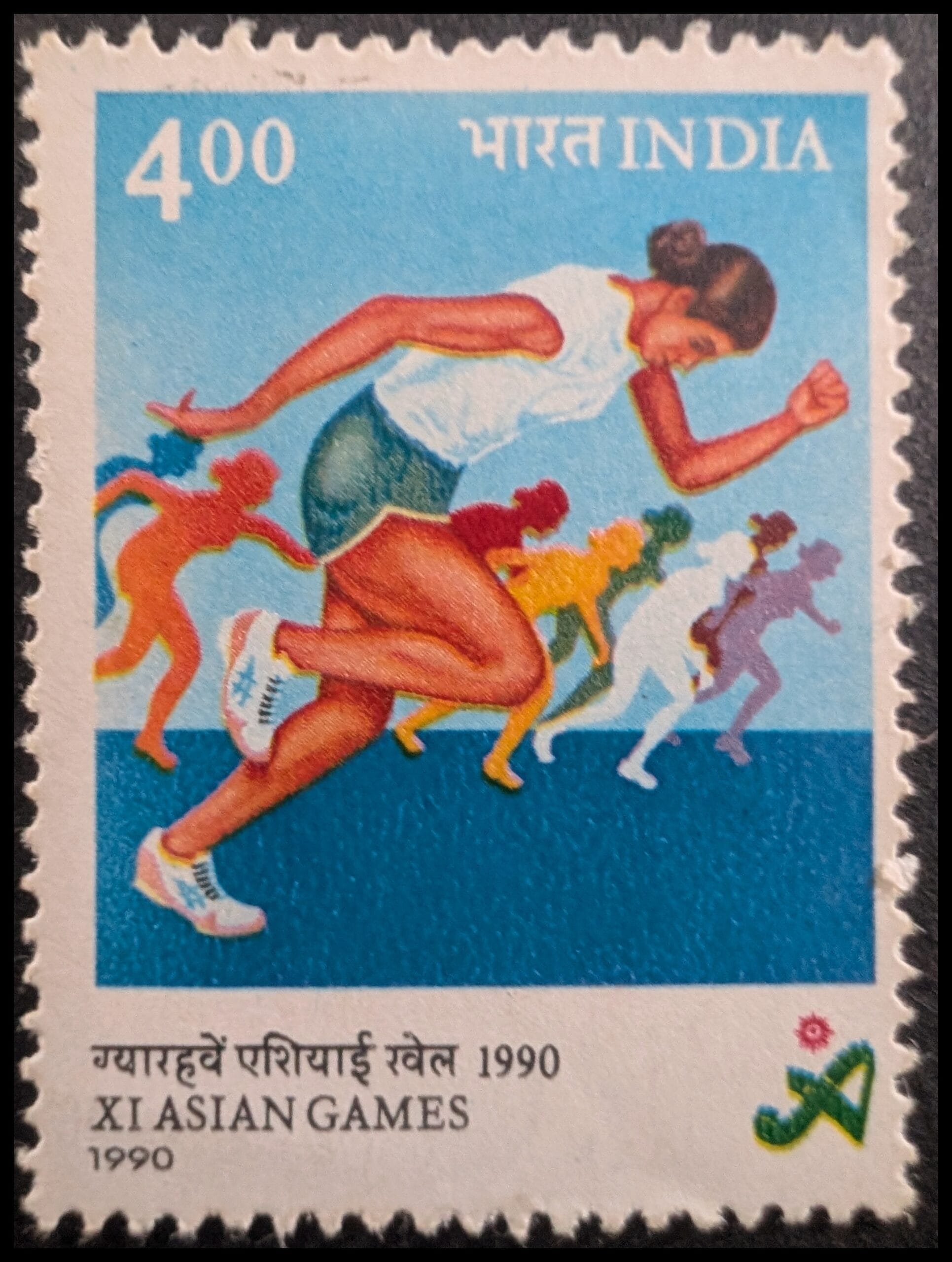
The figure breaking forward across this stamp is not winning a race. Look at the others — a row of smaller athletes behind, each painted a different flat colour, strung out and shrinking into the distance, none of them a country. India printed it in 1990 for the XI Asian Games, an event it was not hosting, in a city it had spent three decades barely speaking to. And the four-rupee value carries no flag and no medal — only a field of athletes with nothing on them to say which nation is which.
That choice is the whole point of the stamp, and it is easy to miss because the design looks like ordinary sports art. It is not. The XI Asian Games were held in Beijing in the autumn of 1990 — the first time China had hosted the event, and the first large international sporting occasion the country had ever run. India issued a set of four stamps to mark it. The other three name their sports plainly. This one, the athletics value, is the set’s open face: the event that belongs to no single nation.
| Issue | XI Asian Games, Beijing — Athletics |
|---|---|
| Issued | 29 September 1990 |
| Denomination | 4 rupees |
| Country | India |
| Designer | C.R. Pakrashi (athletics, cycling and the first-day cover) |
| Printer | India Security Press, Nashik |
| Process | Photogravure, multicolour |
| Perforation | 13 × 13 |
| Print run | 1 million |
| Catalogue | Phila 1248 |
Why India printed the XI Asian Games at all
India had form here. It had lit the very first Asian Games torch in 1951, in Delhi, and hosted the ninth Games there in 1982. Marking the eleventh with stamps was, on its face, routine continuity — the Department of Posts saying, again, that it took the Asian movement seriously. The India Post brochure lays out the lineage carefully: 1951, 1982, and now Beijing, four decades of the same festival widening from eleven countries to more than thirty.
There is a wrinkle in the timing worth noticing. The four stamps were issued on 29 September 1990 — a week into a Games that ran from 22 September to 7 October. India was issuing them not to remember a finished event but in the middle of an unfinished one, before anyone knew how it would end.
What the brochure does not say — because it did not need to, everyone reading it in 1990 knew — is what Beijing meant. India and China had fought a war in 1962 and then, for the better part of thirty years, treated each other as a closed border and a grievance. The estrangement only began to break in December 1988, when Rajiv Gandhi flew to Beijing: the first visit by an Indian prime minister in thirty-four years, and the trip on which Deng Xiaoping held the younger man’s hand, in front of the cameras, for what witnesses timed at close to three minutes. The visit marked the beginning of a thaw.
So the timing of this stamp is not neutral. India was printing postage for a sporting event in the capital of the country it had just, and only just, started speaking to again. A stamp is a small public statement — it circulates, it goes abroad on letters, it says in miniature what a government is content to be seen endorsing. Marking Beijing 1990 was a low-cost, public way of showing the thaw held.
The runners with no country

Now the design earns its reading. C.R. Pakrashi, who drew the athletics and cycling values and the first-day cover, did not put an Indian athlete on the four-rupee stamp. He put a lead sprinter — brown-limbed, mid-stride, breaking out of the frame — and behind that figure a receding rank of runners in flat, unmixed colours: red, ochre-yellow, green, white, violet. They wear no vests, carry no numbers, trail no flags. Colour is doing the work a nation would normally do. Each runner is legible as a distinct competitor without being pinned to a distinct country.
That is the pan-Asian idea made visual. The Asian Games were founded on a slogan the brochure still quoted in 1990 — a festival to bring the youth of the continent together — and the surest way to draw fraternity rather than rivalry is to draw a field that could be anyone. Had Pakrashi given the lead runner a tricolour vest, the stamp would have said India competes. Flagless, the same figures let a reader see Asia runs — a larger and more generous thing to read off a stamp, and one that sits easily beside a border quarrel only just beginning to mend.
It is worth being honest about the limits of this. A design read is a reading, not a confession of intent: the brochure does not say Pakrashi stripped the runners of nationality to signal reconciliation, and it would be a fabrication to claim it did. But the effect is on the paper whatever the motive. The stamp declines to name a winner, and in 1990, aimed at Beijing, declining to name a winner was itself a position.

The corner settles it. Tucked into the lower right is the host emblem — a red sun above a green form that bends into the letter A. That form is the Great Wall of China, stylised, and the A stands for Asia; the same silhouette also reads as the Roman numeral XI. The sun is borrowed from the badge of the Olympic Council of Asia.
So the one nationally specific image on the whole stamp is not Indian at all. It is Chinese — the Wall, the monument Rajiv Gandhi had dutifully climbed two years earlier, folded into a letter that means the whole continent. India put the host’s own wall on its stamp and let it stand for everyone. For a design about erasing borders, choosing the most famous border-wall on earth as the emblem is either an accident or a very good joke.
What else the XI Asian Games set carried
The four-stamp set is worth knowing as a whole, because the athletics value is the least surprising member of it. India’s four sports were athletics, cycling, archery — and kabaddi. That last one matters: the 1990 Beijing Games were the first Asiad to include kabaddi as a competitive sport, the tag-and-wrestle game that had lived for centuries in Indian and South Asian village grounds and had never before been an international event. India, which would dominate Asian Games kabaddi for decades afterward, put it on a stamp in the same breath as it entered the programme.
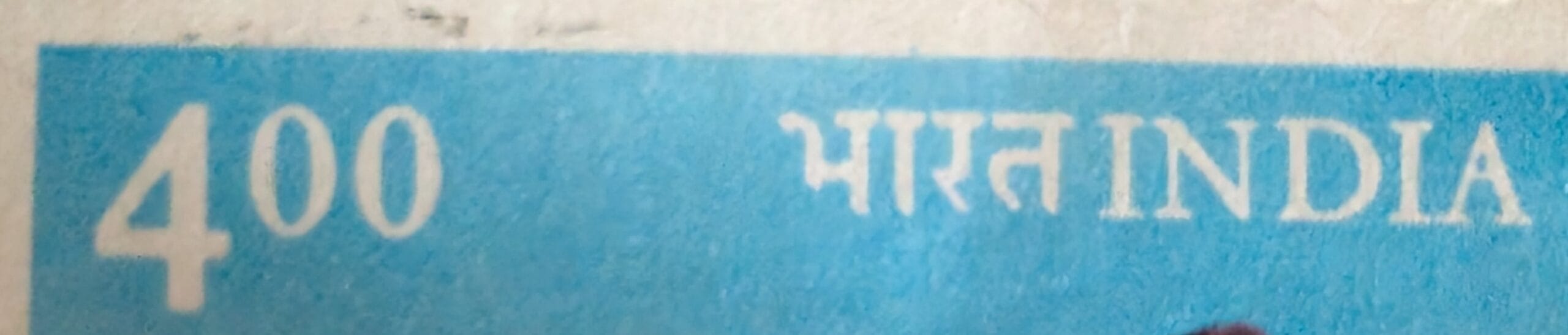
Set against kabaddi’s arrival, the running figures look almost modest — the universal sport, the one every country already shares. But that is the division of labour across the set. One stamp announces something India was bringing to Asia; this one draws the thing all of Asia already had in common. The only explicit national marker inside the design is the line भारत INDIA. Everything inside the frame is trying to belong to the continent rather than the nation that printed it.
A postage stamp cannot mend a border or win a medal. What it can do is decide, in a space the size of a thumbnail, whose story it is going to tell — and this one, printed by the country that lit the first Asian torch, for a Games in the capital of a country it had fought a war with and only lately begun speaking to again, quietly chose to tell nobody’s. A field of faceless athletes, each a different colour, no flag between them, all still running.
Further Reading & Links
- The IX Asian Games, Delhi 1982 — the last time India hosted the Asiad, and the stamp for a federation that dissolved three days before those Games opened.
- India on 1990 Asian Games — issue details and brochure text (iStamp Gallery) — designers, printer, print run, and the India Post brochure confirming kabaddi’s first inclusion.
- 1990 Asian Games (Wikipedia) — Beijing as the first Asian Games hosted by China; dates, nations, and the host emblem.
- The emblem of the XI Asian Games (China Daily) — the Great Wall forming the letter A, topped by the Olympic Council of Asia’s sun, also reading as “XI”.
- Rajiv Gandhi’s 1988 visit to China (Ministry of Foreign Affairs, PRC) — the first visit by an Indian prime minister in thirty-four years, which reopened relations before this stamp was issued.