Hungary Celebrated the Metric System Twenty-Two Days Too Early
The Stamp
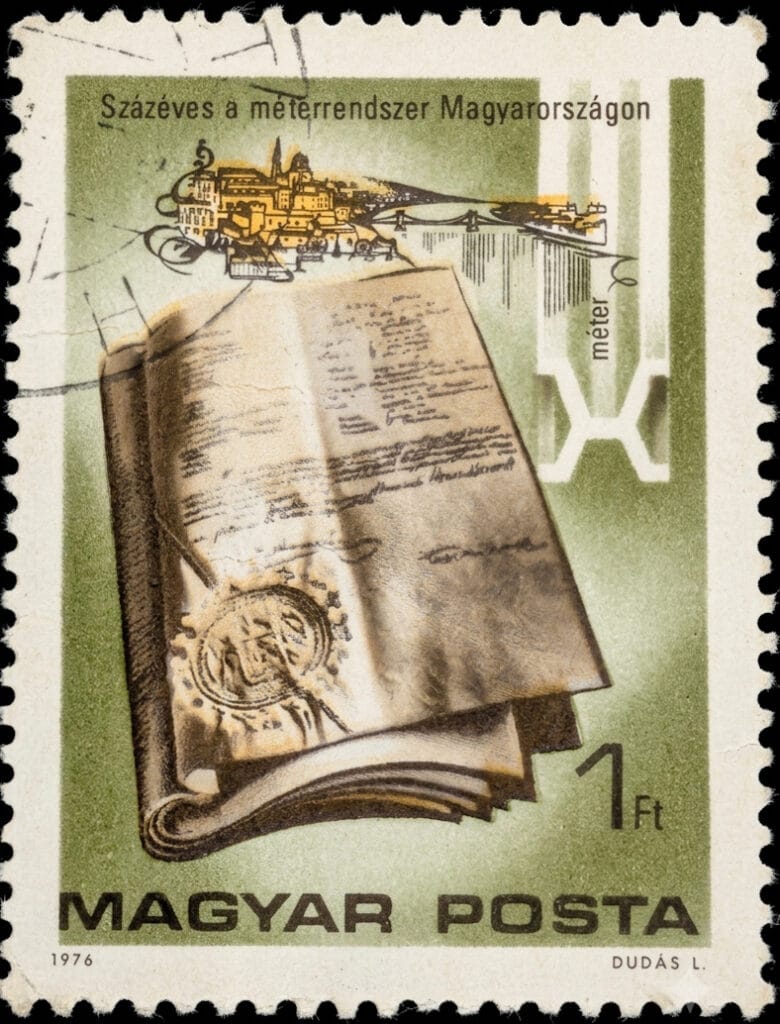
| Country | Hungary — Magyar Posta |
|---|---|
| Issued | 5 April 1976 |
| Denomination | 1 forint |
| Occasion | Centenary of the metric system in Hungary |
| Inscription | Százéves a méterrendszer Magyarországon — “The metric system is one hundred years old in Hungary” |
| Designer | Credited on the stamp as DUDÁS L. |
| Size | 34 × 44 mm |
| Perforation | Comb 11½ × 12 |
| Printing | Offset lithography |
| Catalogue | Michel 3115A · Scott 2418 · Yvert 2488 · Stanley Gibbons 3030 |
| Condition of this copy | Used; partial machine cancellation across the upper left |
The Story Behind the Metric System Stamp
Hungary marked a century of the metre on 5 April 1976. Twenty-two days later, its government gave the country until 1980 to stop using anything else.
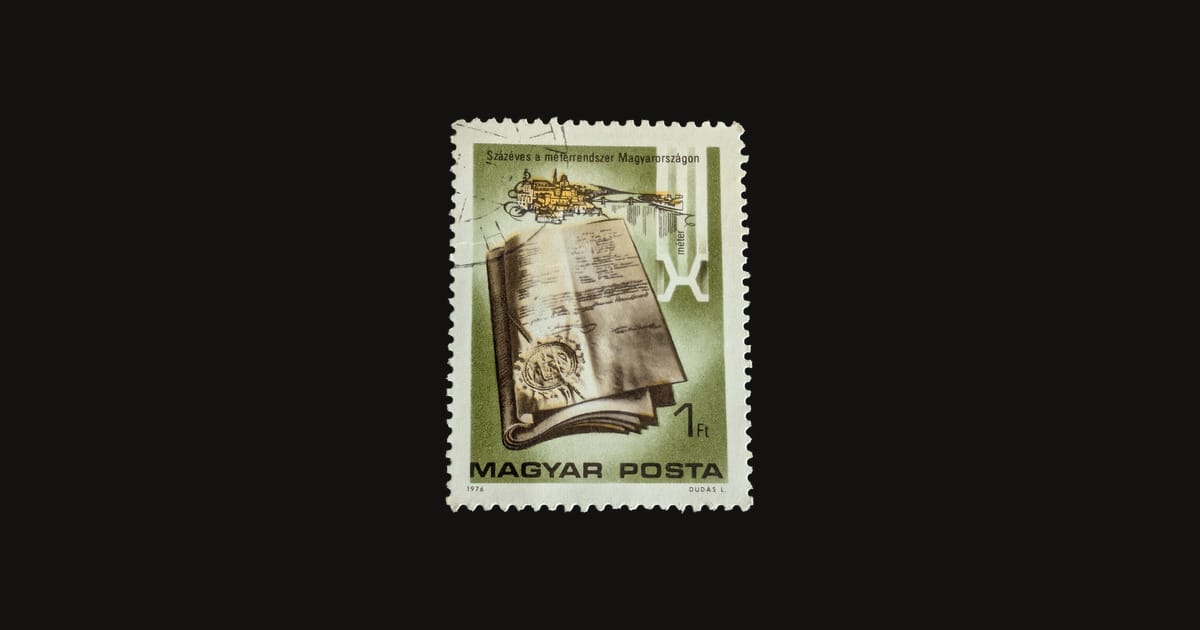
The metric system stamp that carried that celebration is a small olive-green rectangle, 34 by 44 millimetres, worth one forint. It shows an open document with a heavy seal, a skyline drawn in gold line-work, and — pushed to the right edge — a shape most readers would take for a decorative letter X. It is not decorative. That comes later.
Start instead with the date the stamp is counting from.
A Law Passed in 1874, Enforced in 1876
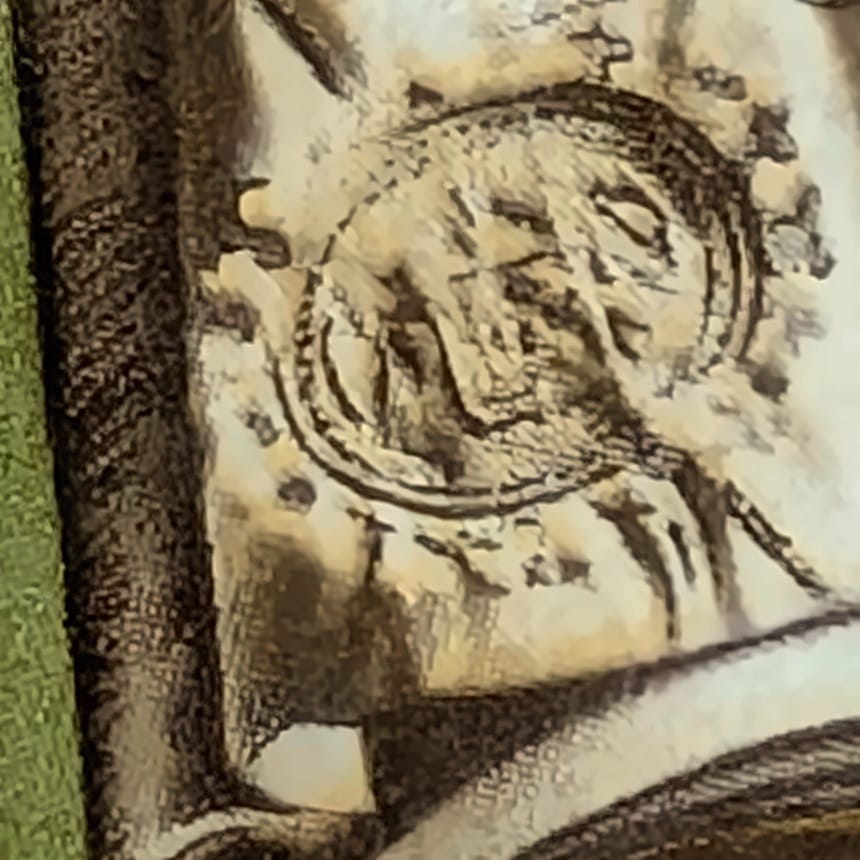
Hungary’s House of Representatives passed the metric law in April 1874: Act VIII of 1874, on the introduction of the metric measure. It named the metre as the basis of length, the kilogram for weight and the litre for volume, and committed the country to decimal reckoning throughout.
Then it waited. The metric system did not become compulsory across Austria-Hungary until 1 January 1876.
Two years is a long gap between a vote and a rule, and the gap tells you what conversion actually costs. Every market scale, land survey, timber yard, grain merchant and tailor’s counter in the kingdom had to be re-cut, re-stamped and re-learned.
Much of the act is not philosophy but arithmetic. It sets out, at length, the conversion factors between the old units and the new — a statute operating as a lookup table. Hold that in mind when you look at the metric system stamp, because the document at its centre is not a proclamation. It is a spreadsheet with a seal on it.
So the centenary this metric system stamp celebrates is not the anniversary of the vote. It is the anniversary of the enforcement — the day the country had to comply, not the day it agreed to.
Laws fix dates. Habits ignore them. Keep that in mind; the stamp will need it later.
What the Metric System Stamp Replaced
The system this metric system stamp helped bury was itself barely a generation old. An imperial order of 1853 had already unified measures across the Habsburg lands — on Viennese units, not metric ones. A Viennese hundredweight ran to roughly 56 kilograms.
Hungarian merchants had scarcely finished absorbing one standardization when the next arrived. Inside twenty-three years, the same shopkeeper could be asked to think in three different systems. One assumes the shopkeeper had views.
Nor were the units being replaced tidy ones. A Hungarian mérföld ran to roughly 7.59 kilometres, an öl to about 3.16 metres. Every such figure had to be memorised, tabulated or simply trusted. Hungarian accounts of the changeover record what you would expect of any period when a whole country has to re-learn its arithmetic: the conversion was worked by people willing to take advantage of anyone not watching the scales closely enough. A century later the metric system stamp remembers the law. It does not remember the short-changed.
The older Hungarian units did not vanish so much as retreat into the language. Rőf, itce, akó, mérföld — the ell, the pint, the cask, the mile — survive as words long after they stopped being quantities. A country can legislate a measurement out of the ledger faster than out of the mouth.
There is a further oddity buried in the dates. When Hungary’s metric law took effect on 1 January 1876, the physical object that would define the metre for the next seventy years did not yet exist. The Metre Convention was signed in Paris in 1875. The platinum-iridium prototype bars were not manufactured at Sèvres until 1889. Hungary adopted the metre more than a decade before anyone could point at one.
What the Metric System Stamp Does Not Say
Magyar Posta issued this metric system stamp on 5 April 1976. On 27 April 1976 — twenty-two days later — the Hungarian Council of Ministers issued decree 8/1976 (IV. 27) MT, mandating the transition to the International System of Units and prohibiting the use of other units from 1 January 1980.
The two are not, strictly, a contradiction. The metric system of 1876 and SI of 1976 are not the same thing — SI is the formalized modern descendant, extended long after Hungary’s original conversion, and Hungarian practice had been drifting towards it since 1960.
But set the two documents side by side and the celebration changes colour. The stamp says: settled, a hundred years ago, done. The decree says: not yet, and you have until 1980. The same state issued both inside the same month.
That is what makes this metric system stamp worth a second look. It is a piece of official self-congratulation posted three weeks ahead of an official concession — and neither the post office nor the ministry was lying. Standardisation is simply never finished on the day the law says it is. It finishes in workshops, on shop floors, and in the habits of people who keep saying akó because their fathers did.
Looking Closer at the Metric System Stamp
The X Is Not a Decoration
On the right edge, reversed out in white against the olive field, sits a shape like a slab-serif X, with the word méter running vertically beside it. Read as typography, it makes no sense: no word on the stamp begins with X, and the letter sits outside the native Hungarian alphabet.
It is not a letter. It is a cross-section.
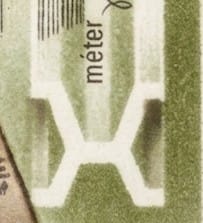
The international prototype metre, made at Sèvres from an alloy of ninety per cent platinum and ten per cent iridium, was not a plain rod. It was milled to an X-shaped profile devised by the French engineer Henri Tresca — chosen to give maximum stiffness for the weight, and to put the two defining lines on the one plane inside the metal that does not stretch when the bar sags.
The designer has drawn the metre end-on. Not a picture of a ruler: the engineering profile of the object that was the metre from 1889 until 1960, when the definition moved to the wavelength of krypton-86 light. Behind the X, four white vertical bars run the height of the panel, reading as graduations on a scale rule.
For a commemorative, this metric system stamp makes an unusually literal visual argument. Most anniversary issues reach for an emblem. Dudás reached for a technical drawing and trusted the reader to look twice.
The Metric System Stamp in Three Registers
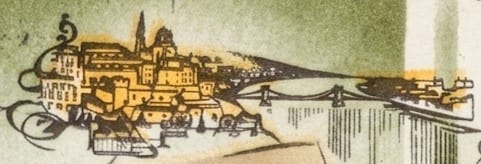
The metric system stamp stacks three kinds of image in three different drawing styles.
At the top, the city: a river panorama in gold and black line-work, a hill crowned with buildings, a suspension bridge running off to the right. Pure contour, no shading — the vocabulary of an engraving or an architect’s elevation.
At the centre, the document: an open folio of handwritten lines under a heavy embossed seal, rendered in soft airbrushed grey-brown gradients with almost no outline. It is the only object on the stamp with weight and shadow.
At the right, the standard: hard-edged, geometric, reversed out of the ground, closer to a diagram than an illustration.
Line, tone, geometry — the city, the law, the standard. And the document is both the largest object on this metric system stamp and the only one granted physical presence. Whatever the stated occasion, the designer’s real subject is not the metre. It is the paperwork that made the metre binding.
The palette agrees. Olive-green is a bureaucratic colour, the green of a file cover. The only warmth on the stamp is the gold of the skyline — the city as the payoff, the thing the law and the standard were built for.
The Cancellation Tells You Almost Nothing
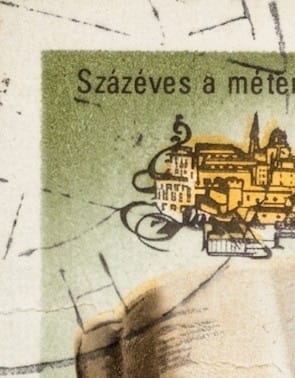
This copy carries a partial cancellation: fine parallel strokes crossing the upper-left corner and the top perforations, with no legible town mark, no date, no readable postmark ring. Whatever route this stamp travelled cannot be recovered from the evidence on its face.
There is nothing to reconstruct here, and reconstructing it anyway would be an invention. What the strokes do confirm is that the stamp worked: it was bought, stuck down, defaced and carried. A centenary tribute to precision, cancelled by a machine that did not care where it landed.
Closing
A hundred years after Hungary made the metre compulsory, it printed a stamp saying so, then issued a decree conceding the work was still under way. Both documents were correct. A standard is not adopted on a date; it is adopted over a lifetime. The metric system stamp shows a sealed law, a city, and a bar of platinum drawn end-on. What it cannot show is the part that actually took the century — a nation of people learning to stop reaching for the akó.
Further Reading & Links
From StampTales
- The Window That Only Survives on Paper — Magyar Posta four years earlier, and a very different job for a stamp.
- Cuba’s Cayo Jutías Lighthouse, 1982 — another state putting a piece of measuring-and-navigating infrastructure on its mail.
- The 1984 Fleet Review Stamp — official self-presentation, and the gap between ceremony and capability.
- Tilak Swaraj, Through the Lens — what a state does when it uses a stamp to fix the anniversary of a political claim.
- The 1991 USA Cardinal Stamp — a companion piece from The World in a Stamp.


2 Comments
Comments are closed.