The Building on the Indian Military Academy Stamp Has a British Name
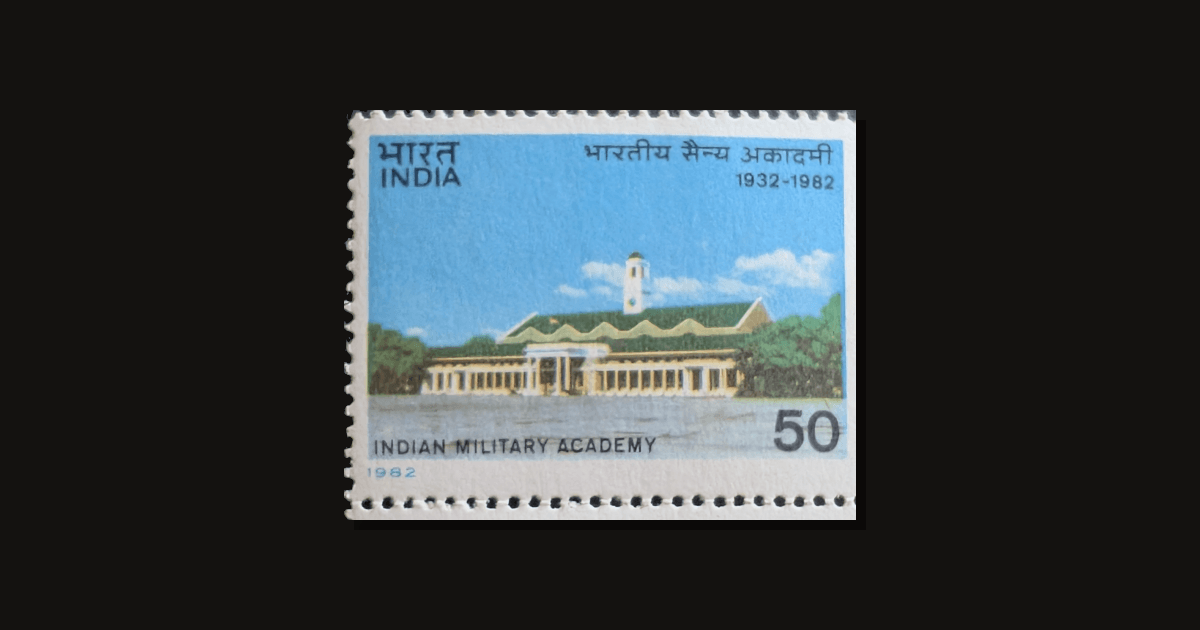
The 1982 Indian Military Academy stamp shows a building. It leaves out the sentence carved inside it, and the man the building is named after.
The Stamp
| Issue | 50th Anniversary of the Indian Military Academy, Dehradun |
|---|---|
| Country | India — Department of Posts |
| Subject | The Chetwode Building, IMA Dehradun |
| Issued | 1982 (golden jubilee, 1932–1982) |
| Denomination | 50 paise |
| Catalogue | India Phila 914 · Stanley Gibbons 1067 |
The Story
The Indian Military Academy stamp hides its British namesake in plain sight. The building is the Chetwode Building; the man it honours is nowhere named on the stamp at all.
The building on the stamp is the Chetwode Building, the long pillared block with the clock tower — the structure most closely associated with the Academy. It is the backdrop to the Passing Out Parade, the image printed on the Academy’s mementoes, one of the Indian Army’s most recognisable institutional buildings. And it is named after Field Marshal Sir Philip Chetwode, the British Commander-in-Chief in India who inaugurated the Academy on 10 December 1932.

At that inauguration Chetwode gave a speech. One passage of it became the credo of the Academy, engraved on the wall inside the building and taught to generations of cadets since:
The safety, honour and welfare of your country come first, always and every time. The honour, welfare and comfort of the men you command come next. Your own ease, comfort and safety come last, always and every time.
Read the order of it. The officer’s own life is placed dead last, deliberately, as a matter of stated hierarchy. That is the sentence the building holds. The stamp shows the walls; it does not show the words.
Why the Indian Military Academy stamp keeps a colonial name
There is an easy story to tell here, and it is probably the wrong one. The easy story is that independent India simply forgot to change the name — that a colonial relic survived by pure inertia. That reading is hard to sustain. The name and the motto were not quietly dropped at Independence; they are still there, and in 1982 the state put the building on a commemorative stamp. Whatever the mix of reasons, this was not a case of an oversight nobody got around to correcting.
The Academy that opened in 1932 was a British answer to an Indian demand. For decades, an Indian who wanted a King’s commission had to reach Sandhurst in England — a route open, in practice, to a tiny handful. The campaign to “Indianise” the officer corps, to train Indian officers on Indian soil and in Indian numbers, was a long political fight running in parallel with the wider struggle for self-rule, and the IMA was the concession it finally won.
The first class was forty cadets. The first commandant, appointed to run the place, was British. When the Academy received its first colours in 1934, before that first batch had even graduated, they were presented on behalf of King George V. Everything about the founding was arranged to keep the new institution inside the imperial frame — and the new institution proceeded, over the next fifteen years, to walk straight out of it.
And then history did the thing that makes this stamp worth stopping on. The first batch to graduate, in December 1934, is remembered at the Academy as the Pioneers. Forty cadets had been inducted; twenty-nine passed out. Among them were three men who would each go on to lead a national army.
Sam Manekshaw became independent India’s first Field Marshal and won the 1971 war. Muhammad Musa became Commander-in-Chief of the Pakistan Army. Smith Dun, an ethnic Karen who graduated at the top of the course and commanded its passing-out parade, became Commander-in-Chief of the Burmese Army. One intake, one drill square, one Chetwode motto — and within a generation its graduates were running the armies of three countries, two of which would fight each other.
That is what the building had come to mean by 1982. It was no longer simply a colonial inheritance; it had acquired an Indian institutional history of its own — its own dead, its own wars, its own line of Field Marshals, all of it accumulated inside walls a departing empire had put up. The retention of Chetwode’s name can be read less as deference to the empire than as an acceptance of the Academy’s own complicated origins: a country secure enough to absorb where it came from without editing it.
The two mottoes now sit side by side rather than one replacing the other. The Academy carries its own credo in Hindi, “Veerta aur Vivek” — Valour and Wisdom — alongside the English hierarchy of duty that Chetwode set out in 1932. They coexist on the same campus, which is the quiet trick of the place: the institution did not have to reject its founding in order to become its own. The golden-jubilee stamp of 1982 marks fifty years of that layered inheritance.
The jubilee itself made the point plainly. In 1982 the Academy held a Golden Jubilee Parade of five hundred Gentleman Cadets, reviewed by Prime Minister Indira Gandhi; among the guests were officers who, half a century earlier, had themselves been inspected on that same square by Chetwode as cadets. Fifty years had turned a British commander-in-chief’s parade ground into the setting for an Indian prime minister to take the salute. The stamp is the small paper trace of that anniversary.
What the building was, and who drew it
The Chetwode Building was built around 1930, before the Academy existed, and it belongs to a specific moment in Indian architecture. It is commonly credited to R. T. Russell — the same Public Works Department circle that was then raising Lutyens’ New Delhi, the architect of Connaught Place and Teen Murti. That attribution is repeated widely but not firmly documented, so take it as the tradition rather than the record.
What is certain is the style. The long axial corridors, the measured symmetry, the central clock tower rising over a parade ground: this is the civic architecture of imperial New Delhi, transplanted to the foothills of the Himalayas and handed, eventually, to the army of the nation the empire was leaving. It is worth setting beside the way another Indian stamp frames a monument — the 1990 Charminar stamp shows the building and leaves out the city packed around it. A stamp is always a decision about what to keep in frame.
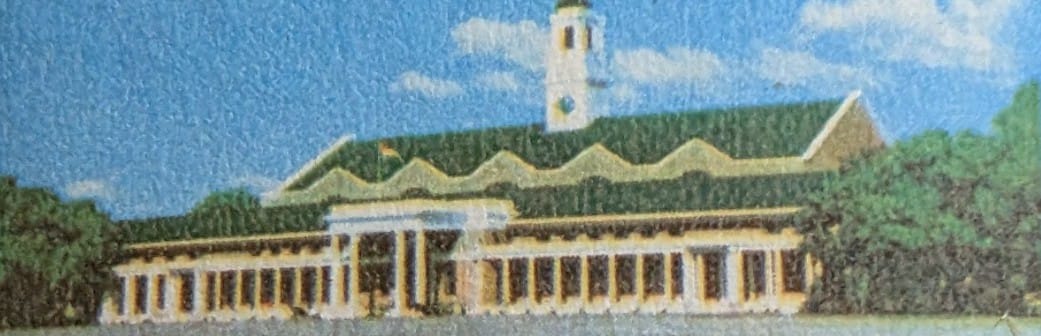
The stamp catches the building the way the Academy likes to be seen: the façade mirrored in the ornamental water in front of it, the tower dead centre, the whole thing balanced and still. It is a portrait of order. For a military academy that is not decoration — line, symmetry and visibility are the grammar of the parade ground, and the building was designed to be looked at in exactly this frontal, ceremonial way.
Looking Closer at the Indian Military Academy stamp
Everything on the Indian Military Academy stamp is arranged to be legible at a glance, which is itself a choice worth reading.
The bilingual masthead sets up the whole tension in miniature. Top left, in Devanagari and Roman, the country signs its own name: भारत, INDIA. Top right, in Devanagari alone, भारतीय सैन्य अकादमी — Indian Military Academy — and beneath it the jubilee dates, 1932–1982. An Indian institution, named in an Indian script, celebrating fifty years — sitting on top of a building named for a Briton. The stamp does not hide the contradiction. It just declines to explain it.

The colour does quiet work too. The sky is a flat, confident blue; the roof a deep institutional green; the façade a pale sandstone yellow doubled by its own reflection in the water. There is no flag, no crest, no soldier, no weapon.
A stamp marking the golden jubilee of an army’s officer academy chooses to show no army at all — only a calm building on a still morning. The martial content is entirely withheld, and the withholding is the point: the Academy’s self-image is not the battlefield but the institution, the permanence of the place that makes the soldier. It is the opposite instinct to a stamp like the 1984 Fleet Review issue, where the state put its hardware on parade; here the state shows only where the officer is formed.
At the foot, in plain capitals, the caption states the barest fact: INDIAN MILITARY ACADEMY, with the year and the fifty-paise value. No motto. No founder. The stamp is confident that the building alone will carry the meaning to anyone who already knows it — and equally content to let everyone else see only a handsome colonial block by the water.

Closing
A cadet passing out of Dehradun carries the Chetwode motto out through the gate having read it, most likely, off the wall of the building on this stamp. The words were written by a man who commanded the army India was trying to get out from under; the building was raised by the empire he served; and both were kept, unedited, by the country that inherited them. The stamp frames all of that as a pale symmetrical building reflected in still water, and says only its plainest name. What it leaves off — the founder, the sentence, the three army chiefs who came out of one class — is the part worth knowing.
Further Reading & Links
- Indian Military Academy — Wikipedia: founding, the Pioneers of 1934, and the Academy today.
- Field Marshal Sir Philip Chetwode — Wikipedia: the British commander who gave the Academy its name and its credo.
- Indian Military Academy — Valour and Wisdom — India Perspectives (Government of India): the Academy’s own account of its founding, the Chetwode committee, and the three army chiefs from the first batch.