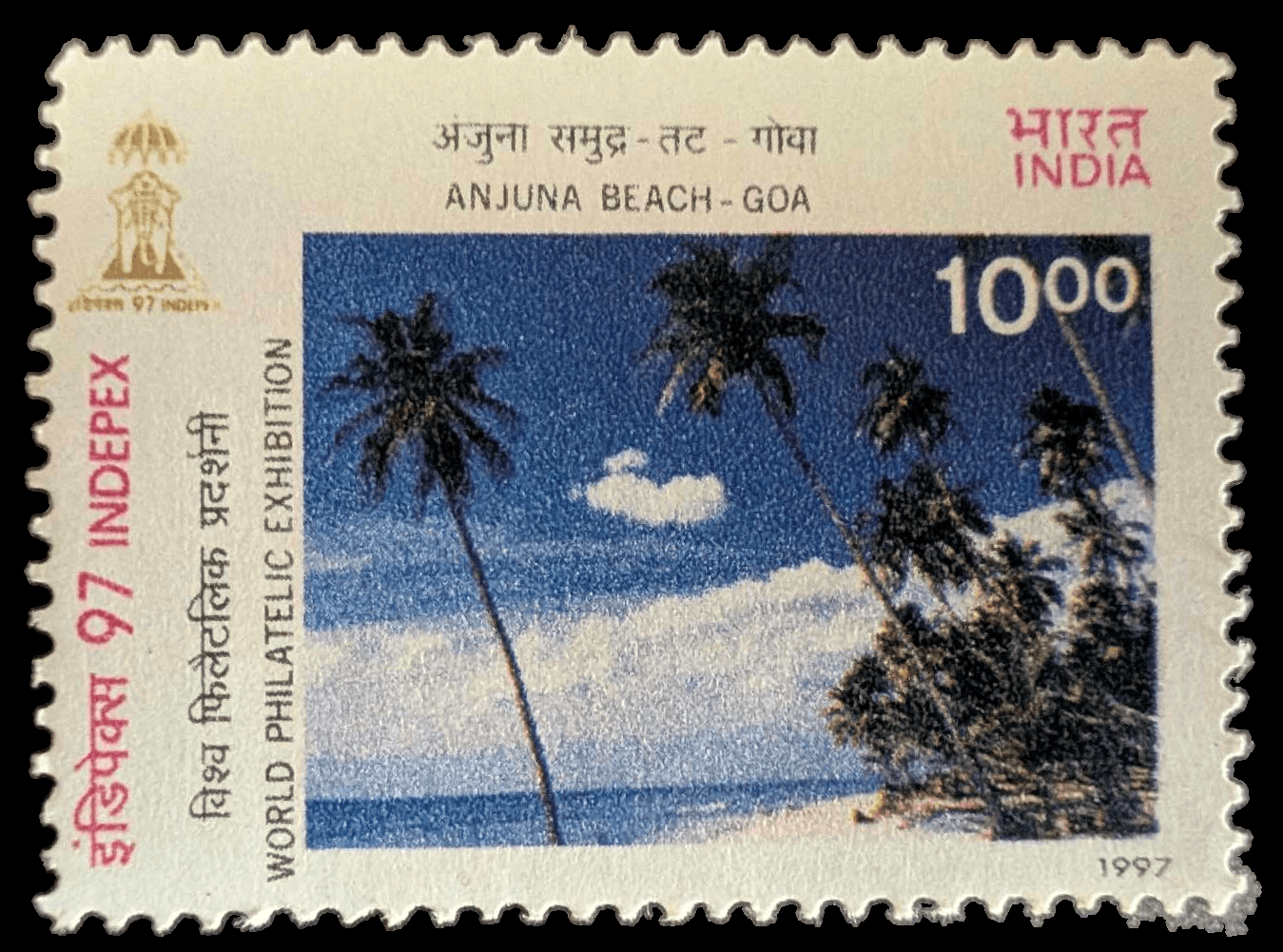
Ten Rupees for a Beach Already Famous for Something Else — The Anjuna Beach Stamp of 1997
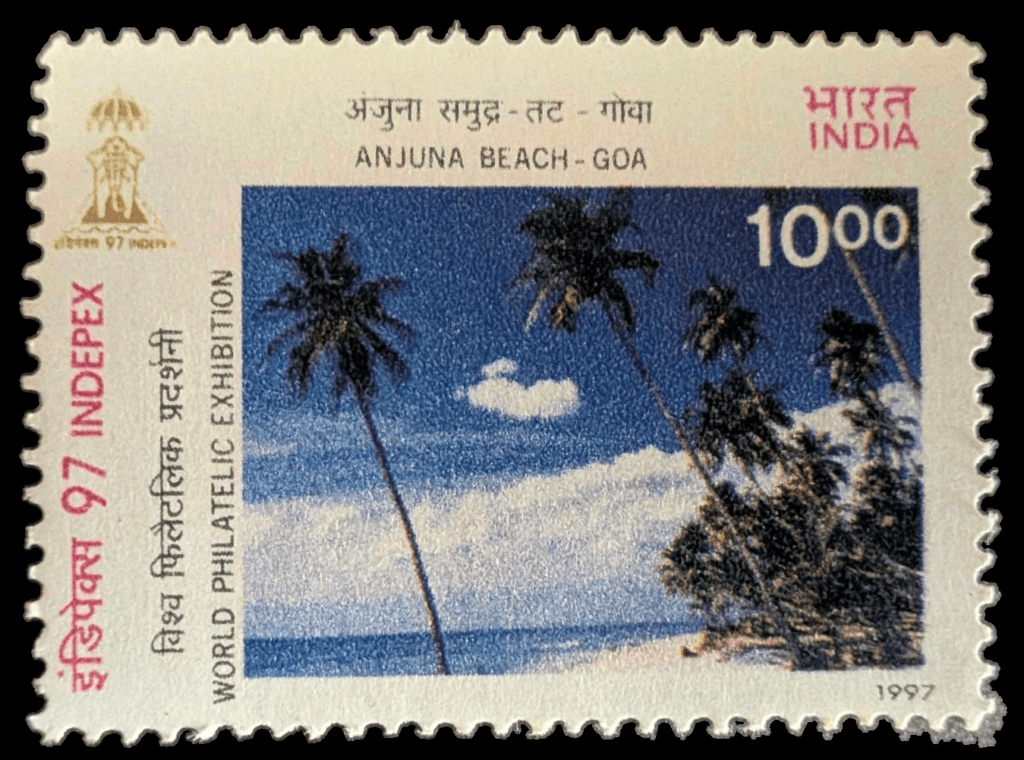
The Anjuna Beach stamp 1997 shows a shoreline that says nothing about why the rest of the world already knew its name.
The Stamp
- Issued: 11 August 1997
- Denomination: ₹10 (1000 paise)
- Occasion: 50th Anniversary of Indian Independence; INDEPEX ’97 World Philatelic Exhibition, New Delhi
- Subject: Anjuna Beach, Goa
- Inscription (Hindi): अंजुना समुद्र-तट – गोवा
- Inscription (English): ANJUNA BEACH – GOA
- Design: Upward-angled, ground-level photograph — coconut palm crowns silhouetted against a blue sky with cloud, no figures or shoreline visible
- National emblem: Lion Capital of Ashoka with सत्यमेव जयते
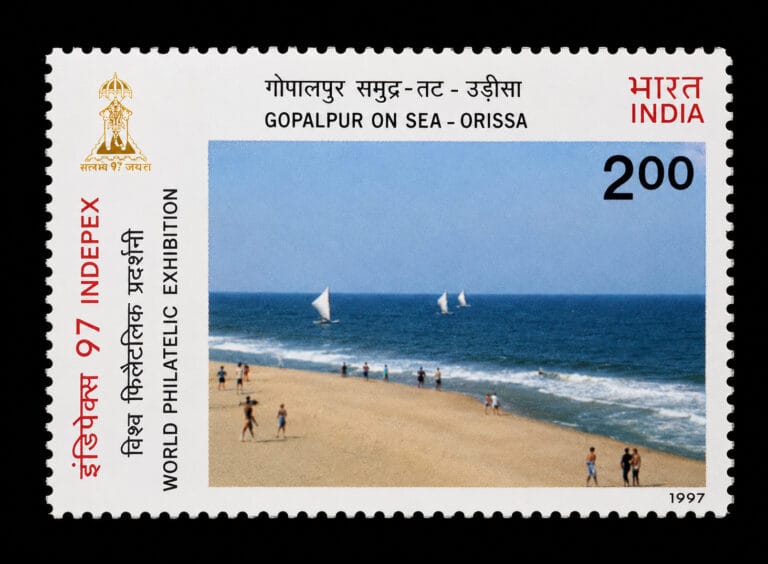
- Other stamps in the set: Gopalpur-on-Sea, Odisha (₹2); Kovalam Beach, Thiruvananthapuram (₹6); Bogmalo Beach, Goa (₹11)
The Story
Anjuna Beach’s 1997 stamp shows nothing but palm trees and sky. Not a single wave, not a single body on the sand, not a single beach shack — just black silhouettes of coconut fronds leaning across a cobalt-blue frame, tilted upward as if the photographer were lying flat on the beach, camera pointed straight up. It is a picture of a place with almost nothing in it.
That emptiness is the story.
The Anjuna Beach stamp 1997 is one of four in a “Beaches of India” set issued for the 50th anniversary of Indian independence and exhibited later that year at INDEPEX ’97, the World Philatelic Exhibition held in New Delhi — Gopalpur-on-Sea, Kovalam, Anjuna and Bogmalo, each built from the same visual grammar of palm, sand and sky. The spread favors variety over regional balance: two of the four beaches sit side by side on the Goa coast alone, with one each representing Odisha and Kerala.
Goa itself had been part of India for barely three and a half decades by 1997, annexed from Portugal in 1961 after roughly four and a half centuries of colonial rule — a recent enough political change that its coastline carried a different weight than Odisha’s or Kerala’s, both of which had never left Indian rule at all. That same colonial history is often cited as one reason travelers on the hippie trail found Goa unusually welcoming compared with the rest of India, at a moment when few other Indian destinations extended the same latitude to Western newcomers.
A set built to sample “coastal India” for a world audience was, in that sense, folding a still-young addition to the map in alongside two much older ones, using the same flattening visual language for all three — the architecture, language and cuisine that colonial rule left behind absent from the frame just as thoroughly as everything else.
The Anjuna Beach stamp 1997 works under the same constraint every stamp does before it says anything else: it is roughly three centimeters by four. In that space it cannot hold architecture, people, coastline, market stalls, music and thirty years of history all at once — only ever one detail, chosen instead of everything else that happens to be true. A stamp is not dishonest for leaving things out; it’s an exercise in radical reduction, and every beach in this set undergoes the same reduction, regardless of what each place actually contains.
Anjuna itself, away from the stamp’s frame, is a village in North Goa’s Bardez taluka, near the town of Mapusa — a sandy cove on the Arabian Sea broken up by outcrops of black rock, lined with the same coconut palms the photograph isolates. It remains, today, a working panchayat village with its own post office, a detail easy to overlook next to everything else the name has come to signify.
What Anjuna contained, by 1997, was considerably more than palm trees. From the late 1960s, it had become a terminus of the overland hippie trail, the road running through Turkey, Iran, Afghanistan and Pakistan that eventually emptied onto Goa’s beaches. Word-of-mouth accounts credit a restaurant run by a traveler nicknamed “Eight Finger Eddie” as an early gathering point, where new arrivals got their bearings and met others who had made the same overland journey.
A flea market grew out of that traffic by the mid-1970s, where travelers running low on money bartered clothes and instruments to fund their way home — a barter economy as much as a marketplace, and a social institution in its own right. The market still runs today, every Wednesday, drawing a mix of aging veterans from that original generation alongside present-day backpackers and tourists.
The parties around that scene shifted just as distinctly. Bonfire jam sessions built around cassette tapes of psychedelic rock in the 1970s gave way, through the 1980s, to electronic sound; by the 1990s that sound had its own name, Goa trance, reaching its commercial peak in roughly the same years this stamp was issued. A new wave of young Israeli travelers had by then become the scene’s most committed audience, layered on top of the original hippie arrivals a generation earlier. The genre would go on to spread far beyond this one beach, its name now attached to festivals and record labels well outside India — a global export that this particular stamp, produced in the same years, never once acknowledges.
Whatever the reasons behind the design, the photograph preserves one version of Anjuna while history remembers another.
Why the Anjuna Beach Stamp 1997 Shows Only Palms and Sky
The camera angle excludes sand, water and every human trace in a single decision — no beach shack, no figure, no boat, just palms and sky. Above the palms, the stamp carries its exhibition branding in bilingual Hindi and English, with the national emblem rendered in gold — a reminder that this design serves an occasion, not simply a place. The framing itself is deliberately generic, interchangeable with almost any tropical coastline in Kerala or Odisha as easily as Goa, and in that sense it is the composition doing, at the level of a single photograph, exactly what the whole set does: reducing a specific, well-documented place down to its most exportable shape.
On the Anjuna Beach stamp 1997, the palms are arranged in layers rather than as a single cluster: a dense stand fills the lower third of the frame, while two more distant crowns recede toward the upper right, giving the otherwise flat sky some sense of depth. A single, isolated white cloud sits roughly center-frame, distinct from the thinner bands beside it — the one soft shape in an otherwise hard-edged image. The bilingual identification runs vertically along the right edge, “Anjuna Beach – Goa” in Devanagari and English stacked one above the other, with the year “1997” printed small along the left margin.
The color palette reinforces the effect. A single dominant blue runs through sky and cloud-break alike, while the palm fronds render as near-total black silhouette rather than photographically detailed foliage — a high-contrast, stencil-like treatment that favors graphic clarity over botanical realism. The result reads as pleasant, uncontroversial scenery, the kind of image that could sit at the front of almost any exhibition catalogue.
Read alongside its three siblings — Gopalpur-on-Sea, Kovalam, Bogmalo — the four stamps share that same visual grammar: palm, sand, sky, rearranged just enough to avoid outright repetition. One detail interrupts the pattern: a taut diagonal line — almost certainly an overhead wire or a rope strung between the palms — cuts across the frame from lower left to upper right, passing directly behind the isolated cloud. It’s the one piece of infrastructure the frame doesn’t manage to exclude, left in whether by design or simply because the original photograph was reused as-is. In a composition built entirely around omission, it’s the single thread connecting the picture back to a place where people actually lived.
This Copy
This copy shows some light toning along the white border — the paper reads a warm cream rather than stark white, consistent with a stamp approaching thirty years old, and it doesn’t touch the image panel itself. The blue of the sky and the black of the palm silhouettes remain strong, with no visible fading. Perforations are clean and intact on all four sides, and centering is good — the photograph panel sits squarely within the frame. This is the fourth and final piece in the INDEPEX ’97 “Beaches of India” set, now complete in this collection alongside Gopalpur-on-Sea, Kovalam and Bogmalo.
Further Reading & Links
This stamp is part of the same 1997 INDEPEX set as StampTales’ Bogmalo Beach stamp, Kovalam Beach stamp, and Gopalpur-on-Sea stamp, all explored elsewhere on this site, and sits within StampTales’ The World in a Stamp collection. All four are seen together in What Four Indian Beach Stamps Reveal Together. For more on the countercultural and musical history touched on above, Dancecult: Journal of Electronic Dance Music Culture, a peer-reviewed academic source, gives a fuller account.


4 Comments
Comments are closed.