The Window That Only Survives on Paper
The stamp
- Country: Hungary — Magyar Posta
- Issued: – 15 November 1972
- Denomination: – 40 fillér
- Series: Stained Glass Windows, 19th–20th Centuries (seven values)
- Subject: Múzsák — The Muses — after a design by József Rippl-Rónai
- Stamp designer: Éva Zombory (1927–1998)
- Condition: Used; partial cancellation across the lower right
The Story
Almost none of Rippl-Rónai’s glass survives. Forty fillér of paper does.
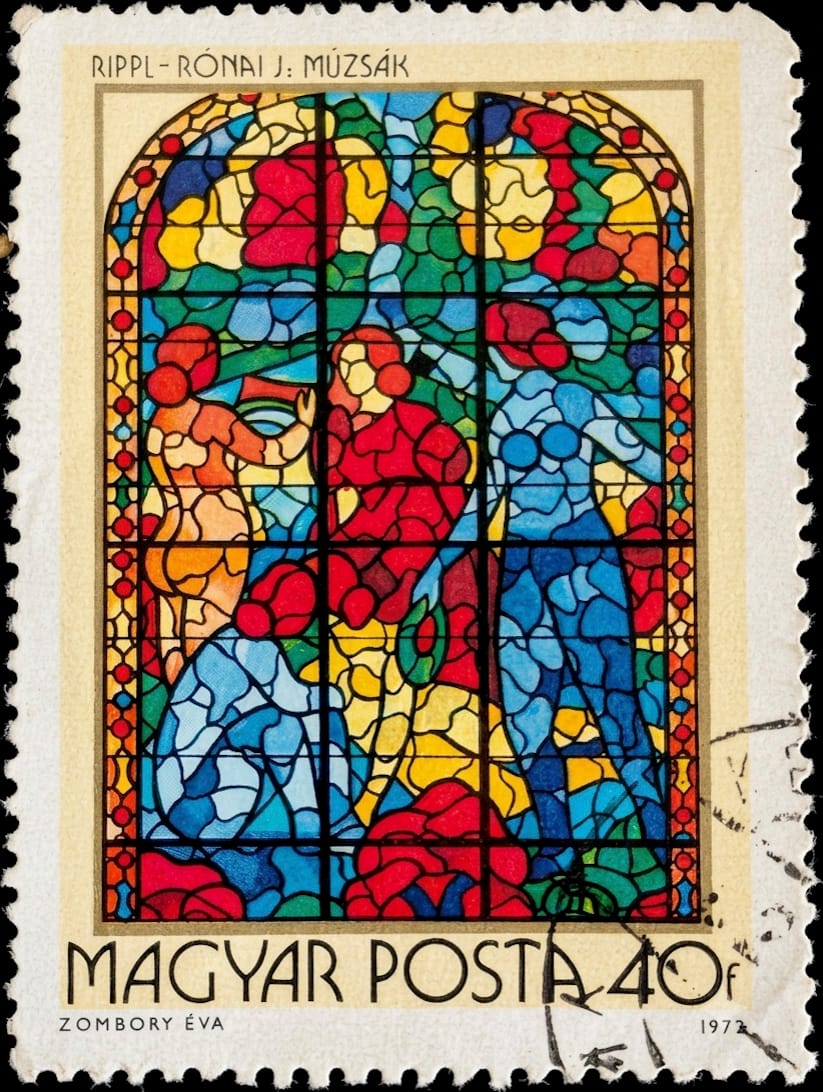
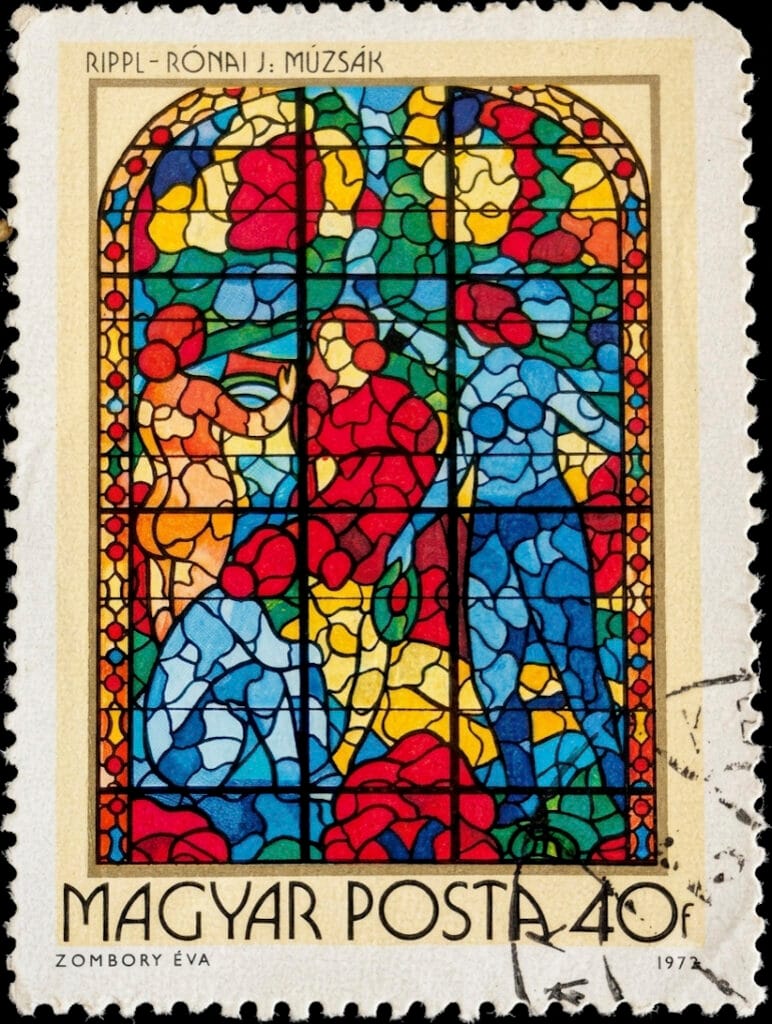
The Hungary stained glass stamp above was issued by Magyar Posta on 15 November 1972, one of seven values in a set called Stained Glass Windows, 19th–20th Centuries. Its subject is a window titled Múzsák — The Muses — credited on the stamp to the painter József Rippl-Rónai.
A second name sits in the opposite corner: Éva Zombory, the graphic artist who redrew the window at postage size. Roughly six decades separate the two.
A painter who kept designing things nobody built
Rippl-Rónai (1861–1927) qualified as a pharmacist before he qualified as anything else. He took his degree in Budapest, reached the Munich academy in 1884, and arrived in Paris two years later on a grant, assisting Mihály Munkácsy — the most commercially successful Hungarian painter of the day.
In 1888 he fell in with Les Nabis, the circle around Bonnard and Vuillard, and his work changed: flat forms, dark contours, colour laid down in autonomous blocks.
Then he did something painters rarely do. He decided that an artist’s whole manner of living was part of the work — including, by his own account, the clothes he wore. That conviction pushed him sideways into design: embroidered hangings, ceramics, glass, and finally an entire interior, the dining room of the Andrássy Palace.
Here is the part that matters. The Museum of Applied Arts, which holds his applied work, records that despite his many design ideas, very few were ever actually realised — and most of the major ones were later destroyed. The Andrássy dining room is gone. The short list of things that did get made in glass includes windows for the Japan Coffee House and for the Ernst Museum, both in Budapest.
A painter’s canvases can survive neglect in an attic. A window cannot. It is architecture, and architecture gets demolished.
The brothers who turned the drawings into glass
A stained-glass window is never one person’s work. Rippl-Rónai drew; someone else cut, leaded, fired and fitted.
That someone was usually the Róth workshop. Miksa Róth (1865–1944) apprenticed in his father’s leaded-glass studio and is the figure most credited with making stained glass and mosaic prominent art forms in Hungary, supplying the Academy of Music and the Gresham insurance offices.
His younger brother Manó is the one most accounts forget. Manó’s workshop executed the Ernst Museum staircase windows to Rippl-Rónai’s design.
So the object on this stamp already had at least two authors before a stamp designer ever looked at it. By 1972 it had three.
What the Hungary stained glass stamp actually shows
I could not establish it with confidence.
Philatelic catalogues identify the 40-fillér subject as The Muses after Rippl-Rónai, and the stamp’s own top line says the same. But Hungarian architectural writing describes the large Rippl-Rónai window on the Ernst Museum stair landing as depicting Arcadia, not the Muses. A separate record notes that in 1915 two staircase windows were commissioned for the Museum of Applied Arts, one realising a Rippl-Rónai design.
Either could be the window on this stamp. Neither is confirmed by a source I would put my name to. So the article stops there, and the gap goes in the Verification Notes rather than under a confident sentence.
Seven windows, one century
The 1972 set surveyed roughly a hundred years of Hungarian glass. Alongside the Muses, the named subjects include a sixteenth-century scribe after Ferenc Sebestyén, a Flight into Egypt after Károly Lotz and Bertalan Székely, Prince Árpád’s Messenger after Jenő Percz, a Nativity after Lili Sztehló, and Prince Árpád and the Chieftains after Károly Kernstok.
A Nativity and a Flight into Egypt, issued by the postal administration of the Hungarian People’s Republic. The set is organised by artist and by medium rather than by subject, which places the religious images inside a frame marked art history. Whether that framing was a deliberate accommodation is not something the stamps can tell us, and I will not pretend otherwise.
One name on that list is worth stopping on. Lili Sztehló (1897–1959) graduated from the Academy of Fine Arts in 1923 and built her career almost entirely in stained glass for parish churches and cathedrals across Hungary. Her Nativity sits in the same set as the Muses.
Which means the series has two women in it: one who made windows, and one who made the stamps. Neither is the name most people would recall, because the credit line belongs to the painter.
The woman who redrew it at 40 fillér
Éva Zombory was born in 1927 in a salt-mining town then inside Czechoslovakia. She spent two years at a medical faculty in Budapest before switching to the Academy of Applied Arts in 1947.
From 1960 until her death in 1998 she worked almost entirely as a stamp designer, taking regular commissions from Magyar Posta and eventually the Munkácsy Prize. Nearly four decades inside a rectangle a few centimeters across.
Her problem on this commission was subtraction. A window metres tall, lit from behind by daylight that changes hour by hour, had to become a flat mark on gummed paper, lit from the front by whatever lamp the reader happens to be under.
At actual size the problem stops being abstract. The whole window is about three centimetres wide. The perforation teeth around the edge are bigger than most of the individual pieces of glass inside it — the holes a clerk tore along are coarser than the artwork they were tearing. Everything below follows from that one fact.
Looking Closer
Start with the black lines, because they are doing the most work.
Everything else on the Hungary stained glass stamp is competing for attention — red, cobalt, ochre, two or three distinct greens, all at close to full strength and none of them yielding. The colours have no shading and no modelling. They sit side by side as flat areas, and the eye has nothing to organize.
In an actual window those dark contours are lead came — the H-sectioned strips that hold each piece of glass and carry the panel’s weight. They are structural before they are decorative. Rippl-Rónai’s Nabi training had already taught him to build pictures from flat colour fields bounded by dark outlines, which means his painterly habit and the physical demands of leaded glass were pulling in the same direction. The design is not a painting adapted to glass. It fits the medium almost suspiciously well.
Now look at the thin straight lines running horizontally and vertically across the image, dividing it into a grid. Those are not part of the artwork at all. They are the saddle bars — the iron supports that stop a large panel from bowing under its own weight.
Zombory kept them. That is a choice, and it changes what the stamp is. She could have reproduced the design; instead she reproduced the object, hardware and all. The stamp is a photograph of a thing in a building, not a facsimile of a drawing.
There is a further consequence. The figures are hard to find. Three human forms occupy the centre of the window — a seated shape at the left with an arm raised, a red-draped figure in the middle, a blue one to the right — but the leading cuts straight across all of them, breaking each body into fragments that read first as pattern and only later as anatomy. You resolve the picture slowly, the way you would resolve a real window while walking up a staircase towards it.
The framing carries the same logic. The coloured glass sits inside a narrow gold border, which sits inside a broad cream field, which sits inside the white paper margin — three nested frames before you reach the perforations. Nothing bleeds to the edge. The effect is a window seen in a wall, at a slight distance, rather than a pattern filling the stamp.
The lettering respects that discipline completely. MAGYAR POSTA and the 40 f denomination sit on the cream band beneath the image in a heavy, wide-set display face; the artist credit runs along the cream band above. Not a single character crosses the coloured area. In a design where the colour is the entire point, every word has been kept off it.
Then there are the two credits, placed at diagonally opposite corners: Rippl-Rónai’s above left, Zombory’s below left, the year 1972 below right. A designer from the age of Hungarian Art Nouveau and a designer from the age of state socialist offset printing, sharing one piece of paper, neither given more room than the other.
The cancellation lands across the lower right — a partial strike, ink on the cream band and clipping the final digit of the date. It obscures almost nothing. What it does prove is that the stamp worked: this piece of paper was bought, licked, stuck down and posted, which is more than most of Rippl-Rónai’s applied designs ever got to do.
Closing
Rippl-Rónai spent years drawing objects for other people to build, and most of what got built has since been broken up, bombed or thrown out. The Andrássy dining room exists now only as a reconstruction. The windows survive in a handful of stairwells, behind scaffolding, in buildings that have changed their names and their purposes more than once. And one of them survives as this: forty fillér of gummed paper, printed flat, lit from precisely the wrong side, small enough to lose between the pages of a book. A window is something you are meant to look through. This one you can only look at. It is still the version that travelled furthest.
Further Reading & Links
Elsewhere on StampTales. The problem this stamp solves — an entire art form squeezed into a rectangle — turns up again in 75 Years of Indian Cinema, 1989, which had to stand in for a whole national cinema and reached for a very different solution. For a second case of a state postal service abroad putting architecture on gummed paper, there is the Cayo Jutías lighthouse stamp, Cuba 1982. The United States Cardinal stamp of 1991 is where this magazine last read colour separation at close range, and Tilak Swaraj, Through the Lens is the clearest demonstration of what macro photography finds in printed paper once the naked eye gives up.
Magyar Posta returns four years later in Hungary Celebrated the Metric System Twenty-Two Days Too Early — the same postal service, a very different job, marking a centenary three weeks before the government conceded the work wasn’t finished.
Sources. The fullest public record of Rippl-Rónai’s applied work — including the blunt note that most of it was never built or was later destroyed — is held by the Museum of Applied Arts in Budapest, whose separate entry on the Róth workshop covers the glassmaking half of the partnership. Biographical detail comes from Wikipedia’s articles on József Rippl-Rónai and Miksa Róth. Éva Zombory is the hardest of the three to research: the Hungarian Wikipedia entry is the only accessible account of her career, and it points to a 1995 monograph by I. Varga that appears to be the sole book-length treatment of a woman who spent thirty-eight years designing her country’s stamps.


One Comment
Comments are closed.