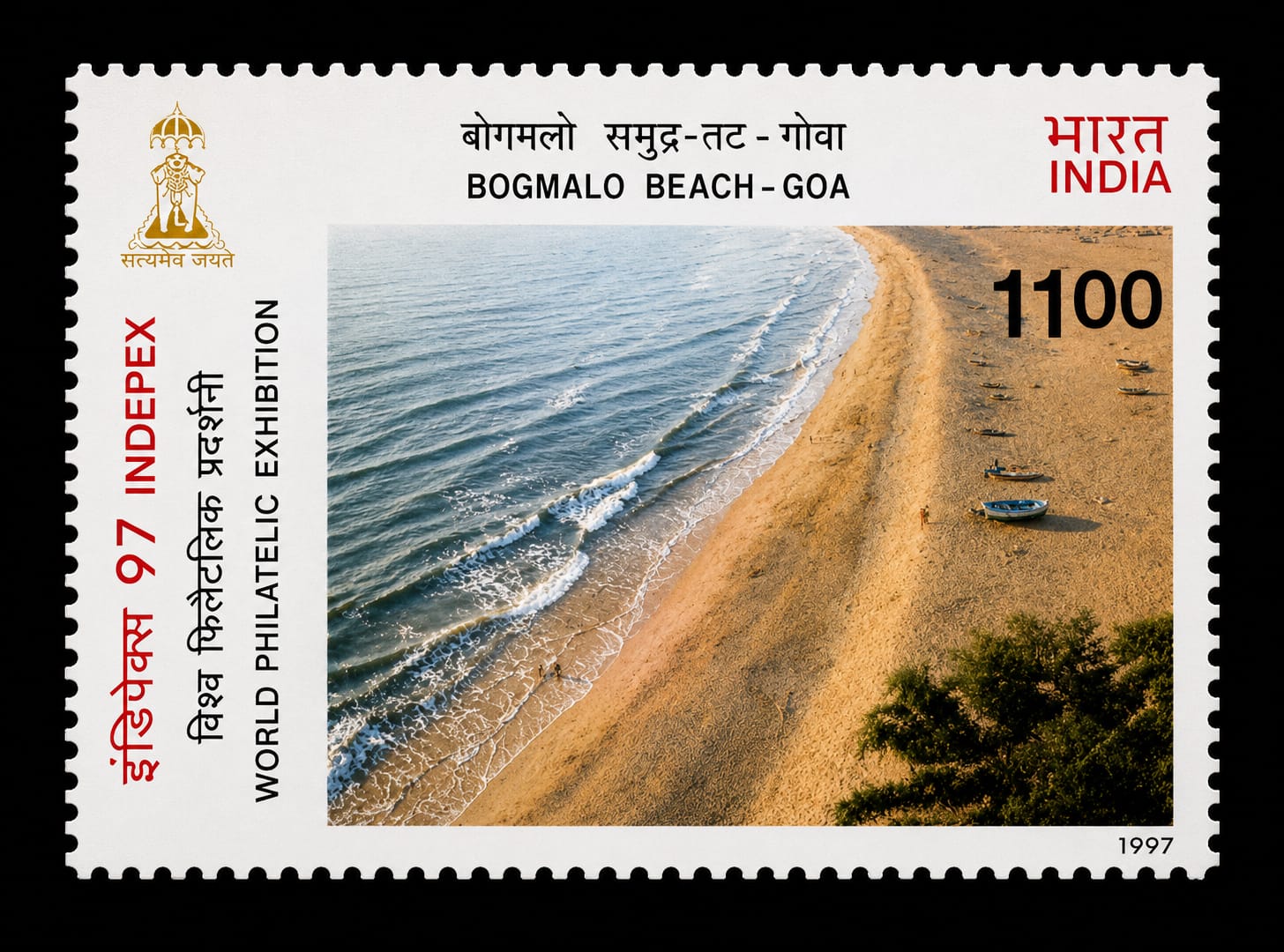
Eleven Rupees for a Bay the Navy Almost Swallowed — The Bogmalo Beach Stamp of 1997
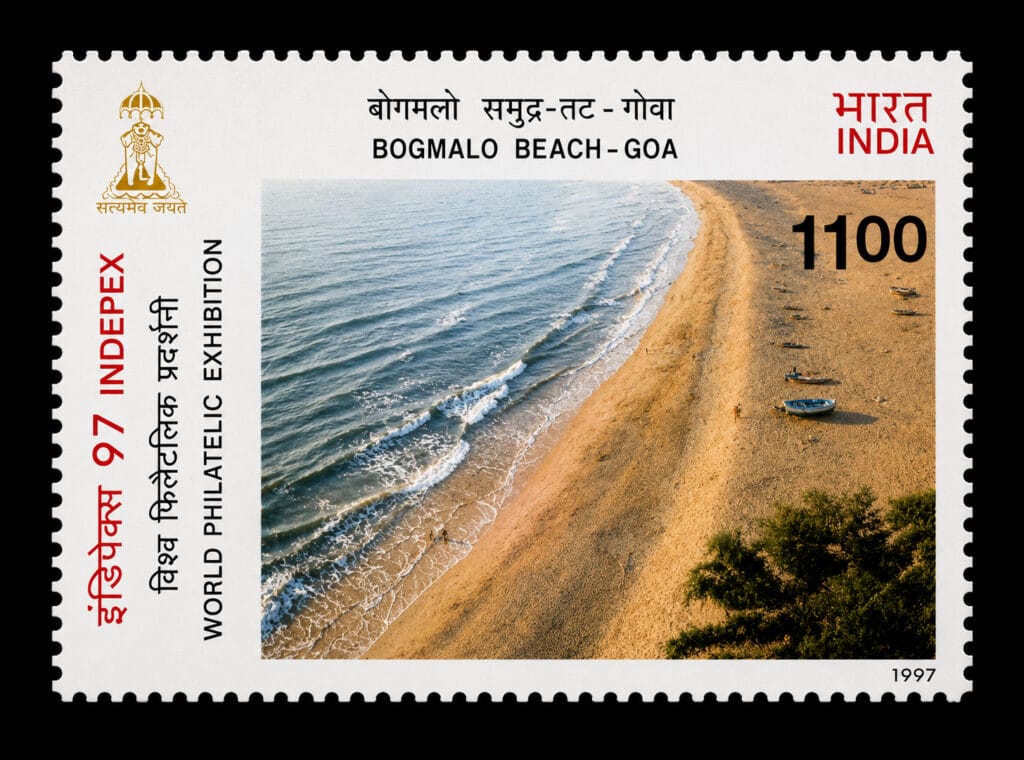
The Bogmalo Beach stamp 1997 gave India’s most expensive beach denomination to a village most people have never heard of — and the reason has nothing to do with scenery.
Why would India Post give its most expensive beach stamp to a village most Indians couldn’t find on a map — a crescent of sand four kilometres from a military runway, in a taluka better known for iron ore than tourism? The answer is on the stamp itself, if you know where not to look.
The Stamp
- Issued: 11 August 1997
- Denomination: ₹11 (1100 paise)
- Series: Beaches of India — INDEPEX ’97 (Set of 4)
- Occasion: 50th Anniversary of Indian Independence; INDEPEX ’97 World Philatelic Exhibition, New Delhi
- Inscription: बोगमलो समुद्र-तट — गोवा / BOGMALO BEACH — GOA
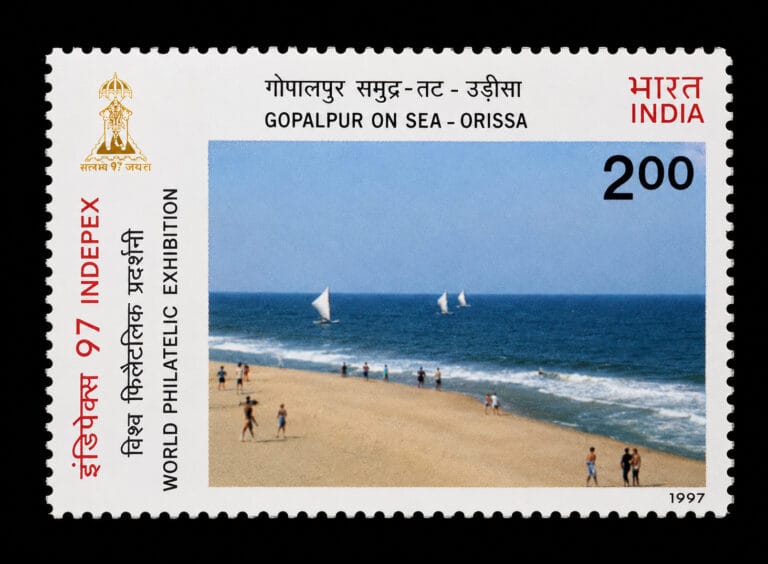
- Other stamps in the set: Gopalpur on Sea, Odisha (₹2); Kovalam Beach, Thiruvananthapuram (₹6); Anjuna Beach, Goa (₹10)
The Story
Four kilometers. That is how close Bogmalo Beach sits to Dabolim Airport — which is not, in the usual sense, a civilian airport.
It is INS Hansa, the Indian Navy’s premier naval air station on the western seaboard, home to Sea Harriers and maritime patrol aircraft since the 1960s. Civilian flights share the runway on sufferance. The Naval Aviation Museum sits just up the road, displaying decommissioned fighters like relics in a temple.
And yet this is the beach India Post chose for the highest denomination in its 1997 set.
INDEPEX ’97 was no ordinary stamp show. Held under the patronage of the Fédération Internationale de Philatélie (FIP), it marked the fiftieth anniversary of Indian independence. The country was presenting itself — not as it wished to be, but as it already was. Ancient and modern. Military and pastoral. Industrial and unhurried.
India Post chose its beaches to tell that particular story.
Bogmalo — pronounced bawg-maa-low — is a village in South Goa’s Mormugao taluka, nine kilometres from the port town of Vasco da Gama. The Portuguese knew it. The Navy claimed most of the headland around it. What remained was a crescent of golden sand where local fishermen still hauled in their catch at dawn, their blue and ochre boats resting on the shore by mid-morning.
The stamp captures exactly this scene: boats beached, waves rolling in undisturbed, no high-rises on the horizon. A coastline that tourism brochures had not yet discovered in force.
What the stamp does not show — what the aerial photograph politely crops out — is the runway threshold just beyond the northern tree line, the restricted zones marked in red on local maps, the occasional roar of a turboprop banking over the bay.
Bogmalo’s beauty has always existed in negotiation with the machinery of national defense. India Post did not choose a famous beach. It chose a contested one, and then presented only the peace.
Why the Bogmalo Beach Stamp 1997 Chose This Village
There is something revealing about a government’s choice of denomination.
In 1997, the INDEPEX beaches set ranged from ₹2 (Gopalpur) to ₹11 (Bogmalo). The eastern coast got the lowest value — the workhorse stamp, designed for everyday letters. Bogmalo got the prestige denomination — more than five times the cost of an inland letter, designed to sit in albums rather than travel on envelopes.
For a village of perhaps a few hundred families, wedged between a naval base and the Arabian Sea, that is a strange and quiet honour.
The stamp is also a time capsule of Goa itself. In 1997, Goa was still transitioning — from a territory liberated in 1961, to a state granted full statehood in 1987, to a tourism destination the rest of India was only beginning to discover. Bogmalo was not Calangute. It was not Anjuna. It was a place you found only if you were lost on the way to the airport or stationed at the base.
The stamp records that version of the place — before the resort construction, before the water-sports operators, before the Google Maps pin.
And because ₹11 was too expensive for ordinary postage, this stamp was rarely used on mail. Most surviving copies are mint. It was born as a collectible — a miniature landscape painting with perforated edges and a gum backing that no one ever licked.
This Copy
The copy photographed for this article is mint and unhinged, its perforations intact on all four sides. The colours remain vivid — the turquoise of the water has not faded, and the gold of the sand holds its warmth against the white border.
Further Reading & Links
This stamp belongs to StampTales’ The World in a Stamp collection, and sits alongside its INDEPEX ’97 siblings also explored on this site — the Kovalam Beach stamp, the Gopalpur-on-Sea stamp, and the Anjuna Beach stamp, the other three beaches in the same set. All four are seen together in What Four Indian Beach Stamps Reveal Together. The naval airbase just beyond the frame, INS Hansa, has its own long history — Wikipedia’s entry on INS Hansa covers its 1961 commissioning and its role as India’s largest naval air station today.


5 Comments
Comments are closed.