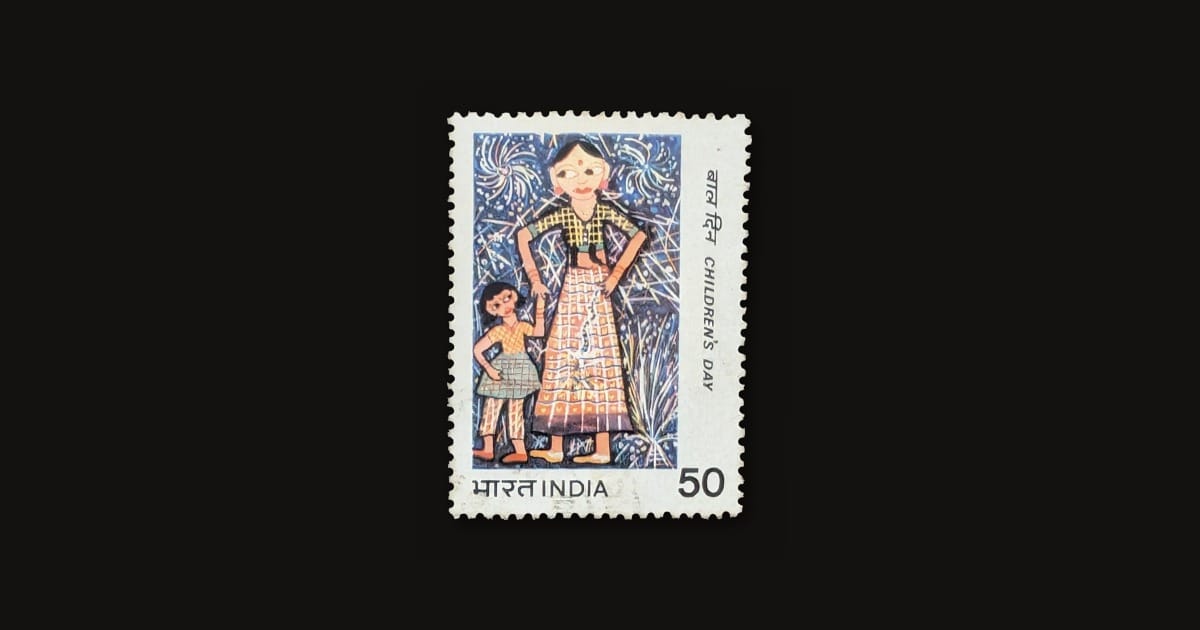
Once a Year an Indian Stamp Is Designed by a Child. In 1983 the Child Painted an Adult.
The 1983 Children’s Day stamp came off a schoolchild’s brush. The only child in the picture is the smallest thing in it.
The Stamp
| Issue | National Children’s Day |
|---|---|
| Country | India — Indian Posts and Telegraphs Department |
| Subject | A woman and a girl among fireworks, from a painting by a schoolchild |
| Issued | 14 November 1983 |
| Denomination | 50 paise |
| Occasion | Birth anniversary of Jawaharlal Nehru, observed as Children’s Day |
| Artist | Recorded as Kashyap Premsawala — see Verification Notes |
| Sheet | 35 stamps |
| Catalogue | Phila 947 · SG 1103 |
| Condition of this copy | Unused, light age toning, a small nick in the paper at the lower right edge |
The Story
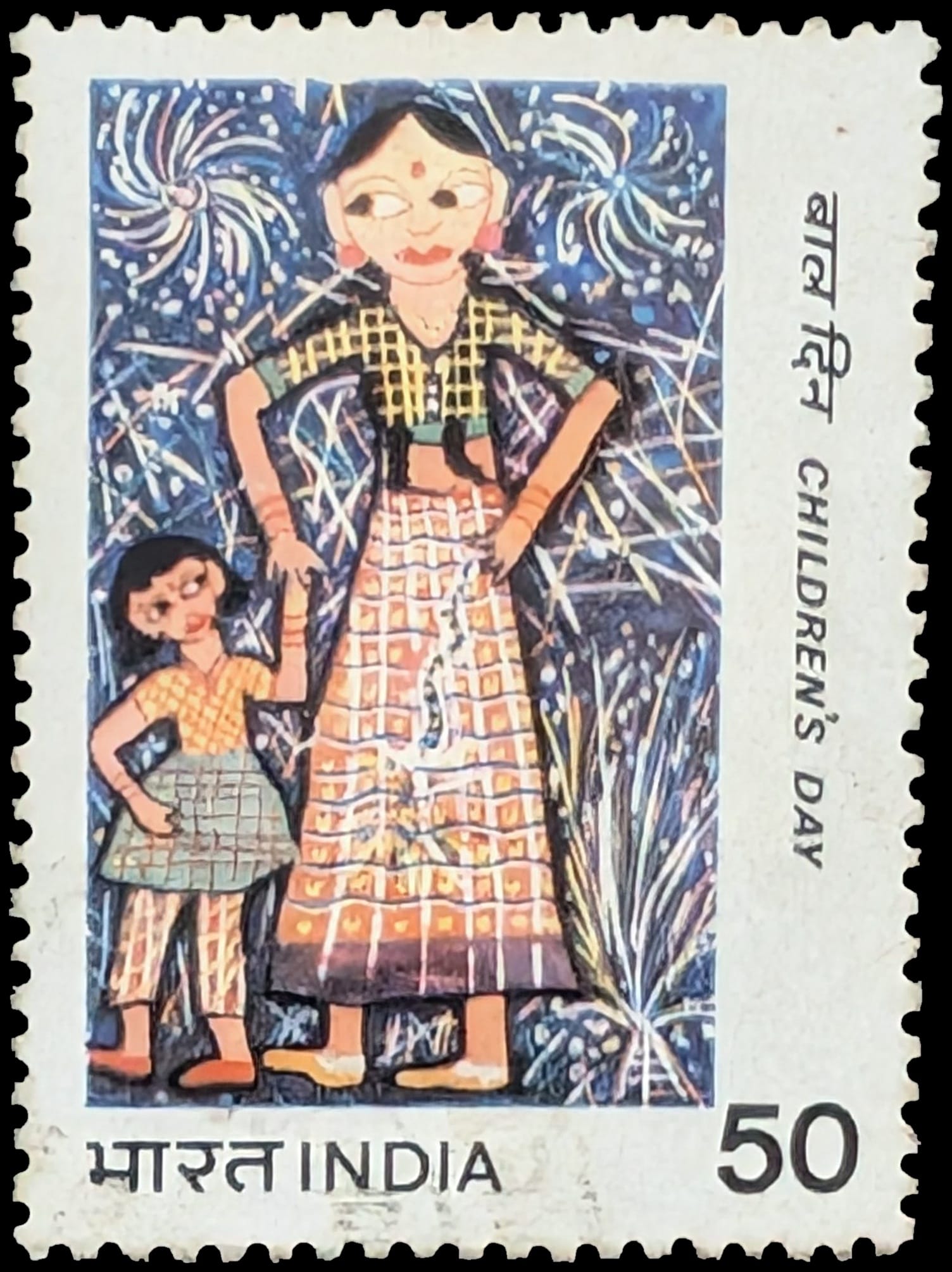
The tallest figure on the 1983 Children’s Day stamp is a woman.
She runs almost the full height of the printed panel, both hands planted on her hips, an orange-and-white checked skirt dropping to her ankles. A girl stands at her left, reaching up. The girl’s head does not come as high as the woman’s hands. Behind the two of them the sky is going off — pinwheels, sparks, white lines scratched across dark blue in every direction.
None of that is wrong. It is a confident, busy, entirely likeable painting. It simply isn’t a painting of children, on the one Indian stamp each year that children are handed to fill.
That is the whole oddity of the 1983 Children’s Day stamp, and it takes about four seconds to see once somebody points at it. What takes longer is working out that it wasn’t an accident.
Before the 1983 Children’s Day stamp, adults held the brush
India issued its first Children’s Day stamps on 14 November 1957 — three of them. One showed an eight-year-old boy eating a banana, worked up from a photograph picked out of ten thousand entries. Shekhar Borker spent the rest of his life as Banana Boy.
The stamps that followed kept to photographs until 1966: a nurse with a child patient, boys waiting for admission to a children’s home, a boy at a lathe, children receiving school meals. Look at that list again. Every image shows children being done to — fed, treated, admitted, trained.
There is a whole theory of childhood sitting inside that run of pictures, and it is a governmental one. Children appear as a category to be managed: a vaccination rate, a nutrition programme, an intake figure. The photographs are warm enough, and they were made by people who meant well. But children were the subject of them. Adults were the authors.
From 1971 the arrangement changed. India Post stopped photographing children and started printing paintings made by them, chosen through a competition run across the country.
There is a technical reason the timing lands where it does. Until 1971 these stamps were printed in a single colour, with one exception in 1962. Multicolour printing arrived on the series only in 1973.
Which matters for what the 1983 Children’s Day stamp is able to show. Blue-black night, apricot skin, five different checked fabrics: none of that could have been reproduced in the photograph years. The press caught up with the children a decade after they were handed the brush. Nothing else in the Indian postal programme works this way. Every other commemorative — the anniversaries, the freedom fighters, the wildlife series, the exhibitions — is drawn by the department’s own professional designers. Once a year, for one issue, the drawing hand belongs instead to a schoolchild.
It is more than symbolic. For one issue a year, the country’s postage carries a schoolchild’s work instead of the department’s professional artwork, in colour, with the country’s name under it. Which makes the 1983 Children’s Day stamp worth sitting with.
What a child did with the 1983 Children’s Day stamp
By 1983 the brush had been in children’s hands for a dozen years. The 1983 Children’s Day stamp is what one of them did with the chance.
Reference lists record the winning entry as a woman and child taken from a work titled Festival, painted by Kashyap Premsawala. The subject of the 1983 Children’s Day stamp is almost certainly Diwali: the sparks, the ground-level burst at the lower right throwing white plumes upward, the two figures dressed and out in the middle of it. Nothing printed on the stamp names the festival, so the identification stops there.
The woman nearly fills the frame. The girl barely reaches her waist. Everything the eye goes to first on the 1983 Children’s Day stamp — the face, the jewellery, the great checked skirt, the two arms braced outward — belongs to the adult.
Three years, and the children keep slipping out
Taken alone, the 1983 Children’s Day stamp is a curiosity. It becomes a pattern when you set it beside the years either side.
The 1982 winner was called “Mother and Child” — an adult, again, sharing the frame. The 1983 Children’s Day stamp gave the adult most of the frame outright. Then in 1984 came “Herdsman and cattle in Forest”: a man, some animals, some trees, and not one child anywhere on it. That last one is worth saying twice. A Children’s Day stamp with no children on it.
The 1983 Children’s Day stamp is not the competition failing. It is the competition doing exactly what it promised. Nobody told these children to paint children, and there is no reason they should have. Handed a blank sheet and a free subject, they painted the world in front of them.
Which leaves the 1983 Children’s Day stamp doing something the 1957 photographs could never have done. The earlier issues show what adults thought children were. This one shows what a child thought was worth looking at.
Looking Closer at the 1983 Children’s Day Stamp
Four things about this design repay a magnifying glass.
The composition has already decided who matters. The woman does not merely take up more room; she sits on the vertical mid-line of the printed panel, upright, symmetrical, both elbows out. The girl’s entire body falls inside the lower-left quarter. The eye enters at the woman’s face, travels down the length of her skirt, and only then finds the girl, low and to one side, already on its way out of the frame. Scale is the obvious part. The placement is the argument.
The posture is the second half of it. Hands on hips is a closed stance. Both elbows push outward, both wrists carry bangles, and the body reads as planted and self-sufficient — a person occupying her own space rather than bending into someone else’s. The girl has to reach up to hip height to make contact at all. Where the two hands meet is not a tender gesture placed to one side; it sits almost dead centre of the panel. The structural middle of this composition is neither face. It is the grip.
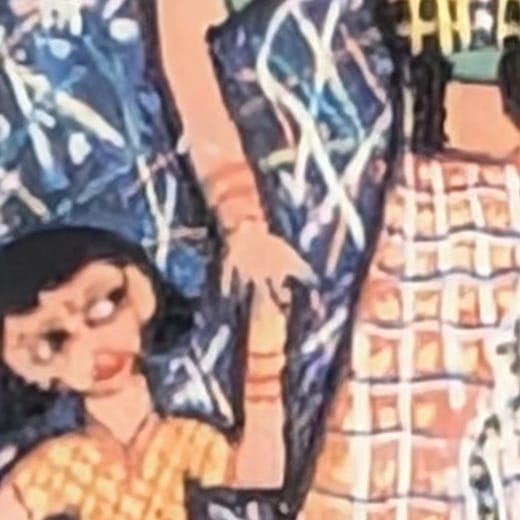
One mark, used for cloth and for light alike. The woman’s bodice is a grid. So is her skirt. So is the girl’s blouse, and her skirt, and her trousers: five garments, one device, five colourways. Then look at the fireworks and it is the same gesture again — crossed strokes, white on dark blue, laid down at speed.
The painter had a single mark and did not distinguish between fabric and fire. A trained designer would have reached for two visual languages and kept them apart. The child found one and used it everywhere, which is why the 1983 Children’s Day stamp holds together as an image despite having no empty space anywhere in it. Repetition is doing the work that composition usually does.
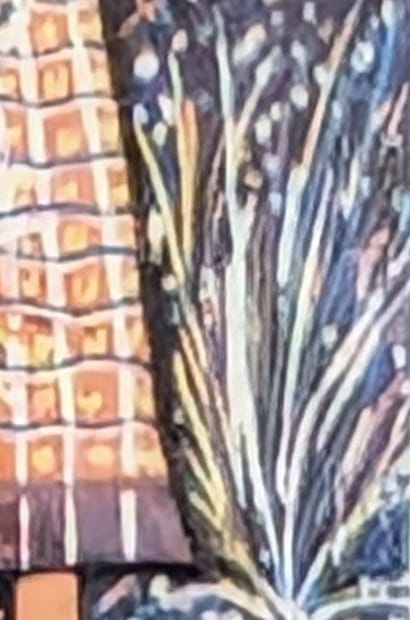
Nothing stands in front of anything. The white sparks run straight across the figures — over the woman’s sleeves, over the checked skirt, over the girl’s leggings. There is no reserved silhouette, no attempt to hold the people clear of the background.
It looks like a printing fault until you have actually stood in a lane on Diwali night. Light does land on you. The flatness a professional would have corrected out of the 1983 Children’s Day stamp turns out to be truer than depth would have been.
The colour carries the same logic. Almost everything cool sits behind — the blue-black ground, the blue-white sparks. Almost everything warm sits on the figures: apricot skin, orange bangles, the yellow of both bodices, the tan of the shoes. The picture is sorted by temperature rather than by distance. That sorting is probably why it survives its own density: with no empty space anywhere, warmth is the only thing separating the people from the noise.
The label is turned on its side. “बाल दिन / CHILDREN’S DAY” runs vertically up the right-hand margin, rotated ninety degrees. INDIA and the 50 stay horizontal along the bottom, where they always are.
The painting is unusually tall, and rather than crop it or shrink it, whoever laid out the 1983 Children’s Day stamp tipped the occasion’s own name sideways to make room. That may be nothing more than a layout constraint. It may also reflect a willingness to keep the child’s composition intact at the label’s expense. Either way, the two words this stamp exists in order to say are the two words you have to tilt your head to read.

One more detail, easy to miss at postal size. In both faces the pupils are painted well off to one side of the whites, close to the inner corners. Neither figure meets your eye, and neither is turned towards the other. Two people are standing in the middle of a firework display with their attention somewhere off the edge of the picture. It gives the 1983 Children’s Day stamp a stillness that its surface has no business producing.
Series Context
The Children’s Day series is not an unbroken run, and the gaps are worth knowing. No stamp appeared in 1965, across 1967 to 1970, in 1972, in 1979, or in 2003.
Two of the absences are pointed. In 1988 and again in 1989, the 14 November slot went to Jawaharlal Nehru’s birth centenary instead. Children’s Day in India exists at all because it is Nehru’s birthday; the day was named for children and dated for a man. Twice, the man took the date back.
Placed in that series, the 1983 Children’s Day stamp stops looking like an outlier. The date belongs to an adult. The photographs of the first decade were made by adults. The competition years are the one stretch where a child decides — and in 1983 the child decided to paint an adult anyway.
One small ghost sits in the table above. This stamp was issued by the Indian Posts and Telegraphs Department, a name that stopped existing in 1985 when the department was split in two — so the stamp outlasted its own issuer.
Closing
Fifty paise bought a sheet of night sky going off in every direction, and two people standing under it in their good clothes. In the middle of all that noise, two hands meet at hip height. That is as high as the child in the picture reaches. It is also, almost exactly, the centre of the frame.
Further Reading & Links
Further reading around the 1983 Children’s Day stamp, on this site and elsewhere.
On StampTales
- Children’s Day 1984 — the stamp with no children on it — the year after this one, the winning painting left children out altogether.
- The 1986 Children’s Day stamp — two ropes cross it tied to nothing; the catalogue names the painter, the stamp does not print her name.
- The 1990 Charminar stamp — another Indian issue where what the design leaves out carries the story.
- The Philatelic Society of India stamp, 1997 — India Post enlarges a line of text that excludes Indians, and prints it seven hundred thousand times.
- The 1989 Indian cinema stamp — a commemorative built on a reproduction of somebody else’s artwork.
Elsewhere
- Children’s Day (India) — Wikipedia)
- Children’s Day stamps of India — Vijaya & Venkat Tata’s thematic index
- Children’s Day and stamp collecting — Indian Philately Digest

3 Comments
Comments are closed.