What Four Indian Beach Stamps Reveal Together

Four beaches. Four photographs. Four versions of India’s coastline, each leaving something important just outside the frame.
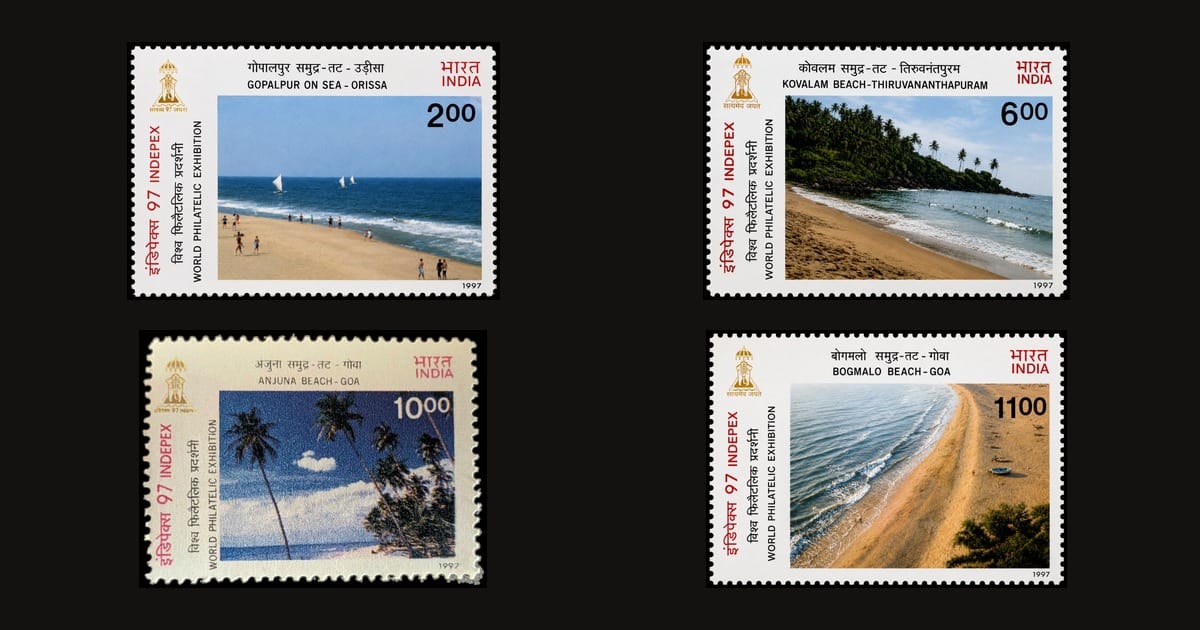
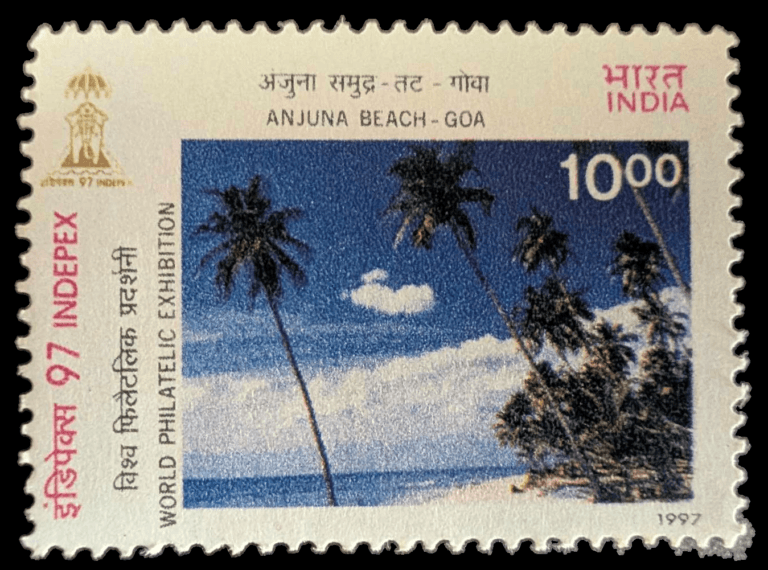
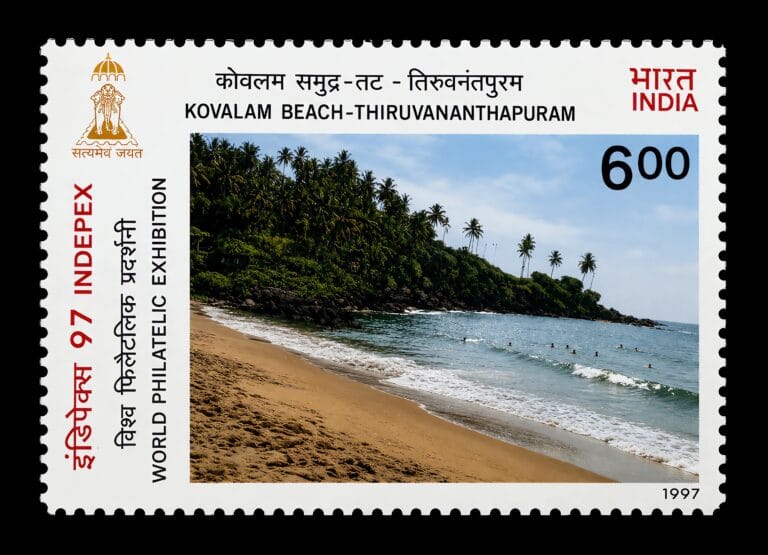
The Beaches of India stamps, issued in August 1997 as the country marked fifty years of independence, form a set of four — Gopalpur-on-Sea in Odisha, Kovalam in Kerala, and Anjuna and Bogmalo, both in Goa. They appeared in the year of INDEPEX ’97, the World Philatelic Exhibition held in New Delhi that December. Read on their own, each stamp tells a specific story about a specific place. Read together, they reveal something none of them says out loud on its own: this set follows the same rule, four times over, about what it leaves out.
| Beach | What the Stamp Shows | What It Leaves Out |
|---|---|---|
| Gopalpur | People and boats on the shore | The working port and rice trade with Burma |
| Kovalam | A quiet tropical headland | The tourism boom already reshaping the coast |
| Anjuna | Palm canopy against sky | The hippie trail and Goa trance history |
| Bogmalo | Golden sand, beached fishing boats | The naval air station just inland |
How the Beaches of India Stamps Were Priced
Start with the numbers. Across the four Beaches of India stamps, Gopalpur got two rupees — the lowest value in the set, and the standard rate for an ordinary inland letter. Kovalam got six. Anjuna got ten. Bogmalo, the highest, got eleven. Denominations like these usually track postal rates rather than any deliberate ranking of importance, so it would be a stretch to read intent into the sequence.
But whether by design or simply as a side effect of postal pricing, the practical result is the same: a two-rupee stamp gets licked, stuck, and mailed, while an eleven-rupee stamp is priced for a collector’s album from the start. Intentional or not, the set ends up creating an unexpected hierarchy — Odisha’s beach priced for everyday use, Goa’s priced out of it.
The geography of the Beaches of India stamps adds a second layer. Two of the four stamps — Anjuna and Bogmalo — represent Goa alone. Kerala gets one. Odisha, whose coastline runs longer than Goa’s but shorter than Kerala’s, also gets one — and the cheapest one at that.
Nothing in the public record explains why these four beaches specifically were chosen over others — tourism figures, photographic availability, and exhibition logistics could all plausibly have played a role, and no single reason can be confirmed here. What can be said is simply that a set built to sample “coastal India” for an international audience ended up representing the smallest of the three states twice over, and the other two only once each.
What the Beaches of India Stamps Leave Out
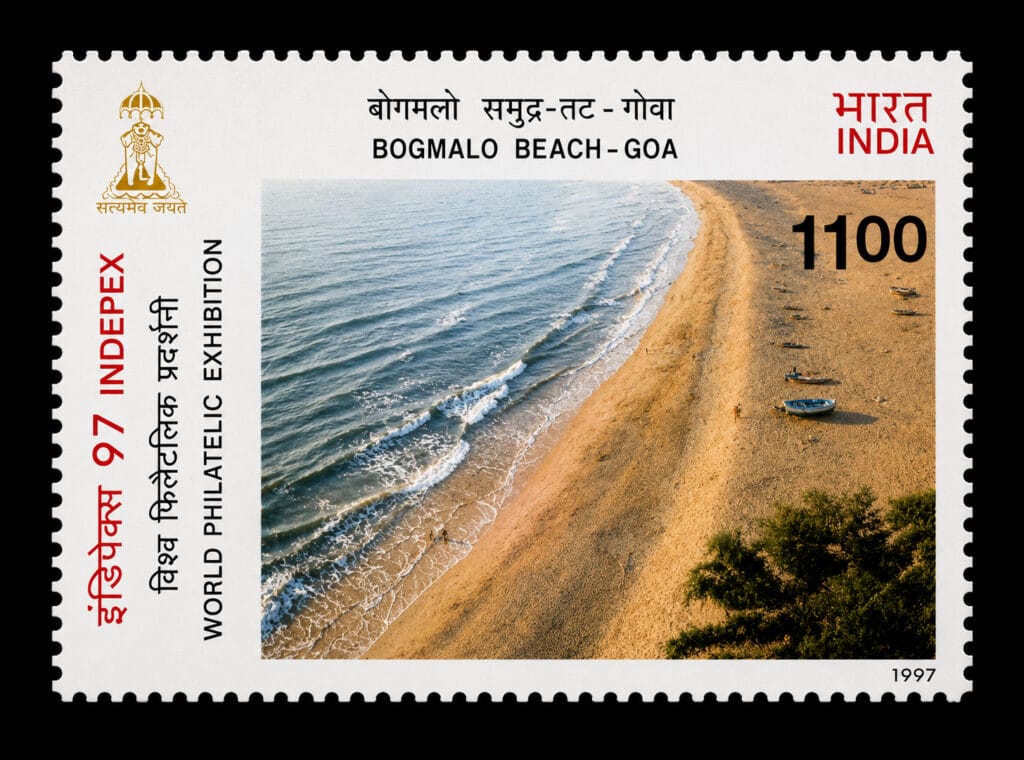
Then there’s what each photograph leaves out. Bogmalo’s aerial shot frames golden sand and beached fishing boats. The composition leaves no hint that India’s largest naval air station, INS Hansa, lies immediately inland. Kovalam’s ground-level image gives you palms, a headland, a handful of swimmers, and nothing of the hotels, guesthouses, and Ayurvedic massage signage that had already reshaped the shoreline by 1997.
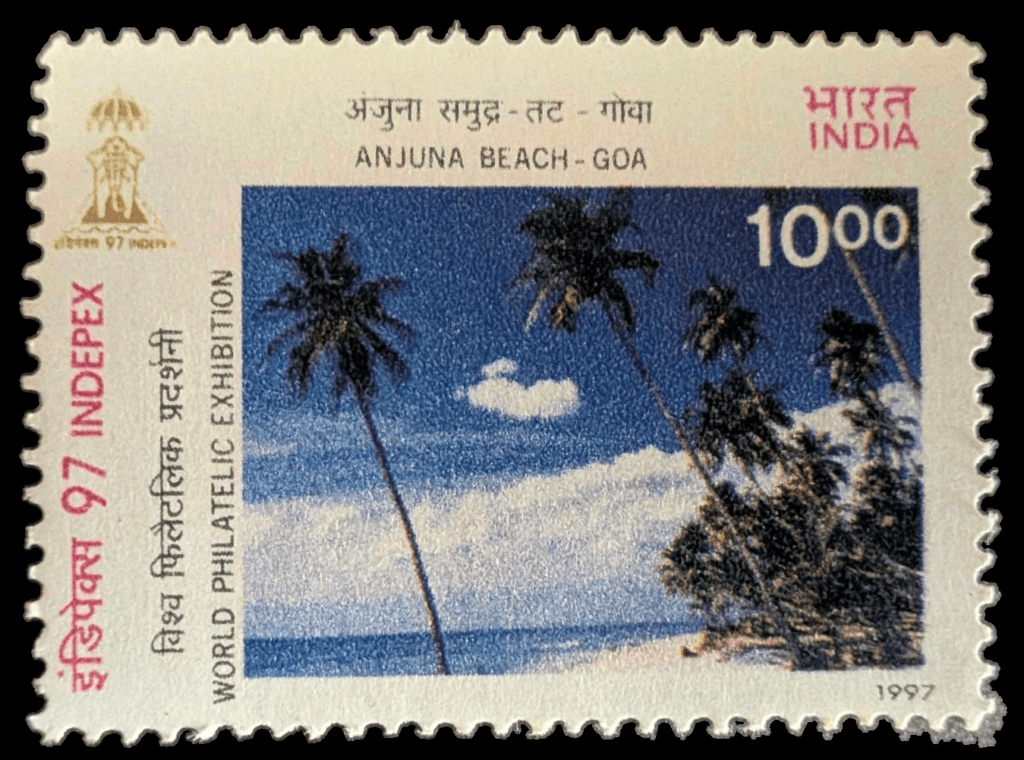
Anjuna’s stamp is the starkest of the four: camera pointed straight up, it shows only palm silhouettes against sky — no sand, no water, no people — with no trace of the beach’s three decades as a terminus of the overland hippie trail, or its role, by the 1990s, in the birth of Goa trance. Only Gopalpur’s stamp breaks the pattern by including people at all, fifteen or twenty figures scattered on the sand — and even there, the photograph says nothing of the working port the beach used to be, the godowns, the rice trade with Burma, the commerce that dried up decades before this stamp existed.
Four different places. Four different omissions. Across the Beaches of India stamps, one recurring pattern holds: the coastline stays, while its context slips beyond the frame.
It would be easy to call this dishonest. It isn’t, quite. A stamp is roughly three centimetres by four — there was never room for a naval base and a hippie trail and a colonial port inside that frame, whatever the photographer was aiming at. But the compositions across the Beaches of India stamps are still compositions, made by someone, at some point, for some reason we can no longer fully reconstruct. The published images could have included Bogmalo’s runway, or Anjuna’s flea market, or Kovalam’s hotels, and none of them do. Four times, across four different states, the published images arrive at the same result: the shoreline stays in frame, and the history sitting just behind it does not.
Fifty years into independence, the four Beaches of India stamps became the version of the country’s coastline that ended up in front of the world — palm, sand, sky, rearranged four times so it wouldn’t repeat itself. Look at any one of these stamps and you see a beach. Look at all four together, and you start to see the editor.
Further Reading & Links
On StampTales
External sources
- India Post — official website — issuing authority for the 1997 Beaches of India stamps
- INS Hansa (Wikipedia) — India’s largest naval air station, adjacent to Bogmalo
- Philatelic Congress of India — co-organizer of the INDEPEX ’97 World Philatelic Exhibition


4 Comments
Comments are closed.