The Quit India Stamp That Was Really the First Page of a Fourteen-Year Plan
The Quit India Resolution stamp 1983 was not issued to remember a vote. It was issued to announce a project — one India Post would not finish for fourteen years.
The Stamp
The Story
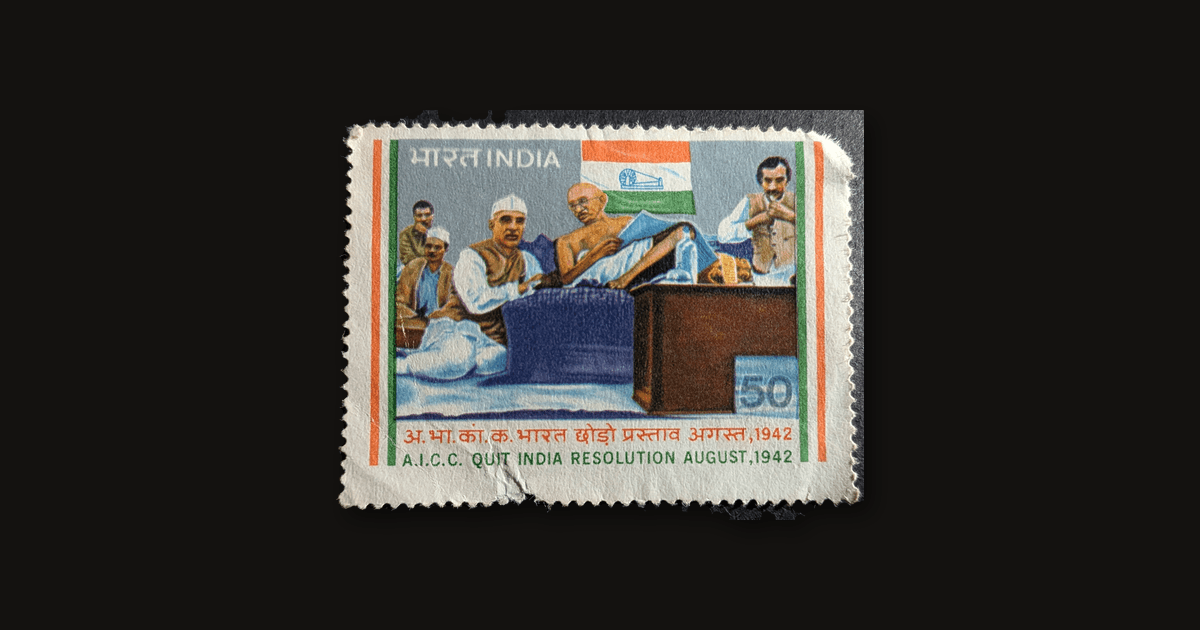
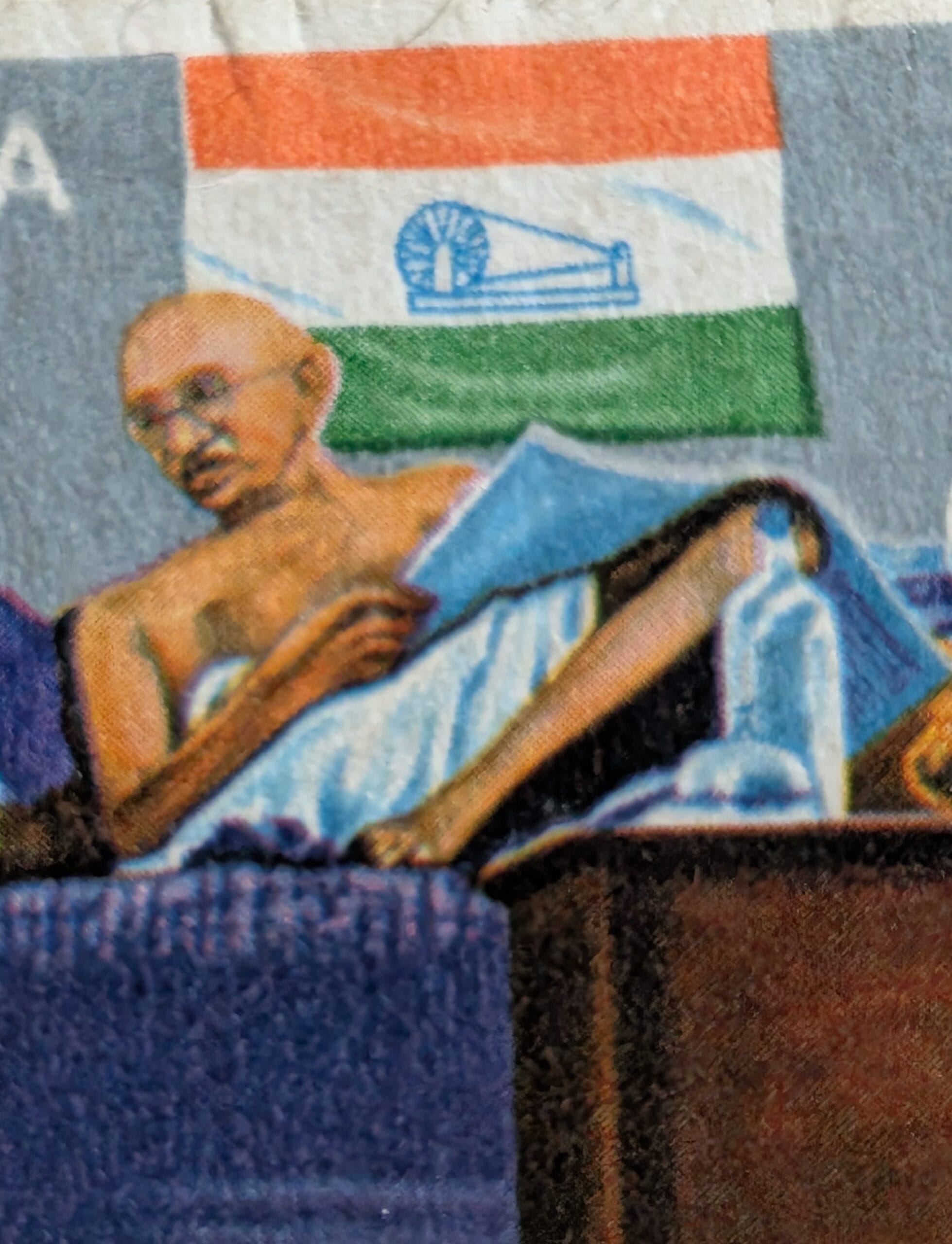
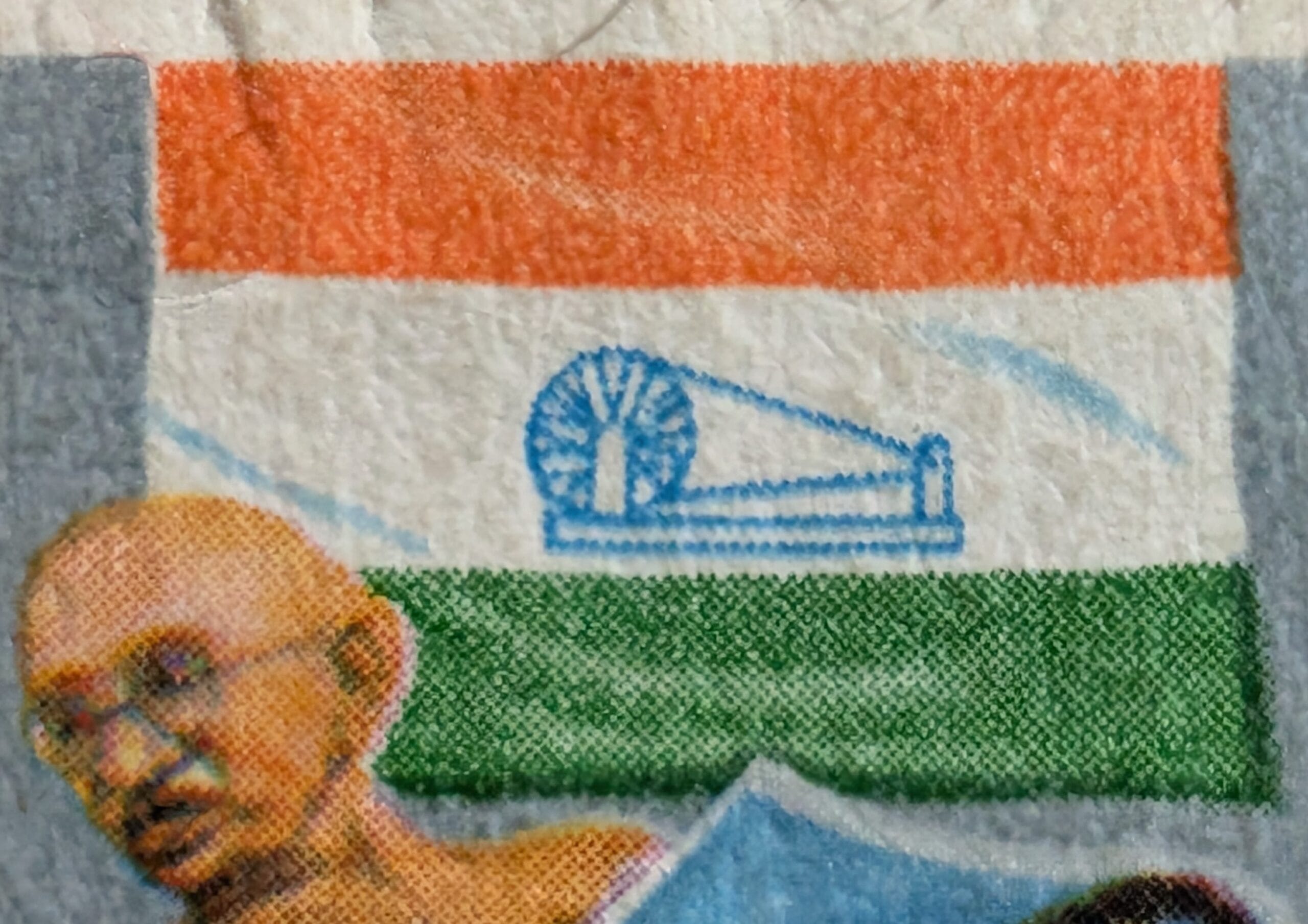
On 9 August 1983, India Post issued a stamp showing seven men in a room. Gandhi reclines against a bolster, one knee up, mid-sentence. Nehru sits beside him in a white cap. Behind them hangs the tricolour with the spinning wheel — the Congress flag, not yet the national one. The caption reads A.I.C.C. Quit India Resolution August, 1942. It is a picture of a committee meeting.
That is the first thing worth noticing about the Quit India Resolution stamp 1983: it commemorates a vote, not a battle. The Quit India movement is remembered for what came after — the arrests, the burned post offices, the tens of thousands jailed by December, the killings whose true toll was never officially counted. None of that is on the stamp. What the stamp shows is the moment before all of it: the All-India Congress Committee, sitting at Gowalia Tank Maidan in Bombay, passing a resolution.
Why India Post Issued the Quit India Resolution Stamp 1983
The stamp was not issued alone, and it was not issued to mark an anniversary. August 1983 was not a round number — it was the 41st year after 1942, an odd figure to commemorate. The reason for the date lies in what the stamp was the first of.
India Post issued it as the opening move of a declared project. The official announcement is unusually candid about its own ambition. India’s freedom stamps so far, it admitted, “do not narrate the complete story” — they had honoured personalities and marked events, but left gaps. So the department proposed to fill them: a series that would issue four to six stamps every year, until 1997, the fiftieth year of independence, “to complete the story of the struggle through stamps.”
Read that again. In 1983, a government postal department committed itself to a fourteen-year publishing schedule whose purpose was to produce an official, illustrated, stamp-by-stamp history of how the nation was born. The Quit India Resolution stamp is chapter one.
What the Department Chose to Start With
Here is where the choice becomes interesting. If you were opening a fourteen-year history of the freedom struggle and could pick any three images to begin, what would you choose? The obvious answers are monuments and martyrs — the flag-hoisting that got seven students shot in Patna, the mass processions, the lathi charges.
India Post chose none of those. The first issue was a set of three stamps: the Quit India Resolution, Mahadev Desai, and Meera Behn. One political event and two people — and the two people are not front-rank leaders. Mahadev Desai was Gandhi’s personal secretary, sometimes called his Boswell; he died on 15 August 1942, six days after the Resolution, in detention at the Aga Khan Palace. Meera Behn was Madeleine Slade, the daughter of a British admiral, who read a book about Gandhi in one sitting, sailed to India, and stayed.
So the series that promised to tell the complete story of a mass movement opened with a single AICC session flanked by two of the people closest to Gandhi personally — his secretary and his English disciple. Before the crowds, the intimates. It is a revealing first instinct: the Quit India Resolution stamp 1983, and the set it belongs to, begins the state’s official history of a people’s revolt inside Gandhi’s immediate circle.
The Word on the Stamp
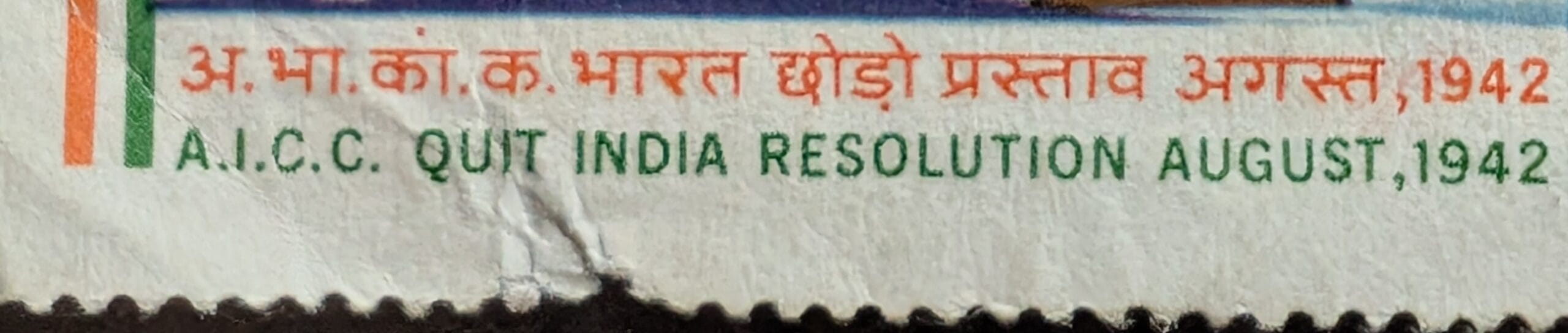
The stamp carries its caption twice, in two scripts: Hindi above, English below, orange lettering over green. The English reads A.I.C.C. Quit India Resolution August, 1942. Both lines name the same event, and both are printed by a government department four decades after it happened.
The tricolour behind Gandhi is worth a second look, too. Most readers will take it for the Indian flag; it isn’t. It is the Congress banner of 1942, spinning wheel at the centre where the Ashoka wheel would later go. The designer needed no date-stamp on the scene — the flag does that work quietly, fixing the moment as pre-independence, a party’s emblem years before the party became the state that would one day print it.
Looking Closer at the Quit India Resolution Stamp 1983
The composition of the Quit India Resolution stamp 1983 is built around a reclining man who is also the most upright thing in the frame. Gandhi is physically lower than everyone — propped on a bolster, legs extended — yet the eye goes to him first, because every other figure is angled toward him and because the tricolour rises directly behind his head like a backdrop arranged for one person. Pakarashi has staged a committee so that it reads as a portrait.
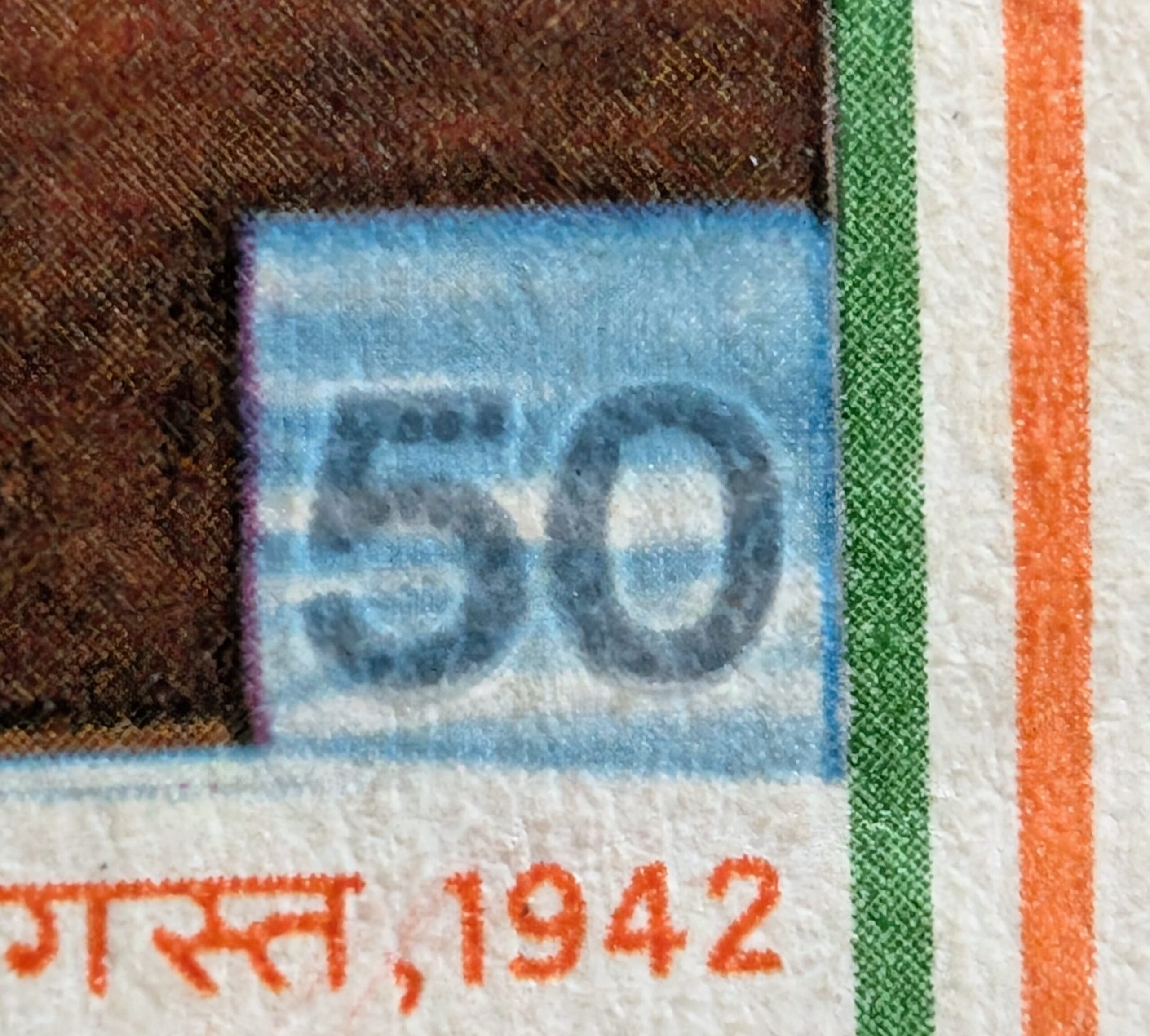
The denomination sits in the lower right in pale blue, tucked against the desk — deliberately unemphatic. Compare that to the caption band running full width along the bottom in two scripts, orange above green. The design spends its contrast budget on the words, not the value — a stamp that wants to be read, not spent.
The colour choice is worth dwelling on. The palette is muted — greys, dull blues, ochre skin tones — against which the flag and the two caption lines are the only saturated elements. The effect is documentary, almost sepia, as though the scene were being remembered rather than witnessed. For the first stamp in a history series, that restraint is a choice: it looks like an archive, not a celebration.
What the design cannot fix is the crowding. Seven figures in a horizontal frame means most of them are heads and shoulders stacked at the edges, and the two men at the far right and far left are barely more than faces. The Resolution was passed by a committee of hundreds; the stamp fits seven, and even seven is a squeeze. The image strains against the format — which may be the truest thing about it, a mass movement compressed into four by three centimetres.
Closing
India Post kept its promise, more or less. The stamps came, year after year, through the 1980s and into the 1990s, until the fiftieth anniversary in 1997. But the project’s first breath — the Quit India Resolution stamp 1983 — is the most honest thing about it: a department looking at its own back catalogue, deciding the story so far was incomplete, and setting out to finish it on purpose. Every official history is an argument about what deserves to be remembered. This one just happened to print its argument on gummed paper, two million copies, and let you stick it to an envelope. The vote came first. So did the stamp.
Further Reading & Links
On StampTales
- The Gandhi 1994 stamp — the man himself, three ways, on a single issue
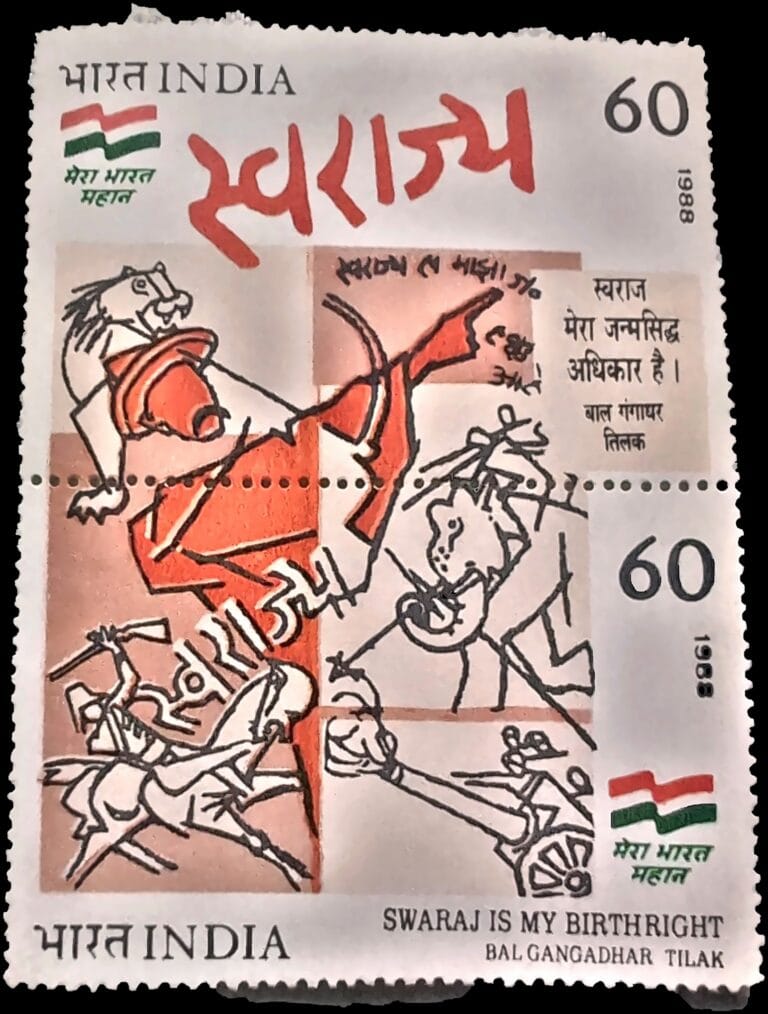
- The Tilak Swaraj stamp 1988 — an earlier freedom-struggle commemorative and how India Post framed a firebrand
- The Fleet Review 1984 stamp — the state at maximum ceremony, issued six months later
External sources
- Quit India Movement (Wikipedia) — the 1942 movement and the AICC resolution
- Mahadev Desai (Wikipedia) — Gandhi’s secretary, the second stamp in the set
- 1942 in India (Wikipedia) — timeline of the Resolution, arrests, and aftermath
One Comment
Comments are closed.