The Regiment That Kept Its Horses
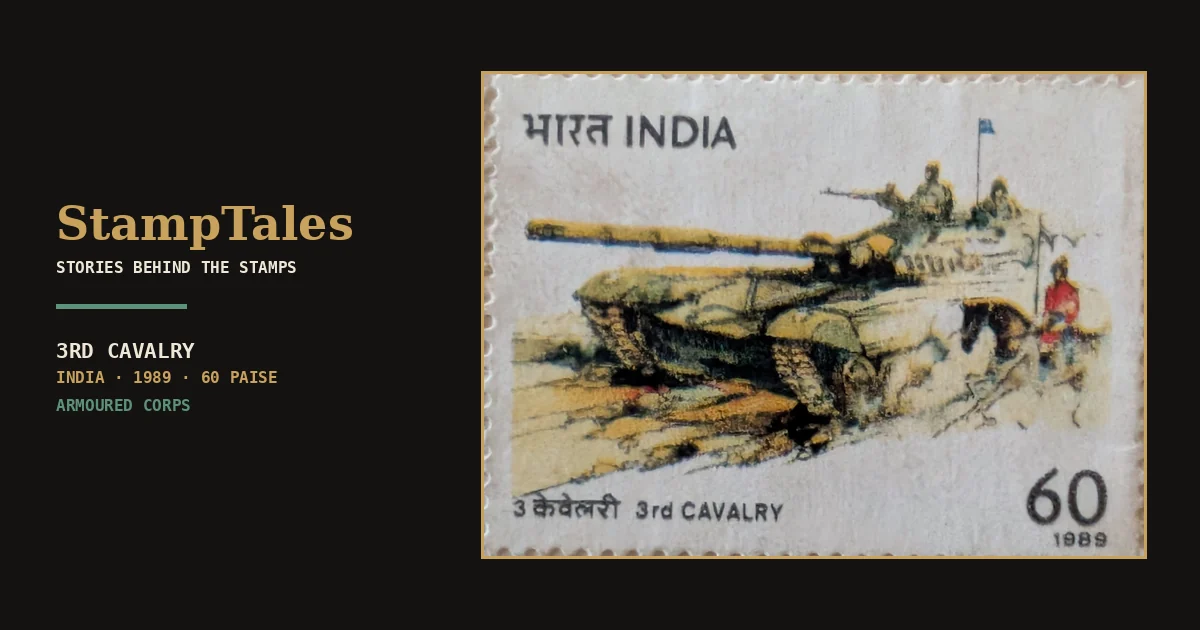
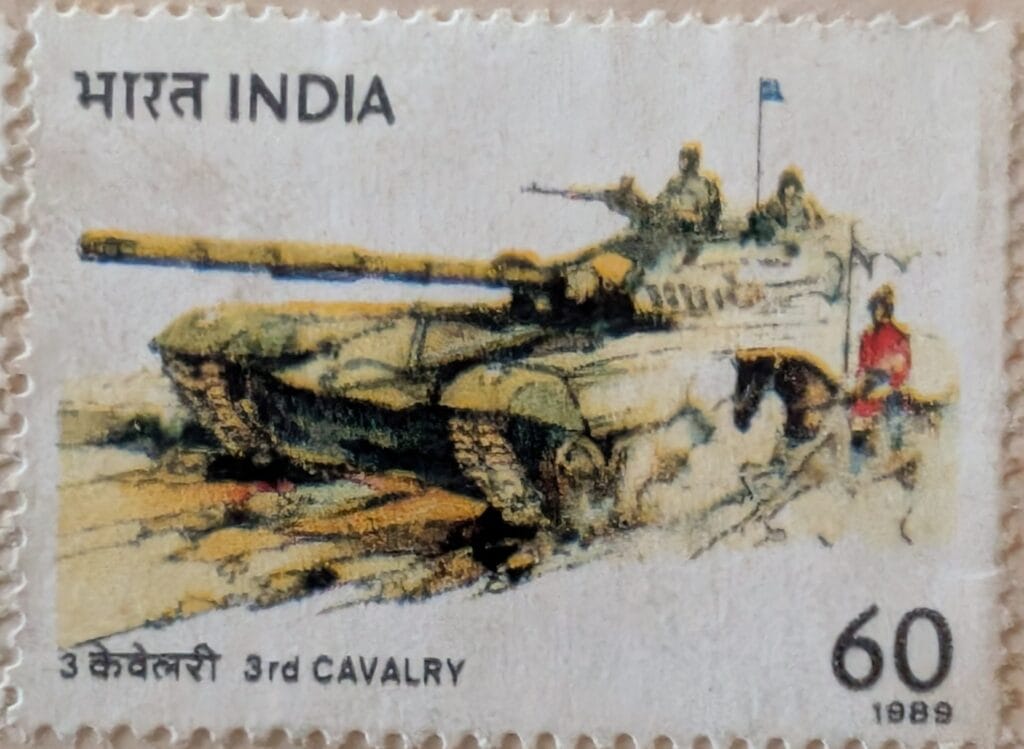
Look at the right edge of this 3rd Cavalry stamp, past the tank, and you will find a horse.
It is not charging. Nobody is riding it. A figure in cavalry red holds it by the head while it stands in the dust behind a main battle tank that fills two-thirds of the frame. India Post issued this 60 paise stamp on 8 February 1989 to honour the 3rd Cavalry, one of the Indian Army’s armoured regiments, and the designer made a choice that most military stamps avoid. The machine is the subject. The horse is the point.
The Stamp
| Subject | 3rd Cavalry, Indian Army Armoured Corps |
|---|---|
| Country | India — Department of Posts |
| Issued | 8 February 1989 |
| Denomination | 60 paise |
| Category | Defence |
| Format | Single commemorative |
| Condition of this copy | Postally used — lightly toned paper, perforations intact on all sides |
The 3rd Cavalry is older than the machine it drives
The 3rd Cavalry does not date from the age of tanks. It was assembled in 1922 from two much older regiments — the 7th Irregular Cavalry, raised at Bareilly in 1841 out of the wreckage of the First Afghan War, and a second irregular cavalry regiment raised at Sultanpur in 1846. By the turn of the century these had become the 5th Cavalry and the 8th Lancers, and by then they had a century of mounted service and a shelf of frontier battle honours behind them. What matters for this stamp is the starting point: the regiment began as men on horses, and stayed that way for a hundred years.
That name is worth pausing on. On the stamp it appears twice: once in English as “3rd CAVALRY,” and once in Devanagari as “केवेलरी” — kevelri.
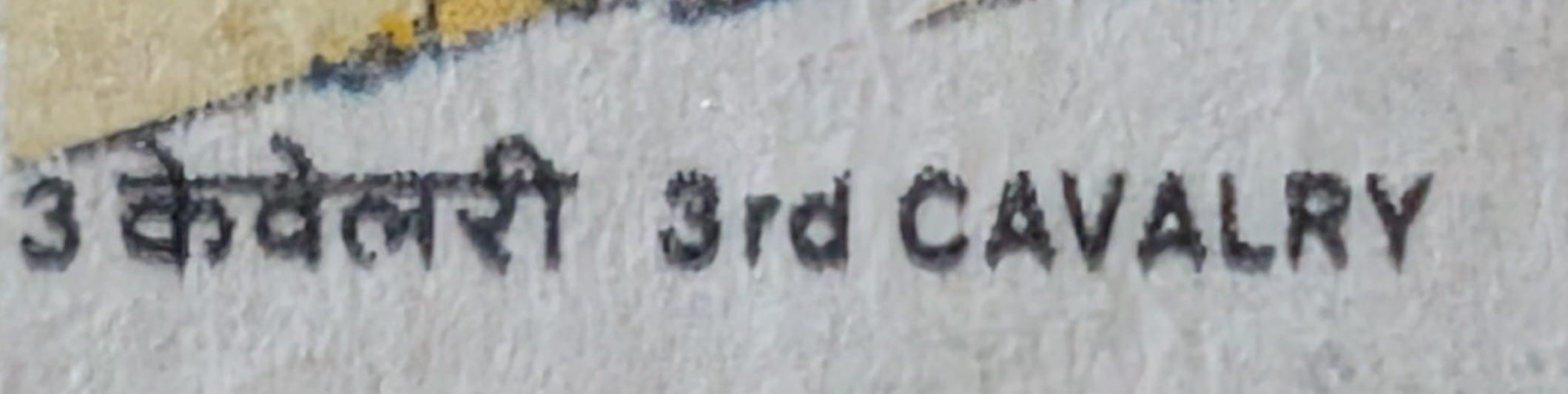
Read the Devanagari aloud and it does not resolve into a Hindi word. It is the English “cavalry,” spelled out phonetically in an Indian script. The regiment’s identity had no indigenous translation to fall back on, because the thing it named — a mounted arm organised on the British model — arrived with the people who named it. The lettering on a stamp meant to celebrate an Indian regiment quietly records that the regiment’s own name is a loan.
What the 3rd Cavalry did when the horses went
The interesting part of the regiment’s history is not that it existed, but that it was among the first to be told its horses were finished.
Across the 1930s and 1940s the world’s mounted arms were mechanised, often against fierce internal resistance — regiments that had defined themselves by the horse for a century did not surrender it gladly. The 3rd Cavalry made the turn early and completely. In 1946 it converted to an airborne reconnaissance role, the first armoured regiment of the Indian Army to be so designated. It was a strange and forward-looking assignment: a cavalry regiment reimagined not as heavy shock troops but as fast, light eyes for an airborne force.
The logic behind that role was the logic that had always defined cavalry. A reconnaissance unit exists to move faster than the main body, to find the enemy, to report, and to get clear — not to stand and slug. For a century the horse had been the tool for exactly that: mobility, reach, the ability to see over the next ridge before the infantry arrived. The aircraft and the light tank did the old job with new machinery.
The timing put it straight into the making of the new republic. In 1948, during Operation Polo, the regiment was part of the force that ended the standoff over Hyderabad and brought the princely state into the Indian Union. A few years later, in the 1950s, the 3rd Cavalry became the first Indian armoured regiment to be re-equipped with Centurion tanks — again first, again at the front of the machine’s arrival.
This is the pattern the stamp is built on. The regiment’s distinction is not a single famous charge but a repeated willingness to be first onto the next machine.
Reading the design
The composition is organised around a single long diagonal: the tank’s gun barrel, laid almost flat across the upper third of the stamp, pointing off the left edge.
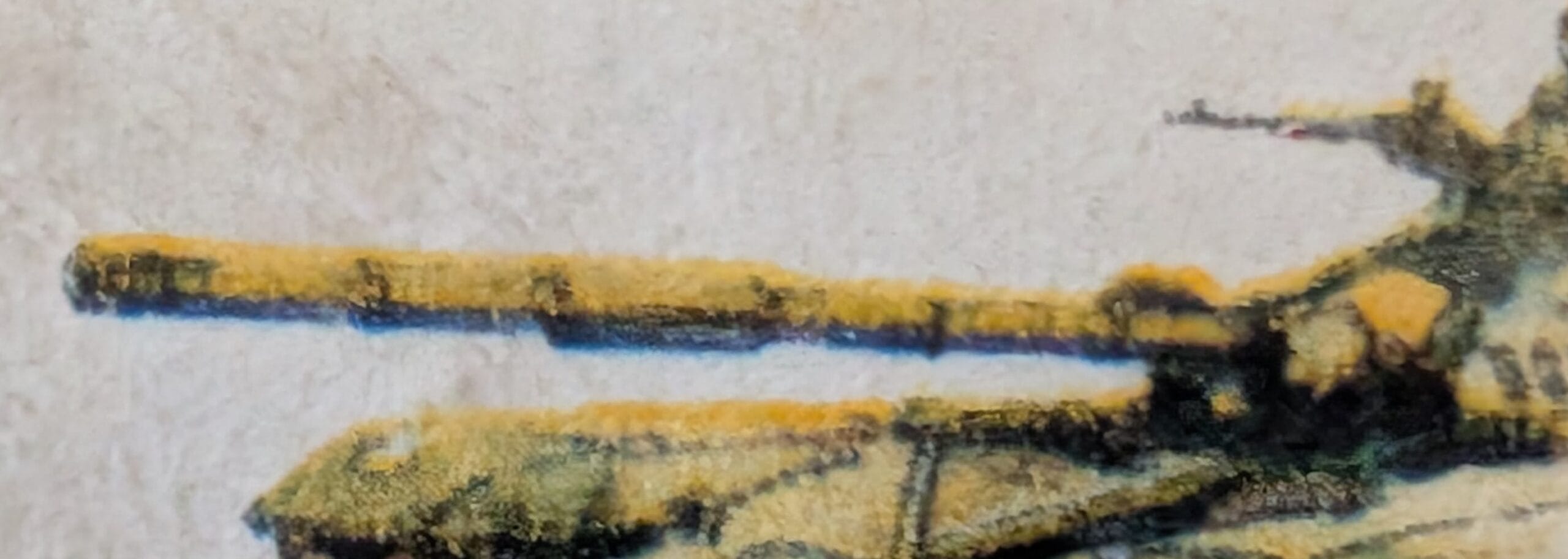
Below the barrel runs a thin, bright horizon line — a sliver of blue and white that gives the scene its only sense of distance. Above the barrel is empty paper, the pale sky the artist left alone. Below is armour: the low hull, the tracks, and two crewmen riding exposed in the cupola under a small regimental pennant. They are painted as loosely as the rest — a few strokes for a helmet, a gloved hand on a machine gun. Not heroic figures. Men doing a job on top of a large machine, and the looseness is deliberate: a working portrait, not a recruiting poster.
And then, to the right, the horse.
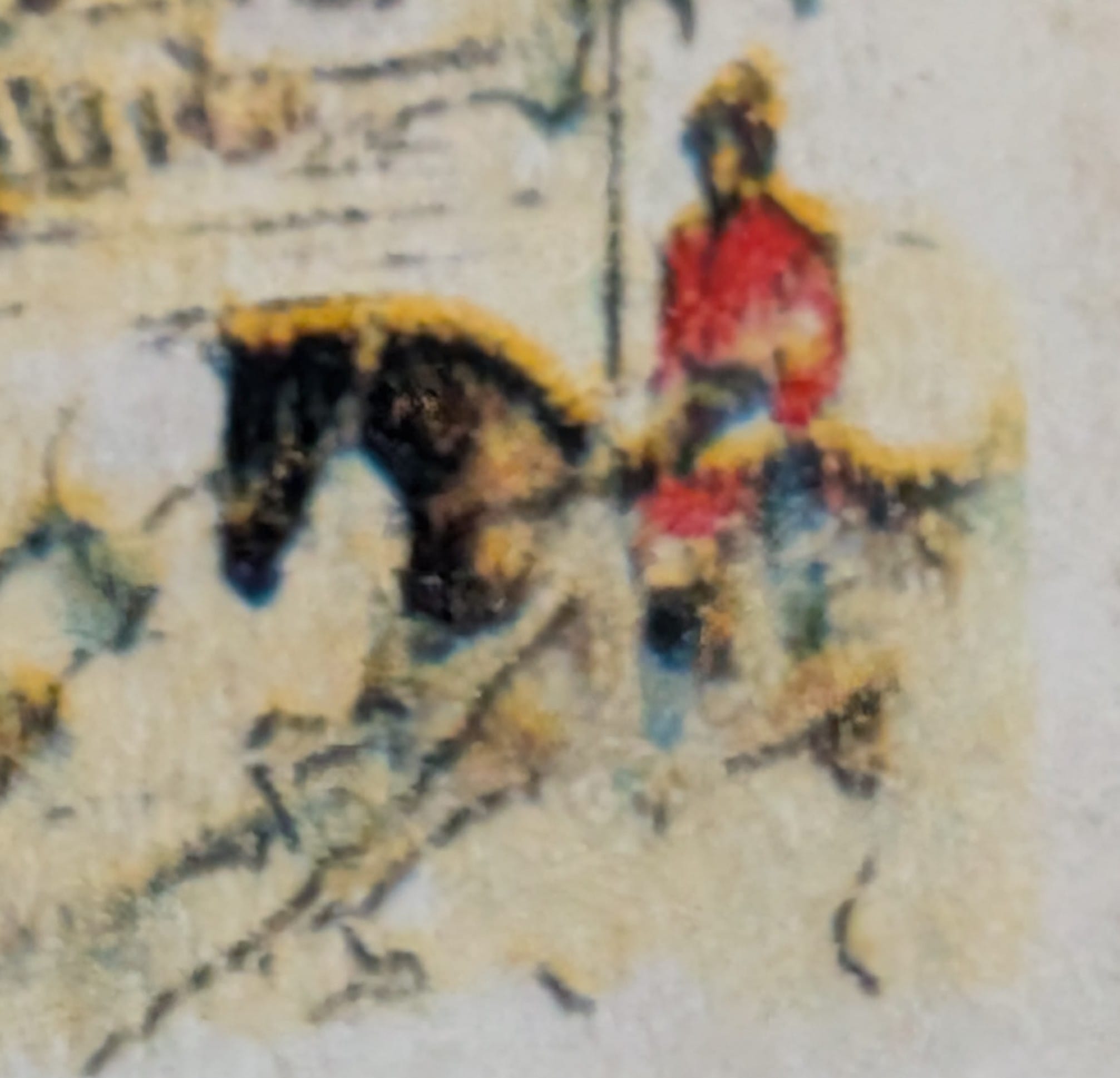
Placed where the eye travels last, it does the quiet work of the entire design. A regiment that has just been drawn as thoroughly modern — airborne, tracked, gunned — is shown standing next to the animal it is named for, held in the traditional red of ceremonial cavalry dress. The tank is what the regiment fights with. The horse is what it remembers being. The designer did not have to include it; a tank alone would have honoured the unit perfectly well. Putting the horse in the same frame turns a portrait into an argument about continuity — that a regiment can shed its weapon three times over and still hold on to the idea of itself.
This Copy
The stamp is a used 60 paise example on lightly toned paper, the perforations intact on all sides. It belongs to the same 1989 commemorative programme as India Post’s 75 Years of Indian Cinema issue, a very different subject printed the same year in the same soft photogravure. The printing shows the mild, slightly out-of-register colour typical of that era’s commemoratives, which suits the loose painterly style of the original artwork more than a crisp modern print would.
The horse it keeps is the whole story: a fighting arm that has changed everything about how it fights, and nothing about what it calls itself.
Further Reading & Links
- Our piece on the 9 Parachute Field Regiment — another Indian regiment defined by the leap to a new kind of warfare.
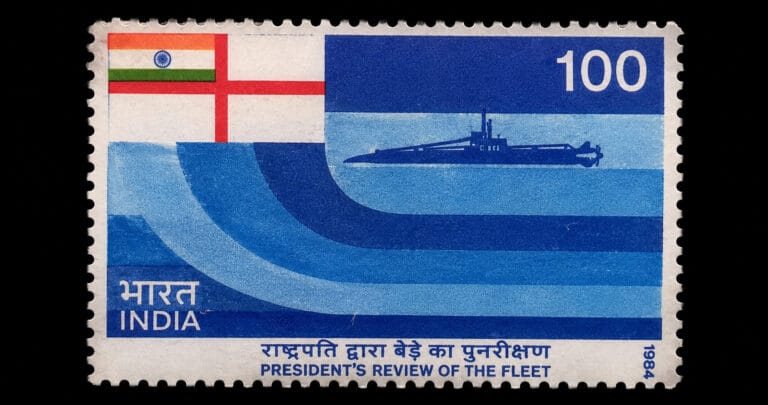
- Our article on the President’s Fleet Review 1984 stamp — the Navy putting its own self-image on a commemorative, a decade before this one.
- Indian Army Armoured Corps — how India’s cavalry regiments became an armoured corps, and why the old names survive.