The stamp that put a kingdom’s stamp inside its own
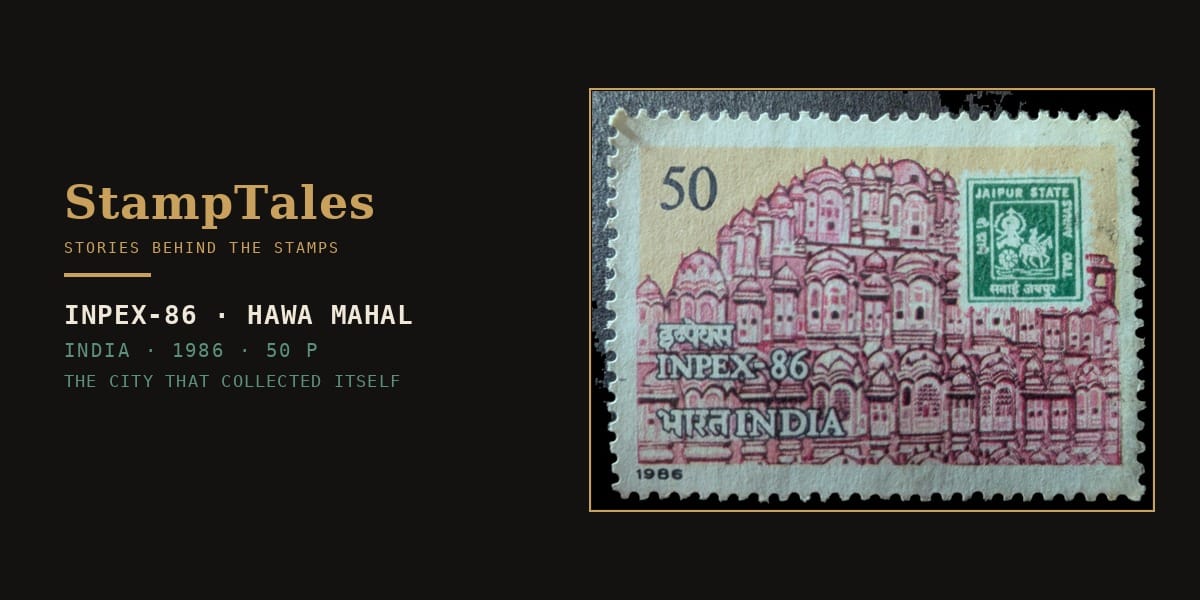
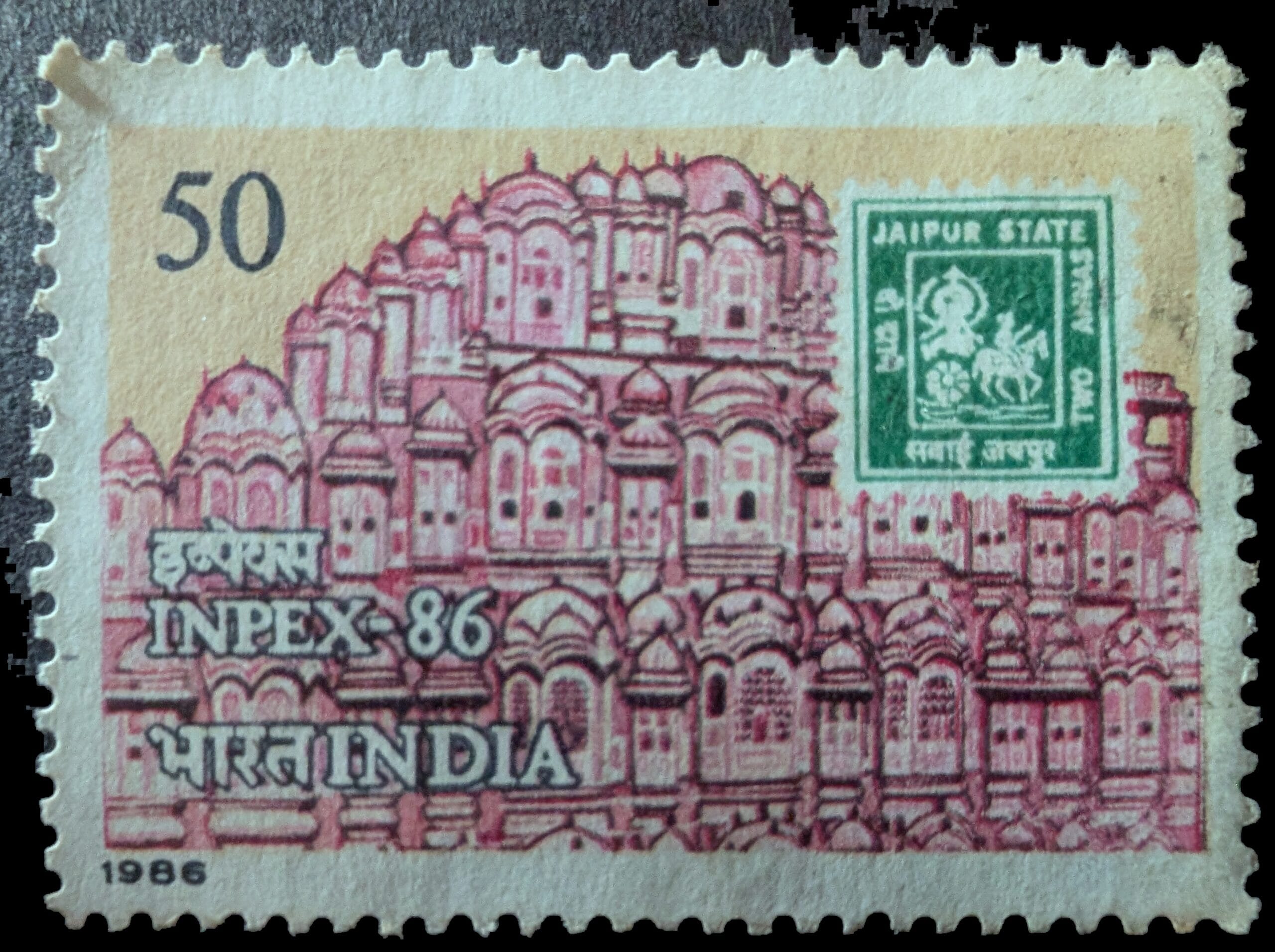
A postage stamp usually looks outward — at a leader, a monument, an idea the state wants you to hold. This one from 1986 looks at a stamp. Tucked into a corner of India Post’s issue for INPEX-86, its fifth national philatelic exhibition, sits a second, older stamp, printed in green: a Jaipur State “Two Annas,” from the years when Jaipur was not a city in the Republic but a kingdom that ran its own post.
The exhibition was called INPEX-86, and it was held in Jaipur. That single fact decides everything on the stamp. India Post did not reach for a neutral emblem of philately — a magnifying glass, a perforation gauge, a globe. It gave the show the face of its host city, and then, in the corner, the city’s own postal past. The stamp is a portrait of Jaipur told entirely through paper.
| Issue | INPEX-86 (Fifth India National Philatelic Exhibition) — Hawa Mahal |
|---|---|
| Issued | 14 February 1986 |
| Denomination | 50 paise |
| Country | India |
| Depicts | Hawa Mahal, Jaipur, with a Jaipur State stamp inset |
| Exhibition | Held at Jaipur, 14–19 February 1986 |
| Catalogue | SG 1182 |
A stamp show comes to Jaipur
By 1986 the India National Philatelic Exhibition — INPEX — was an established fixture, a moving national gathering that had run since the 1970s. The fifth edition opened in Jaipur on 14 February and ran six days. Holding it there was its own kind of statement. Jaipur is a philatelist’s city: before it merged into independent India, the princely state of Jaipur issued its own postage, and those issues are among the more collectable relics of pre-Republic India. To bring the national stamp show to Jaipur was to bring it to a place with a postal history of its own.
India Post marked the occasion with a small set — one stamp carrying the Hawa Mahal, another depicting the state’s old Camel Post — and it is the Hawa Mahal issue that does the more interesting thing. It does not simply illustrate a building. It layers two eras of the same place, and lets the reader notice the seam.
The building that stands in for the city
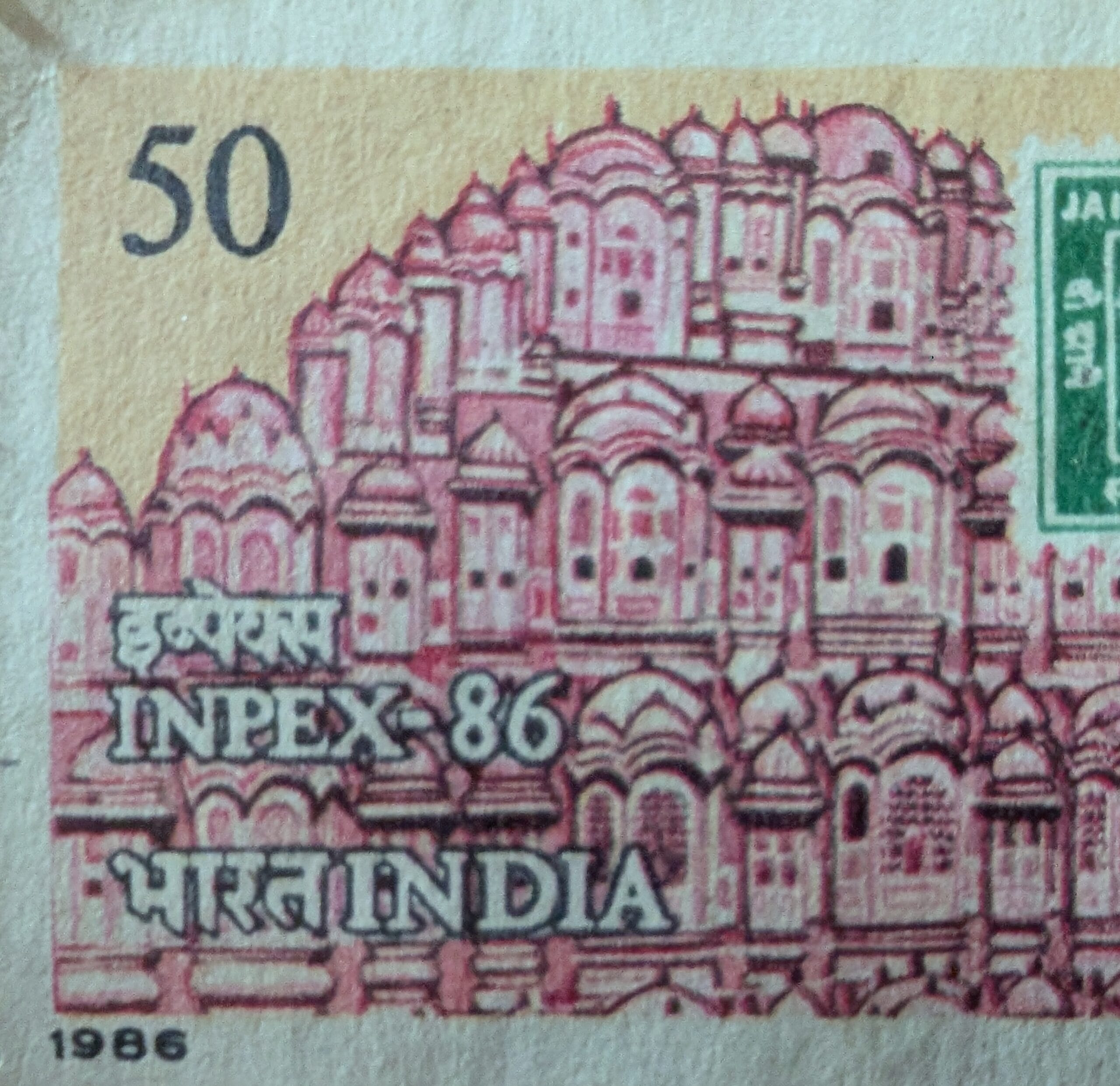
The red mass filling most of the stamp is the Hawa Mahal — the Palace of Winds — built in 1799 by Maharaja Sawai Pratap Singh. It is the single most recognisable thing in Jaipur: a five-storey screen wall pierced by hundreds of small windows, a honeycomb of stone raised so the women of the royal household could watch the street below without being seen. On the stamp it is rendered as a wall of arches and jharokhas, flattened almost to pattern, the individual windows dissolving into rhythm.
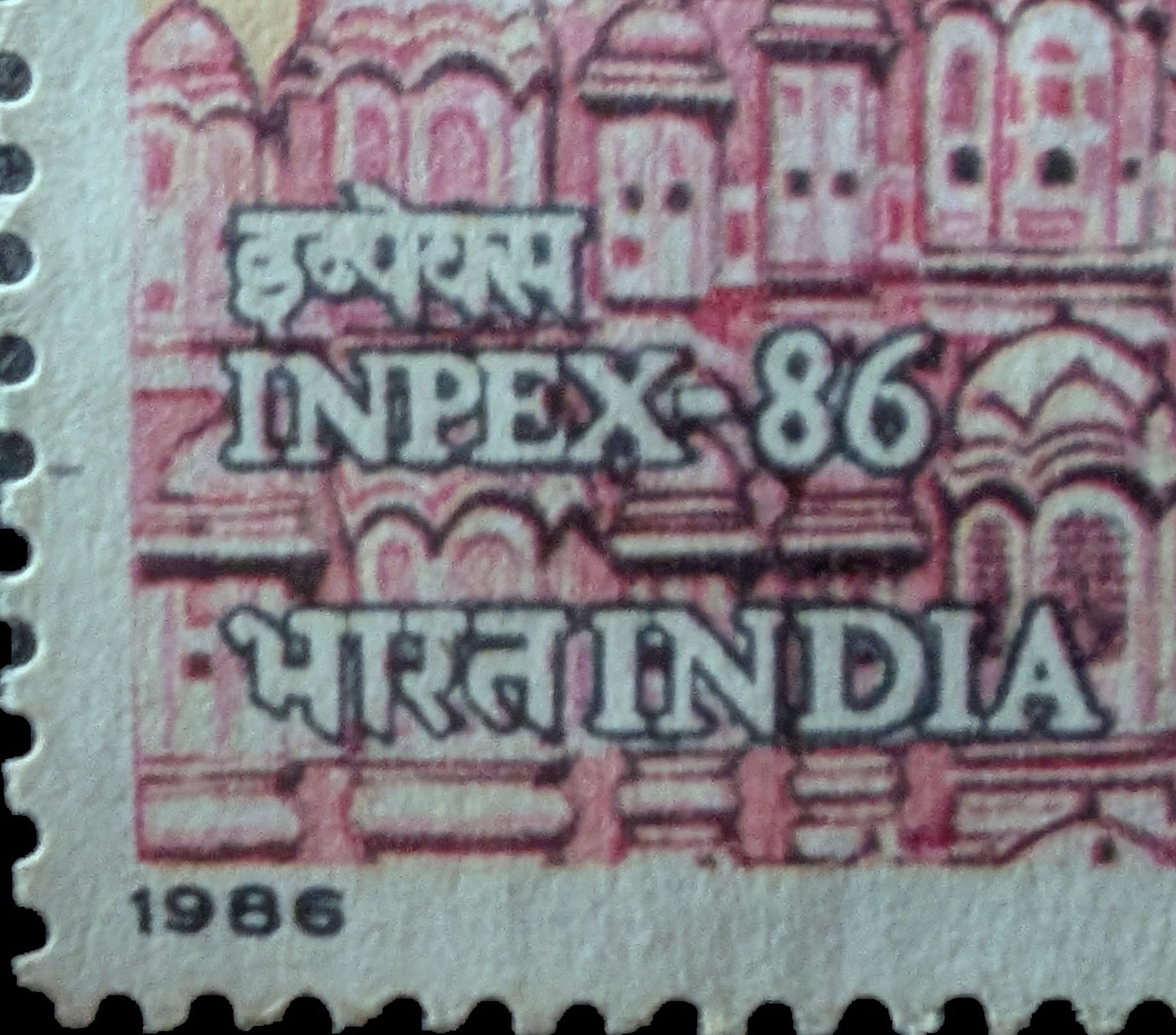
Using it as shorthand for Jaipur is an obvious choice, and the design leans into it rather than fighting it. The palace is not framed as an object to be admired from a distance; it is pushed right up to the edges, cropped, made into a texture. The name of the exhibition — इनपेक्स, INPEX-86, भारत INDIA — is set into the lower left, lettered straight across the arches like a banner hung on the building itself. The stamp is not saying here is a famous palace. It is saying here is where we are.
The stamp inside the stamp
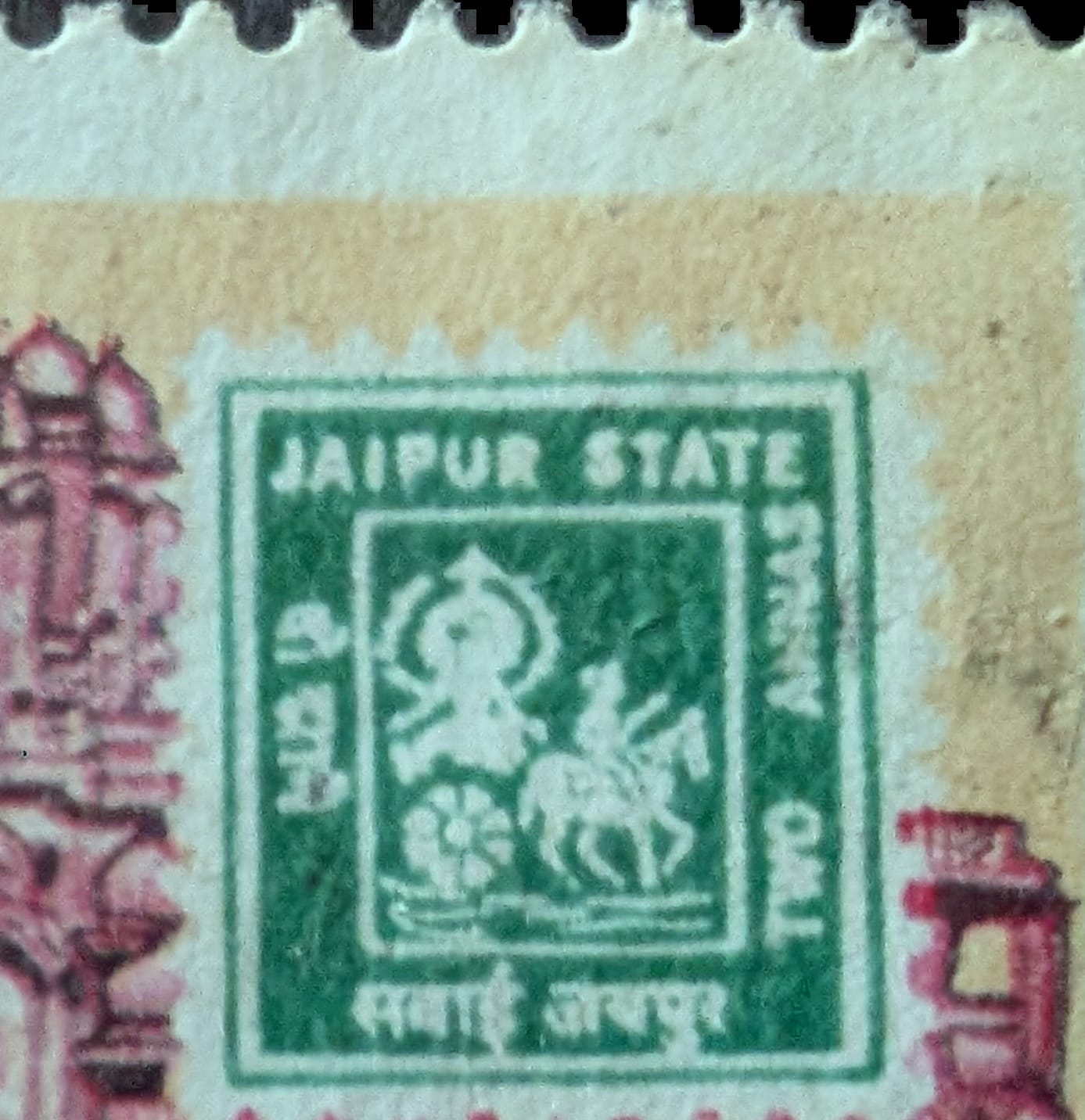
Then there is the green square in the corner, and it changes the whole reading. It is a reproduction of a Jaipur State stamp — “JAIPUR STATE,” “TWO ANNAS,” lettered around a small central device. That device is the Surya Ratha, the Chariot of the Sun: a horse-drawn chariot before a radiant solar disc. It was the design used on Jaipur’s stamps from 1904 onward, when the state first issued its own stamps under Maharaja Sawai Madho Singh II.
The Sun’s Chariot was more than decoration. The rulers of Jaipur were Kachwaha Rajputs, who traced their line to the sun — Suryavanshi, of the solar dynasty. Putting the Sun’s Chariot on the state’s stamps gave that dynastic symbolism a place in the ordinary machinery of the post. Every envelope leaving Jaipur carried the emblem with it.
That is what makes the 1986 stamp quietly strange. By 1986 Jaipur was no longer a princely state with a postal system of its own; yet the Republic’s exhibition stamp reproduced one of its old stamps inside the new issue. On the 1986 stamp the Sun’s Chariot no longer functions as an emblem of sovereignty. It appears instead as heritage — an old piece of Jaipur’s postal history preserved inside a modern Indian issue. The kingdom’s assertion of solar descent has become a philatelic curiosity: a beautiful old thing worth showing at an exhibition.
What a stamp-on-a-stamp is for
The device has a name among collectors — “stamp on stamp,” a stamp that depicts another stamp — and it is a natural fit for a philatelic exhibition, where the subject is stamps themselves. Stamp-on-stamp issues often reproduce a famous rarity, a national first or an earlier issue as a point of philatelic pride. This one does something more specific. It reaches past the Republic’s own issues to a stamp from before the Republic existed, from a state the Republic dissolved.
Read the two halves of the design together and the logic closes. The Hawa Mahal is what Jaipur built when it was a kingdom; the Two Annas is what Jaipur posted when it was a kingdom. Both now belong to a city inside India, and to a hobby that preserves such things. The stamp is not mourning the kingdom and not celebrating its end. It is doing what philately does — keeping the old paper, and finding it interesting.
There is a small irony in the frame that is worth sitting with. The one object on this stamp that was itself designed to project sovereignty — the Sun’s Chariot, the dynasty’s claim to the heavens — is the smallest thing on it, reduced to a green thumbnail in the corner, surrounded by the postage of the nation that outlasted it. The sun that the Kachwahas rode across their own envelopes has set into someone else’s stamp. And that, precisely, is where it has been kept safe.
Further Reading & Links
- Our piece on the Charminar stamp of 1990 — another Indian city reduced to its most famous building on a stamp, and the same trick of a monument standing in for a place.
- Our piece on the Sanchi Stupa definitive of 1994 — more of India picturing itself through its monuments rather than its rulers.
- Hawa Mahal (Wikipedia) — the 1799 Palace of Winds that fills the stamp, its builder and its honeycomb façade.
- Jaipur — princely-state postage stamps, 1904–1947 (StampWorld) — the state’s own issues, including the 1904 Surya Ratha “Sun’s Chariot” design reproduced in the corner.
- List of philatelic exhibitions (Wikipedia) — where INPEX sits in the run of Indian national and world stamp shows.