The stamp that drew a map instead of a flag
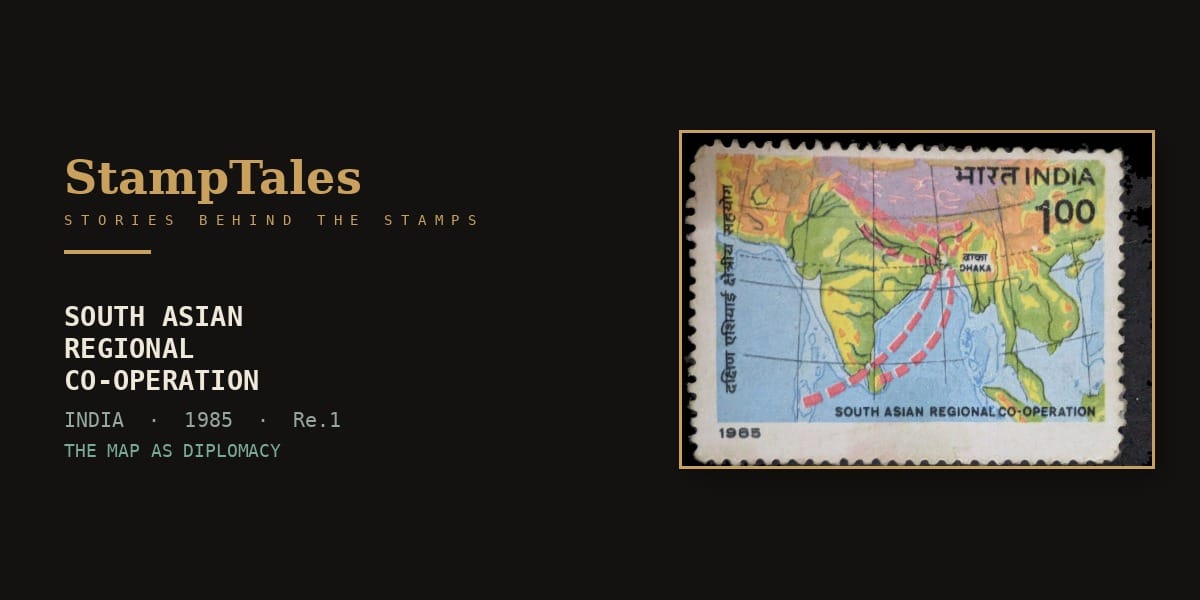
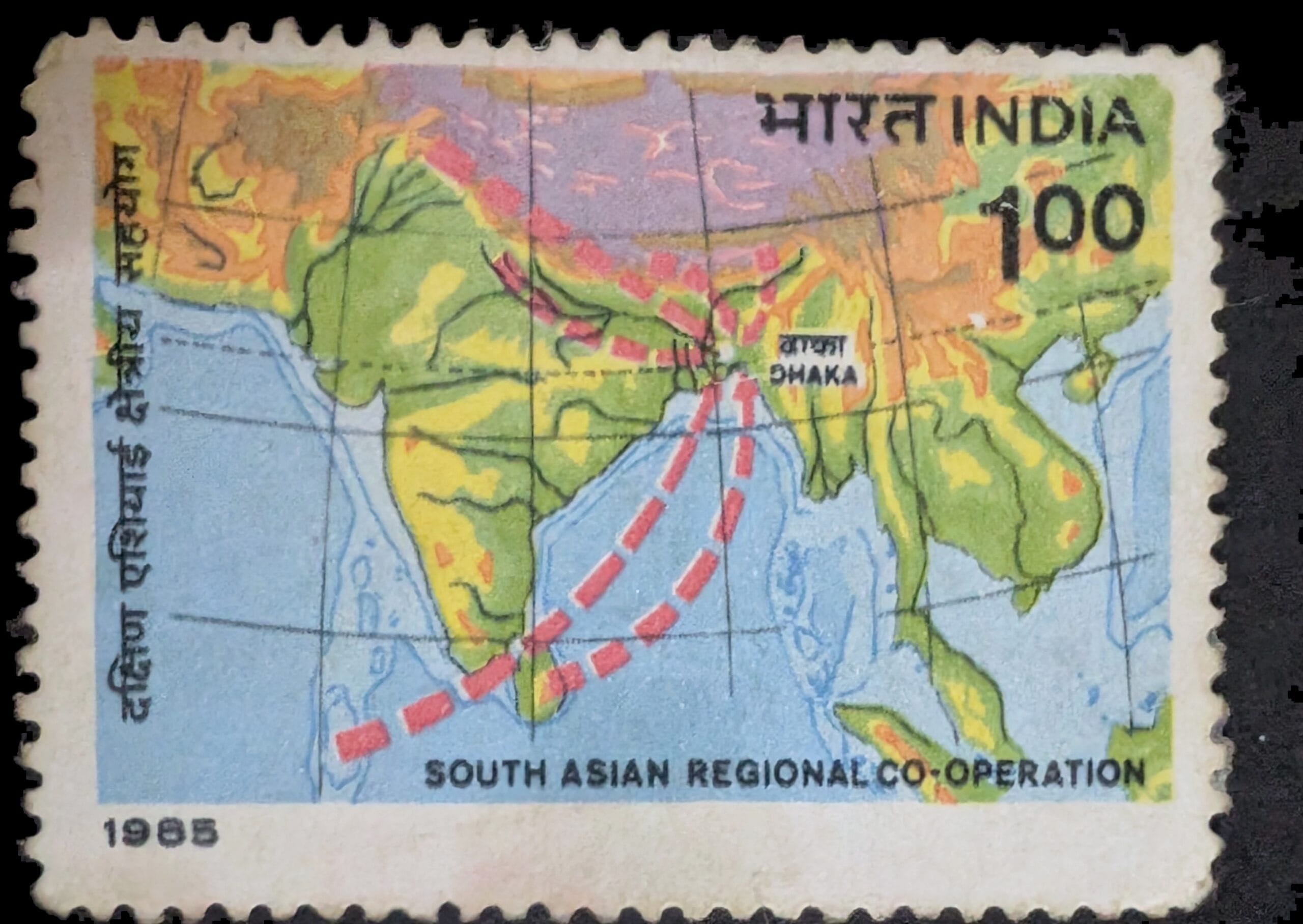
Most stamps that mark a diplomatic occasion reach for the obvious furniture of statecraft: a row of flags, a handshake, a conference emblem, a dove. India’s 1985 stamp for South Asian Regional Co-operation did something stranger and more interesting. It printed a physical-relief map of the subcontinent — the greens of the plains, the ochre of the highlands, the blue of the Bay of Bengal — and let the geography make the argument. There is not a single flag on it.
That is a deliberate answer to a hard question. The seven countries meeting at Dhaka in December 1985 — Bangladesh, Bhutan, India, the Maldives, Nepal, Pakistan and Sri Lanka — did not agree on much. Two of them had gone to war three times. A stamp built from flags would have had to line up those quarrels side by side and pretend they were friends. A stamp built from terrain sidesteps the whole problem: it shows the one thing the seven genuinely share — a place, with mountains, plains, coastlines and sea connecting them into a single region.
This was the second of a set of two India issued for the occasion. The other stamp took the conventional route — the emblem, the ceremonial framing of a summit. This one, the map, is the more revealing of the pair, because it had to decide how to draw a region whose members were still deciding whether they trusted each other.
| Issue | South Asian Regional Co-operation |
|---|---|
| Issued | 1985, for the first SAARC summit, Dhaka |
| Denomination | Re.1 (100 paise) |
| Country | India |
| Design | Relief map of South Asia; dashed routes converging on Dhaka |
| Issued as | One of a set of two |
Every road leads to Dhaka
Look closely and the map is not neutral. Dashed red routes cross the map and converge on one point in the Bengal delta: Dhaka, labelled in Bengali script and in Latin capitals. Convergence is the fact — every line in the picture is heading for the same place.
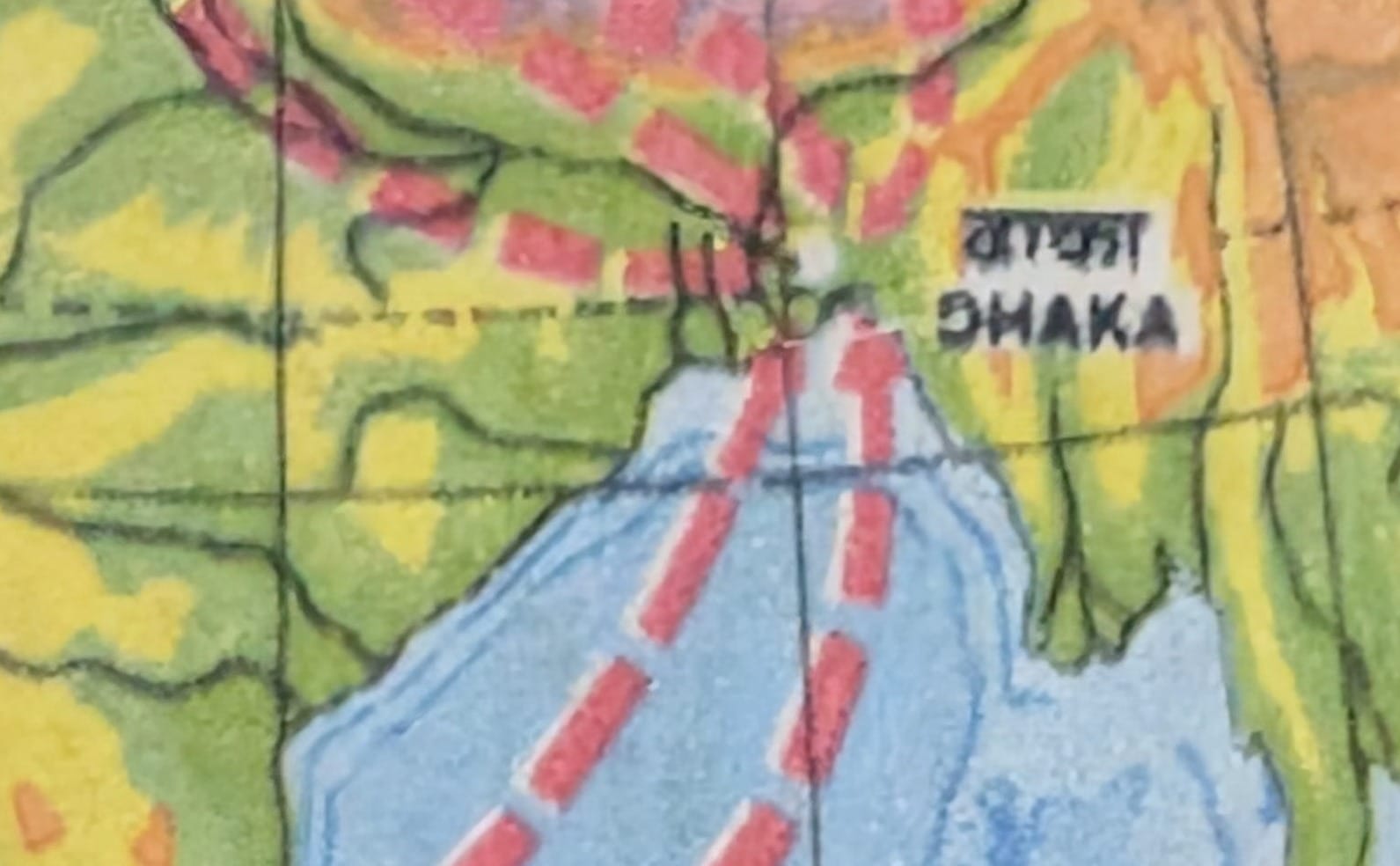
This is the map doing the work a caption would otherwise have to do. December 1985 was the moment the heads of the seven states gathered in the Bangladeshi capital to sign the charter that created the South Asian Association for Regional Cooperation. Dhaka was the host, and the design makes it the gravitational centre of the region for the length of the summit — every line in the picture agreeing, for once, on a destination. It is a modest piece of visual diplomacy, and a pointed one: India issued a stamp that put the Bangladeshi host city at the centre of the map.
The name on the stamp is already out of date
Read the band along the bottom and there is a small, telling wrinkle. It says SOUTH ASIAN REGIONAL CO-OPERATION — not the South Asian Association for Regional Cooperation, and not SAARC.

The wording is a fossil. The phrase “South Asian Regional Cooperation” belonged to the movement’s earlier life. The idea had been floated by Bangladesh’s president in 1980; by August 1983, at a meeting in New Delhi, the seven foreign ministers adopted a Declaration on South Asian Regional Cooperation and an Integrated Programme of Action covering a handful of modest, uncontroversial fields — agriculture, rural development, telecommunications, health. That was cooperation as an activity: a name for a set of joint tasks, deliberately kept away from anything that touched sovereignty or dispute.
What happened at Dhaka in December 1985 was the upgrade. The seven heads of state or government signed a charter and founded a permanent Association; its secretariat opened in Kathmandu in 1987. The 1985 charter gave the cooperation movement the institutional form — and the acronym SAARC — that became its enduring name. The extra A — Association — is the whole difference between a shared to-do list and a standing body.
So the stamp sits exactly on the hinge. It marks the Dhaka summit, but it wears the pre-Dhaka name — the older, plainer phrase for a thing that was, in the very days the stamp honoured, being formalised into an organisation. Whether the design was locked before the charter’s wording settled, or the older phrase was simply preferred, the effect is the same: a small square of paper caught in the act of a movement becoming an organisation. The map shows the founding; the caption still belongs to the courtship.
A relief map is a particular kind of choice
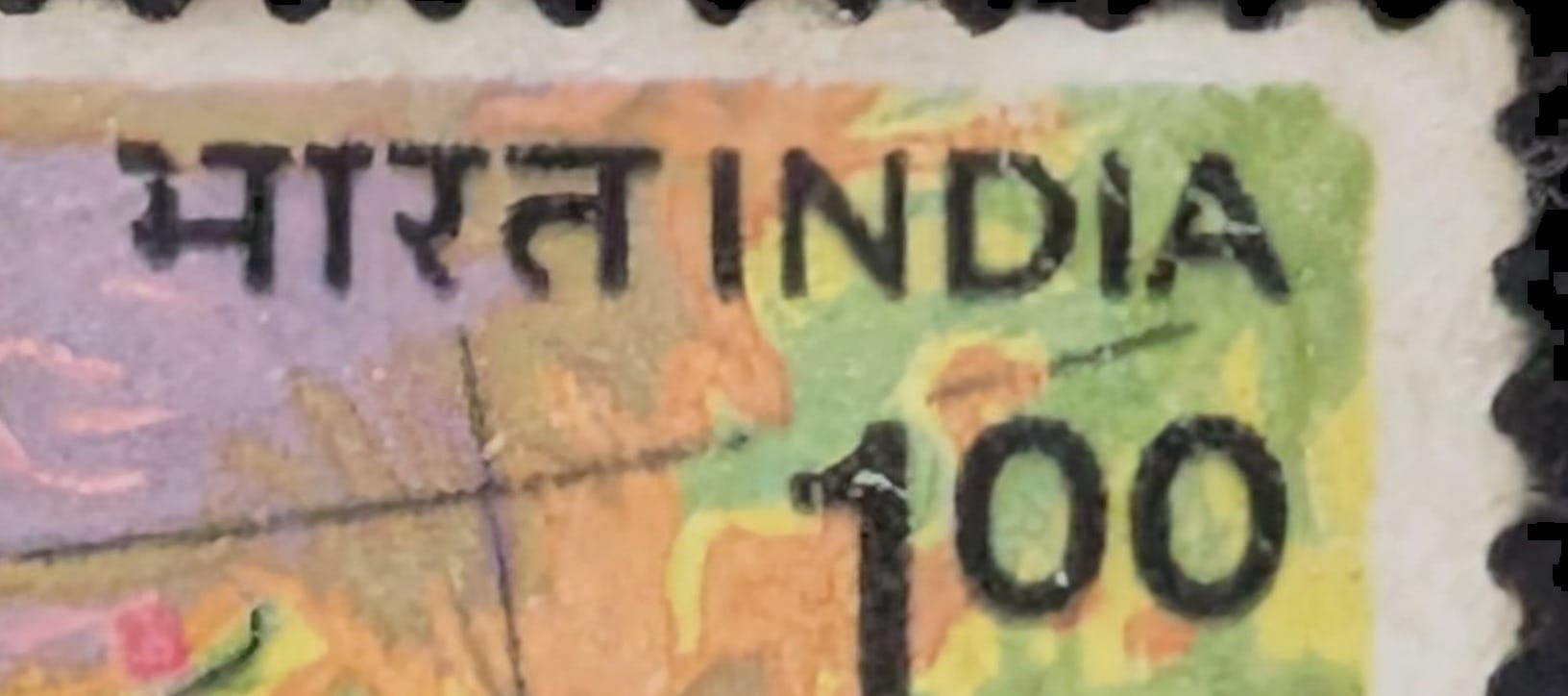
The भारत / INDIA inscription and the Re.1 value sit in the top-right corner, letting the map fill the frame. And the map is a physical one — relief, not political. It shows elevation and vegetation and coastline; borders are not what it wants the eye to notice.
A political map of South Asia is a map of arguments. A political map would have made borders part of the message. This stamp largely refuses to do that. It gives the eye mountains, plains, coastline and sea instead — a continuous physical region rather than a diagram of competing territorial claims. For a stamp presenting these countries as one region, the geography is the message and the politics is left, tactfully, off the plate.
That instinct has aged in a complicated way. SAARC has not held a summit since 2014, stalled by India–Pakistan hostility. The organisation the stamp announced spent its later decades largely frozen. But the stamp made no promises about outcomes. It made a smaller, sturdier claim — that whatever the seven governments did or failed to do, the region underneath their politics would remain. Forty years later that is the part of the picture that has held. The routes to Dhaka faded; the delta they pointed at is still there.
Further Reading & Links
- The Sanchi Stupa 1994 definitive — India picturing a monument, not a ruler
- Hansa Mehta and the Universal Declaration of Human Rights (1998) — India looking outward
- South Asian Association for Regional Cooperation (Britannica) — the 1983 New Delhi declaration, the 1985 Dhaka charter, and the SARC-to-SAARC transition.
- List of SAARC summits (Wikipedia) — confirms the first summit at Dhaka, 7–8 December 1985, and the signing of the charter.
- SAARC and India — formation and paralysis (Anantam IAS) — the arc from 1985 optimism to the post-2014 freeze.
- India Trade with South and South East Asia — Wadhva, IIM Ahmedabad working paper (IDEAS/RePEc) — a contemporaneous 1985 source describing the seven countries “loosely grouped under South Asian Regional Cooperation (SARC)” and “likely to formally launch” SAARC that December — the exact wording the stamp preserves.