The 1989 Stamp That Reminded India to Use Its Postcode
The Stamp
| Issue | ‘Use PINCODE’ campaign |
| Country | India |
| Date of issue | 14 October 1989 |
| Denomination | 60 paise |
| Catalogue | Phila-1213 |
| Depicts | Stylised messenger bird (pigeon) & bilingual “USE PINCODE” roundel |
| Printer | Not independently verified for this issue |
Most stamps mark something the country is proud of. This one marks something it was still trying to get its own citizens to do.
By 1989 the Postal Index Number was seventeen years old. It had run since 15 August 1972 — six digits meant to end the daily confusion of a country where a dozen villages share a name and an address can arrive written in any of a dozen scripts. And yet here, three-quarters of the way through that year, the Department of Posts spent an entire commemorative issue — design, printing, a slot in the year’s official programme — on a single instruction aimed at its own customers: use the code. It said so twice, in two languages, in case once was not enough.
The Use Pincode issue is, in plain terms, an advertisement — the state buying space on its own postage to sell citizens its own product. A stamp is the smallest official surface a government owns, and India chose to spend one urging the public to cooperate. That alone tells you India Post thought the reminder was worth the space.
The system that arrived ahead of its public
The PIN was the work of Shriram Bhikaji Velankar, an additional secretary in the Ministry of Communications and a senior member of the Posts and Telegraphs Board — and, improbably for the father of a numbering scheme, a Sanskrit poet later given the President’s Award for the language. The idea is said to have come from a single encounter. While Velankar was posted in the Kolkata postal department, a soldier came to him in distress: news of his ailing parents in Kerala was taking more than a month to reach him in the north-east. The problem was not distance. It was ambiguity — bad handwriting, incomplete addresses, and too many places wearing the same name.
That last problem was real and everywhere. There is a Kota in Rajasthan and a Kota in Karnataka; Bilaspur sits in both Himachal Pradesh and Chhattisgarh. Before the PIN, senders papered over the confusion by hand, scrawling a nearby landmark and the word “via” beside the town — Puthucode, Kannambra (via) — and hoping a clerk knew the difference.
Velankar’s answer was to replace the guesswork with arithmetic. The first digit fixes the zone, the second the sub-zone, the third the sorting district; the last three land on the individual post office. Nine zones in all, one of them — those beginning with 9 — reserved entirely for the Army Postal Service, the branch whose delivery troubles the anecdote describes.
On paper it was elegant. In practice a sorting clerk can only use a code the sender bothers to write. The machinery of the PIN waited at the delivery end; whether it was used at all depended on the people at the posting end. A system that leans on public habit is only as good as the habit — and habit is the one thing a government cannot legislate into the corner of an envelope.
That is the gap the 1989 stamp was issued to close. Not a technical gap. A behavioural one.
Reading the Use Pincode design
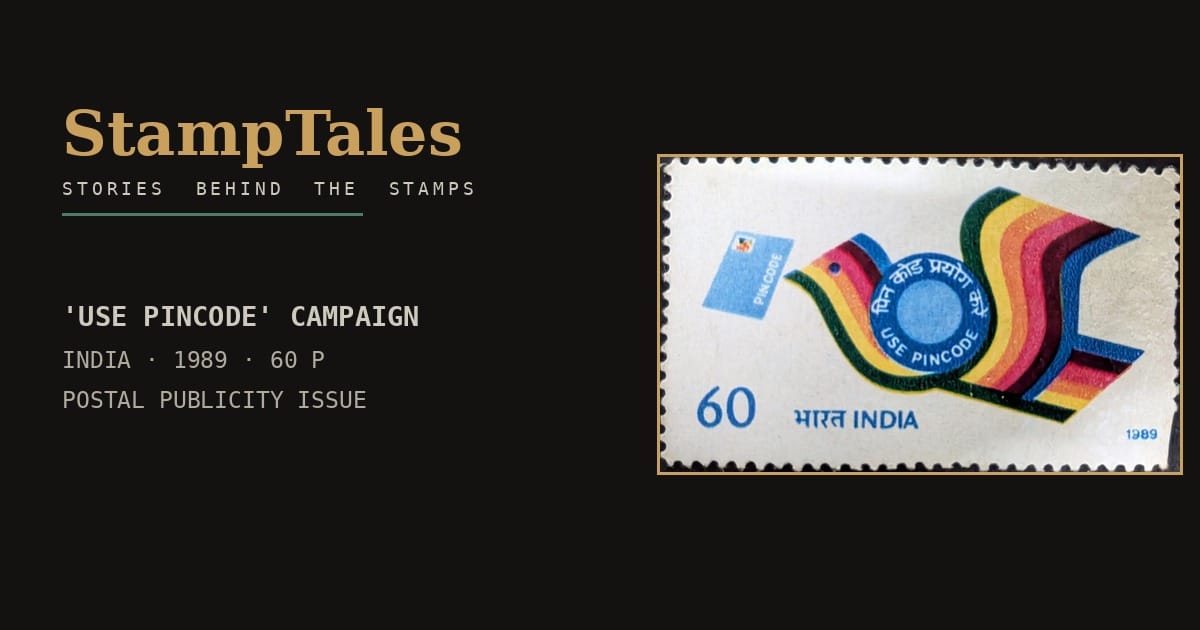
Look at what the designer actually had to do here, because it is a harder brief than it looks. You cannot put a six-digit number on a stamp; a code means nothing without an address to belong to. You have to sell the idea of the number instead. So the stamp does the only thing available to it — it repeats the command until it sticks.
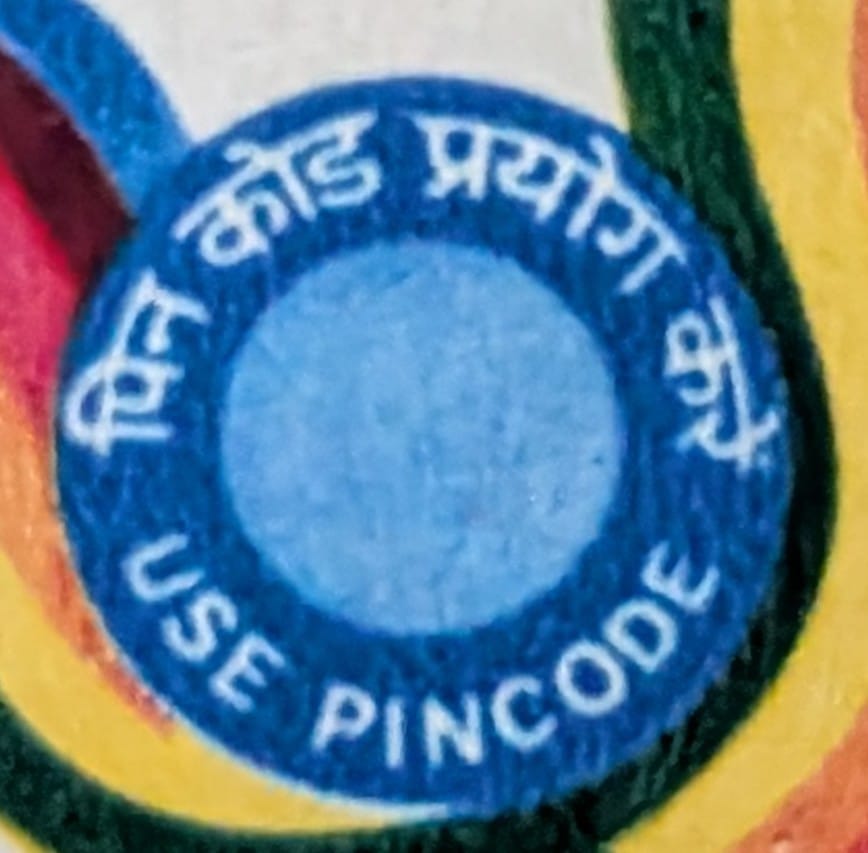
The message appears three times on one small rectangle. A blue roundel at the centre carries it in Hindi around the top — pin code prayog karein, “use the PIN code” — and in English around the bottom: USE PINCODE. Then, in the upper-left corner, a small blue envelope — the thing being posted — wears the word PINCODE up its side a third time. The stamp is not confident you will read it once. It says the same thing in two scripts and then labels the letter as well, the way a parent writes a child’s name inside both shoes.
Carrying all of this is a bird built entirely out of colour. Its body is a stack of ribbons — green, yellow, orange, red, a deep maroon, then blue — fanning from a compressed beak on the left into a broad spread on the right, part wing, part tail, part the pure swoosh of speed. The catalogue records it plainly as a pigeon; on the stamp it looks less like a bird than like motion itself, the oldest symbol of carried news redrawn in the visual language of 1980s officialdom. The single dark eye is the only still point in the whole design. Everything else is going somewhere. The rainbow is doing the persuading the number cannot.

Why a stamp, and why then
There is a small irony worth sitting with. To advertise its sorting code, the Post Office reached for the one product every letter-writer already touches — the stamp — and turned it into a billboard aimed back at the person licking it. The medium and the message were the same object. If you were the kind of citizen who needed reminding to write a PIN, you were also, by definition, holding the reminder at the exact moment you addressed the envelope. It was targeted advertising of a very analogue kind.
Public-information stamps were not new for India; road safety, family planning and national integration had all been given the same treatment. What sets the Use Pincode issue apart is its subject. The others promoted ideas — be careful, be fewer, be one people. Even India’s most celebratory issues, like the one marking the 1942 Quit India resolution, record a moment the nation was proud of. This one promoted a piece of the Post Office’s own machinery — a sign, printed in multicolour, that India Post still thought the system was worth actively encouraging.
Where the Defence Services Staff College owl is a stamp about an institution insisting on its own emblem, this is a stamp about a habit insisting on itself.
What the Use Pincode issue really admits
It would be easy to read the stamp as a sign of a system falling short. It is fairer to read it as the opposite. A postal service that keeps promoting a good idea until the public takes it up — that puts real design effort into winning cooperation rather than assuming it — is a service doing its job well. And the PIN did win. It is now so ingrained that scarcely anyone in India writes an address without it, and the same six digits quietly route e-commerce parcels, courier logistics and bank verification that the designers of 1972 never imagined.
The stamp caught the system at its most uncertain moment — old enough to be taken for granted, not yet old enough to be obeyed. Which is the honest condition of almost every good idea that depends on other people. It works the day everyone finally does the small thing you asked. Until then you are a bright paper bird, repeating yourself in two languages, hoping somebody writes the number down.