The Society Took Ten Years to Admit an Indian. The Philatelic Society Stamp Never Says So.
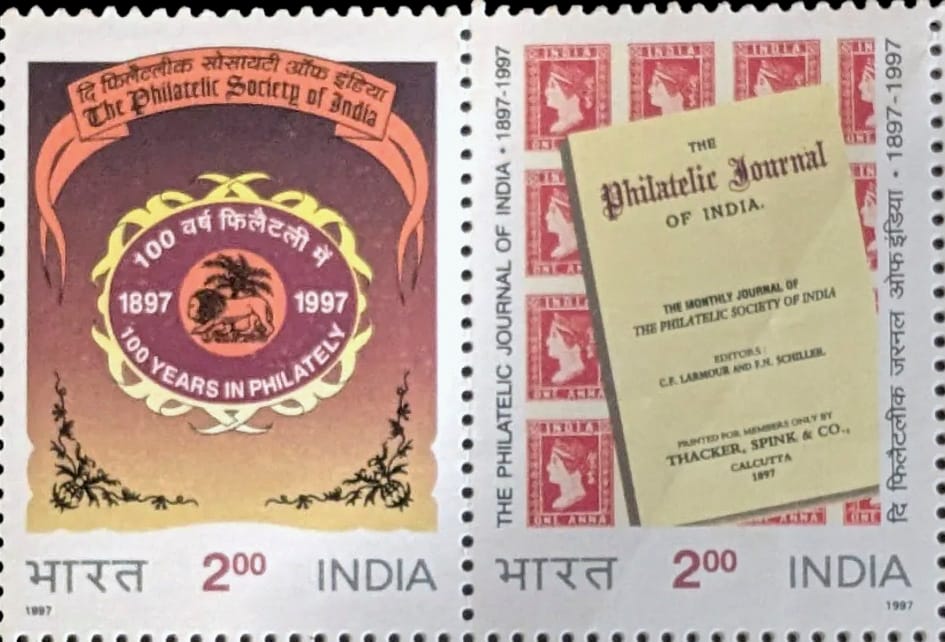
The Stamp
| Issue | Centenary of The Philatelic Society of India |
|---|---|
| Country | India — Department of Posts |
| Subject | Society centenary emblem; cover of the first Philatelic Journal of India, 1897 |
| Issued | 27 March 1997 |
| Denomination | 200 paise (₹2.00) on each design |
| Occasion | Centenary of the society, founded 6 March 1897 |
| Format | Se-tenant pair, printed joined |
| Designer | Not recorded in any source consulted |
| Printing | Not recorded in any source consulted |
| Quantity printed | 700,000 |
| Catalogue | Stanley Gibbons 1709–1710 |
| Condition of this copy | Mint; bottom sheet margin attached |
The Story
The Philatelic Society of India admitted its first Indian member in 1907.
The society had been founded ten years earlier, and the 1997 Philatelic Society stamp commemorates that founding without mentioning the interval. It is a se-tenant pair, issued on 27 March 1997, both halves at two rupees. One design carries the society’s centenary emblem. The other reproduces the cover of the first issue of its journal.
The anniversary fell on 6 March. The stamps appeared on the 27th, three weeks after the date they mark.
The founding meeting took place on 6 March 1897 at 6 Middleton Row, Calcutta, a private address rather than an institution. Charles Stewart-Wilson was elected president. The vice-presidents were Lady Collen, Professor O. V. Muller and Major C. H. I. Hopkins. Wilmot Corfield took the treasury, and the secretary, P. Aylwyn Selfe, came from the Bank of Bengal. Every one of them was British.
The society was not conjured out of nothing. The Philatelic Society of Bengal had existed since 1894, and the proposal for an all-India body came out of its meetings in 1896. Bengal merged into India. The word India in the new name described a jurisdiction to be covered, not a population to be recruited from.
That distinction held for a decade. C. K. Dutt of Calcutta joined in 1907, the first Indian in a society that had carried India in its title since its opening minute. The society’s own history gives the date as 1 May 1907. The Department of Posts folder issued alongside the Philatelic Society stamp gives the year and stops there.
Stewart-Wilson went on to become Director General of Posts and Telegraphs. The founding president of a private collectors’ club ended up running the postal system whose products the club collected. The Philatelic Society stamp was issued a century later by the successor to that same department, which makes it, among other things, an institution photographing its own family album.
The Journal Behind the Philatelic Society Stamp
The journal came first. Volume I, Number 1 of The Philatelic Journal of India is dated January 1897, two months before the society that would own it was inaugurated. The publication existed, and the membership was assembled around it.
There was a handover. The Philatelic Society of Bengal had published its own monthly, The Philatelic World, from July 1894. Its final number appeared in March 1897, the month the new society was inaugurated. One journal stopped so that another could start, and the cover reproduced by the Philatelic Society stamp belongs to the survivor.
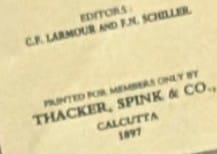
The handover was staffed as well as scheduled. The cover names its editors as C. F. Larmour and F. N. Schiller. Larmour had co-edited The Philatelic World for the Bengal society. The same man closed one journal and opened the next, and the Philatelic Society stamp reproduces his name at four centimetres.
Thacker, Spink and Co. of Calcutta printed it. The firm was the standard imprint for Anglo-Indian scholarship, and it later produced the society’s own handbooks on Indian fiscal and telegraph stamps. Its name sits on the cover reproduced by the Philatelic Society stamp, in small capitals, still legible at four centimetres.
So does a shorter line, and it is the strangest thing on the pair. The cover states that the journal was printed for members only. A specialist bibliography of philatelic literature confirms the restriction: Volumes I and II went to members alone, and that membership stood at fifty at the outset.
The society’s scholarship outlived its social arrangements. Two of its books took the Crawford Medal from the Royal Philatelic Society London: a study of the four annas lithographs in 1932, and a study of the one anna and two annas in 1950. Both examined India’s first issues of 1854. Those are the same stamps printed in rows behind the journal cover on the Philatelic Society stamp, the subject the society did its finest work on, used here as wallpaper.
Seven hundred thousand pairs were printed in 1997. A document made for fifty readers was reissued at postal scale, and the sentence declaring it private was enlarged along with everything else. Nobody removed it. Nobody, apparently, read it.
What the Record Cannot Agree On
The founding membership is not a settled number, and the Philatelic Society stamp does not attempt one. The Department of Posts folder describes a band of fifty Englishmen. The society’s own published history claims 550 members, of whom 50 were women. A separate survey of Indian philatelic societies puts the opening figure at 60, including six women. The bibliography behind the journal gives fifty.
These cannot all be true, and this magazine will not pretend to settle them. What survives the disagreement is the detail every account repeats. The founders were British to a man and, on two of the four counts, to a woman. Ten years passed before that changed.
The folder hedges elsewhere too. It calls the society one of the ten oldest in the world and probably the oldest in Asia. Probably is an unusual word in a government publication celebrating a centenary, and it may be the most honest word on the page.
There is something almost funny in the confusion. Philately is the discipline of the countable: perforation gauges, die states, printings, watermarks, shades. A society built on that discipline cannot agree on how many people were in the room.
Where the Philatelic Society Stamp Points
Everything the pair depicts is Calcutta. The society was inaugurated there. Thacker, Spink printed there. The One Anna reds massed behind the journal cover were lithographed there in 1854, at the Survey Office, by a deputy surveyor-general who took the job on because the Survey already owned the stones. Engraving plates in London would have cost more than the administration cared to spend, so India’s first adhesive stamps were printed by a mapping office.
The centenary was not only a stamp. The same folder records a national exhibition, CENTIPEX-97, mounted with the Department of Posts and under the patronage of the Philatelic Congress of India. The Philatelic Society stamp was the portable part of a larger anniversary, and the part that outlasted it.
By 1997 the society had moved. The folder issued with the Philatelic Society stamp records fortnightly meetings at the General Post Office in Bombay, and the society still gathers there. The stamp is an entirely Calcutta object commemorating a body that had long since gone west. It fixes the society at the one moment when everything about it — address, printer, membership — was still British.
Looking Closer at the Philatelic Society Stamp
The two halves of the Philatelic Society stamp do not agree about what a stamp is.
The left design is drawn. Flat colour, a purple-to-ochre wash, a ribbon banner unfurling across the top, ornamental vines in the lower corners: the visual language of a presentation certificate. The right design is photographic. A journal cover lies at a slight angle and casts a real shadow onto the stamps beneath it. One half illustrates an idea. The other documents an object.
The split is doing work. The emblem side has to stand for a century, which no photograph can. The journal side has to prove that one piece of paper existed in January 1897, which no illustration would. Set side by side, the Philatelic Society stamp argues that an institution is both a claim and a receipt.
The tilt on the journal cover is the sharpest decision in the design. Laid flat it would have read as a scan. Tilted, with a shadow falling to its left, it reads as something just set down on a desk, an object handled rather than archived.
Beneath it the One Anna reds are stacked in rows with white gaps between them. The spacing is not decorative. India’s 1854 lithographs were printed widely spaced and issued imperforate, and the Philatelic Society stamp keeps those gaps instead of tidying them into a modern sheet.
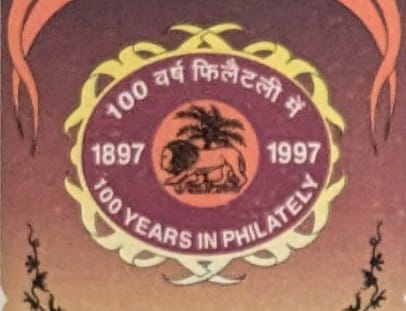
The emblem’s centre holds the oldest object on the Philatelic Society stamp. Inside the medallion, ringed by the words 100 YEARS IN PHILATELY and the two dates, a lion rests beneath a palm tree. The pairing is not philatelic. Lion-and-palm was a device of East India Company coinage, and when the Reserve Bank of India settled its own seal in 1935 it worked from that same double mohur, then swapped the lion for a tiger on the grounds that a tiger was the more Indian animal. Here, on a stamp issued fifty years after independence, the lion is still sitting there.
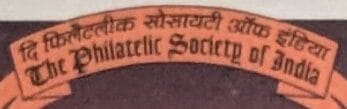
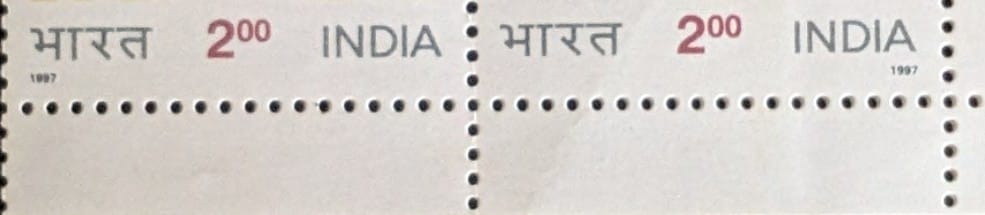
The lettering carries a second load. The banner gives the society’s name twice: Devanagari on top, English beneath it in blackletter. The Devanagari is not a translation. It spells the English out phonetically, definite article and all, so that even in 1997 the name arrives in Hindi only as a sound. The journal masthead below repeats the blackletter. Only भारत, the rupee value and INDIA along the bottom edge are set in the plain sans-serif of 1997, the one place on the Philatelic Society stamp where the present speaks in its own voice.
Closing
A small British circle in Calcutta printed a journal and wrote on the cover that it was not for outsiders. A hundred years later the India they had not enrolled reprinted that line seven hundred thousand times and sold it over a post office counter.
Further Reading & Links
On StampTales
If the Philatelic Society stamp interested you, these go to adjacent ground:
- https://stamptales.in/world-philatelic-exhibition-1989-stamp/ — “World Philatelic Exhibition 1989 stamp”: how India Post reproduced Dead Letter Office cancellation markings on a stamp celebrating the very hobby of collecting them.
- https://stamptales.in/stamp-collecting-1989-india-philatelic-exhibition — “Stamp Collecting 1989”: where this stamp puts the collectors’ institution in the frame, that one puts the act of collecting itself — a child, an album, a bowl of water.
- https://stamptales.in/1989-indian-cinema-stamp/ — 1989 Indian Cinema stamp: what happens when a postal service is asked to compress seventy-five years into four centimetres.
- https://stamptales.in/charminar-stamp-1990-hyderabad/]— “Hyderabad Was Built Around One Building. The Charminar Stamp Never Says So.”: another India Post commemorative whose official folder does not match the historical record.
- https://stamptales.in/the-sentence-that-sent-a-man-to-prison/ — Tilak Swaraj 1988: the other side of 1890s Calcutta, and what Indians were doing while the club was forming.
External sources
- The Philatelic Society of India — Wikipedia (founding meeting, office-holders, Crawford Medal publications)
- A Brief History — The Philatelic Society of India (source of the 550-member figure and C. K. Dutt’s admission date)
- Journals — The Philatelist (bibliographic record of The Philatelic Journal of India, including the members-only restriction on Volumes I and II)
- India: First Bi-Color Stamps — Smithsonian National Postal Museum (why the 1854 issues were lithographed in Calcutta rather than engraved in London)
- Centenary of The Philatelic Society of India — Indian Philatelics (reproduces the Department of Posts information folder)

3 Comments
Comments are closed.