The Regiment That Was Born Before It Could Jump
The regiment dates its Golden Jubilee to 1 April 1943 — but the 9 Parachute Field Regiment kept that birthday for more than two years before it could do the one thing its name now promises.
The Stamp
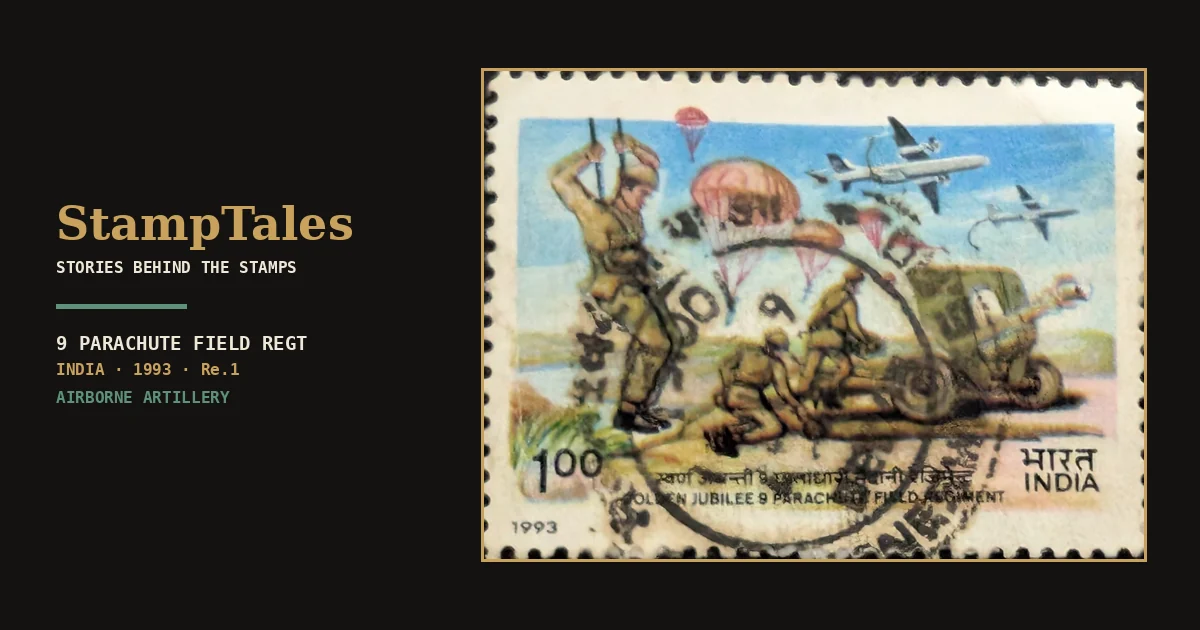
| Subject | Golden Jubilee, 9 Parachute Field Regiment |
|---|---|
| Country | India — Department of Posts |
| Issued | 1 April 1993 |
| Denomination | ₹1.00 (100 paise) |
| Category | Defence |
| Format | Single commemorative |
| Quantity printed | 1,000,000 (India Post information folder) |
| Condition of this copy | Postally used — heavy circular cancellation across the centre, cream toning consistent with age |
The Story
On 1 April 1993, India Post marked fifty years of a regiment that spent its first two and a half years unable to do the one thing its name now promises. The stamp says Golden Jubilee. It counts from 1 April 1943. On that day, in a camp at Kumbergaon near Pune, the unit was raised as 9 Field Regiment of the Royal Indian Artillery — ordinary gunners, a Madrasi unit, with no aircraft, no parachutes, and no airborne role of any kind. The airborne regiment the stamp draws did not yet exist. It was raised more than two years before it could jump.
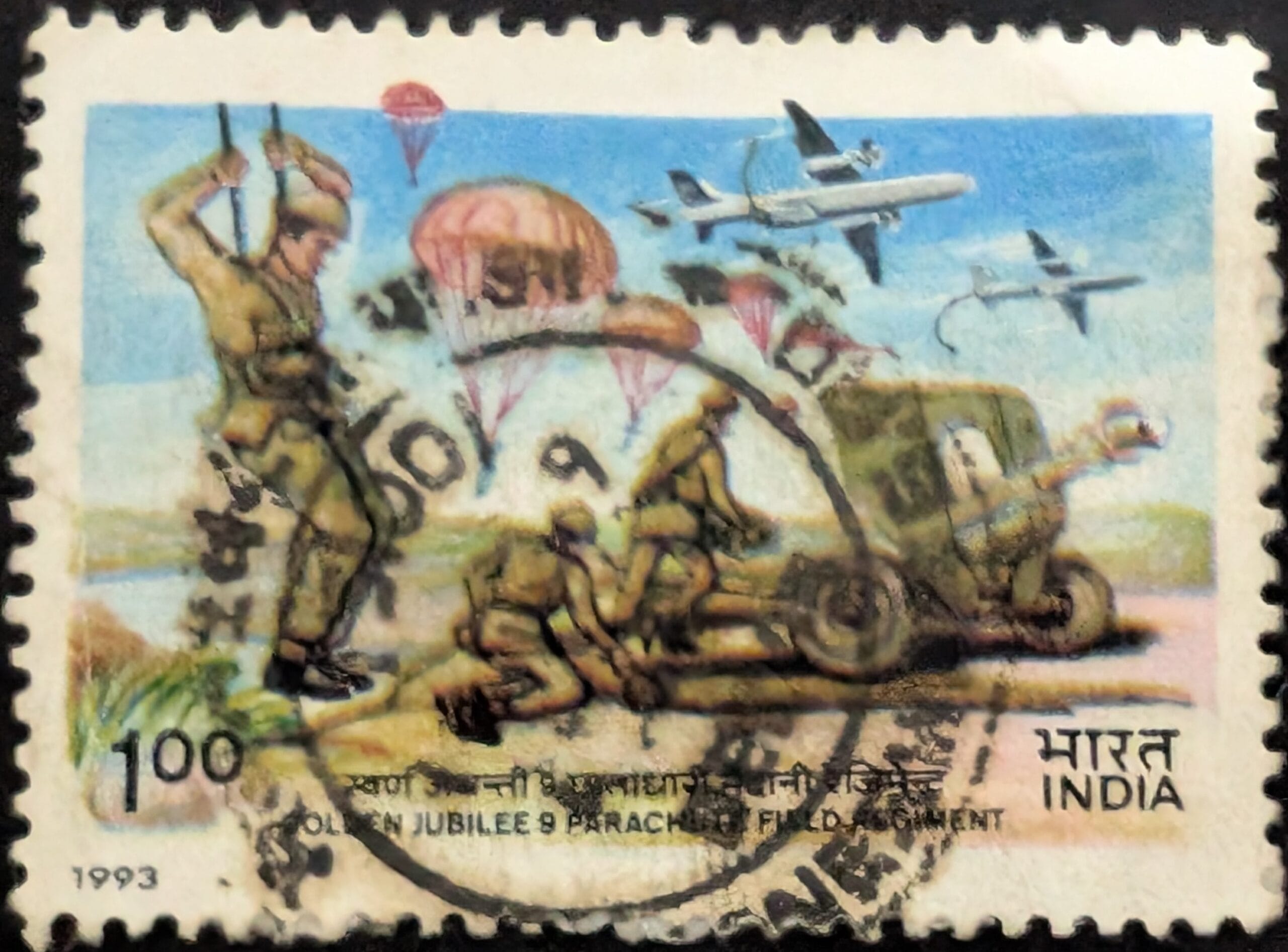
The parachute came later. The unit became what the regiment and India Post both record as the first Parachute Field Regiment in the Indian sub-continent in November 1945 — better than two years after the birthday the jubilee counts from. This is not a mistake on the stamp. It is how regiments reckon their own age: by lineage, not by role. A unit keeps its founding date the way a family keeps a surname, through every change of trade. What is striking is what the designer did with that gap. Given a regiment whose fiftieth birthday belonged to an earlier, un-airborne version of itself, the stamp does not draw the field battery of 1943. It draws the thing the unit became.
How the 9 Parachute Field Regiment reckons its age
The jubilee arithmetic is worth sitting with, because it inverts what you would expect. The obvious anniversary for an airborne unit is the day it first became airborne. Instead the regiment dates itself to the day it was raised as conventional artillery, and treats the November 1945 conversion as an event within its life rather than the start of it. The maroon beret, the parachute wings, the whole airborne identity — all of it is reckoned as something the regiment grew into, not something it was issued at birth.
That choice is quietly honest. It admits that the airborne part is an acquired skill, layered onto an older craft. A field gun and its crew are the constant; the aircraft is the addition. The stamp agrees with that reading, which is why the aircraft sit at the top edge of the frame while the gun and its men fill the centre.
What a parachute field regiment actually does
Here is the part the name hides. A parachute field regiment is not paratroopers who happen to carry rifles. It is gunners who drop a field gun out of an aeroplane, land it under a canopy, then put it back together and fire it. The jump is the easy part. The hard part is the gun.
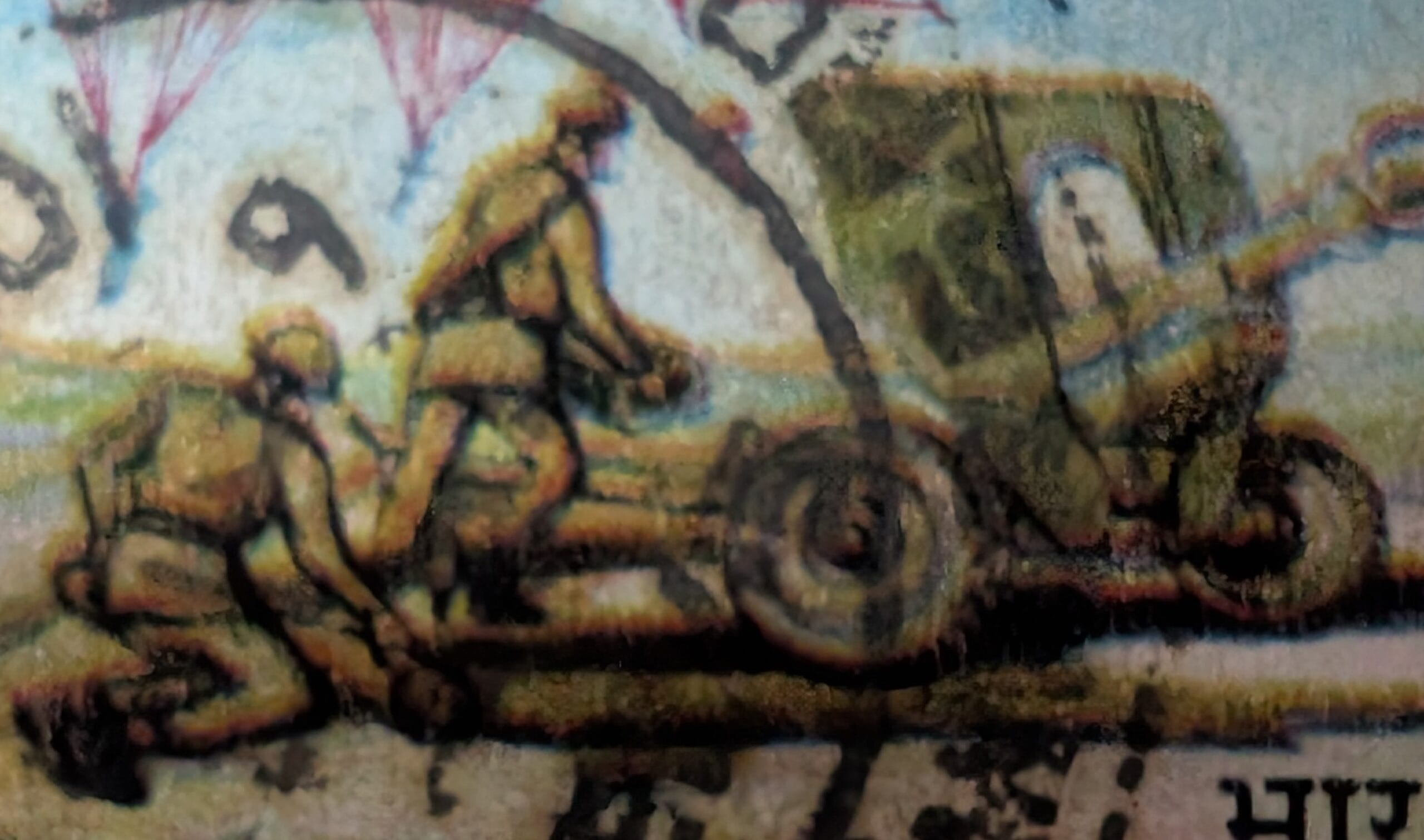
Look at the centre of the stamp: a crew bent low around a wheeled gun, hauling it by the trail. That is not decoration. It is the doctrine drawn literally. An airborne gun has to come apart into loads light enough to fall under a parachute and rugged enough to survive the landing, and then go back together — often under fire, on ground no vehicle has reached yet. Once it is down, muscle moves it. Contemporary airborne-artillery doctrine treated the gun crew itself as the primary means of moving the weapon once it reached the ground. The stamp chose to show that — the dragging, not the descent. It is the least cinematic moment in the whole sequence, and it is the one that defines the trade.
The composition compresses the entire operation into a single continuous action. High and to the right, a transport aircraft and a lighter jet.
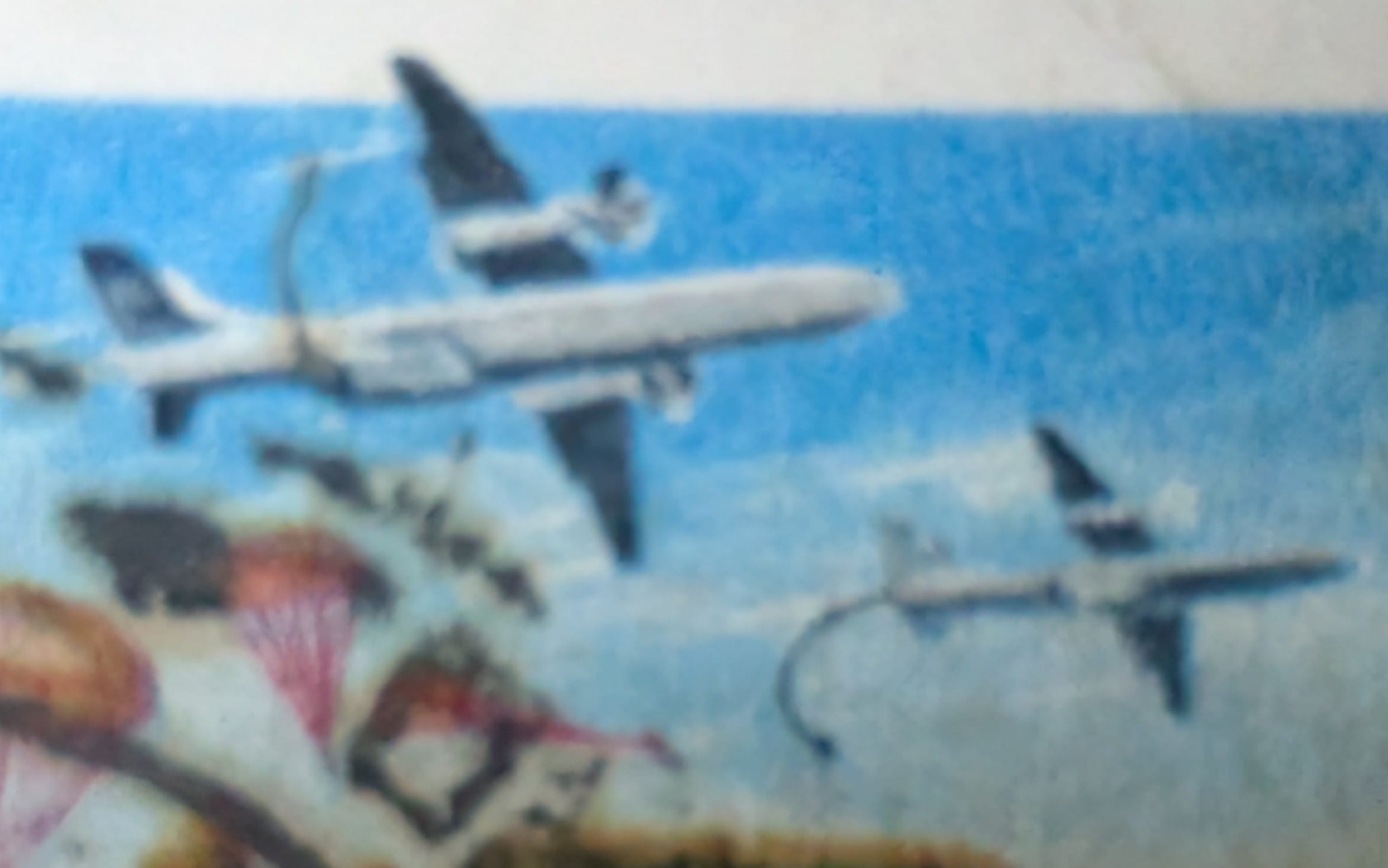
Below them, canopies open — carrying loads down, not men.
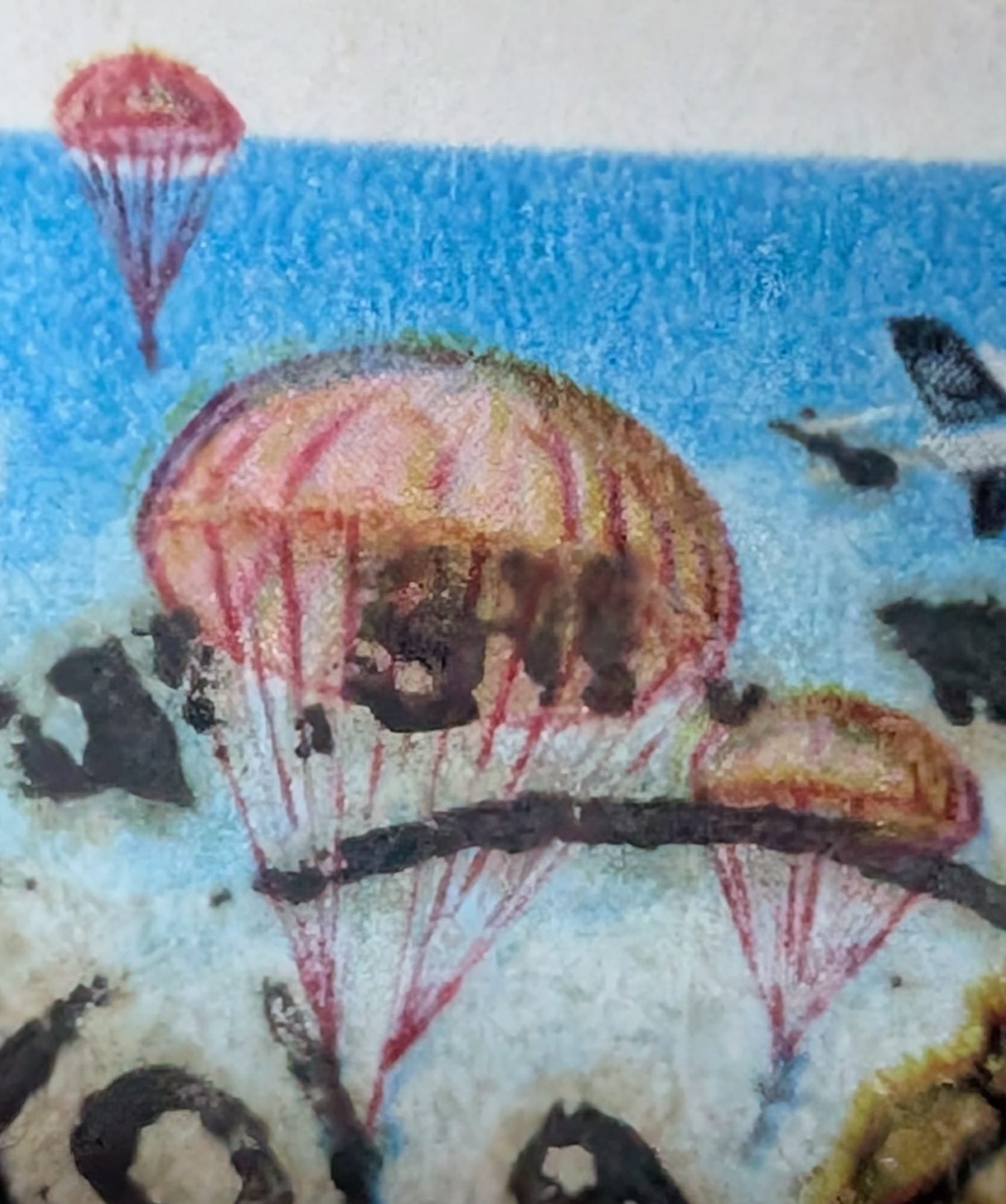
On the left, a standing figure with an arm raised. And at the base, where the eye finally settles, the gun and the men straining to move it. The reader travels from sky to ground and comes to rest on the labour. That is a deliberate order, and it puts the emphasis exactly where the regiment would want it.
Where the 9 Parachute Field Regiment earned its name
The service record explains why the stamp ignores 1943 and reaches for the gun instead. By 1993 the regiment’s identity had been forged not in a Pune training camp but across a run of operations that reads like a gazetteer of where independent India used force. Operation Polo in 1948, the integration of Hyderabad. Operation Vijay in 1961, the capture of Daman. The 1971 war. Siachen, under Operation Meghdoot, on the highest battlefield in the world. A regiment that began as Madrasi field artillery in a Pune camp ended up firing guns onto a glacier. Fifty years is a long time for a unit to keep its shape while its work moves from the plains to the roof of the subcontinent.
The stamp is, in the end, a self-portrait commissioned by the institution it portrays — the official India Post information folder speaks in the regiment’s own proud register. Like most such portraits, it shows the tool and not the cost. There are no casualties in the frame, no failures, no glacier weather. There is a gun, a crew, and a clean blue sky. That is the licence a jubilee grants: to show yourself at your most capable, in the act you are proudest of.
Closing
What is unusual is which act the stamp chose. Not the founding it is nominally celebrating. Not a named victory. The stamp draws the moment after the parachute has done its work and before the gun has fired — the crew still bent to the trail, still pushing. It is an odd thing to put on a fiftieth birthday: not the beginning and not the triumph, but the labour in between. It may be the truest picture a regiment could give of itself. The jump is the story everyone tells. The dragging is the job.
Further Reading & Links
On StampTales
- The Fleet Review 1984 stamp — the Navy’s official self-portrait on a stamp, the same instinct to show hardware rather than history
- The Tilak Swaraj stamp 1988 — another freedom-and-force commemorative, and how India Post framed it
- The Quit India Resolution stamp 1983 — commemoration as a way of fixing a date in the national memory
External sources
- 9 (Parachute) Field Regiment (India) — WikipediaFieldRegiment(India)) — raising and conversion dates, service record
- 9 Parachute Field Regiment — ParaData, Airborne Assault Museum — an independent record of the unit’s history
- Golden Jubilee information folder — Indian Philatelics — India Post issue details