The stamp priced at an age
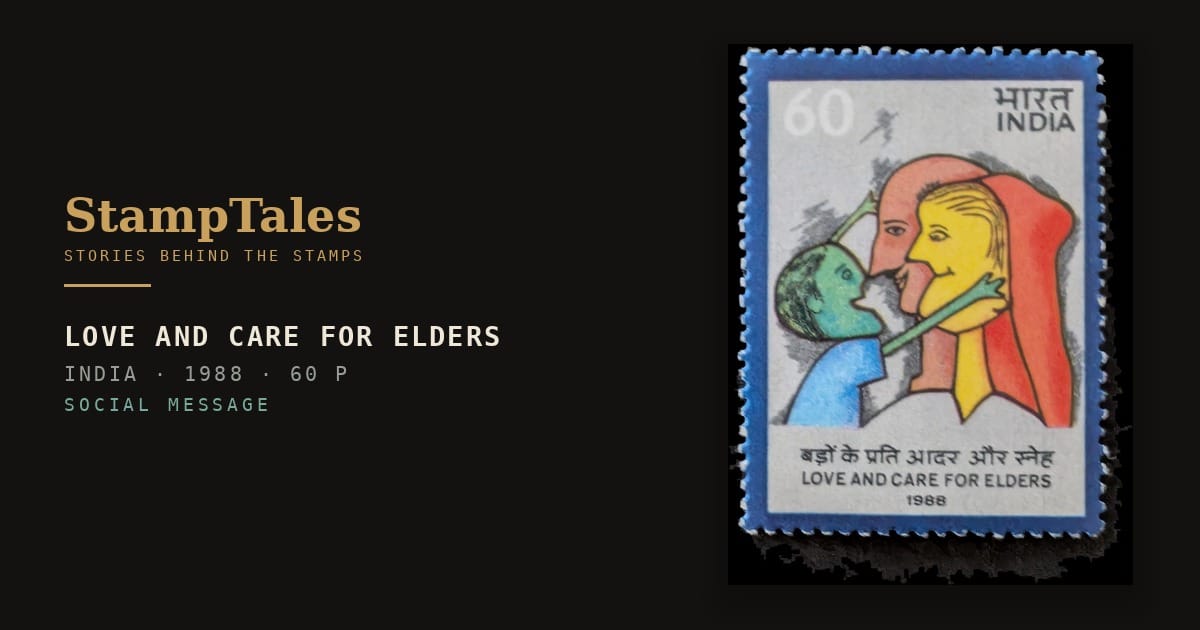
The 60 printed in the corner of this stamp is a postal rate. It was also chosen, deliberately, to be an age. India Post issued Love and Care for Elders at sixty paise because sixty is the year an Indian is counted old — and the government wanted the price you paid to say so before you had read a word of the design.
That is an odd thing for a post office to do. A denomination is usually the one part of a stamp nobody is meant to notice: it has to be some number, and 60 paise was an ordinary enough rate in 1988. Here the number was made to carry the message. The information brochure India Post printed alongside the issue is explicit about it — “the denomination of this stamp at 60 P. acquires added significance as it marks the age of 60 years.” Once you know that, the small grey figure of the value stops being fine print and starts being the caption.
| Issue | Love and Care for Elders |
|---|---|
| Issued | 24 May 1988 |
| Denomination | 60 paise |
| Country | India |
| Designer | Neeta Verma, National Institute of Design, Ahmedabad |
| Printer | India Security Press, Nashik |
| Process | Photogravure, multicolour |
| Print run | 1.5 million |
| Catalogue | SG 1316 |
Why Love and Care for Elders cost exactly 60 paise
Sixty is not an arbitrary threshold. It is the age at which Indian officialdom begins to treat a person as elderly — the line at which pensions, concessions and the label “senior citizen” switch on. Pricing the stamp at the number was a small piece of design wit, and a serious one. It folded the argument into the object. You could not buy the thing without handing over, coin for coin, the exact figure the stamp was asking you to think about.
A child, reaching up

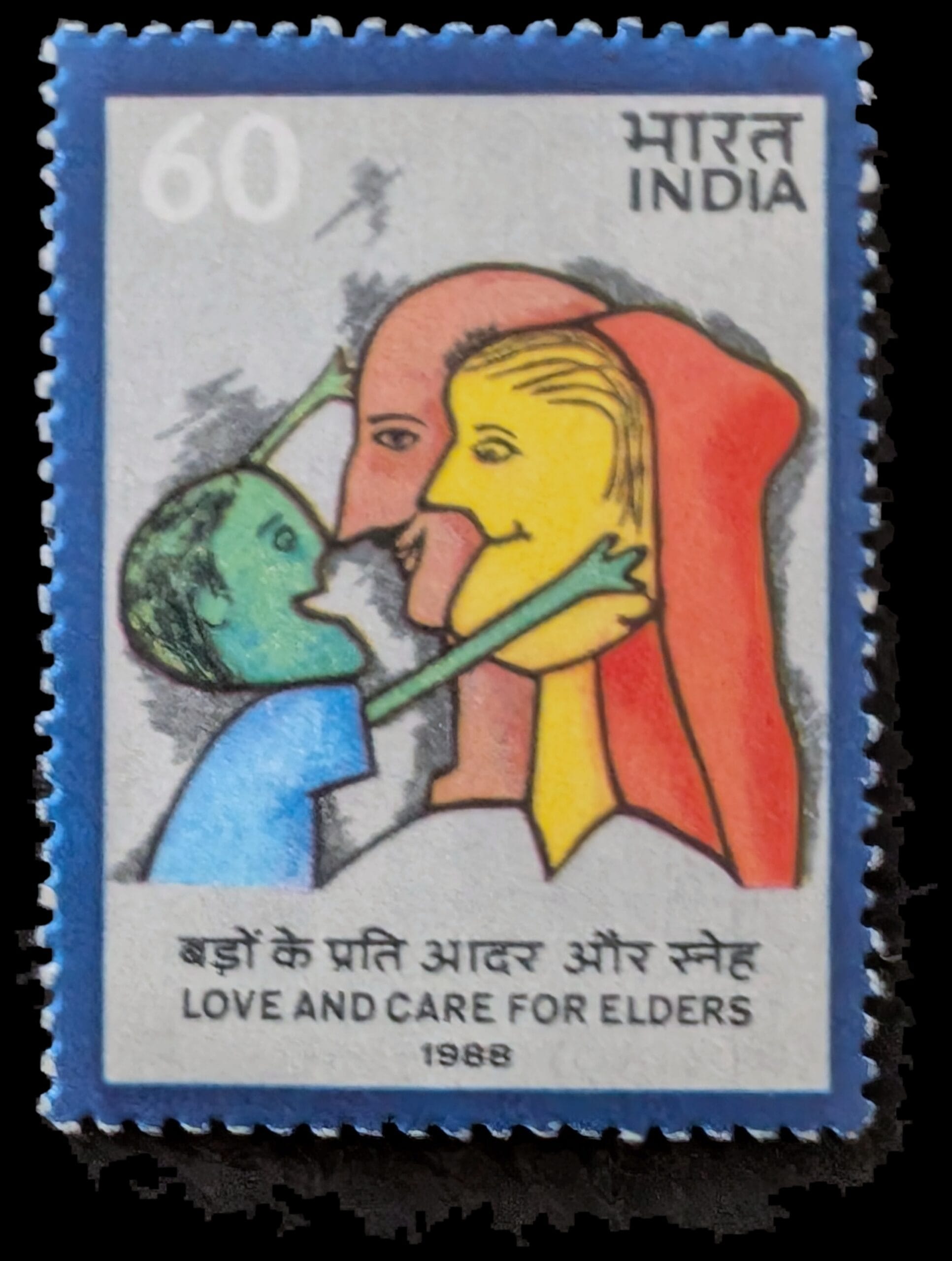
Neeta Verma, working out of the National Institute of Design in Ahmedabad, did not draw the scene the way a greetings card would. The faces are flat planes of yellow and coral under a red veil; the child at the lower left is a block of blue with a green face and two arms thrown upward. There is no attempt at likeness.
This is trained modernism. NID was India’s postwar design school, built to give the young republic a visual language that was neither colonial pastiche nor folk revival, and the abstraction is a choice, not a limitation. A photograph of a real grandmother and grandchild would have fixed the pair as one specific family. Stylised, they are no one in particular — which is what lets them stand for anyone.
The India Post brochure describes the image simply as “a child extending its arms to embrace elders with affection and love.” The direction of the gesture matters. The small figure reaches up; the elders lean down. Nothing in the frame is transactional — no one is being fed, washed or nursed. The stamp is careful to show affection rather than care-work, which is a softer and more comfortable thing for a state to celebrate than the daily labour of looking after the old.

The number sits in the top-left corner in a pale, almost apologetic grey, with भारत / INDIA opposite. You have to be told it means something before it looks like it does. That is the whole trick of the stamp, sitting in plain sight.
What the Hindi says that the English does not
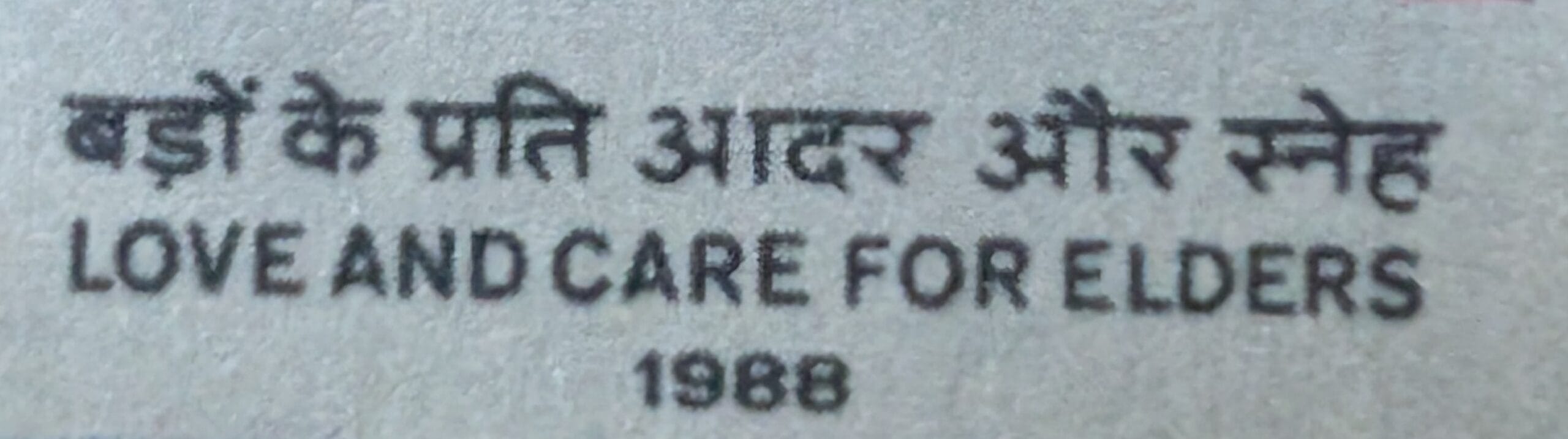
Read the caption band and a small gap opens up. The English reads LOVE AND CARE FOR ELDERS. The Hindi above it — बड़ों के प्रति आदर और स्नेह — says something a shade different: aadar aur sneh, respect and affection. Aadar is closer to reverence than to care. The English asks the reader to look after the old; the Hindi asks them to look up to the old. In a single line the stamp holds both halves of the Indian bargain with age — the elder as a dependent to be tended, and the elder as an authority to be honoured — and it does not pretend they are the same thing.
The cancellation extends the second idea. India Post built the first-day postmark around a sun, and the brochure explains why: the sun stands for “the status of elders with regard to the younger generation.” Not a setting sun, note — a source. The design’s instinct throughout is to place the old above the young, not below them.
Love and Care for Elders and the freedom generation
The stamp did not appear in a vacuum. India Post issued it in what the brochure calls the country’s fortieth year of independence, and it read the two facts together. The elders being saluted in 1988 were, in the government’s framing, a particular cohort — the people who had been adults at Independence, “our senior citizens and elders who made an invaluable contribution to consolidate the gains of political freedom.” Turning sixty in 1988 meant you had been born around 1928 and had lived the whole arc of the freedom struggle as a young adult. To honour the old that year was, quietly, to honour the freedom generation before it was gone.
India Post had used stamps as public messages for years — family-planning slogans on everyday mail since 1966, and through the 1980s the freedom movement remembered on issues like the Tilak Swaraj stamp. What makes this one unusual is its direction. Those social-message stamps almost always addressed the young and the yet-to-be-born; a stamp that turned to face the old instead was rarer, and it arrived early.
Because the state of affairs it gestured at had, in 1988, almost no legal shape. India would not adopt a National Policy for Older Persons until 1999. The law that finally obliged grown children to maintain their ageing parents — the Maintenance and Welfare of Parents and Senior Citizens Act — did not pass until 2007, nineteen years after this small square asked the country, for sixty paise, to remember its elders. The sentiment preceded the statute by almost two decades; the “traditional values” it invoked reach back further still, to the figure India most often stands them on — Gandhi. Whether that gap reflects well on the stamp or poorly on the interval is left, fairly, to the reader.
A postage stamp cannot legislate. What it can do is put a proposition into a hundred thousand hands and let it circulate. This one carried a single idea to the exact price of the age it was about, and trusted people to notice. Sixty paise, and sixty years — the same number, asking to be read twice.
Further Reading & Links
- The 1994 Human Resource Development stamp — another India Post issue that prints a government idea directly onto the object.
- List of postage stamps of India (1981–1990)) — confirms the 24 May 1988 issue date and 60-paise denomination.
- Love and Care for Elders — issue details and brochure text (iStamp Gallery) — designer, printer, print run and the quoted India Post brochure.
- The Maintenance and Welfare of Parents and Senior Citizens Act, 2007 — the statute that followed the sentiment by nineteen years.
- How social messages rode Indian stamps from 1966 (ThePrint) — the tradition this issue quietly departs from.