The summit stamp with nothing Indian on it
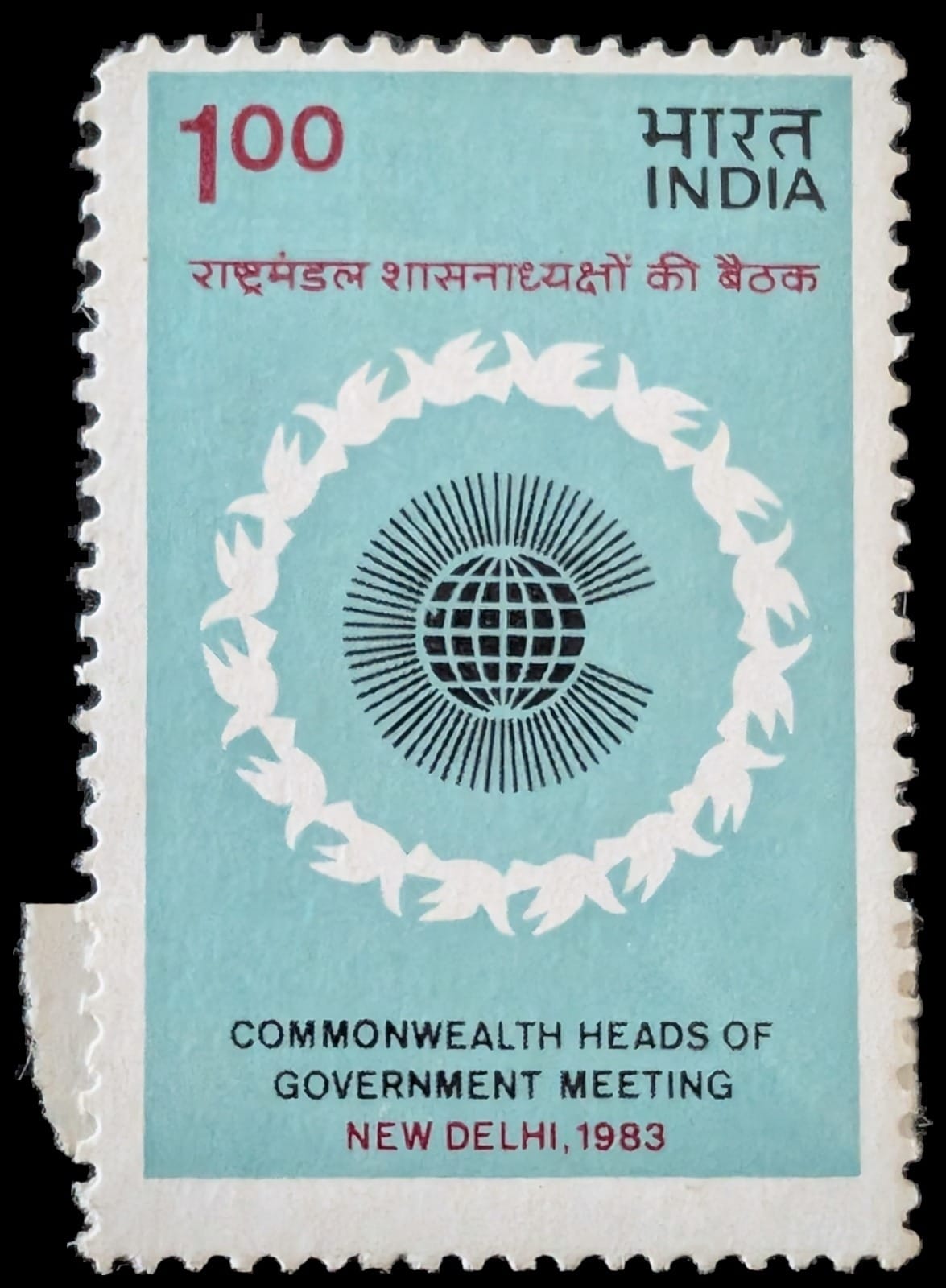
When India hosted the Commonwealth Heads of Government Meeting in New Delhi in November 1983, its commemorative stamp carried no specifically Indian image at all. No lion, no tricolour, no map, no monument — nothing except the two words भारत / INDIA in a corner and the price. At the centre of the design, sits a borrowed logo: the Commonwealth’s own globe-and-rays emblem, ringed by a wreath of doves.
That is a deliberate act of self-effacement, and it repays a second look. This was not a shy country. Eight months earlier, in the same city, India had hosted the Non-Aligned Movement summit and cast itself as the leader of a bloc defined precisely by not belonging to anyone else’s club. To then print, on a national stamp, the insignia of the post-imperial Commonwealth that had grown out of the British Empire — and to make it the whole design — was a choice with some history folded into it.
| Issue | Commonwealth Heads of Government Meeting, New Delhi |
|---|---|
| Issued | 23 November 1983 |
| Denomination | Re.1 (100 paise) |
| Country | India |
| Design | The Commonwealth emblem — a globe within a C of radiating rays — ringed by a wreath of doves |
| Occasion | Seventh Commonwealth Heads of Government Meeting, 23–29 Nov 1983, Vigyan Bhavan |
| Catalogue | India Post Phila 952 |
A logo designed by two Canadians
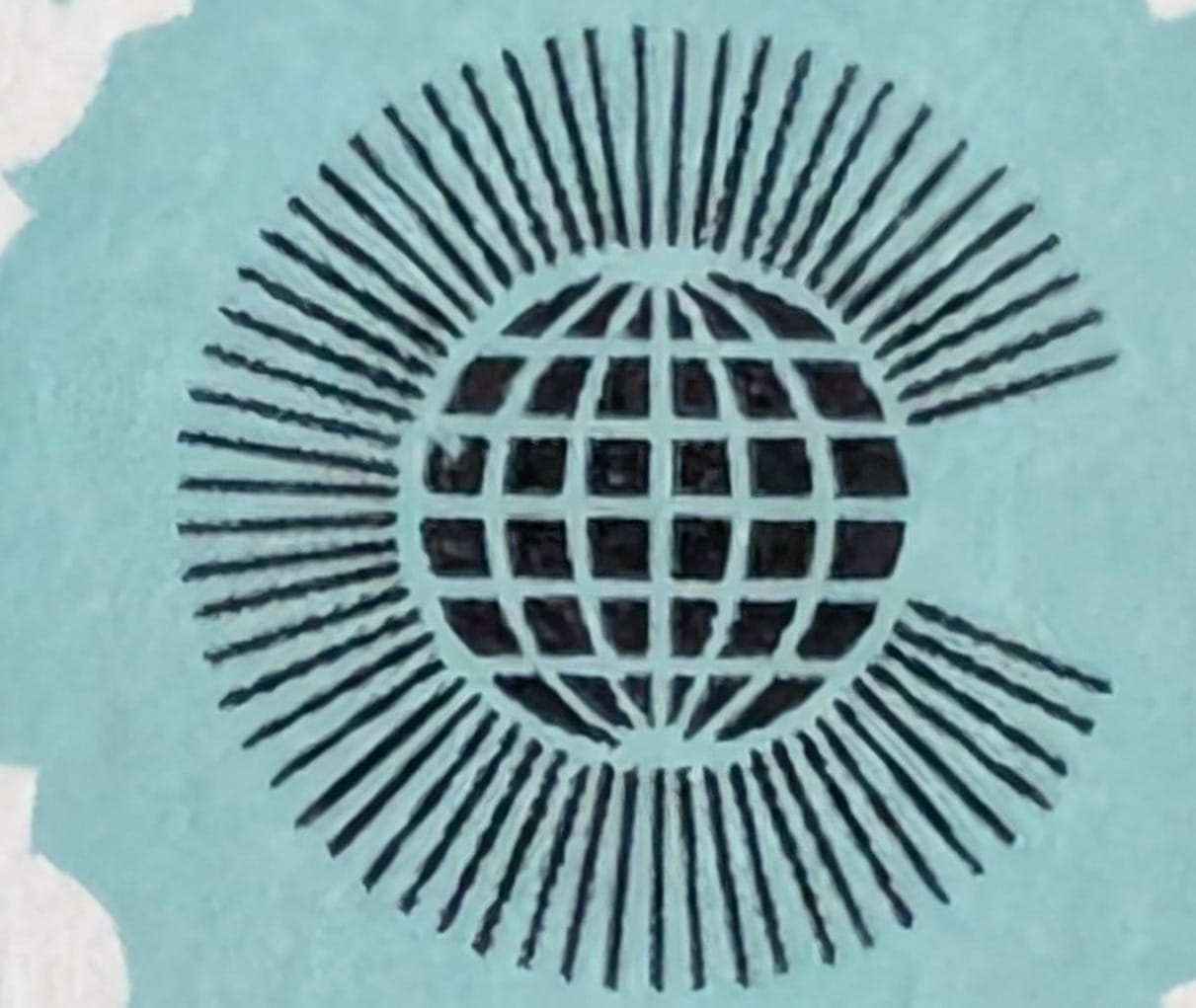
The device at the centre of the stamp is not an Indian invention and was never meant to be. It is the official emblem of the Commonwealth of Nations: a gridded globe wrapped in radiating gold rays that stop short on one side so the whole thing reads as a letter C — C for Commonwealth. The design was adopted in 1976, and the initiative for it is credited to two Canadians, the first Commonwealth Secretary-General Arnold Smith and Prime Minister Pierre Trudeau. The rays are usually counted at sixty-four.
Look closely and the gap is the point. The rays do not close the circle; they leave an opening on the right, and that opening is what turns a sunburst into a letter. It is a modest, almost bureaucratic piece of graphic design — the visual equivalent of a shared letterhead — and India reproduced it faithfully. What India added was the ring around it.
The doves are the Indian sentence
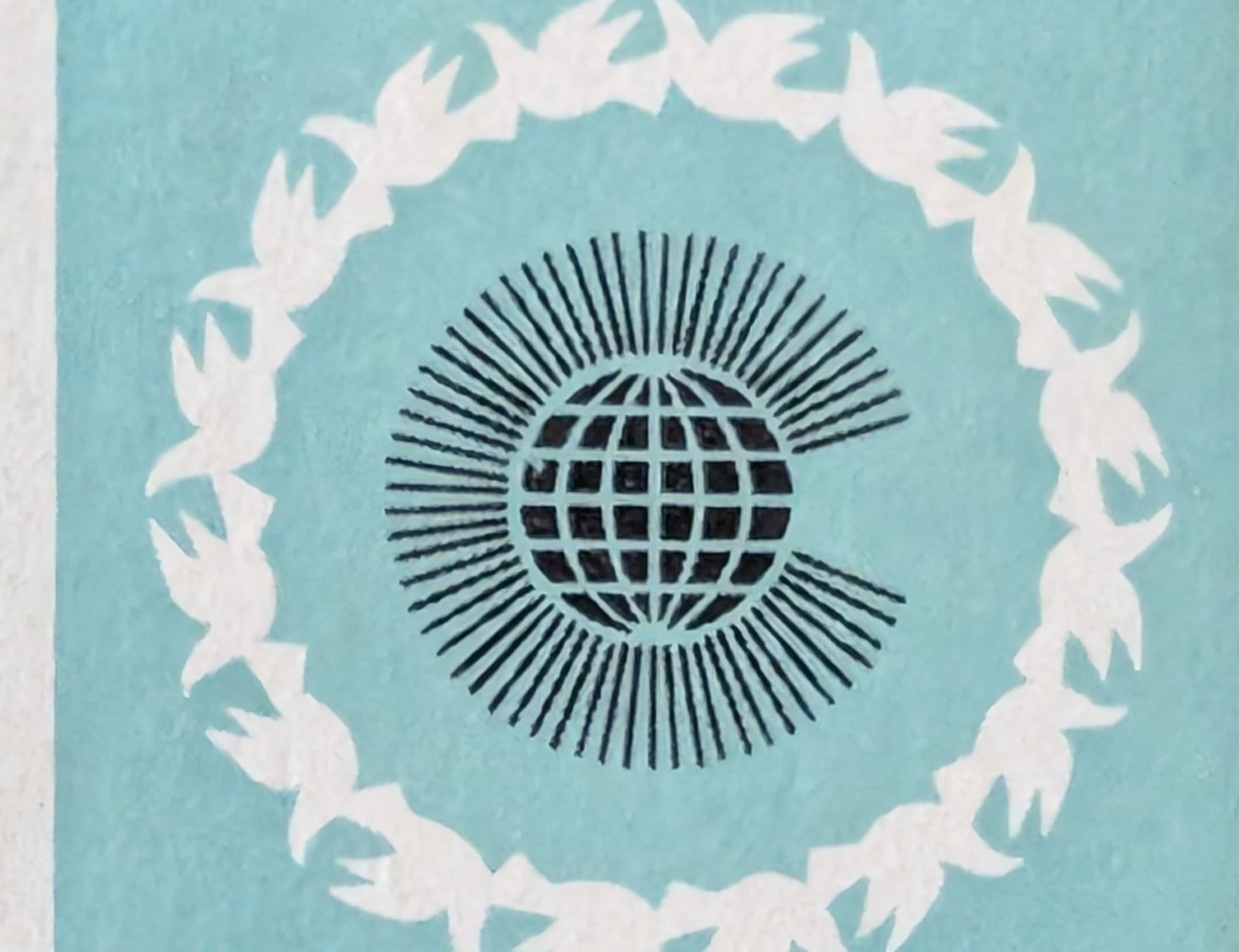
Circling the borrowed emblem is a wreath of stylised white birds, wing to wing, chasing each other around the globe. The doves are not part of the official Commonwealth device; the stamp adds a ring of them around it. If the globe-and-rays is the institution talking, the ring of doves is the host adding a line of its own — a wreath of peace around a summit of governments.
It is a quietly diplomatic piece of composition. The Commonwealth supplies the noun; India supplies the adjective. The stamp does not argue with the emblem or crowd it; it frames it, the way a good host seats a guest at the head of the table. Nothing about the design competes with the thing it was made to honour.
Why a country would print someone else’s badge
The self-effacement was not entirely India’s idea, and knowing that changes how the stamp reads. At the previous summit, in Melbourne in 1981, the Commonwealth heads had agreed in principle to a coordinated special stamp issue every five years — partly to raise the organisation’s profile, partly to contribute to the Commonwealth Fund for Technical Cooperation. By the time the leaders reached New Delhi, the “Special Commonwealth Stamp Issue” was a numbered paper on the conference agenda alongside apartheid in southern Africa and reform of the world’s financial institutions. The stamp, in other words, was a collective decision the members had taken together, and India was executing its share of a shared plan.
That reframes the design. A stamp with no national pictorial symbol is less strange once you see it as one panel in a set the whole club was producing — each member printing a version of the same idea, so that the emblem, not any one country’s face, was what travelled. India’s contribution was to render the agreed emblem well and to ring it with peace.
But the deeper reason a country prints someone else’s badge is that, by 1983, India had made its peace with an old contradiction. It left the Empire in 1947 and remained in the Commonwealth as a republic in 1949 — the first to do so, under a formula that recognised the King as the association’s symbolic head without making him India’s sovereign. That compromise, embodied in the 1949 London Declaration, established the constitutional formula on which the modern Commonwealth was built. To host the summit and put the club’s own emblem on the stamp was, in a way, India acknowledging authorship of the arrangement rather than distancing itself from it.
The summit the stamp does not mention
What the stamp leaves out is as pointed as what it includes. The New Delhi meeting was not a ceremonial gathering. Its agenda was dominated by southern Africa — the Commonwealth was moving, summit by summit, toward the confrontation over sanctions against apartheid South Africa that would nearly split it apart at Nassau in 1985 and again in London in 1986. Grenada, freshly invaded by the United States weeks before the leaders arrived, and the nuclear standoff between Washington and Moscow filled the rest of the room.
None of that is on the stamp. A globe ringed by doves puts the meeting into the language of cooperation and peace, and says nothing about who is fighting with whom over what. That is not a criticism. A commemorative stamp is a handshake at the door, not a transcript of the argument inside. But there is a gap between the serenity of the image and the difficulty of the week it marked.

Only two explicitly national marks appear in the dominant visual element: the maroon 100 in one corner and भारत / INDIA in the other. Everything else — the emblem, the register, the message — is the Commonwealth’s. For a nation that usually filled its stamps with its own faces and forts and rivers, that restraint is the most Indian decision on the sheet.
The stamp asks to be read as an emblem of unity, and it is one. It just happens to mark a meeting where unity was the problem to be solved, not the mood in the room — and where the country that printed it had spent decades deciding exactly how much of this club it wanted to belong to.
Further Reading & Links
- India’s other 1983 New Delhi summit — the stamp that drew a map instead of a flag — how India pictured its own neighbourhood two years later.
- Sanchi Stupa, 1994 — a monument where a leader’s portrait might have gone — the same instinct to keep the national face off the stamp.
- Hansa Mehta, 1998 — India’s hand in drafting the Universal Declaration of Human Rights — the same country picturing itself through a shared international institution, this time the UN.
- 1983 Commonwealth Heads of Government Meeting — the New Delhi summit, its dates, chair and agenda.
- Flag and emblem of the Commonwealth of Nations — the globe-and-rays device, adopted 1976, and its Canadian origins.
- Commonwealth summit records, New Delhi 1983 (Commonwealth Secretariat library) — the conference papers, including HGM(83)6, the Special Commonwealth Stamp Issue.