The Sentence That Sent a Man to Prison
The empire jailed Tilak for a sentence. The Tilak Swaraj stamp 1988 mailed it nationwide.
The Stamp
- Country: India
- Issued: 16 August 1988
- Denomination: 60 paise (each stamp in pair)
- Format: Vertical se-tenant pair
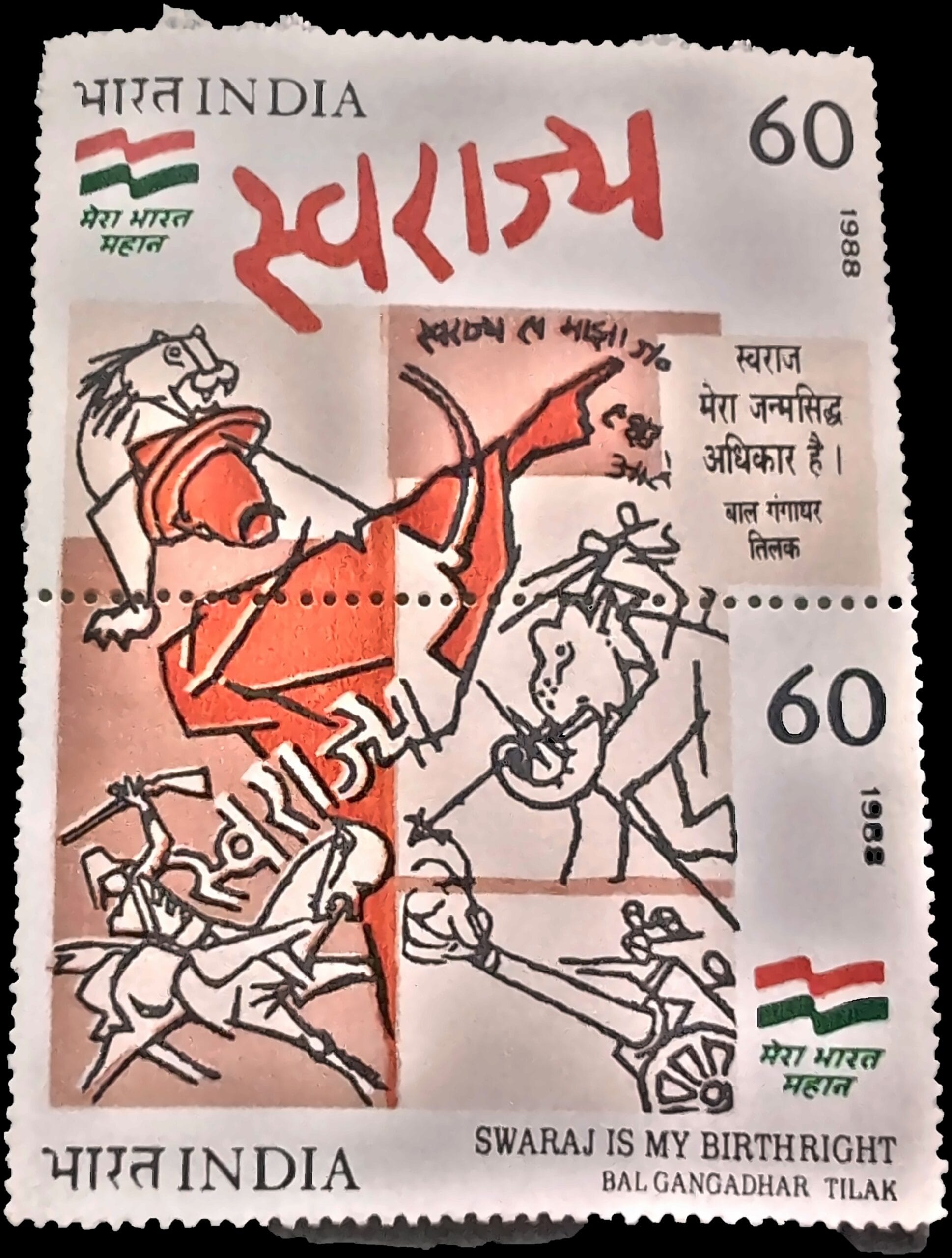
- Subject: “Swaraj Is My Birthright” — Bal Gangadhar Tilak
- Design: Painting by M.F. Husain
- Series: Freedom Forty
- Printing: Photogravure
- Issuing Authority: India Post
The Story
The British convicted Bal Gangadhar Tilak of sedition twice — in 1897 and again in 1908 — for words he published in Kesari, the Marathi-language newspaper he founded in Pune. Ninety years after the first trial, the Republic of India placed his most defiant sentence on a postage stamp and circulated it through its own postal system. The empire punished the phrase; the nation canonized it.
The Man the Empire Called Dangerous
Tilak was born Keshav Gangadhar Tilak on 23 July 1856 in Ratnagiri, a coastal district in the Bombay Presidency. He trained as a lawyer at Elphinstone College and the Government Law College in Bombay, but chose education and journalism over legal practice. In 1881, at twenty-four, he co-founded Kesari (“The Lion”) in Marathi and The Mahratta in English — twin newspapers designed to articulate political consciousness to audiences the Indian National Congress had not yet reached.
What made Tilak dangerous to the colonial administration was not ideology alone. It was method. He understood that abstract political arguments in English-language periodicals would not mobilise a largely rural, semi-literate population. So he built an alternative infrastructure of political consciousness — one disguised as culture.
In 1893, after the British government’s anti-public assembly legislation of 1892 had effectively banned Hindu gatherings of more than twenty people, Tilak seized on a loophole: the law exempted religious assemblies. He transformed the Ganesh Chaturthi celebrations — until then a private domestic ritual in Maharashtra — into large, organised public festivals held in open spaces, accessible to all castes and classes. The pavilions hosted not just worship but political speeches, nationalist poetry recitals, plays, and folk performances. A religious festival became a parliament the British could not legally shut down.
He applied the same logic to the Shivaji festival, reviving it as a vehicle for historical pride that cast the Maratha warrior-king as a precedent for resistance to foreign rule. Through newspapers, festivals, and public oratory, Tilak constructed a political language that operated below the threshold of what the colonial state recognised as sedition — until, inevitably, the state revised that threshold downward to catch him.
Two Trials, One Phrase
The first prosecution came in 1897. When bubonic plague devastated Pune and British forces enforced invasive house-searches under military escort — entering homes, examining occupants, destroying personal property — Tilak’s editorials in Kesari criticised the administration with increasing ferocity. He quoted the Bhagavad Gita to argue that no blame attached to anyone who killed an oppressor without thought of reward. After two plague officials, Commissioner W.C. Rand and Lieutenant Ayerst, were assassinated by the Chapekar brothers, the colonial government charged Tilak under Section 124A — sedition. He was convicted and sentenced to eighteen months’ rigorous imprisonment, emerging as a national figure whose punishment had confirmed his relevance.
The second trial, in 1908, proved more consequential and more theatrically unjust. On 30 April 1908, two Bengali revolutionaries — Prafulla Chaki and Khudiram Bose — threw a bomb at a carriage in Muzaffarpur, intending to kill Chief Presidency Magistrate Douglas Kingsford but erroneously killing two women. Tilak’s Kesari editorials defended the revolutionary impulse and called for immediate swaraj. Arrested on 25 May, he stood trial before Justice Dinshaw Davar and a special jury of six Europeans and three Parsis — no Hindu among them. The jury convicted by a vote of seven to two. Muhammad Ali Jinnah, then a young barrister, served as his defence lawyer.
Justice Davar’s sentencing remarks abandoned judicial restraint entirely. He called the articles “seething with sedition” and condemned Tilak for hailing “the advent of the bomb in India as if something had come to India for its good.” The sentence: six years of rigorous imprisonment in Mandalay, Burma, and a fine of one thousand rupees. It was during this forced silence that Tilak’s reputation grew beyond Maharashtra into all-India consciousness. He wrote the Gita Rahasya in his cell; Mahatma Gandhi would later call him “the Maker of Modern India”; Jawaharlal Nehru named him “the Father of the Indian Revolution.”
Birthright as Battle Cry
The phrase “Swaraj is my birthright and I shall have it” — in Marathi, “स्वराज्य हा माझा जन्मसिद्ध हक्क आहे आणि तो मी मिळवणारच” — was originally coined by Tilak’s associate Kaka Baptista, but it was Tilak who wielded it as a political weapon and became inseparable from it. The sentence crystallised his philosophy into a single rhetorical device: it reframed self-rule not as a colonial concession to be petitioned for, but as an inherent right being withheld. It collapsed the distance between political philosophy and personal grievance — anyone who heard it could adopt it as their own claim.
After his release from Mandalay in June 1914, Tilak channeled this energy into the All India Home Rule League, co-founded with Annie Besant in 1916. The league grew from 1,400 members in April 1916 to approximately 32,000 by 1917 — evidence that the language of birthright had found its audience. Tilak died on 1 August 1920, six months before the Non-Cooperation movement would take the demand for swaraj into every village in India. The man who declared the birthright did not live to see it claimed.
Why India Post Issued the Tilak Swaraj Stamp 1988
India Post issued the Tilak Swaraj stamp 1988 on 16 August — one day after the forty-first anniversary of Indian independence. The timing placed it within the “Freedom Forty” commemorative series, a sustained philatelic effort by India Post throughout 1987–1988 to mark four decades of self-rule through stamps celebrating the independence movement’s key figures and moments. The Tilak Swaraj se-tenant pair was among the series’ most visually ambitious entries, commissioning original artwork rather than adapting a portrait photograph.
The choice of artist was itself a statement. M.F. Husain — India’s most celebrated modern painter, who had been nominated to the Rajya Sabha in 1986 — provided the dynamic composition that fills both stamps. Husain was not an obvious selection for a philatelic commission; his canvases typically measured in feet, not centimeters. His involvement elevated the stamp from governmental souvenir to artistic collaboration between the state and its most prominent living painter. The galloping horse — Husain’s lifelong motif for national energy — charges across the perforation line as if the boundary between the two stamps cannot contain the movement’s momentum.
“The empire punished the phrase; the nation canonised it.”
Looking Closer
The Tilak Swaraj Stamp 1988 as Manifesto
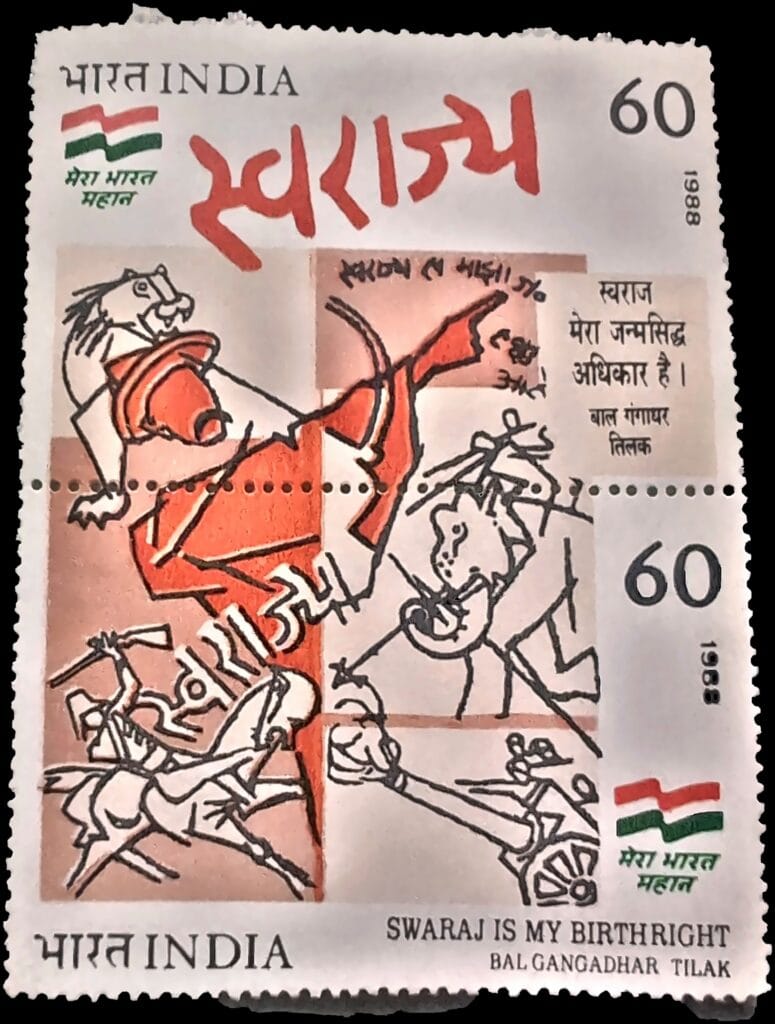
The Tilak Swaraj stamp 1988 is designed to be read as a single vertical painting split by a perforation line — a deliberate rejection of the conventional portrait-and-text format that dominates Indian commemorative stamps. The composition demands that the viewer see both halves together, which means the act of separating the stamps destroys the artwork’s coherence. The postal object and the art object are in tension: use one, lose the other.
Husain’s Visual Language
M.F. Husain’s signature style is unmistakable here — the galloping horse and rider rendered in bold red-orange strokes, the figures in dynamic motion, bodies caught mid-gesture. Husain repeatedly used the horse as a symbol of national energy and forward momentum throughout his career. On this stamp, the mounted warrior charges through the frame surrounded by freedom fighters, their postures suggesting collective uprising rather than individual heroism. The visual argument is clear: swaraj was not one man’s declaration but a people’s movement that Tilak’s words catalysed.
Typography as Hierarchy
The word “स्वराज” dominates the upper stamp in oversized red Devanagari script — larger than the denomination, larger than the country name, larger than anything else on the surface. This is a typographic choice that subordinates the postal function to the political message. The stamp announces its subject before it announces its price. Below, the English translation “SWARAJ IS MY BIRTHRIGHT” and “BAL GANGADHAR TILAK” occupy a quieter register, serving international legibility. The bilingual architecture mirrors India Post’s standard practice, but the scale disparity between Hindi and English text here communicates something beyond convention: this is a message first, a stamp second.
The Tricolour as Framing Device
Two Indian flags bookend the composition — one at the top left, one at the bottom right — creating a diagonal axis that frames Husain’s central painting. They function not as decoration but as temporal markers: the flag that did not exist during Tilak’s lifetime now brackets his words, confirming that the birthright he demanded was eventually secured. The stamps perform a completed circle — from demand to fulfilment — within a four-centimetre frame.
Closing
Tilak spent six years in a Mandalay prison for the crime of publishing words the British Crown considered dangerous. Eight decades later, the Tilak Swaraj stamp 1988 printed those same words on gummed paper and asked its postal workers to carry them across the country, sixty paise at a time. Every letter that bore this stamp completed a journey Tilak began but never finished — from sedition to sovereignty, from a jail cell to a letterbox.
This stamp belongs to StampTales’ Time Capsule collection, and sits alongside the site’s other chronicle of India’s freedom movement — the Gandhi stamp, issued six years later, for the self-rule Tilak did not live to see. Kesari, the Marathi newspaper Tilak built his political voice around, has its own long afterlife — Wikipedia’s entry on Kesari traces it from its 1881 founding to the newspaper it remains today. The artwork on this very stamp pair rewards a closer look too — see it broken down detail by detail in Through the Lens. Every stamp on this site, including this one, is photographed from the author’s own collection — more on that process is on the About page.

7 Comments
Comments are closed.