The 1994 Gandhi Stamp – Three Postures, One Stark Legacy
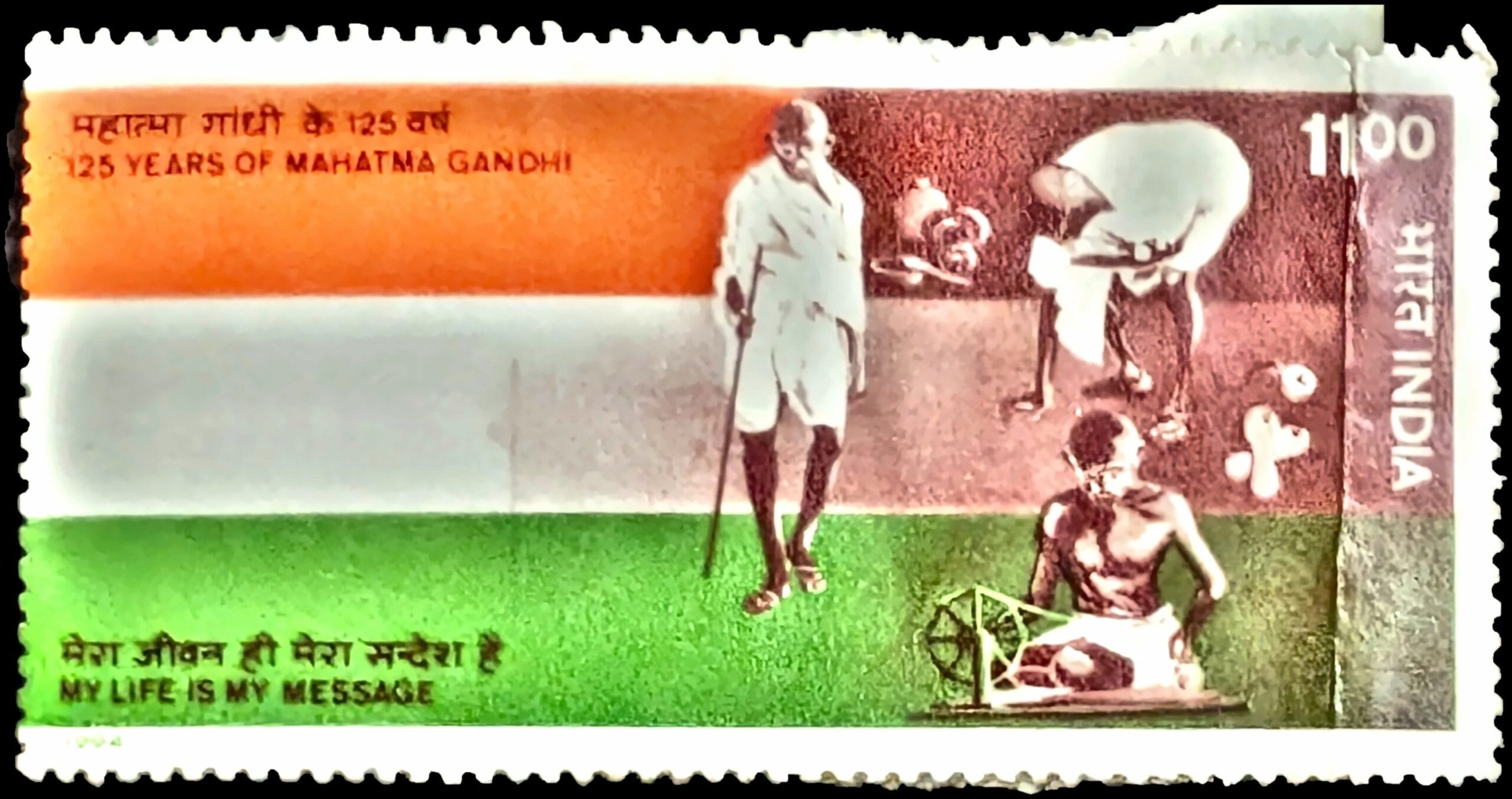
The 1994 Gandhi stamp India issued for his 125th birth anniversary was the first to show his life in three postures instead of one — and the tricolour itself was the medium.
The Stamp
Issued: 1994, India Post
Denomination: ₹11.00
Occasion: 125th birth anniversary of Mohandas Karamchand Gandhi (born 2 October 1869)
Inscription: “मेरा जीवन ही मेरा संदेश है / My Life Is My Message”
The Story
The 1994 Gandhi stamp India issued for his 125th birth anniversary did something no earlier commemorative had tried — it told his life story in three postures instead of one.
In 1994, India turned 47. Gandhi had been dead for 46 years. And yet, when India Post chose to mark the 125th anniversary of his birth, the design team reached not for a single portrait — but for three.
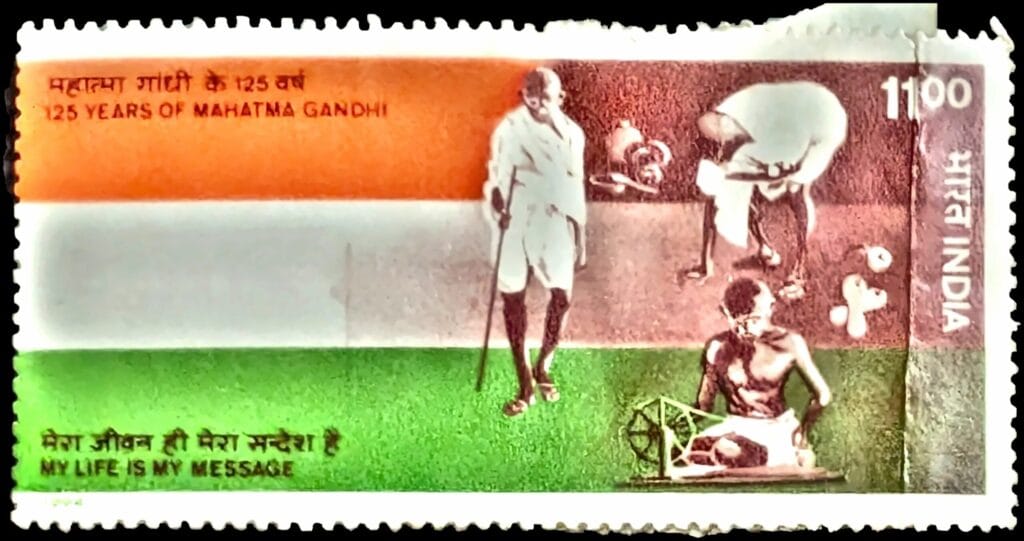
The stamp is divided by the Indian tricolour. Saffron at the top. White in the centre. Green at the base. Each band holds a different Gandhi:
- Standing tall with his walking staff — the pilgrim, the traveller, the man who believed in arriving on foot.
- Bent forward, mid-stride — the activist, leaning into resistance, body curved against the weight of empire.
- Seated at the charkha — the spinner, the economist, the man who argued that self-reliance begins with a single thread.
Three postures. Three philosophies. One man.
The choice was not decorative. A portrait fixes a person at one moment — the Gandhi of the spinning wheel, or the Gandhi of the salt march, or the frail elder of the last years. Placing three figures on a single stamp refuses that freezing. It insists that the man was a sequence, not a snapshot: that the pilgrim, the resister, and the economist were the same argument carried out in three registers.
At the bottom, in both Hindi and English, the inscription that has outlived every statue and every speech: “My Life Is My Message.” The words were Gandhi’s own, given to a journalist who had asked, near the end, for a message to carry back. He replied that he had none to give apart from the life itself. On a stamp built from three postures, the line reads less like a slogan than like an instruction for how to look at it.
Why the 1994 Gandhi Stamp India Broke With Tradition
This stamp didn’t need to be bold. At ₹11 — a routine denomination for 1994 — it wasn’t designed to be rare or collectable. It was designed to travel. On envelopes across the country, carried by postmen on bicycles, pressed into the hands of clerks and shopkeepers and students.
That’s the quiet genius of commemorative postage. A museum asks you to come to it. A stamp comes to you.
By 1994, India had issued dozens of Gandhi stamps. But the 1994 Gandhi stamp India did something the others hadn’t: it showed him in motion across a full life, not frozen in a single moment. The break was one of grammar as much as design — earlier issues had treated him as an icon to be venerated; this one treated him as a life to be read.
The 1994 Gandhi stamp India in a longer line of tributes
India began putting Gandhi on its stamps almost immediately after his death. The 1948 Memorial issue, released within months of his assassination, showed a single sombre portrait — mourning made official. The 1969 series marked his birth centenary; the 1980 commemoration returned to the Dandi salt march. Each earlier tribute isolated one Gandhi: the martyr, the centenarian’s memory, the marcher.
Set against that line, the 1994 Gandhi stamp India is the outlier. It is the first to concede that no single image could hold him, and to make that concession the whole design. Where the 1948 stamp asked the viewer to grieve and the 1969 stamp asked the viewer to commemorate, the 1994 stamp asks the viewer to follow — from the staff, to the stride, to the wheel.
Further Reading & Links
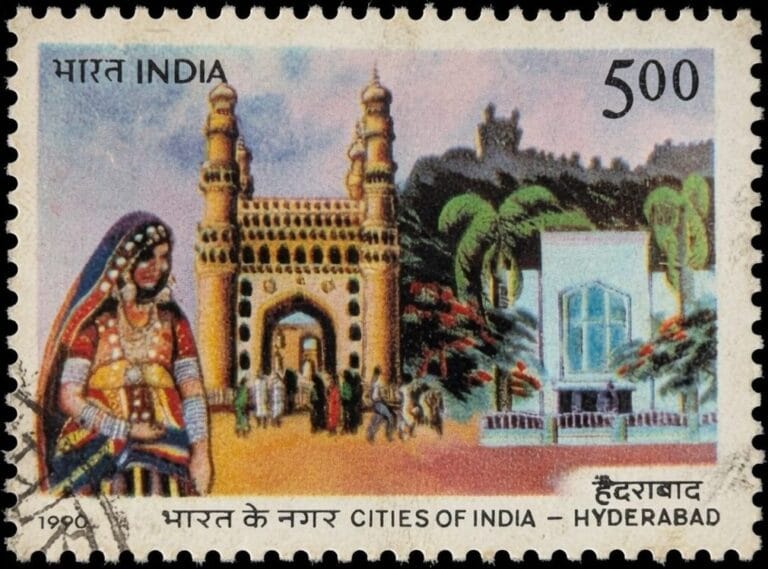
This stamp sits within StampTales’ Time Capsule collection. The charkha at the base of the design carried real political weight in Gandhi’s lifetime: Google Arts & Culture’s history of the charkha traces how it became the Swadeshi movement’s central symbol before the Ashoka Chakra replaced it on independent India’s flag. For Gandhi’s own relationship with spinning, Live History India’s account of his charkha is a good next read. The same year this stamp appeared, India also issued a ₹5 definitive showing the Sanchi Stupa — where this ₹11 Gandhi commemorative pictured the nation through a leader’s face, the Sanchi definitive pictured it through a two-thousand-year-old monument.
9 Comments
Comments are closed.