Cuba’s Hidden 1982 Lighthouse for an Island No One Lives On
Cuba put this lighthouse on a stamp in 1982. Nobody has ever lived on the island it guards.
The Stamp
- Country: Cuba
- Year: 1982
- Denomination: 5 centavos
- Subject: Faro Cayo Jutías (Cayo Jutías Lighthouse)
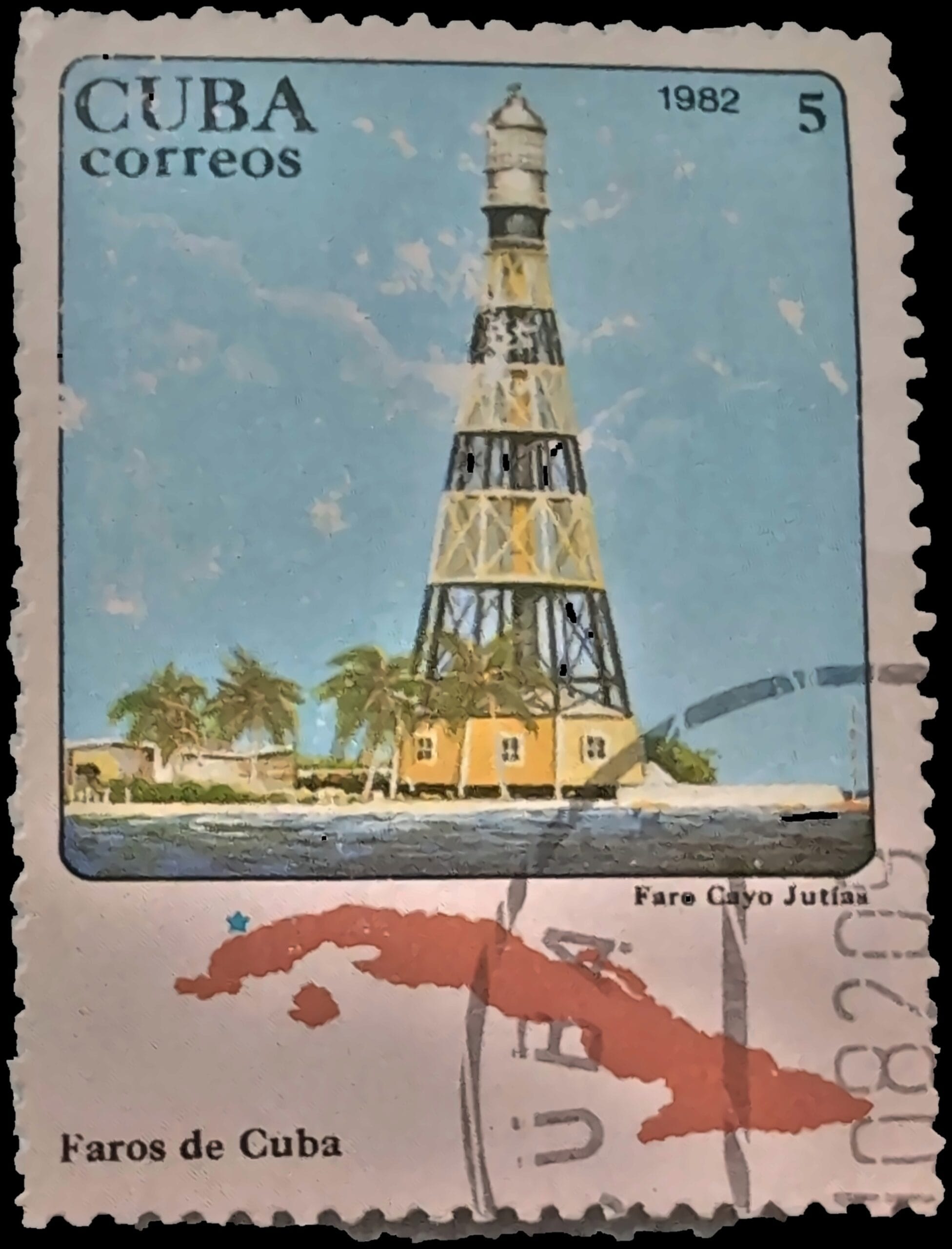
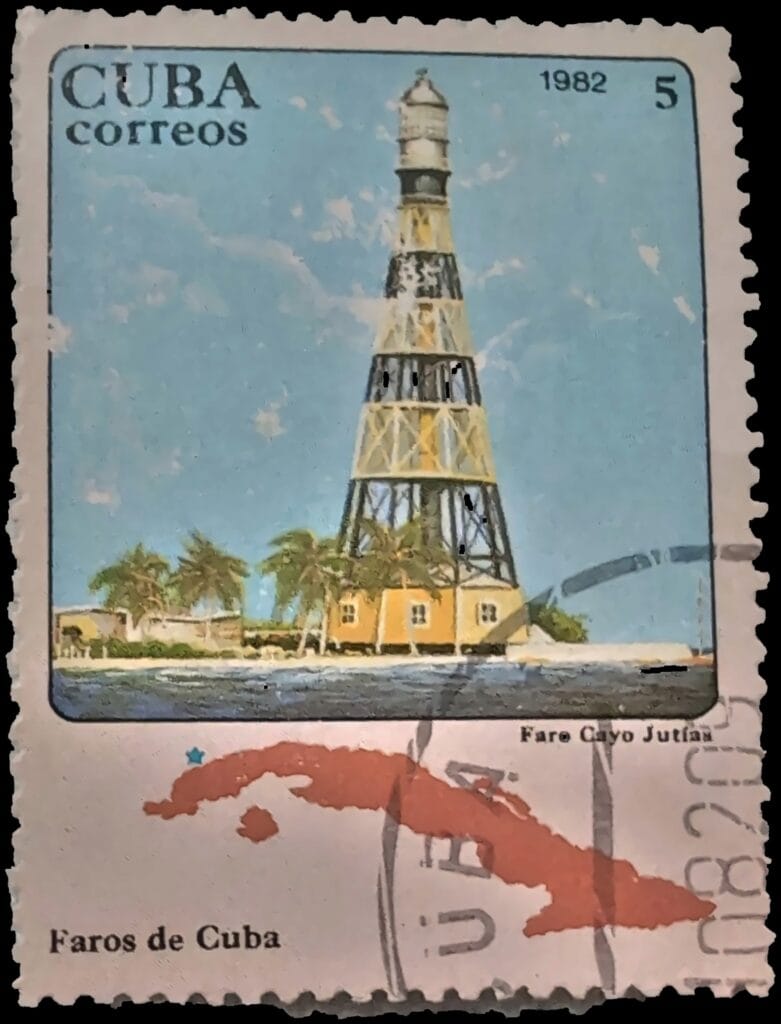
- Design: An illustrated view of the lighthouse and its adjoining keeper’s house, palms, and shoreline, paired with a small outline map of Cuba with a star marking the lighthouse’s location on the island’s northwest coast.
The Story
The Faro Cayo Jutías stamp puts its lighthouse in the middle of nowhere — literally. Cayo Jutías sits on Cuba’s northern coast, part of the Los Colorados archipelago in Pinar del Río province, closest to the small settlement of Santa Lucía. It has never had a town, a harbor, or a single permanent resident. What it has always had is a reef, and a lighthouse built to warn ships away from it.
The tower went up in 1902, in the brief window of American occupation between Spain’s withdrawal from Cuba and the start of Cuban self-governance. It was one of at least two lighthouses the occupying administration built on the island during that period — infrastructure raised by a government that would not be in charge much longer, for a coastline it was about to hand over entirely.
Through the nineteenth century, Spain’s colonial government had already strung more than thirty lighthouses along Cuba’s coastline to protect shipping. This particular stretch — an uninhabited cay facing the Gulf of Mexico — was not among them, until 1902 finally filled the gap.
No town ever grew up around the light. Cayo Jutías was never settled, and the lighthouse was never built to guide anyone home — only to warn ships away from a reef that could open a hull long before a sailor ever saw land. More than a century later, this uninhabited cay’s only real claim to a place on any map is still this one steel tower.
Cuba’s postal service spent plenty of stamps on presidents and revolutions. That the Faro Cayo Jutías stamp spent one, in 1982, on a lighthouse nobody lives near says something worth noticing: a nation’s story isn’t written only by the people who run it — it’s also carried by the quiet, unglamorous structures that just keep working, night after night, whether or not anyone is watching.
History often celebrates those who changed the world. Infrastructure quietly makes the world possible.
Looking Closer
The Faro Cayo Jutías stamp shoots the tower from near its base, looking sharply upward, so the lattice steelwork tapers away toward a distant lantern room. From that angle, the skeletal cross-bracing reads almost like a rhythm — alternating bands of dark and pale steel climbing the frame. That’s not incidental: lighthouse keepers have long relied on a tower’s paint scheme as a daymark, a way to tell one silhouette from another along a coast, and this illustration reproduces that idea closely enough to double as a small lesson in how lighthouses are meant to be read from a distance.
At the tower’s foot, a keeper’s house in matching warm yellow anchors an otherwise soaring composition in human scale. The palms beside it do two things at once: they place the scene unmistakably in tropical Cuba, and they soften the industrial steel rising above them.
Below the main illustration on the Faro Cayo Jutías stamp sits a second, smaller device: a red silhouette of Cuba with a single star marking the northwest coast. The Faros de Cuba series wasn’t only cataloguing individual towers — it was fixing each one to its place on the national coastline, one stamp at a time.
On this Faro Cayo Jutías stamp, the postmark adds an honest layer the illustrator never intended. The cancellation lines run diagonally across the whole stamp, cutting through the tower itself as much as the map beneath it — a plain reminder that this is a used, posted stamp with a real postal history, not a pristine mint specimen.
Closing
Long before satellites circled the Earth, a flash of light was enough.
For generations of sailors, a lighthouse was reassurance made visible—a promise that land, danger and safety all had known positions. That quiet certainty is what this small Cuban stamp preserves.
It is easy to overlook a lighthouse because it exists to prevent drama rather than create it. Yet every safe arrival owes something to the structures that stood watch through countless uneventful nights.
This stamp asks us to remember them.
Sometimes history isn’t lit by the brightest spotlight. Sometimes it’s the steadiest beam that gets remembered. If quiet, overlooked stories like this one are your kind of history, the Gandhi ₹11 stamp feature is another example of a small object carrying more than it first lets on, and the World in a Stamp category has more like it. For the lighthouse’s full technical record — focal height, range, and light characteristic — the Lighthouse Directory at UNC Chapel Hill and Wikipedia’s list of Cuban lighthouses are both good starting points.




2 Comments
Comments are closed.