Borrowed Power — The 1989 Fleet Review Stamp and the Submarine India Had to Give Back
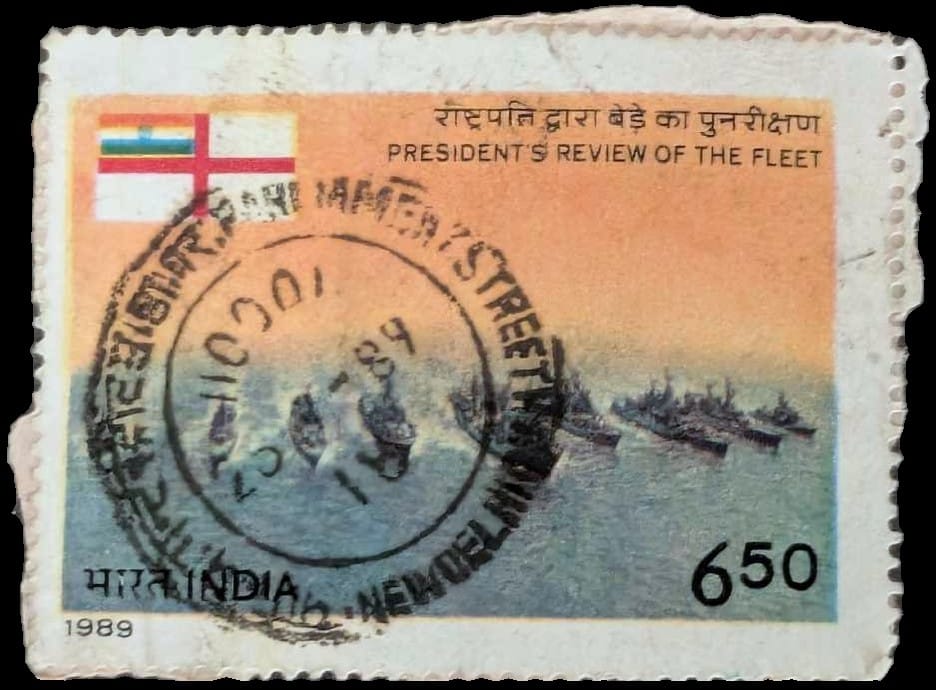
The Stamp
- Country: India
- Year of Issue: 1989
- Denomination: 650p (₹6.50)
- Occasion: 7th President’s Review of the Fleet, off Bombay, 15 February 1989
- Reviewing President: R. Venkataraman
- Issuing Authority: Department of Posts, India
- This copy: Used single; postmarked New Delhi, October 1989 (exact day stylized/unclear on the cancellation, not stated as certain); toning, edge wear and perforation loss on one corner, and a torn paper edge, are original condition — preserved, not restored
The Story
The submarine sailing past the President was already promised back.
This 1989 Fleet Review stamp captures a single ceremonial morning off Bombay — but its most celebrated participant had a return address in the Soviet Union.
On 15 February 1989, R. Venkataraman, then President of India, stood aboard the Presidential yacht off the Gateway of India to review the seventh President’s Fleet Review since Independence. Eighty-six ships from the Navy and Coast Guard steamed past in formation — more than the sixty-five that had turned out for the previous review in 1984. Both of India’s aircraft carriers, INS Vikrant and INS Viraat, sailed the same column that day; the two carriers overlapped in service for only a decade, from Viraat’s 1987 commissioning to Vikrant’s 1997 decommissioning, and this review fell inside that window.
The ceremony itself follows a fixed choreography, largely unchanged from review to review. The President arrives to a 21-gun salute and boards the Presidential Yacht, distinguished from every other vessel present by the President’s Standard on its mast and the Ashoka emblem at its side.
The yacht then moves slowly past columns of anchored ships, each crew manning the rails in salute, before a second, mobile column of ships and submarines streams past in review — the Navy’s way of demonstrating not just what it owns, but what it can move under its own power. None of that pageantry survives onto the stamp. What the design keeps is the aftermath: ships already reformed into sailing order, the ceremony implied rather than shown.
Among those eighty-six ships sailed one that had already made headlines on its own. INS Chakra had joined the fleet just over a year earlier, becoming the first nuclear-powered submarine to fly the Indian ensign — and its presence at the review was broadcast to television audiences across the country. It hadn’t been built in India or bought outright. It was a Charlie-class cruise-missile submarine, leased from the Soviet Union for three years — the first time any nation had leased a nuclear submarine to another.
Why the 1989 Fleet Review Stamp Chose a Submarine
The lease came with conditions. Chakra sailed without nuclear weapons, was barred from combat use, and operated under a clock that had started the moment its Indian crew took command at Vladivostok in early 1988. By the time it passed the Presidential yacht, watched by television audiences across the country, less than two years remained on that lease. The submarine that made India the sixth nation to operate nuclear-powered underwater propulsion would sail back to the Soviet Union before the decade closed, decommissioned at Vladivostok in January 1991 — twenty-three months after this stamp went on sale.
International coverage understood the contradiction even then. Time magazine framed India’s new capability as the arrival of a rising power, while the Washington Post cast the same submarine with open suspicion — two very different reactions to one leased hull. Neither framing was really about the vessel itself. Both were responses to what its presence suggested about where Indian naval ambition might be heading, regardless of whether the ship would still be Indian by the time anyone found out.
None of that ambiguity survives in the stamp’s design. The 650-paise issue — a notably high denomination for a 1989 commemorative — shows only a column of naval vessels moving toward the horizon, dark silhouettes suspended between a blue upper sky and a warm amber sea. No single ship is identifiable in that line — carrier, destroyer, and submarine blur into the same dark shape. Whichever silhouette a viewer takes for Chakra, nothing in the image tells you that vessel was on loan, or that its clock had already started. The stamp recorded a fleet at its most confident, days after acquiring a technology no one was certain it would keep.
The Presidential Fleet Review tradition itself predates the Republic by centuries. Naval reviews by a head of state trace back to the British monarchy in the fifteenth century, and closer to home, the Maratha commander Kanhoji Angre reviewed his own fleet off Ratnagiri in the eighteenth century. India’s Republic-era version, held roughly once per Presidential tenure, ranks second only to the Republic Day parade in ceremonial weight.
The Department of Posts had begun commemorating it on stamps only five years earlier, with the 1984 review under President Zail Singh. What changed between the two issues wasn’t the ceremony — it was the stakes. By 1989, India wasn’t only displaying ships it owned outright. It was showing off a capability it had rented, betting that the experience gained would outlast the lease itself.
The wager did eventually pay off — just not with this particular hull, and not only through this one vessel. The fleet reviewed that day was never just Chakra: it included frigates, destroyers, minesweepers, and two aircraft carriers built and acquired years apart, the ordinary backbone of any navy’s strength.
But the experience gained during Chakra’s three Indian years did contribute to the institutional knowledge that later supported India’s indigenous nuclear-submarine programme; INS Arihant, India’s first indigenously built nuclear-powered submarine, was launched almost two decades after this review, as one product of that longer effort. A second INS Chakra, leased from Russia in 2011, served for another decade before it too sailed home. This 1989 Fleet Review stamp, then, isn’t only a record of one ceremony off Bombay. It’s an early chapter in a pattern that has recurred roughly once a generation since: India borrowing the capability first, and building the confidence to own it later.
Looking Closer
Look at where the ships sit in the frame. The task force occupies barely the lower third of the stamp — a thin, dark line moving diagonally across a horizon that dominates everything above it. That’s an unusual choice for a stamp meant to project naval strength: the vessels are small, almost incidental, dwarfed by sky and sea. The effect reads less as “look how large our navy is” and more as “look how much space our navy now claims” — presence measured by reach, not scale.
The color transition running through the design carries its own argument. The upper register is a cool blue-grey; the lower register, where the ships sail, glows amber-orange, as if lit from below by a rising or setting sun. Contemporary Indian commemoratives rarely used a gradient this deliberate for a straightforward documentary subject. Whether the intended light is dawn or dusk, the ambiguity works in the stamp’s favor: a fleet review is exactly that kind of staged moment, built to look like a beginning, commemorating an achievement that — in the case of its most advanced participant — was already counting down to an ending.
The Naval Ensign occupies the bottom-right corner, small and unforced rather than centered as the dominant graphic element many contemporary military stamps favored. It functions closer to a signature than a flag-waving statement — confirmation of ownership placed quietly beside ships whose ownership, in at least one case, wasn’t fully settled.
The bilingual caption beneath the ships — Hindi above, English below — states the occasion plainly: President’s Review of the Fleet. No superlatives, no adjectives describing scale. For a government stamp commemorating a record-setting display of naval power, that restraint is notable. The image is left to argue for grandeur; the text simply names what happened.
Closing
Two years after this stamp reached post office counters, the submarine that gave the 1989 review its edge sailed quietly back to Vladivostok, its ensign lowered for the last time under Indian command. What remained wasn’t the hull — that returned to a navy that would later scrap it — but proof of concept: that Indian sailors could run a nuclear reactor at sea, competently, for three uneventful years. A stamp can only show a fleet on the day it sailed past the President. It can’t show the calendar already running underneath the hull that mattered most.
Series Context
This 1989 stamp continues a story StampTales began five years earlier. That first chapter — A Hundred Paise for a Navy That Preferred Silence — The Fleet Review Stamp of 1984 — covers the review that started the whole commemorative habit.
For a same-year companion from a very different corner of Indian life, India’s First Heroine Wasn’t a Woman. The Stamp Never Says So. looks at the platinum-jubilee cinema stamp issued the same year. And a year earlier, The Sentence That Sent a Man to Prison told the story of the 1988 Tilak Swaraj stamp — a reminder that the Department of Posts used the same medium in the same decade to project two very different kinds of national confidence: one built on defiance, the other on hardware.
Further historical detail comes from Wikipedia’s entry on the President’s fleet review, its dedicated page on the Soviet submarine K-43, and Bharat Rakshak’s technical profile of the Charlie-class INS Chakra.


2 Comments
Comments are closed.