Three stamps short of a frame
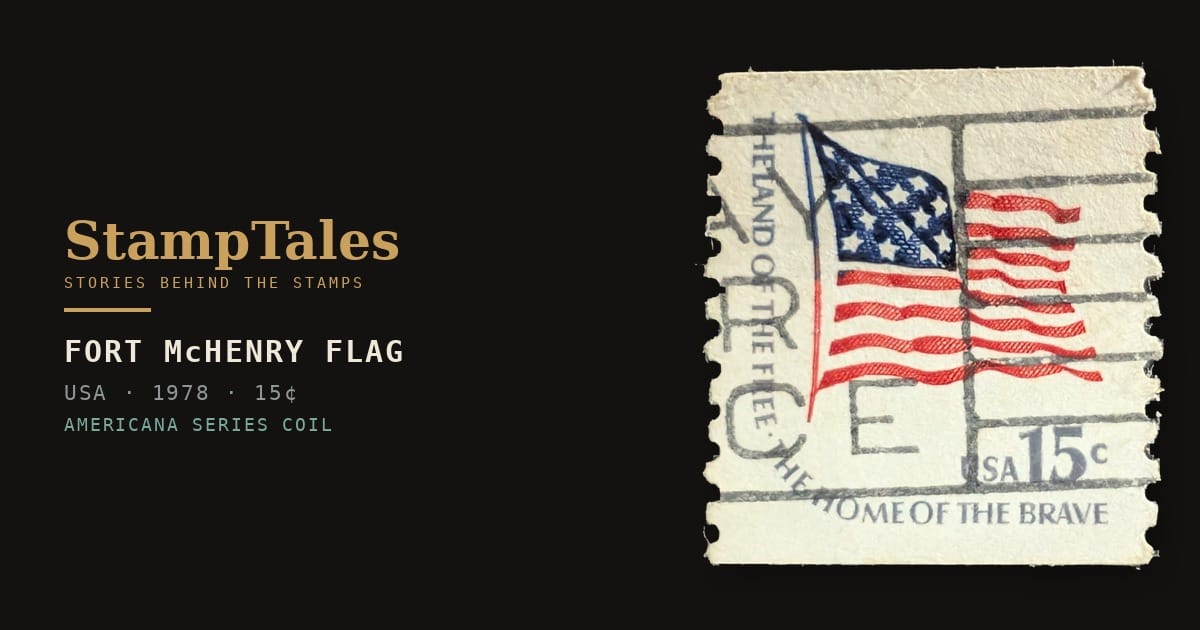
The words on this stamp were designed to meet the words on three others. The Land of the Free runs up its left edge; The Home of the Brave runs along its bottom; and the 1978 Fort McHenry Flag belongs to a series built so that four copies, set in a block, close their borders into a single frame around four flags. This one never will. It is the coil — the version that comes off a roll in single file, one stamp behind the next, and is never printed or sold as the square of four the design was waiting for.
Those two phrases are the last lines of every verse of the national anthem, the ones a stadium crowd actually knows. Francis Scott Key wrote them in 1814 after a night of watching bombs fall on Fort McHenry. On the stamp they wrap a flag around two sides — and the whole object was made to be pulled off a roll, licked, and stuck on a fifteen-cent letter. It is one of the best-known lines the country owns, printed on one of the most disposable things it makes.
| Issue | Fort McHenry Flag (Americana Series) |
|---|---|
| Issued | 30 June 1978, Baltimore, MD |
| Denomination | 15 cents |
| Country | United States |
| This copy | Coil, Scott #1618C — perforated 10 vertically |
| Designer / modeller | V. Jack Ruther |
| Engraver (vignette) | Thomas R. Hipschen; lettering, Robert G. Cullin, Sr. |
| Printer | Bureau of Engraving and Printing (line-engraved) |
| Coil quantity | 596,700,000 |
Why the Fort McHenry Flag wraps its words around a corner
The stamp was part of a system. Between 1975 and 1981 the Postal Service rolled out the Americana Series to replace its ageing Prominent Americans definitives, and — unusually — it hired an outside firm, Kramer, Miller, Lomden & Glassman of Philadelphia, to give the whole set one visual grammar. Every design in the series carries its lettering along two adjoining sides rather than framing it neatly inside. Set four of them together in a block, and those side-inscriptions line up into a border running around all four vignettes at once. The stamps were drawn to be read in company.
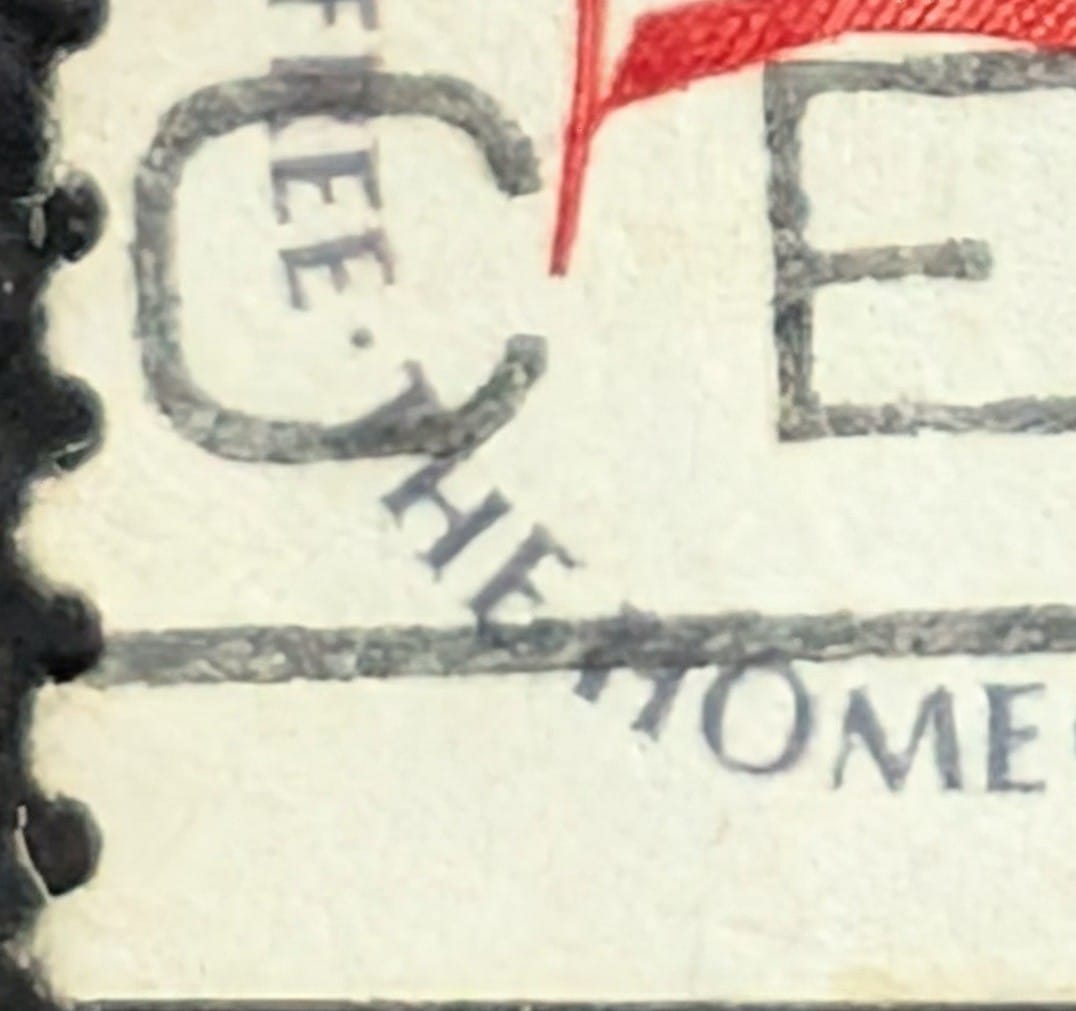
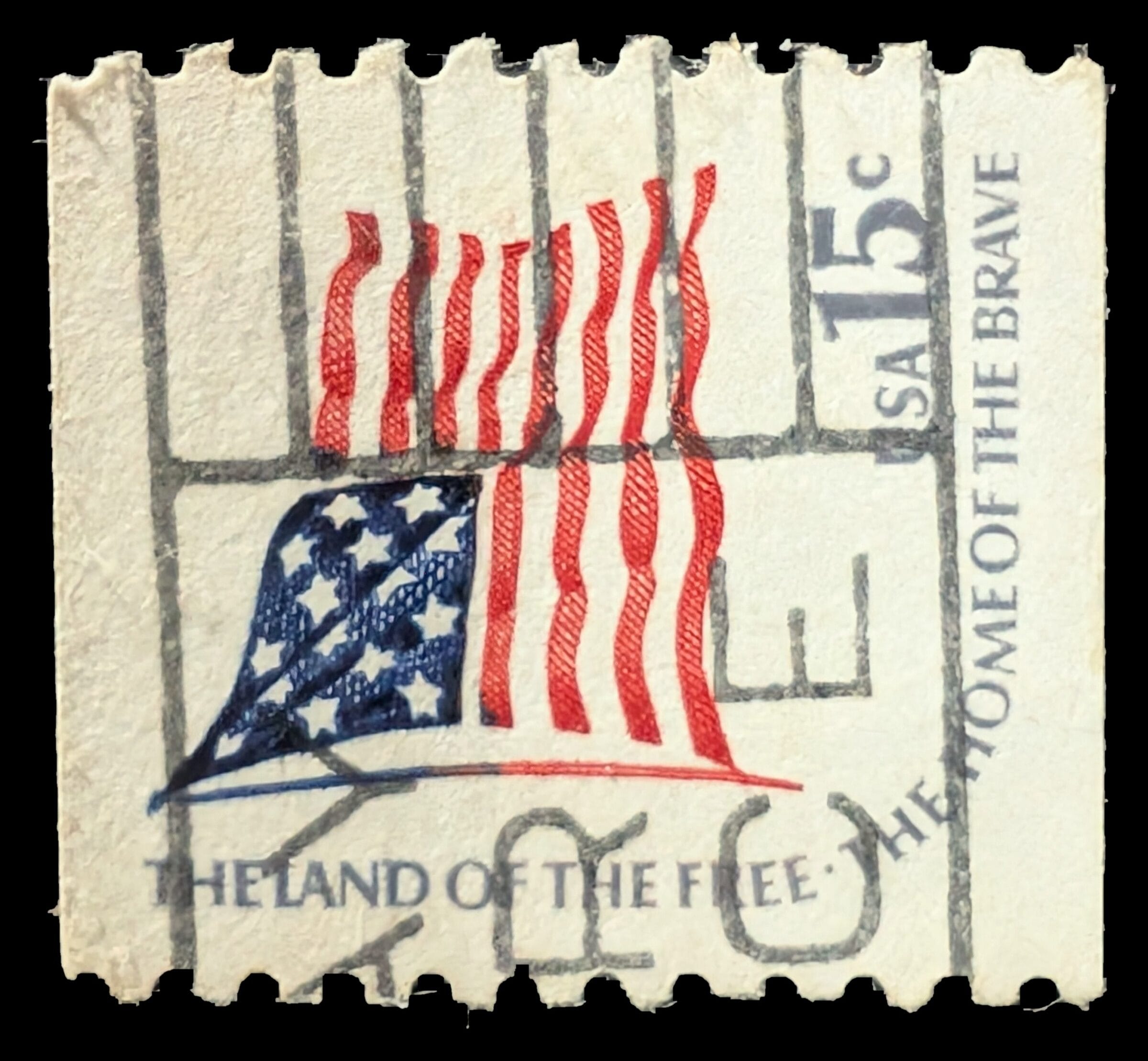
You can see the join on this copy at the lower-left corner, where …of the free · turns the bend and becomes the home of…. That corner is a hand-off point — the place where one stamp’s border was meant to pass the sentence along to its neighbour. It is the most collaborative feature of the design, on the one format that never forms a block.
Why the Fort McHenry Flag was printed by the hundred-million
None of this was a prestige issue. On 29 May 1978 the first-class letter rate in the United States went up to fifteen cents, and the Post Office needed an everyday stamp to carry it. The Fort McHenry Flag, issued a month later on 30 June, was that workhorse — put out at once in sheets, in booklets, and on coils, in the quantities a nation’s ordinary mail actually eats through. The coil printing alone ran to nearly 597 million.
A definitive is the opposite of a commemorative. Nobody frames it; nobody writes about the day it appeared. It exists to be bought at a counter, stuck on a phone bill, and cancelled by a machine that never looks at it. This was mail-room infrastructure — and it happened to have the closing line of the anthem printed on it.
Even the paper was a decision. The Americana definitives were run on tinted stock — a cream paper that was a first for a United States definitive series — so the warm ground under this flag is not only four decades of ageing. Some of it is the sheet the stamp was always printed on.
The one format that can’t close the frame
A coil is a strip. It is joined to its neighbours in one direction only — off a roll, in a single file — and it is never printed or sold as a two-by-two block. On this copy the format is written into the paper: perforations run down the two vertical edges, while the top and bottom are clean, straight-cut lines with no teeth at all.
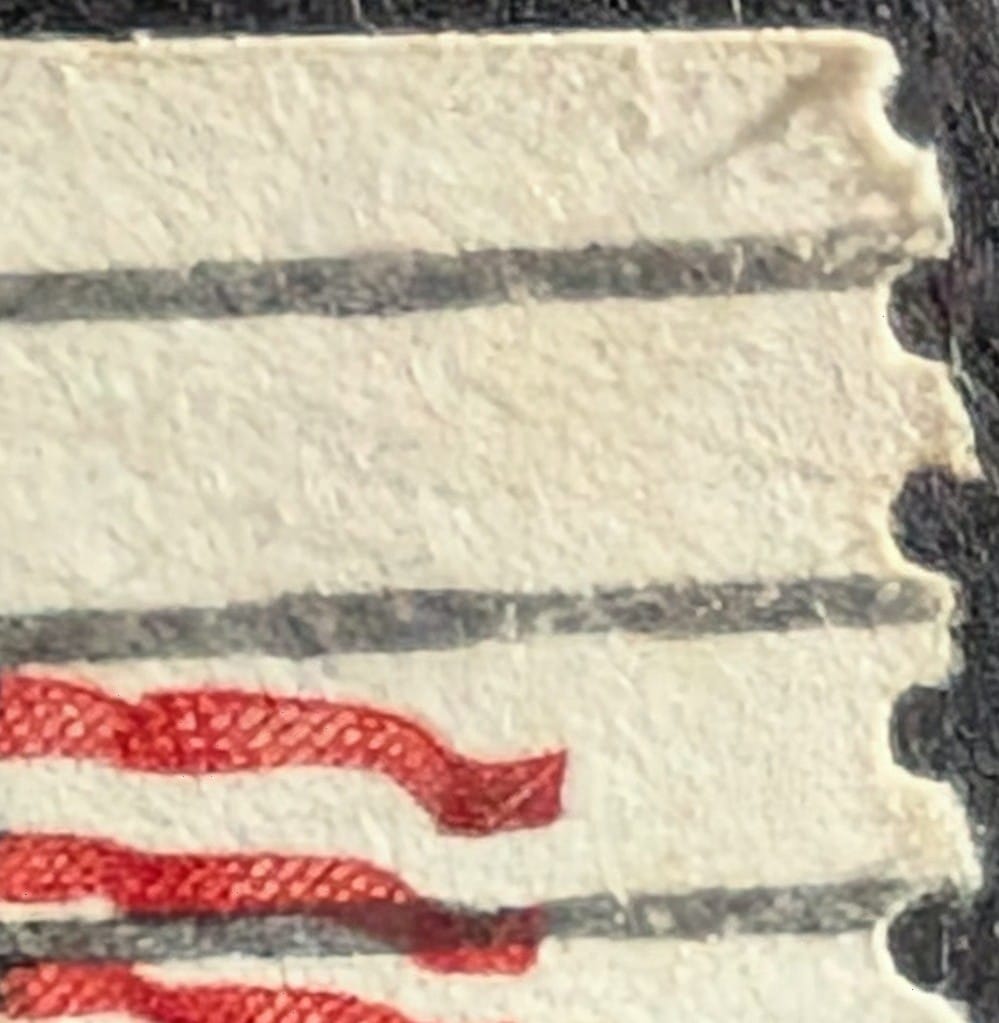
Which means the frame the design keeps waiting for is the one thing a coil can never build. And this copy was used exactly as intended: heavily cancelled, its flag crossed by the parallel bars of a machine killer.
The flag Key actually saw
Look closely and the flag is wrong for 1978 — deliberately. It carries fifteen stars and fifteen stripes, not the fifty-star flag flying over post offices the year the stamp appeared. That older flag was the official flag of the United States from 1795 to 1818, the only one ever to carry more than thirteen stripes, and it is the exact flag Mary Pickersgill sewed for the garrison at Fort McHenry — the one Key watched for through the smoke and found still flying at dawn on 14 September 1814. The words on the stamp are the words of 1814; the flag is the flag of 1814. They match.
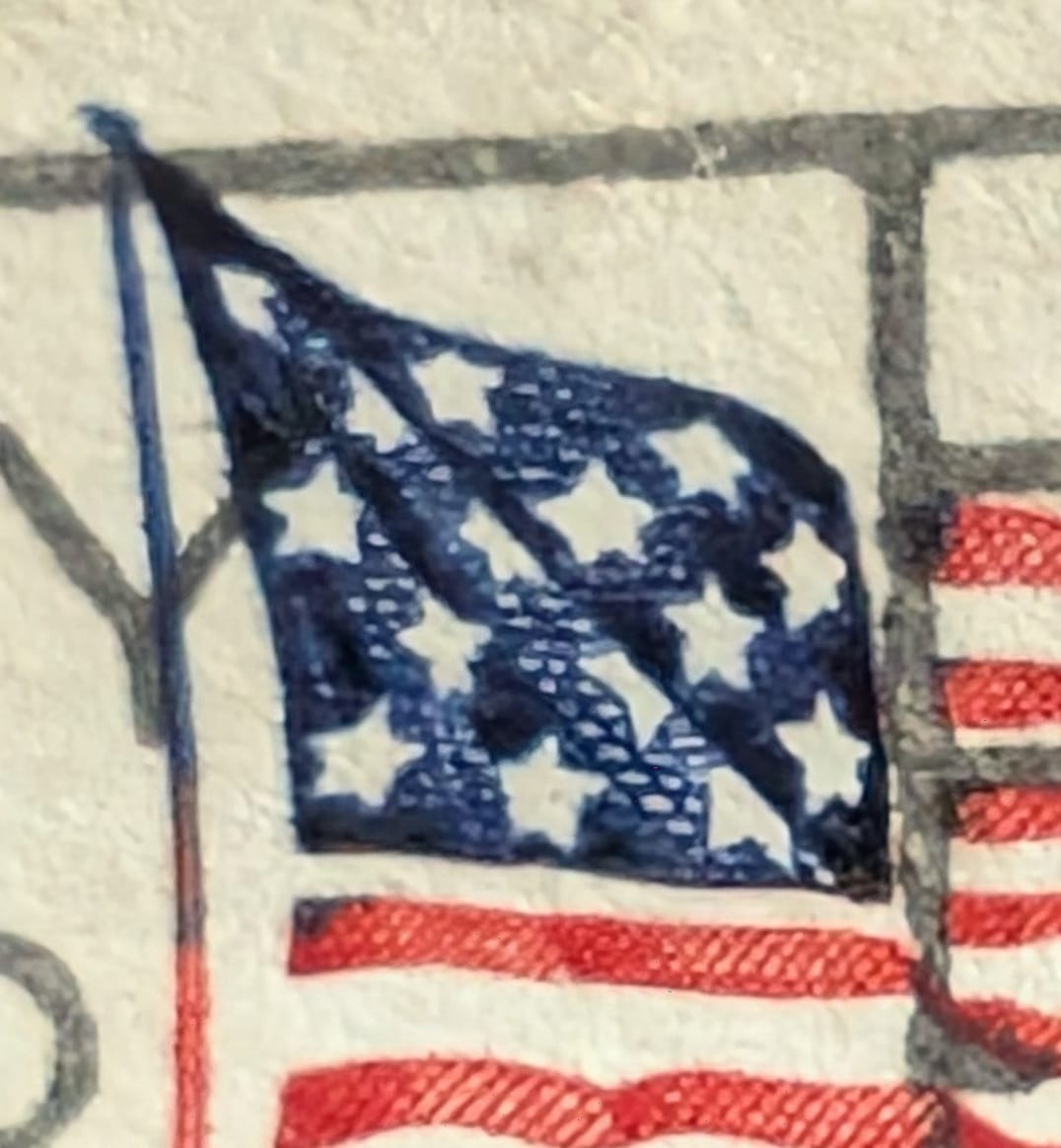
It is line-engraved, so the stars and the waving stripes are built from fine cut lines rather than flat colour, and on this used copy the cross-hatch of the engraving is still legible in the blue. The flag is drawn mid-ripple, which folds the star field in on itself — it reads as a dense scatter rather than a countable grid, which is probably the point. You are meant to recognise it, not audit it.
The song itself became the national anthem only in 1931, more than a century after Key wrote it and forty-seven years before this stamp. By 1978 the couplet on the corner was official, ubiquitous, and worn smooth by a thousand ballgames — which is exactly the register a definitive wants. It doesn’t argue for the flag. It assumes you already stand for it.
So here it is: fifteen cents, the last line of the anthem, and a flag two centuries out of date because that is the flag the line is about. It was printed to be used up, and it was — cancelled, sorted, forgotten. The frame it was drawn to complete is still open, three stamps short, on a roll that only ever moved in one direction.
Further Reading & Links
- 15c Fort McHenry Flag — National Postal Museum — the Americana Series and its two-sided inscriptions that form a frame in blocks of four.
- The Americana Issue identifier (1847usa) — designer, formats, the 15¢ rate purpose, and the ~596.7 million coil printing.
- 1978 15c Fort McHenry, coil (Mystic Stamp Company) — this copy’s variety: Scott #1618C, coil.
- The real story behind the Star-Spangled Banner (Smithsonian Magazine) — the 15-star garrison flag Key saw, and the 1931 adoption of the anthem.