The stamp for a federation that no longer existed
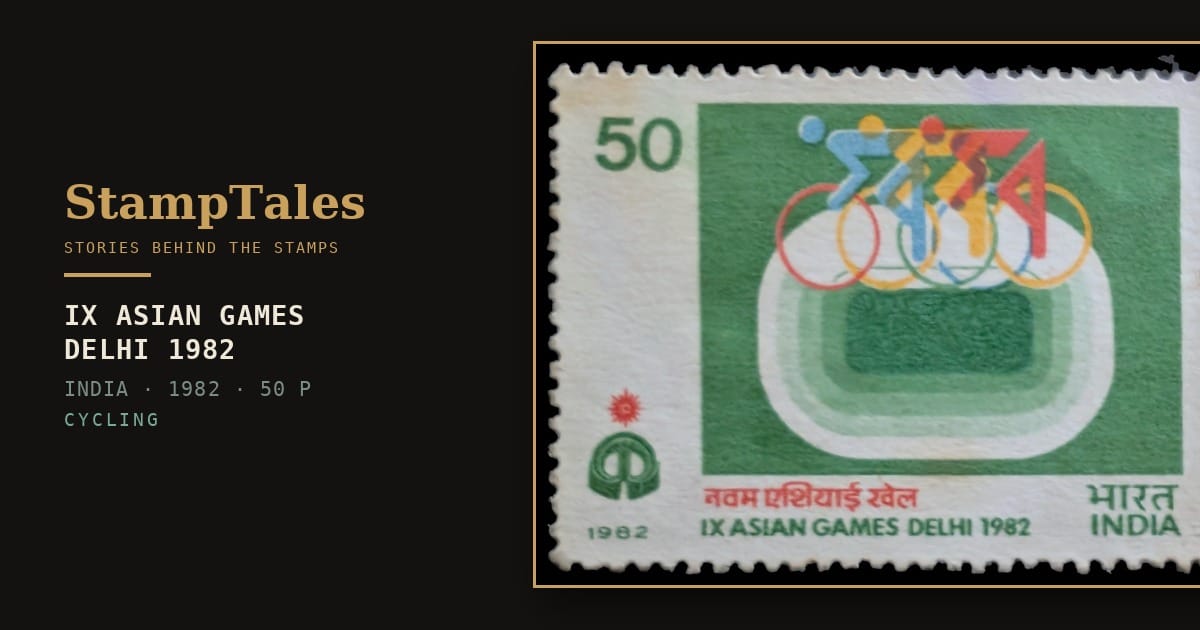
The five coloured rings running beneath the cyclists on this stamp reproduce the interlocking-ring motif of the Asian Games Federation emblem. India Post put it on sale on 19 November 1982 — the stamp reads IX ASIAN GAMES DELHI 1982 along its foot — on the day the ninth Asiad opened in the city. The Federation had been dissolved three days earlier.
That is the quiet joke buried in a cheerful little sports stamp. The body that had governed the Games since 1951, that owned the rising sun and the interlocking rings printed here, wound itself up in New Delhi on 16 November 1982 and handed everything to a successor, the Olympic Council of Asia. By the time the cyclists went on sale they were racing under a flag that had been retired over the weekend. Nobody redesigned the stamp, and there was no reason to — the emblem was decades old and instantly legible. But it is a genuine artefact of a handover: a piece of state printing that outlived, by three days, the institution it advertises.
| Issue | IX Asian Games, New Delhi — Cycling |
|---|---|
| Issued | 19 November 1982 |
| Denomination | 50 paise |
| Country | India |
| Series | Sports pictogram set (Cycling, Javelin, Discus, Football) |
| Printer | India Security Press, Nashik |
| Process | Photogravure, multicolour |
| Catalogue | Phila 908 |
What the Asian Games Delhi 1982 stamp actually shows

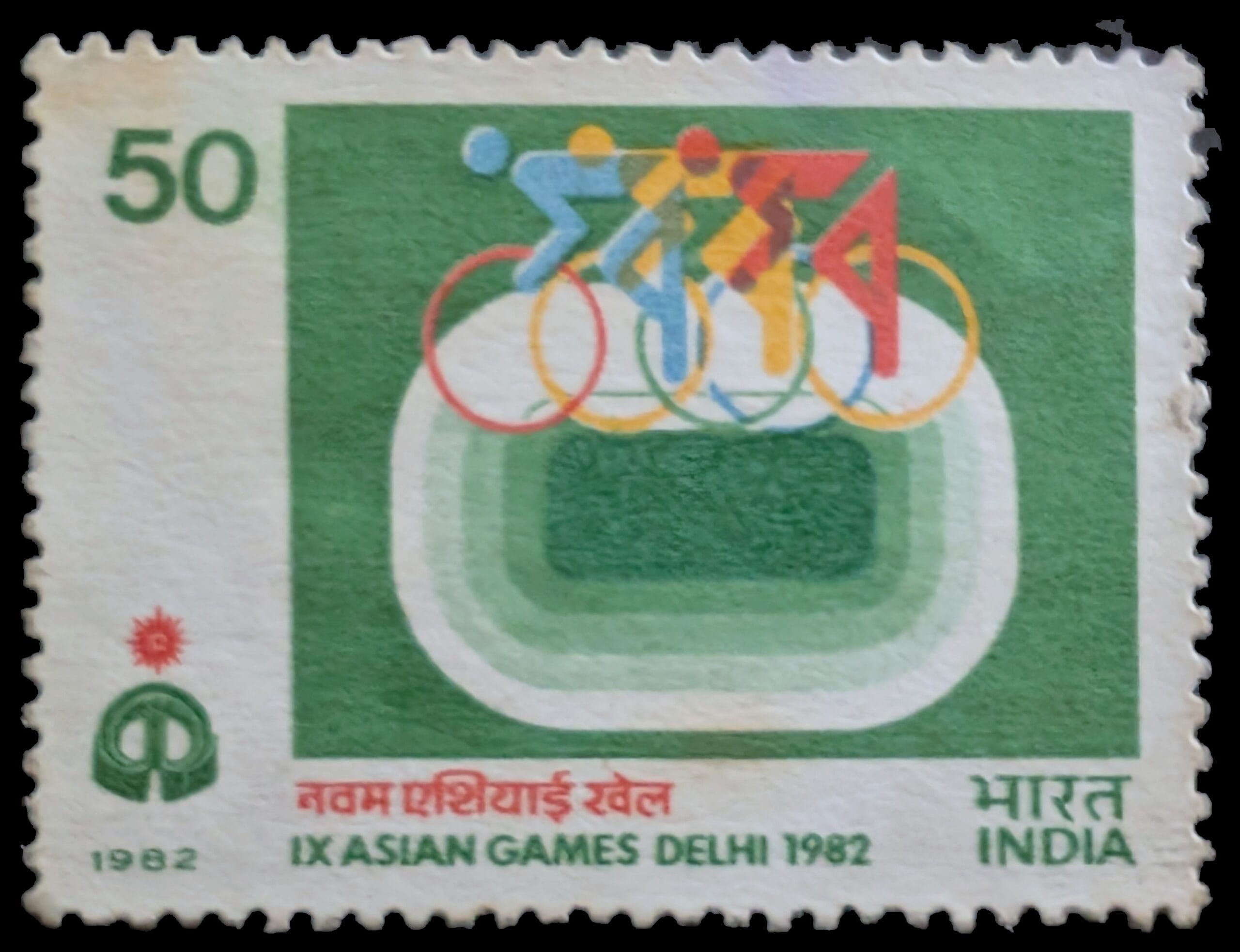
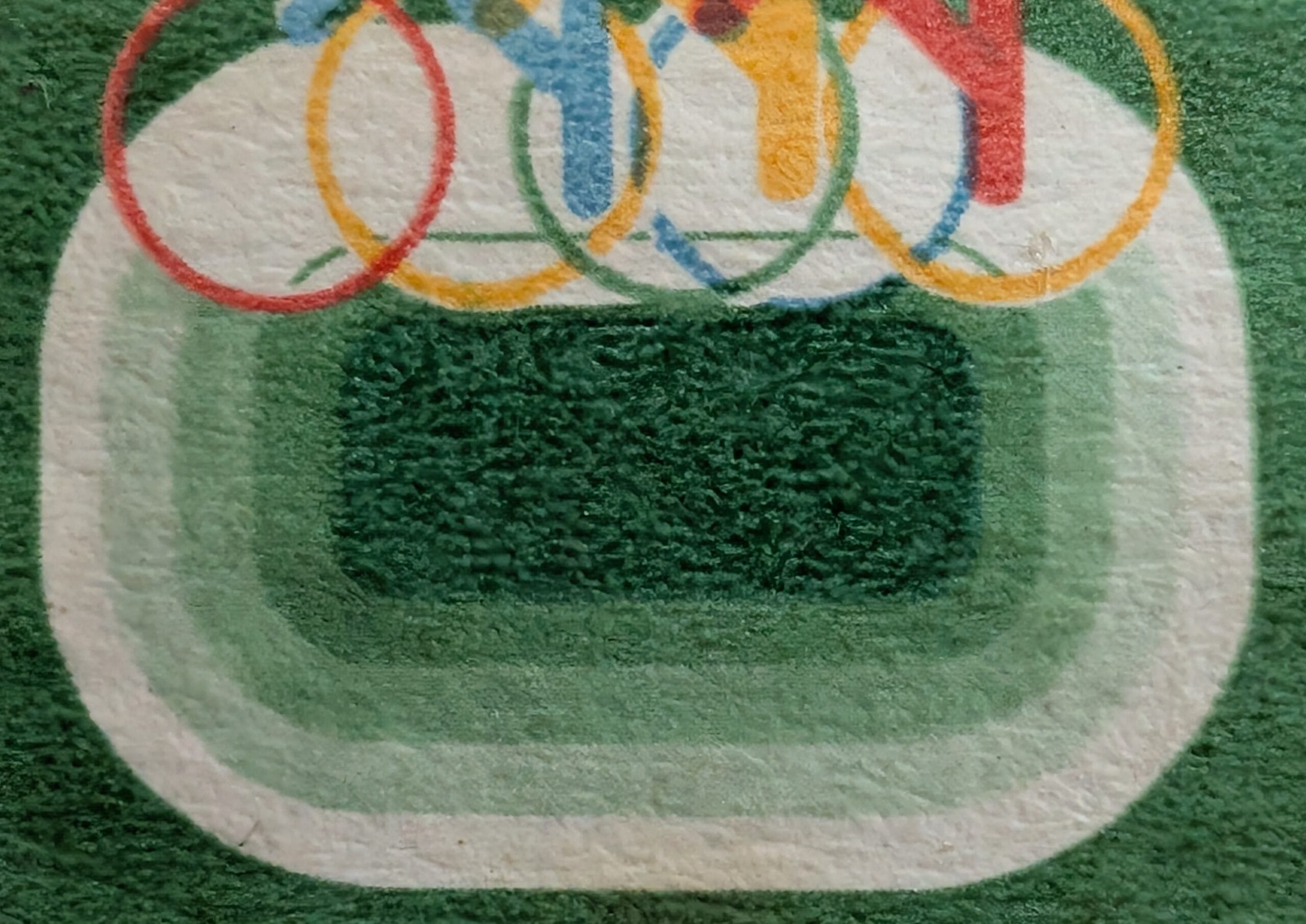
Three cyclists, drawn as flat pictograms in blue, yellow and red, lean into a turn as one overlapping pack. Below them sits a green stadium, rendered as a set of concentric terraced bands seen from an angle, and threaded through the whole scene are five interlocking rings in the same primary colours. Top left, a plain green “50”. Along the foot the title repeats in two scripts, नवम एशियाई खेल in red above the English line in green, with भारत / INDIA in the corner. It is a busy, confident design that wants to read as motion and internationalism at a glance, and mostly succeeds.
The rings are the part worth slowing down on, because they are doing more work than they look. This is not the Olympic five-ring mark, though it is clearly meant to rhyme with it. The motif comes from the older Asian Games emblem: a rising sun with interlocking rings, adopted when the Federation was formed and the first Games were held in this same city in 1951. The rings signalled the continent’s national teams bound together; the sun, in the Federation’s own language, stood for the warmth and energy of Asia.
On this stamp the sun is easy to miss — a small red starburst tucked at the lower left, beside the issuing department’s mark — while the rings are pulled up into the action and turned into the wheels the cyclists are riding. That is a real piece of design wit: the emblem of the Games becomes the machinery of the race.

The federation that dissolved three days early
The timing is not a coincidence so much as an accident of the calendar, and it rewards a second look. The Asian Games Federation had run every Asiad from 1951 to 1978. Through the 1970s it was buckling under exactly the political strains the Games were supposed to rise above — disputes over which nations could compete, which flags could fly — and by the end of the decade the members had agreed to replace it.
The new Olympic Council of Asia was constituted in New Delhi in November 1982, on the eve of the Games, and the old Federation was formally dissolved on 16 November. The Asian Games Delhi 1982 opened three days later, on 19 November, under President Zail Singh and the new body.
So the cycling stamp, and the rest of the sports set sold alongside it, went on counters carrying the mark of an organisation that had ceased to exist seventy-two hours earlier. A stamp is one of the slowest-moving objects a government issues — designed months ahead, printed in bulk, then sold unchanged for years. It is almost built to lag behind the institutions it depicts. Here the lag is unusually crisp: the emblem is not merely dated; it belongs to a body that was wound up in the same city, in the same week that the Games began.
The logo everyone calls Jantar Mantar
The Games had a second piece of visual shorthand, and it too had drifted loose from its origin — this time not in time but in name. The official Games logo — the one printed on the first stamps of the series in 1981, not on this cycling design — is routinely described as “Jantar Mantar,” after Delhi’s eighteenth-century astronomical observatory. The logo is in fact based on one specific instrument at that site, the Mishra Yantra, and Jantar Mantar itself is not a building but an open-air cluster of giant masonry instruments built to track the sun and stars.
Calling the logo “Jantar Mantar” is the kind of shorthand that hardens into fact through repetition; it is closer to tradition than to record, and worth flagging as such. What the organisers reached for, in other words, was not a monument but a machine for measuring the heavens — a fittingly precise emblem for a Games obsessed, that year, with timing and measurement.

What the Asian Games Delhi 1982 stamp set was for
It helps to know what the Asian Games Delhi 1982 were for. This was India’s second time hosting the Asiad, thirty-one years after the first, and the government treated it as a coming-out. The clearest sign of that ambition was on the screen: Doordarshan launched colour television broadcasting for the Games, bringing colour to Indian viewers just as the Asiad became a national spectacle.
A stamp set is a smaller, cheaper piece of the same statement. India issued not one design but a run of them across 1981 and 1982 — the Games logo, the stadiums, then this set of sport pictograms — so that the country’s postal output during the event carried fragments of the same message.
The pictogram style is deliberately international: the same flat, universal figures that Olympic and Asian organisers had been using since the late 1960s to speak across languages. A cyclist reduced to blue geometry needs no caption in any script. During a Games meant to place India at the centre of Asian sport, that legibility was the point.
The irony sits lightly on all of it. The stamp is not solemn and does not need rescuing; it is a bright, quick, well-made thing that did its job. But look again at those rings, now that you know whose they were. They belonged to a federation that had governed Asian sport for thirty-one years and had just signed itself out of existence a few streets away. The cyclists lean into their turn, wheels made from a retired emblem, racing hard under a flag that had already been lowered.
Further Reading & Links
- The XI Asian Games, Beijing 1990](https://stamptales.in/xi-asian-games-1990-running-figures/) — the next Asiad on this site: India’s stamp for a Games in Beijing, with the runners stripped of any flag.
- 1982 Asian Games (Wikipedia) — dates, host, the Mishra Yantra logo and the shift to the Olympic Council of Asia.
- Asian Games Federation (Wikipedia) — confirms the Federation’s dissolution in New Delhi on 16 November 1982 and its succession by the OCA.
- New Delhi 1982 — Olympic Council of Asia — the successor body’s own record: the AGF dissolved to make way for the OCA for these Games.
- India on IX Asian Games 1982 — issue details (iStamp Gallery) — the India P&T issue programme, printer and photogravure process for the series.
- Flashback 1982: The Asian Games that transformed Delhi (Scroll.in) — the colour-television launch, the Appu mascot and the scale of the build-up.