Thirty Cents for a Bird That Named Itself After a Pope — The USA Cardinal Stamp of 1991
The USA Cardinal stamp 1991 issue seems like an unremarkable definitive — until you learn why the bird on it is named after a Catholic bishop.
The USA Cardinal stamp 1991 is a bird named after Catholic clergy, printed on the most utilitarian stamp series America ever made — and somehow it outlasted them all.
The Stamp
- Country: United States of America
- Denomination: 30 cents
- Date of Issue: 22 June 1991
- Series: Flora and Fauna Definitives (1988–2001)
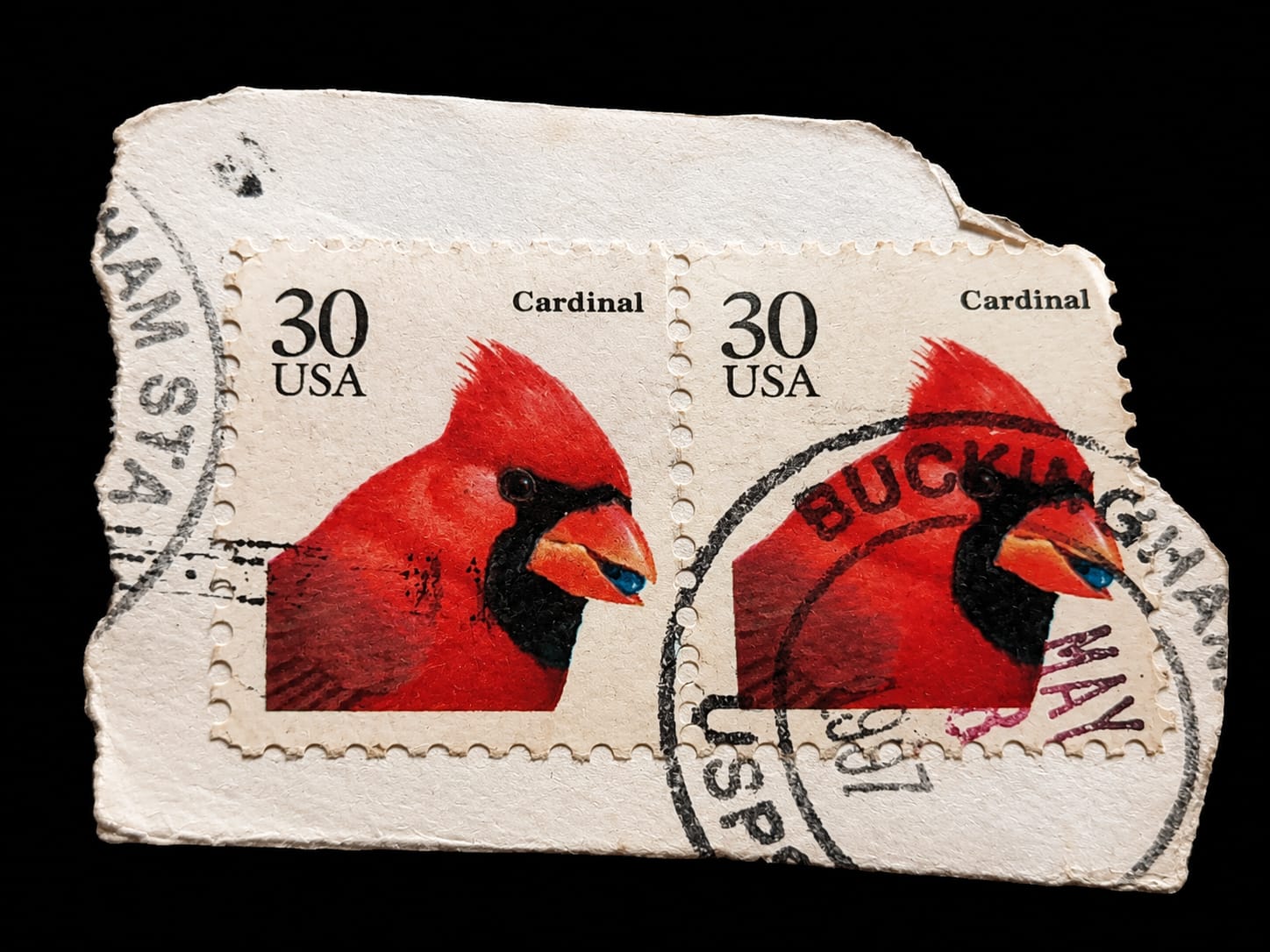
- Subject: Northern Cardinal (Cardinalis cardinalis), male Design: Realistic portrait — head and upper breast, facing left
- Colour palette: Crimson red, black mask, orange-coral beak, cream background
- Printing: Gravure, Bureau of Engraving and Printing
- Perforations: 11 × 11
The Story
A Name Borrowed from Rome
The bird didn’t come first. The word did.
When Catholic missionaries arrived in the Americas, they saw a crested songbird drenched in the same scarlet as a cardinal’s cassock. So they called it cardinal. Linnaeus formalized it in 1758 — Loxia cardinalis, later reshuffled to Cardinalis cardinalis, the rare binomial where genus and species say the same thing twice. As if the taxonomists stuttered in admiration.
By 1991, the Northern Cardinal was already the official state bird of seven US states — Illinois, Indiana, Kentucky, North Carolina, Ohio, Virginia, West Virginia. No other bird holds that record. When the USPS needed a subject for their 30-cent definitive, the cardinal was less a choice than an inevitability.
Why the USA Cardinal Stamp 1991 Cost 30 Cents
Here’s where philatelic gossip gets interesting.
The Smithsonian’s National Postal Museum notes that the 30-cent Cardinal was “reportedly issued to meet the postcard rate to Canada and Mexico.” But many collectors believed it was actually created to meet a proposed 30-cent first-class domestic rate — one that the Postal Rate Commission had denied. The USPS printed the stamp anyway, hedging its bets. When the rate didn’t materialize domestically, they found the international postcard excuse.
Either way, the USA Cardinal stamp 1991 existed because bureaucracy needed a price point and a bird needed a platform. Both got what they wanted.
The Flora and Fauna Series
The USA Cardinal stamp 1991 didn’t arrive alone. It was part of the Flora and Fauna definitive series — thirty-six stamps issued between 1988 and 2001, split evenly between plants and animals. The series was born from a 1987 brainstorm: Express Mail stamps featured eagles, so Priority Mail could feature fast land animals. The idea expanded. Eventually it swallowed everything — kestrels, bobcats, fawns, sunfish, pine cones, peach blossoms.
The Cardinal sat at 30 cents while the American Kestrel held the 1-cent slot and the Bobcat claimed $2. It was a postal ecosystem where your denomination determined your prestige.
What made the series remarkable was its longevity. Thirteen years in circulation. These weren’t commemoratives printed once and forgotten — they were workhorses, reprinted across multiple plate numbers, booklet formats, and coil configurations. The Cardinal saw daily use on international postcards for the better part of a decade.
The USA Cardinal Stamp 1991 Up Close
The male Northern Cardinal is one of North America’s most recognised birds — not because it’s rare (it isn’t), but because it refuses to be subtle. Crimson plumage head to tail. A crest that rises when agitated. A black mask that makes it look like it’s attending a Venetian ball. An orange-coral beak built for cracking seeds.
The colour comes from carotenoid pigments in its diet — the same compounds that make tomatoes red and carrots orange. A poorly fed cardinal fades. A well-fed one blazes. The stamp captures a male at peak condition: deep, saturated red with no brown undertones. This is a bird eating well.
Female cardinals are olive-brown with reddish hints — beautiful in their own way, but the USPS wasn’t interested in subtlety. The USA Cardinal stamp 1991 needed to read at 30mm × 25mm. Crimson reads. Olive doesn’t.
Reading the Cancellation
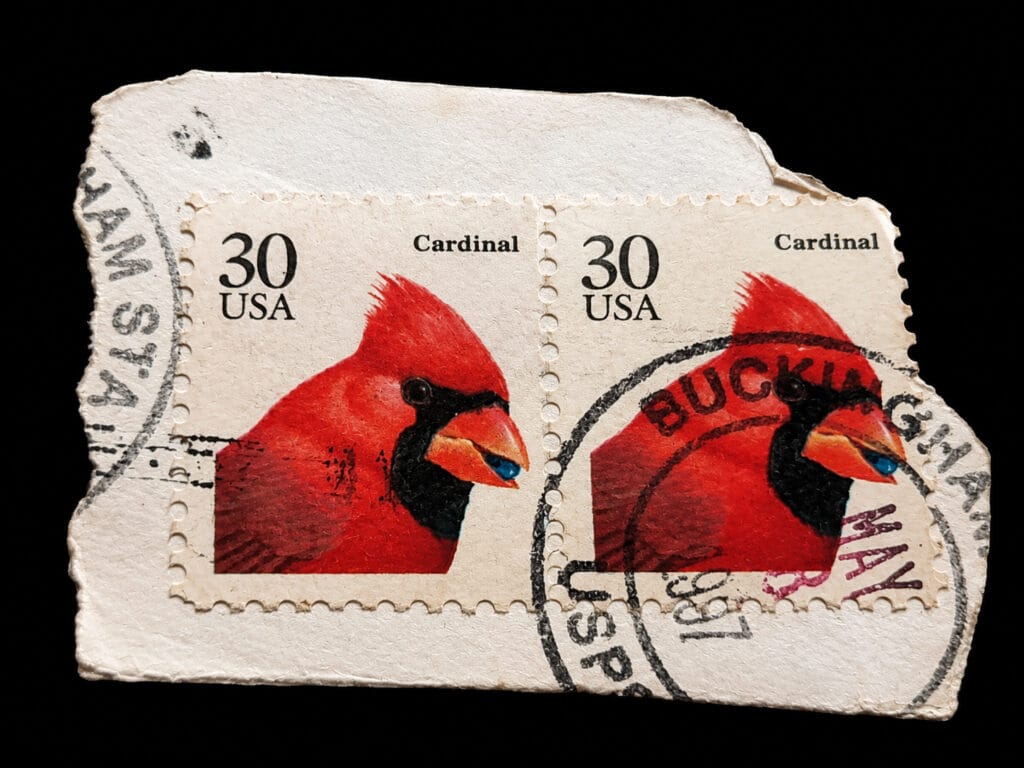
My pair carries a partial circular date stamp reading “BUCKINGHAM” — likely Buckingham, Virginia (population ~8,000, Buckingham County). The irony isn’t lost: a stamp named after Catholic bishops, cancelled in a town named after an English duke. The date fragments suggest 1997 — six years of service before this pair retired from active duty.
This Copy
Configuration: Horizontal pair, still joined at the central perforation line. Condition: Poor to fair — bottom perforations torn, some paper loss at the edges. This is a pair on piece: fragments of the original envelope paper remain attached on the reverse. Colours: The crimson holds strong and unfaded. Cancellation: Legible partial circular date stamp — “BUCKINGHAM” and date fragments that suggest 1997.
An intact used pair with a readable cancellation carries its own small history. Someone in Buckingham, Virginia franked an envelope with two 30-cent Cardinals — sixty cents of postage, likely on a heavier letter or a small package. The USA Cardinal stamp 1991 was built to do exactly this and nothing more: carry ordinary mail, unnoticed, until it stopped.
Why This Stamp Matters (Beyond the Obvious)
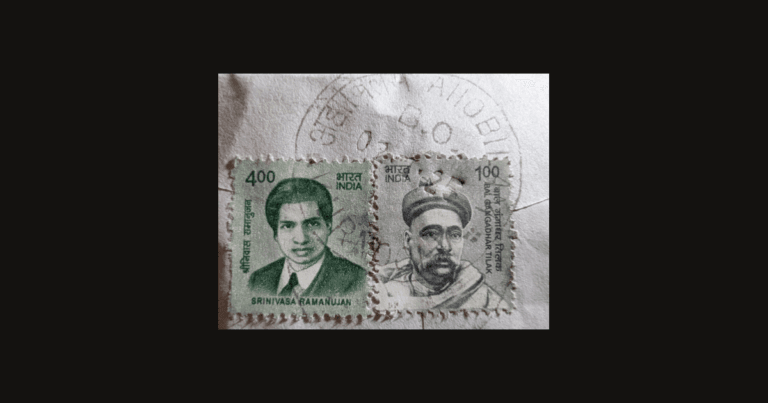
India’s definitive series tend toward monuments and maps. America’s chose living things — birds, mammals, flowers, fish. It’s a philosophical difference in what a nation considers worth repeating on millions of envelopes, day after day, year after year. India says: here are our achievements. America says: here is our backyard.
The USA Cardinal stamp 1991 isn’t rare. It isn’t valuable. A used pair in this condition is worth perhaps 10–15 cents to a dealer. But it’s a clean example of what a definitive stamp is supposed to do — be so ordinary that people forget it’s there, so well-designed that it still registers after a thousand encounters.
Thirty-six stamps. Thirteen years. Billions of impressions. The Flora and Fauna series carried more American mail than any commemorative ever could. The Cardinal was its red heart.
FURTHER READING & LINKS
On StampTales
- A European Owl on an African Stamp — another macro study of what a nation chooses to honour on birds, this time a 1970s collector-market issue from Central Africa.
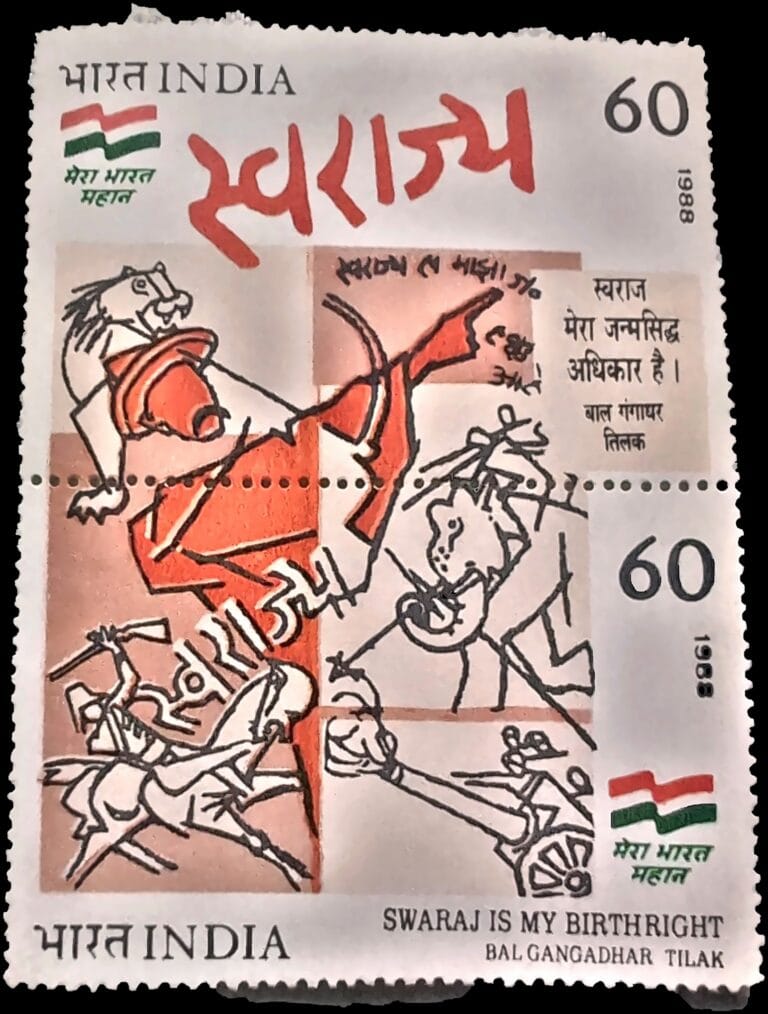
- The Stamp That Split a Revolution in Two — another Through the Lens macro study, this one examining design choices on a 1988 Indian commemorative.
External sources
- All About Birds guide to the Northern Cardinal — Cornell Lab of Ornithology
- Smithsonian National Postal Museum — Flora and Fauna series documentation




4 Comments
Comments are closed.