Stamp Collecting 1989 – The Stamp That Collected Itself
The stamp collecting 1989 issue put a child sorting stamps on a stamp — a hobby whose own name, India Post declared in print, means “fond of the tax-exempt.”
The Stamp
| Issue | Stamp Collecting |
|---|---|
| Country | India — Department of Posts |
| Subject | A child sorting a stamp collection; part of the four-stamp INDIA-89 set |
| Issued | 20 January 1989 — opening day of the exhibition |
| Denomination | 60 paise |
| Occasion | INDIA-89 World Philatelic Exhibition, New Delhi |
| Designer | K. S. Radhakrishnan |
| Printing | Photogravure, India Security Press |
| Size | 3.55 × 2.54 cm (printing size) |
| Perforation | 13 × 13 |
| Quantity printed | 1,500,000 |
The Story
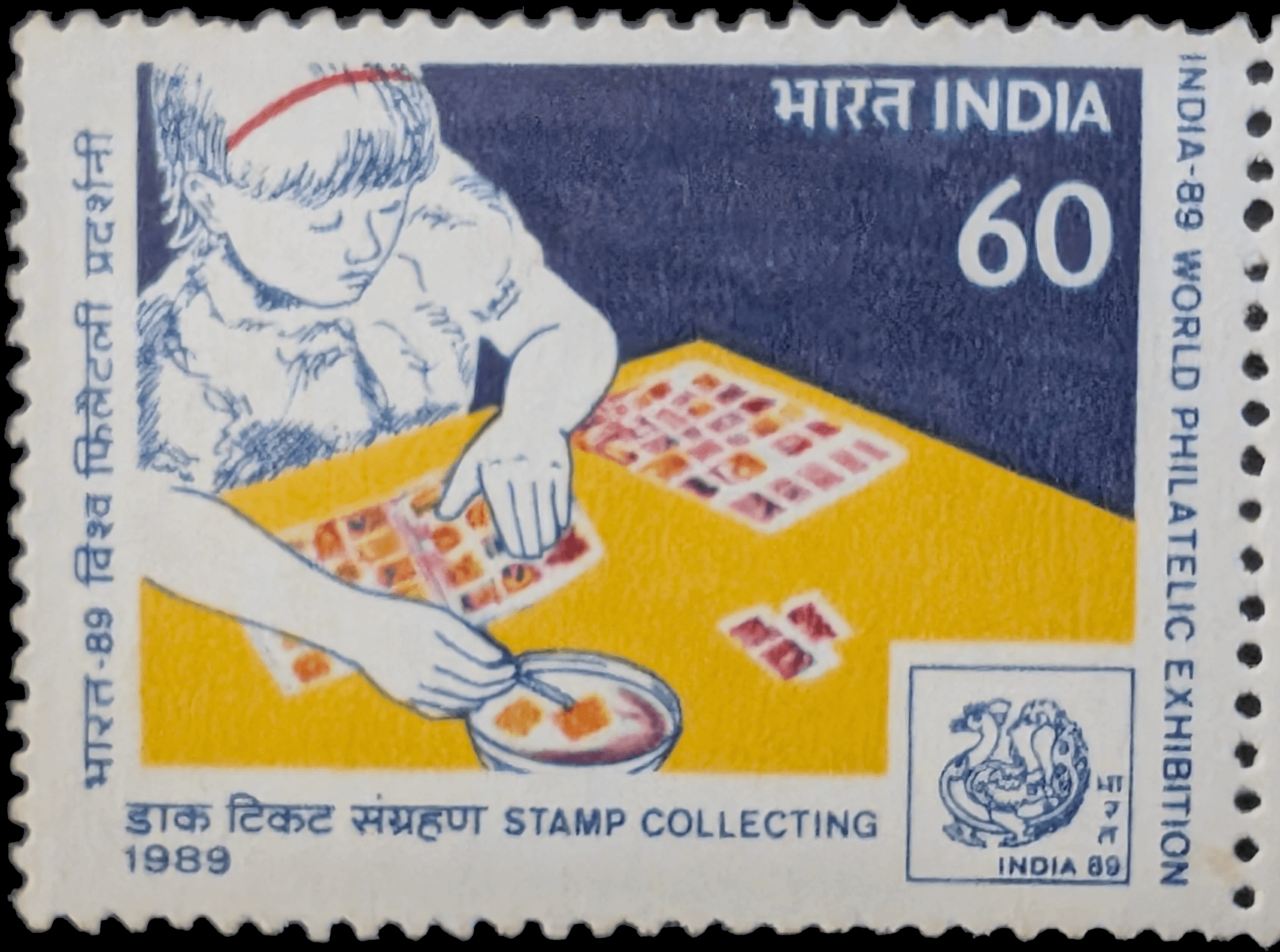
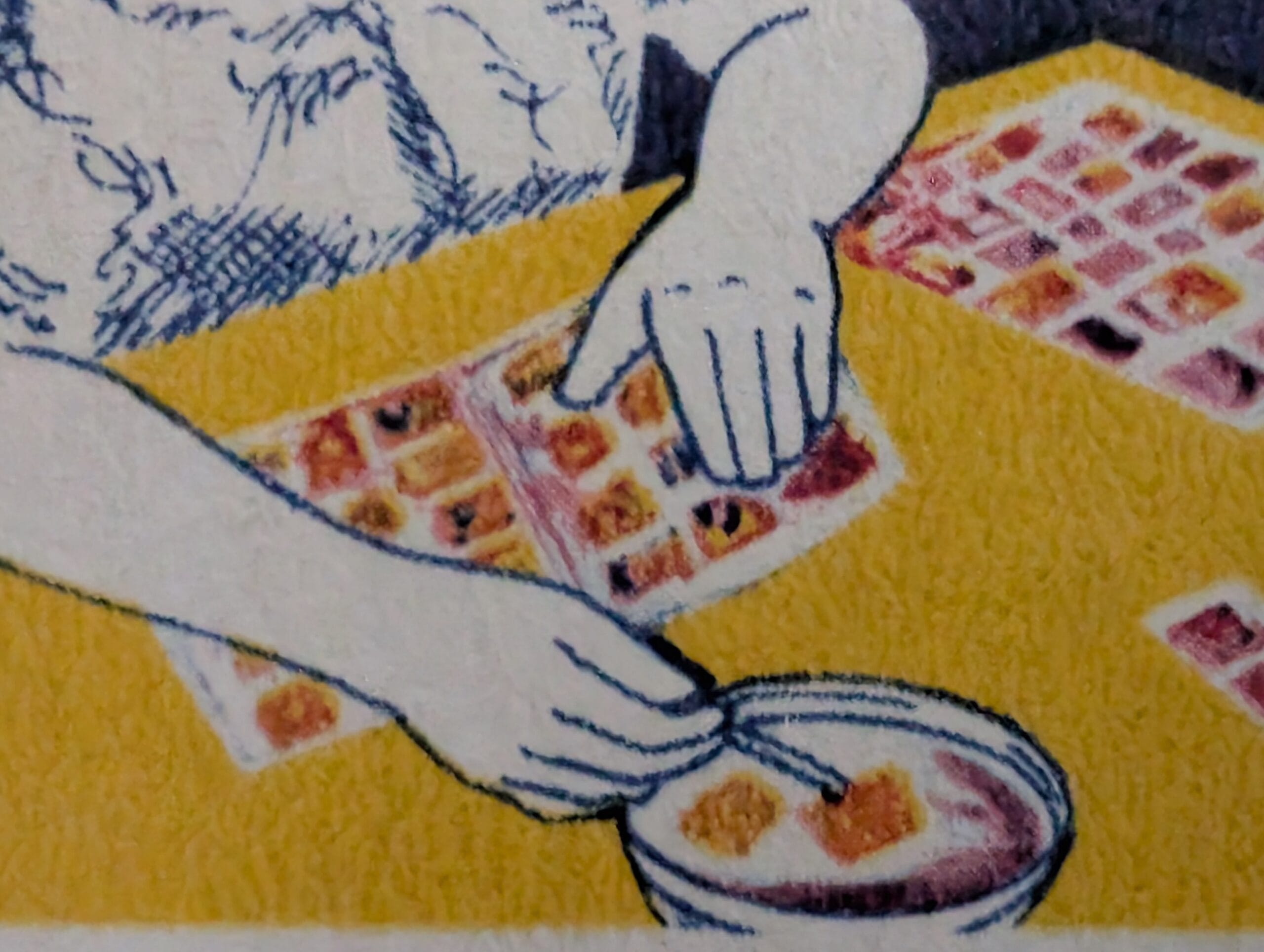
The stamp collecting 1989 issue is a stamp about wanting stamps. A child bends over a table, one hand steadying an album, the other lifting a loose stamp toward a page of empty squares. In front sits what appears to be a bowl of water — the kind collectors use to soak stamps free of their paper backing. Few Indian commemoratives feel this domestic: not a monument, not a leader, not a battle, but an afternoon at a work surface with a bowl and a book.
And it hides a small, perfect joke that India Post told on itself, in print, in the official design note.
The note traces the word every collector uses without thinking. Philately, it explains, comes from the Greek philos, “fond of,” and ateleia, “exempt from tax.” The name of the hobby means, roughly, the love of the tax-exempt thing. Because that is what a postage stamp is: a receipt. Stick one on an envelope and you are holding proof that the carriage has already been paid, that this letter travels tax-free from here. Collectors are, by the strict etymology their own government printed, people fond of paid-up tax tokens.
So look again at what the 60-paise stamp shows. A child, lovingly, is sorting the small paper proofs that a postal fee was settled. The exhibition it was made for was a hall full of adults doing the same at scale. And the object recording all of this is itself one of those proofs — a stamp about stamps, printed as a stamp, released for a festival of stamps. The self-portrait is complete before you have read a word of the caption.
What the stamp collecting 1989 design chose to show
India Post could have marked its World Philatelic Exhibition the way it marked most things: with grandeur. The other three stamps in the same set did exactly that — a Travancore princely-state stamp, a mail-coach from the 1840s, the mastheads of India’s earliest stamp journals. History, heritage, institutions. Then this one: a child and a bowl.
The choice matters because it aims low on purpose. An international exhibition is a prestige event — competitive exhibits, gold medals, serious men with tweezers and reference catalogues. The design could easily have flattered that world. Instead the Department pointed its 60-paise denomination — the ordinary low value in the set — at the least ceremonial version of the hobby: a child with loose stamps and a bowl of water. The cheapest stamp in the set shows the humblest way in.
That is an unusual instinct for a national post office. State philately tends to celebrate itself upward — toward founders, anniversaries, achievements worth commemorating. A stamp is a tiny official monument, and monuments flatter. This one points the other way, down the age range and down the price scale, to the beginner at the table. The Department chose, for the one stamp in the set that shows a person, to show the least official person it could find.
The set that issued on the last day it could
The timing is its own small story. This was not a stamp released to advertise a coming event. It came out on 20 January 1989 — the opening day of the exhibition itself. The four-stamp set was the finale of a run India Post had been building since 1987, set after set, heralding a show that had, by the time these stamps appeared, already begun. The advertising arrived as the doors opened.
That is a strange way to promote anything, and it tells you the stamps were never really advertisements. They were the exhibition’s own souvenirs, sold to the people already inside — collectors buying, at the show, a stamp about collecting, to carry home into the collections they had brought to the show. The snake had found its tail.
There is a quiet confidence in that. India had hosted world exhibitions before — INPEX and INDIA-80 among them — and by 1989 the Department knew its audience would be standing in the hall, first-day covers in hand, on the morning the stamps went on sale. It did not need to persuade anyone to care about stamps. Everyone in the building already did. So the set could afford to be reflective rather than promotional: not “come and see,” but “here is what you already love, drawn back to you.”
Looking Closer at the Stamp Collecting 1989 Design
Radhakrishnan’s composition does something quietly clever with the child’s posture. The head is bent so far down that the face is nearly lost — we read the scene not from the collector’s expression but from the collector’s hands. Both hands are working. This is a stamp about doing, not admiring, and the design refuses to give you a face because the face is not the point. The album is.
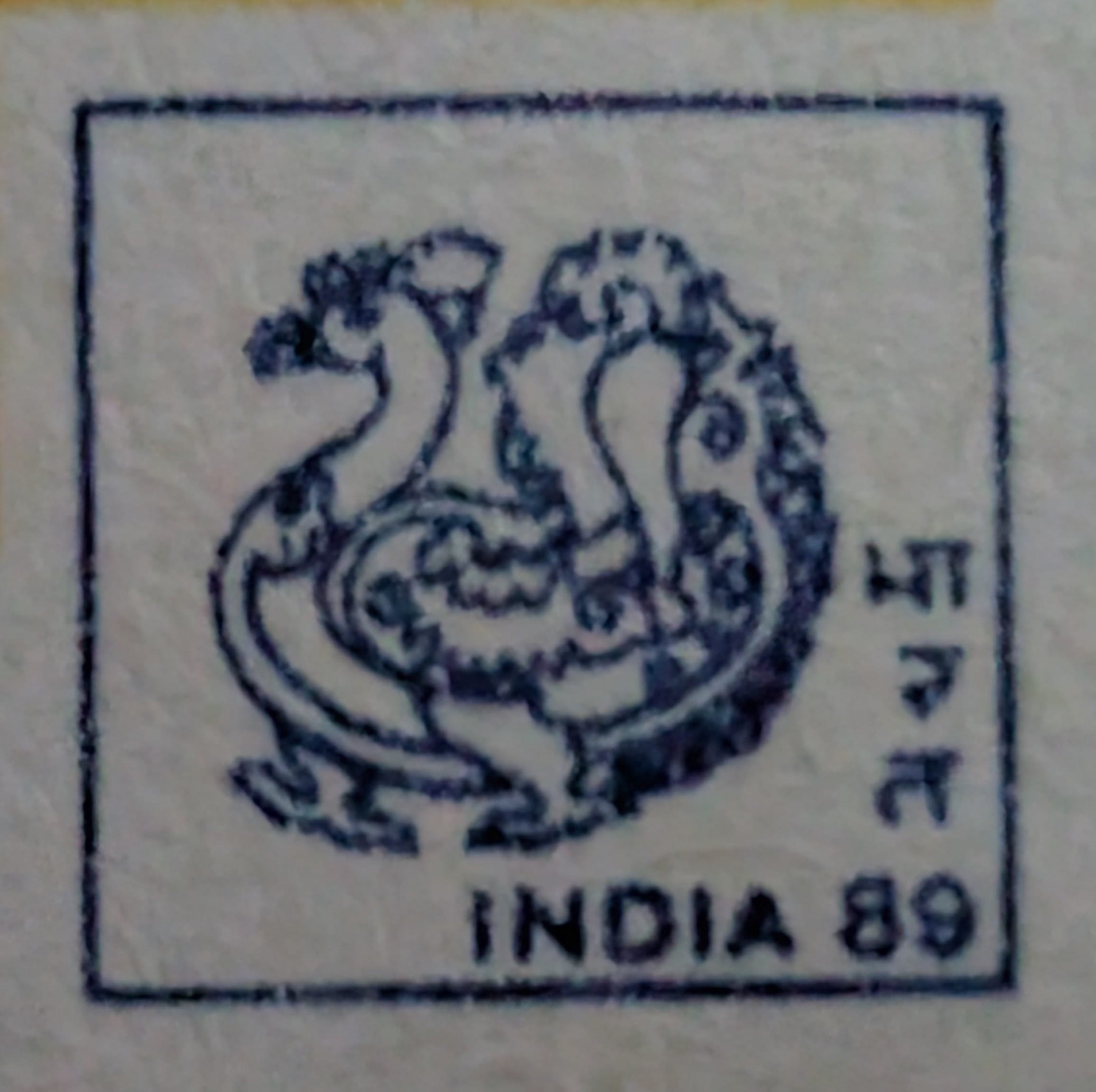
The colour split is the strongest design decision. The tabletop is a flat, saturated yellow — bright, cheap, almost a school-craft yellow — while the ground behind the child is a deep exhibition blue. Warm foreground, cool background. The child and the bowl live entirely in the yellow; the printed titling and the INDIA-89 lion-capital logo live in the blue. The design colour-codes the two worlds this stamp is caught between: the private table and the public hall.
Look at where the text sits in the layout. “STAMP COLLECTING” and its Hindi twin run along the bottom edge in small caps; “INDIA-89 WORLD PHILATELIC EXHIBITION” climbs the right side vertically; the denomination “60” sits large and confident in the upper corner. The institutional language is pushed entirely to the margins — framing the child, surrounding the scene without entering it. The bureaucracy stays at the border. The kid gets the middle.
That marginal framing is not an accident of layout; it is the argument of the picture. Everything official — country, value, exhibition, emblem — is arranged around the edges like a mount around a photograph. What the mount holds is not an institution but an act. A national post office spent its design on the gap between the two, and put the human part where the eye lands first.
And the loose stamps scattered across the yellow are rendered as tiny grids of red and orange — recognisably stamps, deliberately not any particular stamp. Radhakrishnan drew the idea of a collection rather than a specific set, which is the honest choice: the point is the sorting, not the catalogue value. You cannot look up what the child is worth in any catalogue. That is rather the point: the stamp values the act of collecting over anything collected, the sorting over the sorted.
Closing
A child leans over a bowl, lifting loose stamps toward a page of empty squares. A country decided that was worth 60 paise and a place in a world exhibition — the smallest denomination in the set, spent on the beginner in the room. The prestige stamps went to the coaches and the princely states. The child got the bowl of water. It is the only stamp in the set that shows the hobby happening, rather than the history it happens to.
Further Reading & Links
- World Philatelic Exhibition 1989 stamp — the DLO-cancellation design from the same set, the postal system’s paper trail rather than the collector who chases it.
- Philatelic Society 1997 stamp — where the institution of collecting, rather than the act, takes the frame.
- Fleet Review 1989 stamp — the same year’s opposite instinct: the state at maximum ceremony.
- iStampGallery — ‘India 89’ World Philatelic Exhibition set — full four-stamp set, official design notes, and catalogue detail.
- India Post — Department of Posts — the issuing authority.