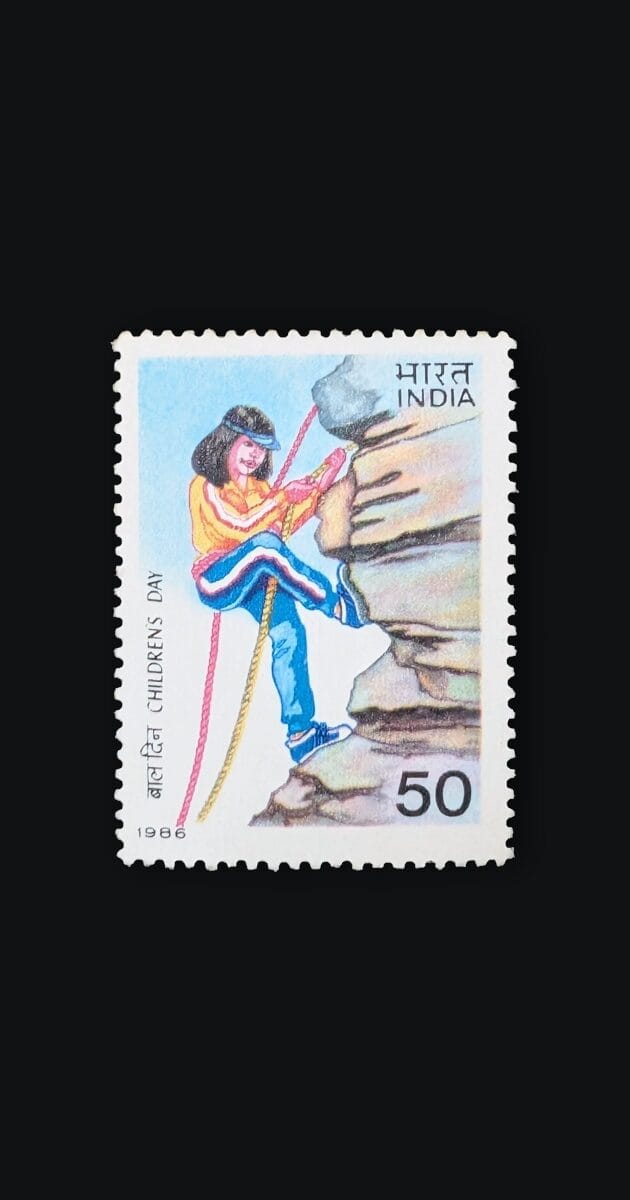
The Girl on the Rock Has a Name. The 1986 Children’s Day Stamp Does Not Print It.
The 1986 Children’s Day stamp is filed under a title it never prints: “Girl Rock Climber.”
The Stamp
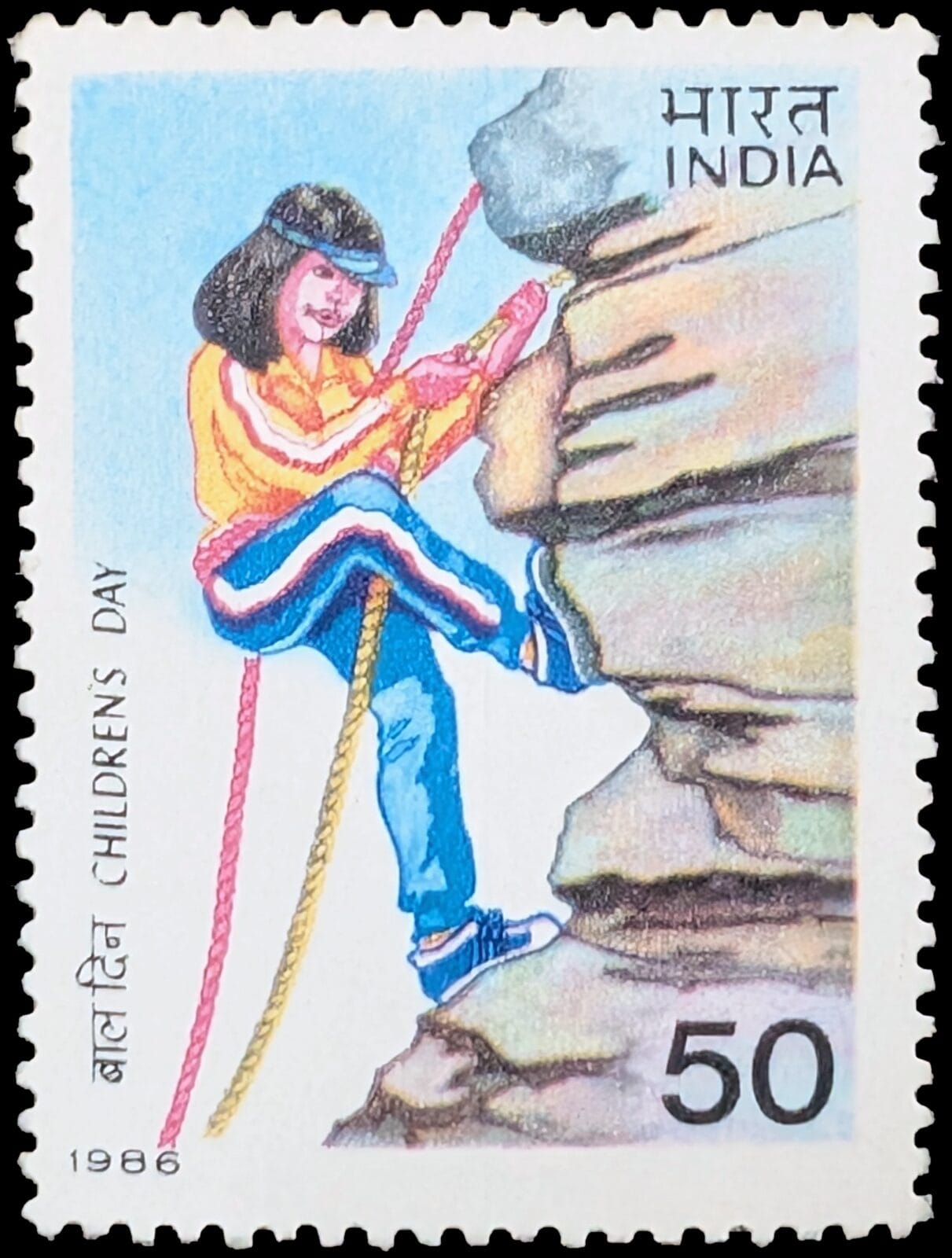
| Issue | National Children’s Day |
|---|---|
| Country | India — Department of Posts |
| Subject | Recorded as “Girl Rock Climber” by Sujasha Dasgupta |
| Issued | 14 November 1986 |
| Denomination | 50 Paise |
| Occasion | Children’s Day — Jawaharlal Nehru’s birth anniversary |
| Catalogue | Phila 1053 – SG 1203 |
| Condition of this copy | Unused, uncancelled; perforations complete |
The Story
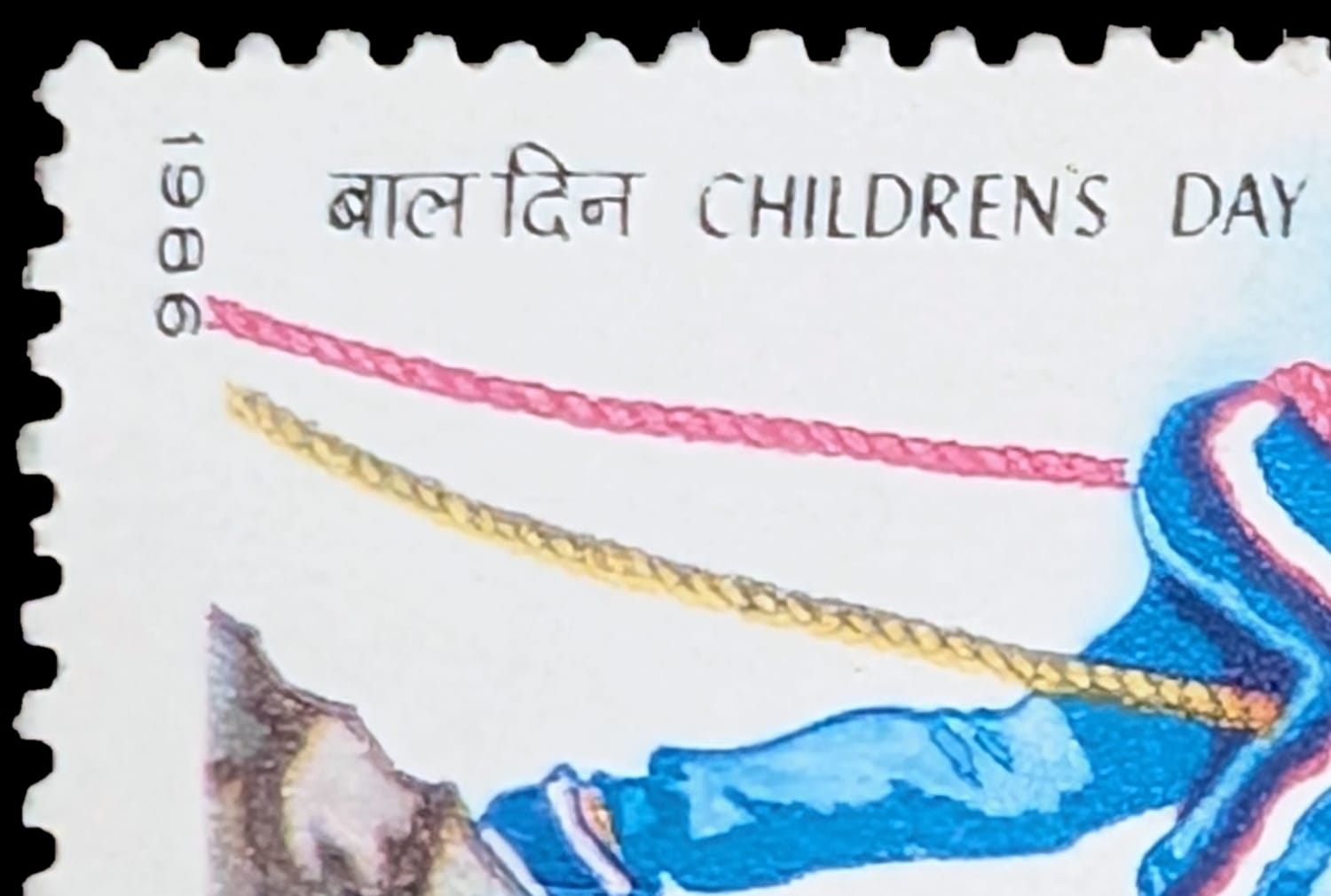
Two ropes cross the 1986 Children’s Day stamp. Neither is tied to anything.
They enter from off the left edge, cross the picture, and finish down by the rocks as loose tips. The 1986 Children’s Day stamp is catalogued as “Girl Rock Climber,” and the catalogue is the only place that phrase appears. It is not on the stamp. Neither is the name of the girl who painted it.
A competition that hands over the pencil
India Post’s Children’s Day stamps began in 1957 with photographs of real children. From 1971 the department changed method. Instead of commissioning a photograph or a designer, it began printing paintings made by schoolchildren and chosen through a national selection, and from 1973 it reproduced them in full colour.
The arrangement deserves stating precisely, because it is what makes the 1986 Children’s Day stamp worth an argument at all. On almost every other Indian commemorative the picture is produced inside the system — a staff artist, a commissioned designer, an official photograph. For one issue a year, on 14 November, the picture arrives from outside. A child hands in a painting and the Department of Posts prints it, at scale, on gummed paper, with the value stamped beside it.
That is a genuine transfer of authority, and India Post has never made much noise about it. What happened between the submitted painting and the printed sheet is not on the public record; the stamp is the only witness.
What else India Post printed that year
1986 was a heavy year for institutional anniversaries. The Bombay Naval Dockyard turned 250 in January; INS Vikrant marked twenty-five years in February; October alone carried the Madras General Post Office bicentenary, 225 years of the 8th Battalion of Coast Sepoy, and 125 years of the Indian Police.
Ten weeks earlier, on 16 September, the department had issued two sporting stamps for the Asian Games in Seoul: a volleyball player and a hurdler, drawn to order. Sport was not an unfamiliar subject that autumn. It simply arrived by commission.
Then, on 14 November, a picture of somebody climbing a rock, drawn by a child. In a year of dockyards, regiments and post offices, the 1986 Children’s Day stamp is the only issue whose image came from outside a government drawing office — the only one nobody at the department drew.
Two years earlier
On 23 May 1984 Bachendri Pal reached the summit of Everest and became the first Indian woman to do so. The following year she led an all-woman team back to the top. The 1985 Children’s Day stamp showed a girl at a home computer. The 1986 Children’s Day stamp showed a girl on a rock face.
Those are dates in a sequence, not a chain of cause. Nothing in the record says Sujasha Dasgupta had Bachendri Pal in mind, and nobody appears to have asked her. The sequence is worth setting down anyway, because of what it establishes about the middle of that decade: a girl doing something physically ambitious had become an ordinary thing for an Indian child to paint, and an ordinary thing for a selection committee to send forward. Nobody treated the 1986 Children’s Day stamp as a statement. That is the interesting part.
What the 1986 Children’s Day stamp does not say
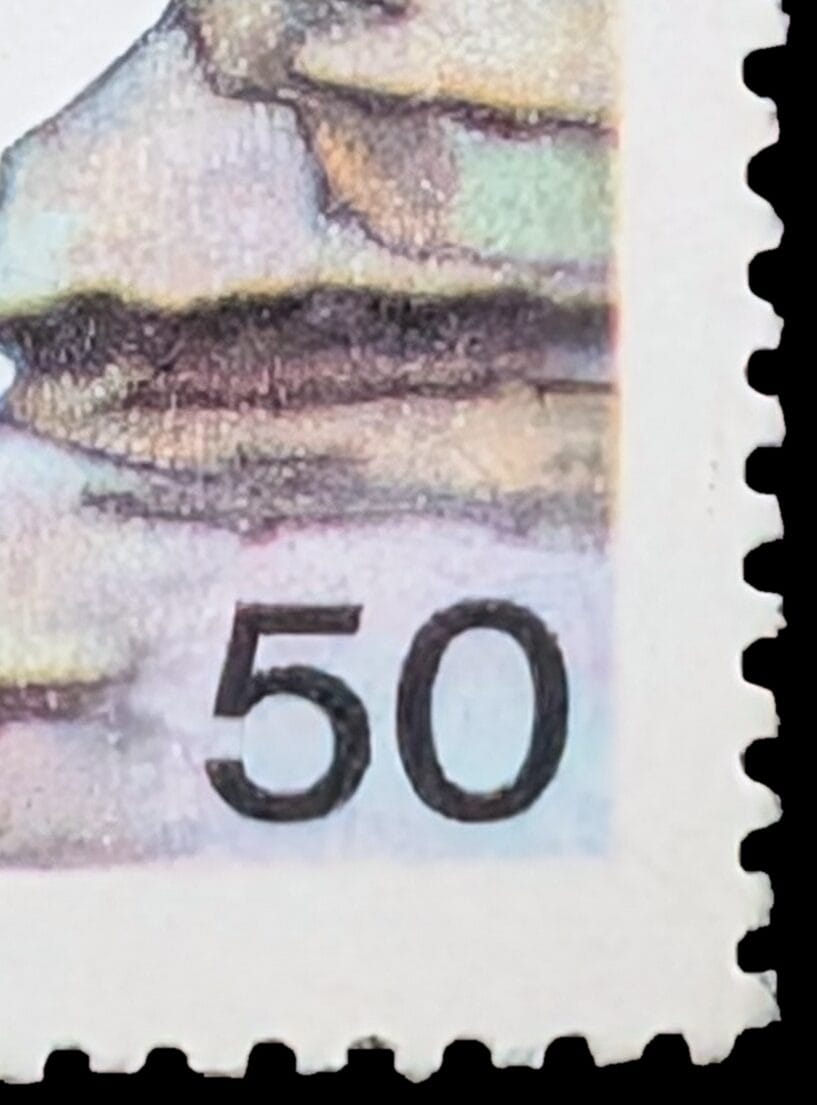
Count the words on the printed sheet. There are four: the year, “बाल दिन CHILDREN’S DAY”, the figure 50, and “भारत INDIA”. That is the whole text.
No title. No painter. The 1986 Children’s Day stamp does not tell you the picture is called “Girl Rock Climber,” and it does not tell you that Sujasha Dasgupta made it. Both facts survive only in catalogue listings compiled afterwards by collectors, and even there the record is thin — a name, and nothing else. No age, no city, no school appears beside it.
This is not unique to 1986. India Post’s stamps almost never carry a designer’s credit, and nobody expects a 50-paise commemorative to work as a wall label. But the Children’s Day issues are the one series where that convention costs something specific. The department’s entire claim for these stamps is that a child made them. It then prints them in a form that makes the claim impossible to check from the object itself.
Run the thought the other way and it gets sharper. Everything on the 1986 Children’s Day stamp that could have been printed by a machine was printed: the year, the occasion, the value, the country. The one element that could only have come from a person is the picture, and the person is the only thing left out. A collector holding the 1986 Children’s Day stamp in 1987 had no way to know whose hand made it, and a collector holding it now depends on a listing somebody else thought to keep.
Why the name was left off is not recorded anywhere. Sheet space is the obvious guess and a poor one, given how much paper this design leaves empty. Departmental convention is likelier, and so is the plain possibility that nobody at any stage thought a credit was owed. The record does not say, and that silence is part of what the 1986 Children’s Day stamp preserves.
Looking Closer at the 1986 Children’s Day Stamp
Start with the ropes on the 1986 Children’s Day stamp, because they are the strangest thing here. Both are drawn with care — the braid worked in short chevrons along the whole length. And both are attached to nothing. There is no anchor, no belayer, nobody holding the far end. The safety system has been drawn as pattern rather than as mechanism.
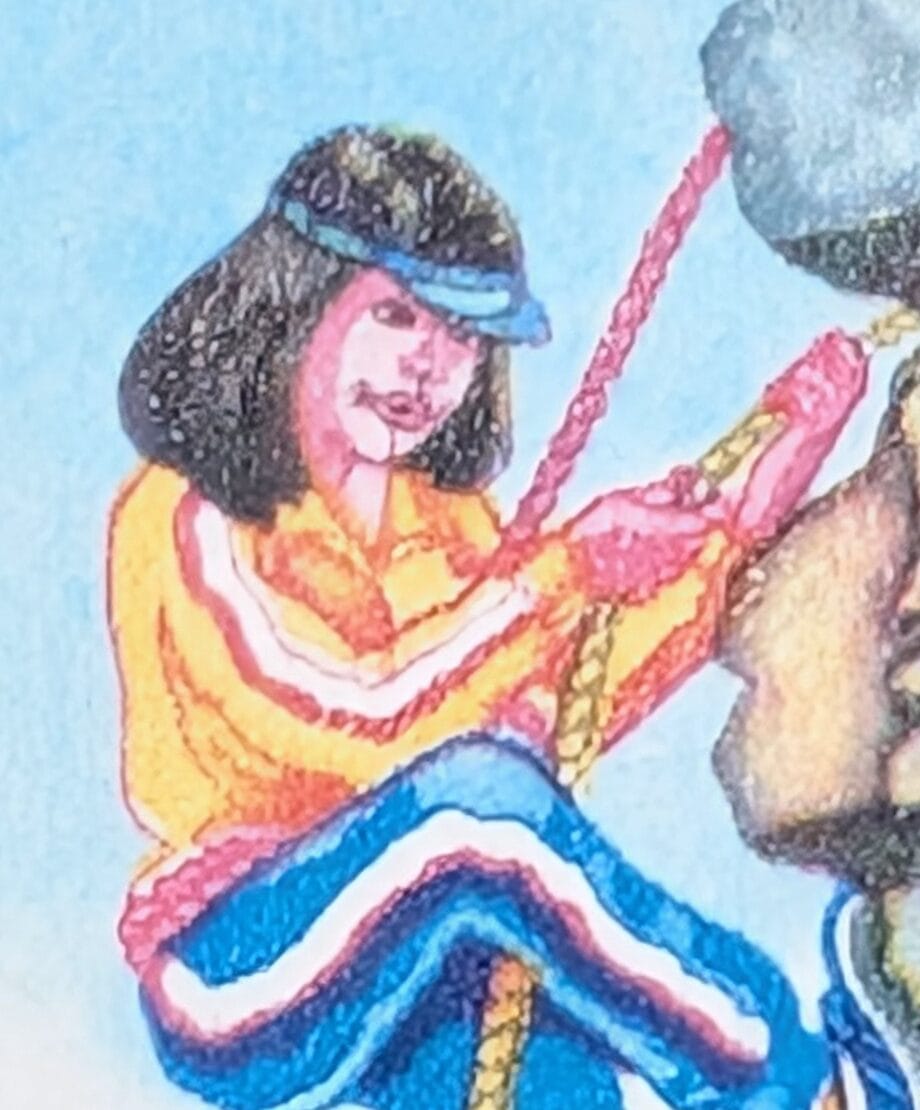
The climber is dressed for a school sports afternoon: a yellow jacket with piped red trim, tracksuit trousers with a side stripe, blue-and-white trainers. Her hair is gathered into a dark knot at the back and a blue band crosses her head. There is no helmet. Real climbing kit has been replaced by the most exciting clothes in a child’s colouring set.
And the drawing barely fills the space it was given. Close to three-quarters of the printed area is pale — unmarked paper at the left, thin wash above, washed-out rock below — and everything carrying weight sits on one diagonal from the top left corner to the climber’s head. The emptiness is not a failure to finish. It is what makes the diagonal read.
Then the scale. In adult mountaineering imagery the mountain is the subject and the human is a speck placed there to prove how large it is. The 1986 Children’s Day stamp inverts that completely. The figure is the biggest object in the frame; the peaks come up to about her knees; her head is above the skyline with clear blue behind it. She is not dwarfed by the rock. She is standing across it, larger than it.
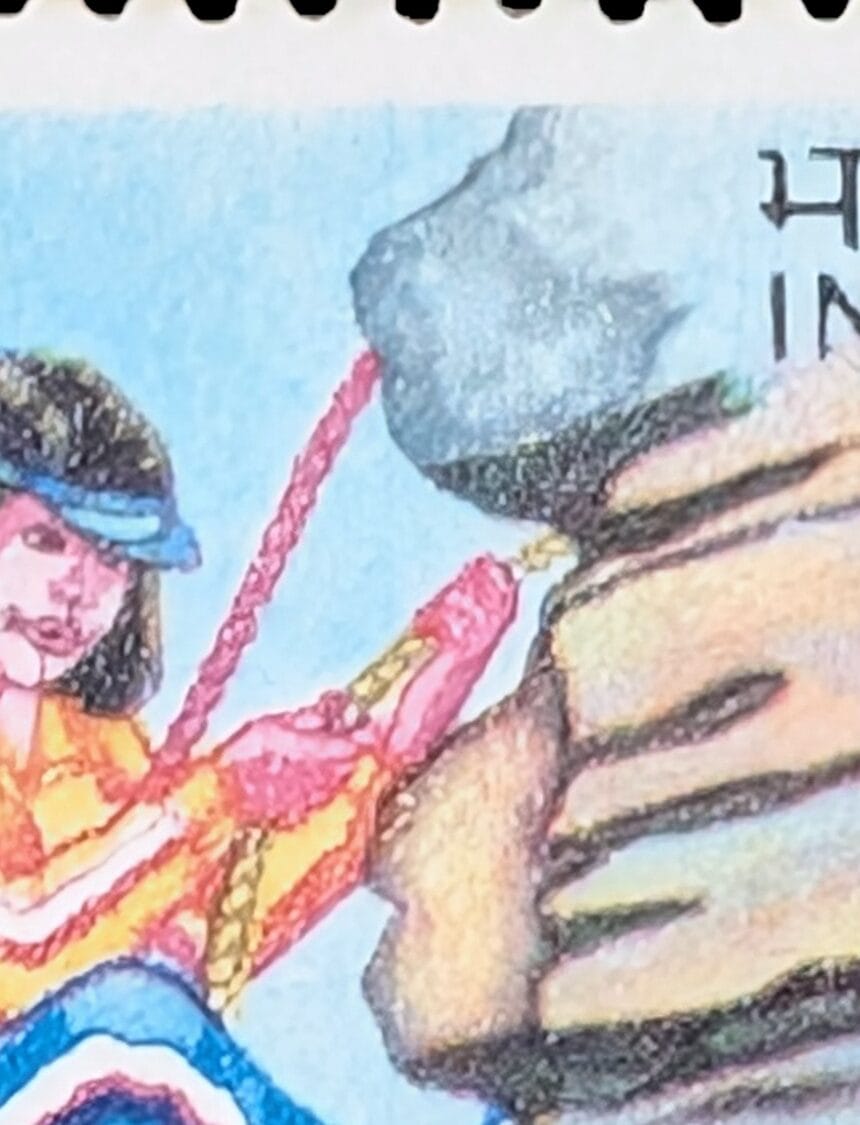
Look closely at the rock and the reproduction gives away how the original was made. The strokes are directional and granular, laid in short parallel passes that change angle where the child changed hands, and the printing has held every one of them. Nothing was smoothed. On the 1986 Children’s Day stamp the ridges are not shaded so much as scribbled, and the scribble survives at 50-paise scale, which is the closest thing the object offers to a signature. The hand is visible. Only the name is not.
The typography of the 1986 Children’s Day stamp is arranged so that nothing interrupts the picture. Three of the four text elements — the year, the denomination, the country — are turned ninety degrees and pushed flat against the margins. Only the occasion line runs horizontally, and it sits in unpainted paper above the drawing.
Nothing crosses the image. No frame boxes it in. The wash thins toward the perforations and the design bleeds to the edge of the paper. Whether that was decided for this stamp or is simply the house layout for the series, the effect is the same: the official furniture is on its side and the drawing has the sheet.
Series Context
The Children’s Day stamps of the 1980s read as a set: “Mother and Child” by Deepak Sharma (1982), a woman and child from “Festival” by Kashyap Premsawala (1983), “Herdsman and Cattle in Forest” by H. Kassam (1984), a girl using a home computer (1985), “Girl Rock Climber” (1986), “My Home” by Siddharth Deshpande (1987).
Read in order, something shifts around the middle of the decade. The early entries are domestic and pastoral — a mother, a herdsman, a festival crowd. Then two years running, the picture is a girl on her own doing something technical, and doing it without an adult anywhere in the frame.
The 1986 Children’s Day stamp is the further of the two. A computer sits on a desk indoors; a rock face does not. Five of these six issues reach the catalogue with a painter’s name attached — the 1985 computer picture is the one that lost its author on the way. Not one of the six carries a name on the stamp.
Closing
A rope that holds nothing is still a rope, drawn carefully, braid by braid, all the way to a loose end. Sujasha Dasgupta put two of them across her picture and the Department of Posts reproduced both exactly as she left them, tips going nowhere, on every sheet it printed. Her name is the only mark that did not make it onto the paper. Forty years on, it survives in a collector’s list and nowhere else.
Further Reading & Links
On StampTales
- The 1983 Children’s Day stamp — a child given free choice painted an adult.
- The 1984 Children’s Day stamp — a Children’s Day stamp with no children on it.
- More from Time Capsule — Indian stamps read as historical documents.
- About StampTales
Elsewhere
- Children’s Day stamps of India, thematic listing — Vijaya & Venkat Tata’s catalogue of the series, and the source of the attribution to Sujasha Dasgupta.
- Indian stamps issued in 1986 — the full year’s programme with issue dates.
- Bachendri Pal — Encyclopaedia Britannica.
- Children’s Day in India) — origins of the 14 November observance.
2 Comments
Comments are closed.