“Ramanujan and Tilak — Paired by Postage, Not by History”
The Srinivasa Ramanujan stamp on this envelope corner was not chosen for who it shows. It was chosen because four rupees plus one rupee is five.
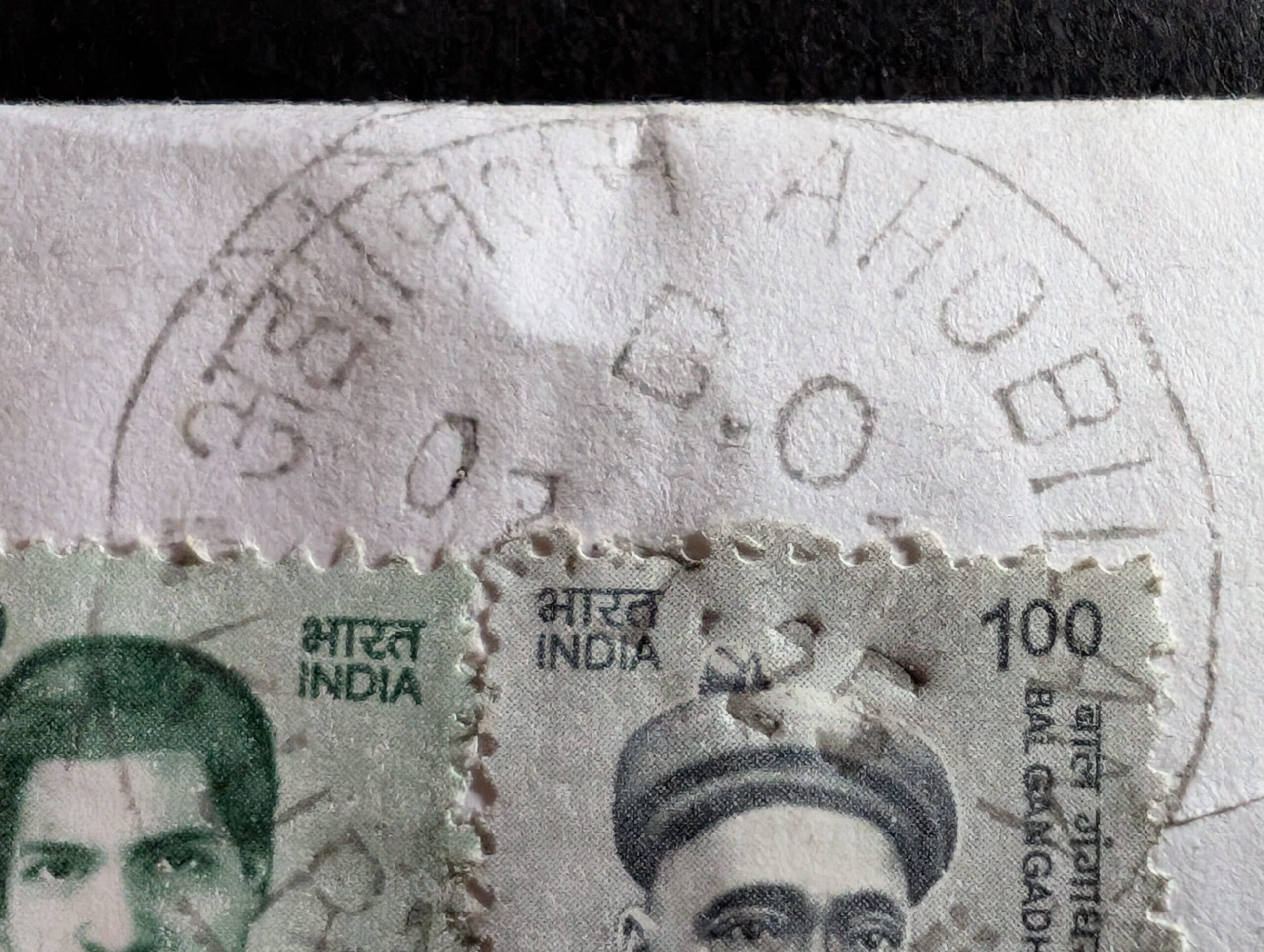
The Stamp
| Series | India’s 11th definitive series (2015–2019) |
|---|---|
| Country | India — Department of Posts |
| Subjects | Srinivasa Ramanujan (₹4.00, green); Bal Gangadhar Tilak (₹1.00, grey–black) |
| Ramanujan issued | 2016 (Phila D194) |
| Printing | Photogravure |
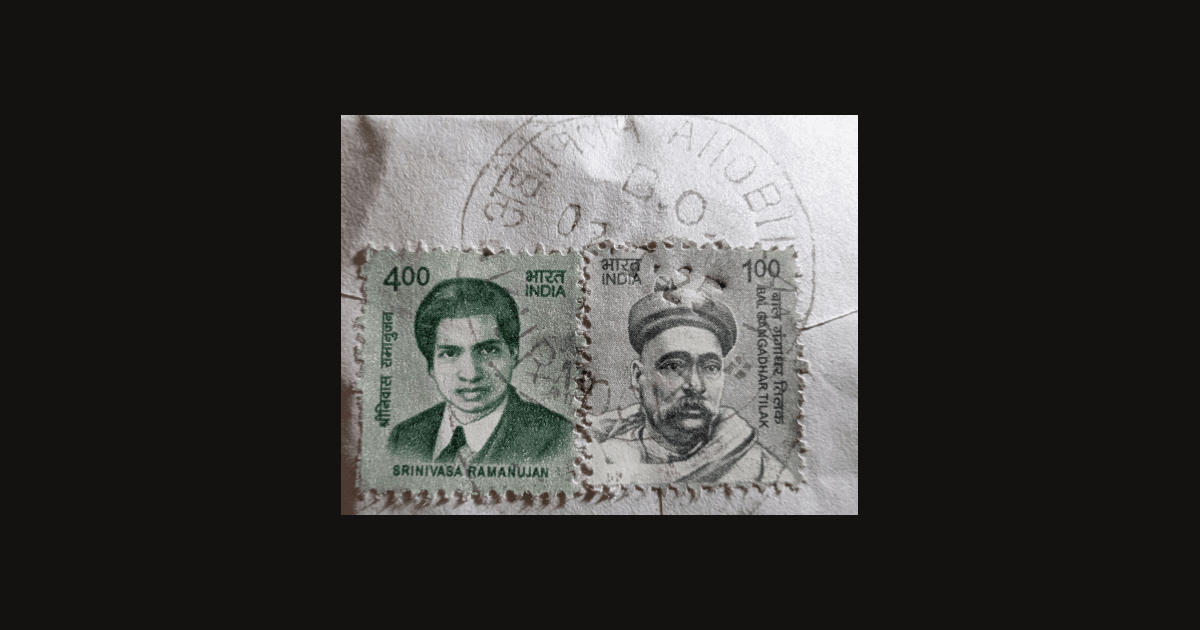
| Used on | Envelope corner, both values tied by one strike |
| Cancellation | AHOBILAM B.O. — branch office, PIN 518543, Nandyal division, Andhra Pradesh |
| Condition of this copy | Used, on cover. Tilak value heavily worn and greyed, cancellation obscuring much of the design. Date largely illegible. |
The Story
Nobody paired a mathematician with a nationalist on purpose. Five rupees did. This Srinivasa Ramanujan stamp shares an envelope corner with Bal Gangadhar Tilak, and the likeliest explanation is the plainest one: arithmetic.
Two stamps sit side by side on the corner of an envelope — a green four-rupee Ramanujan and a grey one-rupee Tilak, struck together by one circular datestamp reading AHOBILAM B.O. Their face values add up to five rupees.
Whether five rupees was the exact postage due is no longer recoverable; the date in the cancellation is largely illegible. But the pairing tells you something simpler than any historical comparison: these portraits were being used as postage, not arranged as a tribute. Four plus one is five, and that is the kind of sum a definitive stamp exists to make.
That is what a definitive stamp is for. StampTales has met Tilak once already, on the 1988 Tilak Swaraj commemorative — a stamp made deliberately, for him, to mark a moment, issued once and then never again. A definitive is the opposite kind of object: the everyday workhorse the post office keeps in every denomination, printed and reprinted for years, sold across the counter and combined in whatever mix adds up to a given rate. A commemorative is made for an occasion. A definitive is made to be used up.
A stamp built to be spent
The whole logic of a definitive series is the ladder of small values. You print a spread of low denominations so that any postage rate can be assembled from what is already in the drawer.
The Ramanujan four and the Tilak one belong to the same run — India’s eleventh definitive series, released in stages between 2015 and 2019, a broad set of national figures that philatelic dealers and cataloguers commonly label “Makers of India” or “Builders of Modern India.” The same series carries Bhagat Singh, Vivekananda, Ambedkar, Shivaji, Tagore, Kalam. Ramanujan and Tilak are two slots in a long tray. The Srinivasa Ramanujan stamp is one such slot — a four-rupee green with no occasion behind it, printed to make up rates.
Here is the detail that says everything about the intent behind them. When the series began appearing, philatelic observers noted that India Post had announced no first-day dates for it and issued no first-day covers — the ceremony that normally attends an Indian stamp simply did not happen. A commemorative exists for its first day; the postmark, the cover, the ceremony are the point. This series skipped all of it. It was not launched so much as stocked.
The Srinivasa Ramanujan stamp as everyday postage
Srinivasa Ramanujan died in 1920, at thirty-two, having built most of his mathematics outside the university system, working through whatever texts he could get hold of, before a letter to G. H. Hardy at Cambridge in 1913 brought his results to England — where Hardy judged that no one would have had the imagination to invent them, so they had to be true. A century later the Republic he never saw independent turned his face into four rupees of green photogravure. Tilak got the same treatment at one rupee: the man who made “Swaraj is my birthright” into a slogan, reduced to a one-rupee workhorse.
The two of them had almost nothing in common in life — and, as it happens, both died in 1920, four months apart, Ramanujan in April and Tilak in August. This envelope corner is about the only place they keep company.
There is a temptation to read the reduction as a diminishment, and it is worth resisting. To be printed as a definitive is to be handled by more hands than any commemorative will ever reach. The commemorative is bought by collectors and admired in albums, kept mint, never posted.
The definitive is licked, cancelled, thrown in a sack, sorted at night, delivered and thrown away. The Srinivasa Ramanujan stamp, as four rupees of ordinary postage, passes through more ordinary Indian lives in a week than Ramanujan the mathematician reached in his lifetime. Being spent is also being everywhere. The stamp a country prints to honour someone ends up in an album; the stamp it prints to be used ends up in the world.
The cancellation
The datestamp is worth naming, because it drags the whole story to a specific hillside. AHOBILAM B.O. is a branch office — the smallest unit in the Indian postal system — carrying PIN 518543, in the temple town of Ahobilam in the Allagadda mandal of what is now Nandyal district, Andhra Pradesh. Until 2022 it was Kurnool district; the postal map, like the stamps, keeps getting reissued. Ahobilam is a Vaishnavite pilgrimage site scattered across the Eastern Ghats — the Nava Narasimha shrines, nine temples to Vishnu’s man-lion avatar strung up the gorges, reached by hill roads. The local tongue is Telugu.
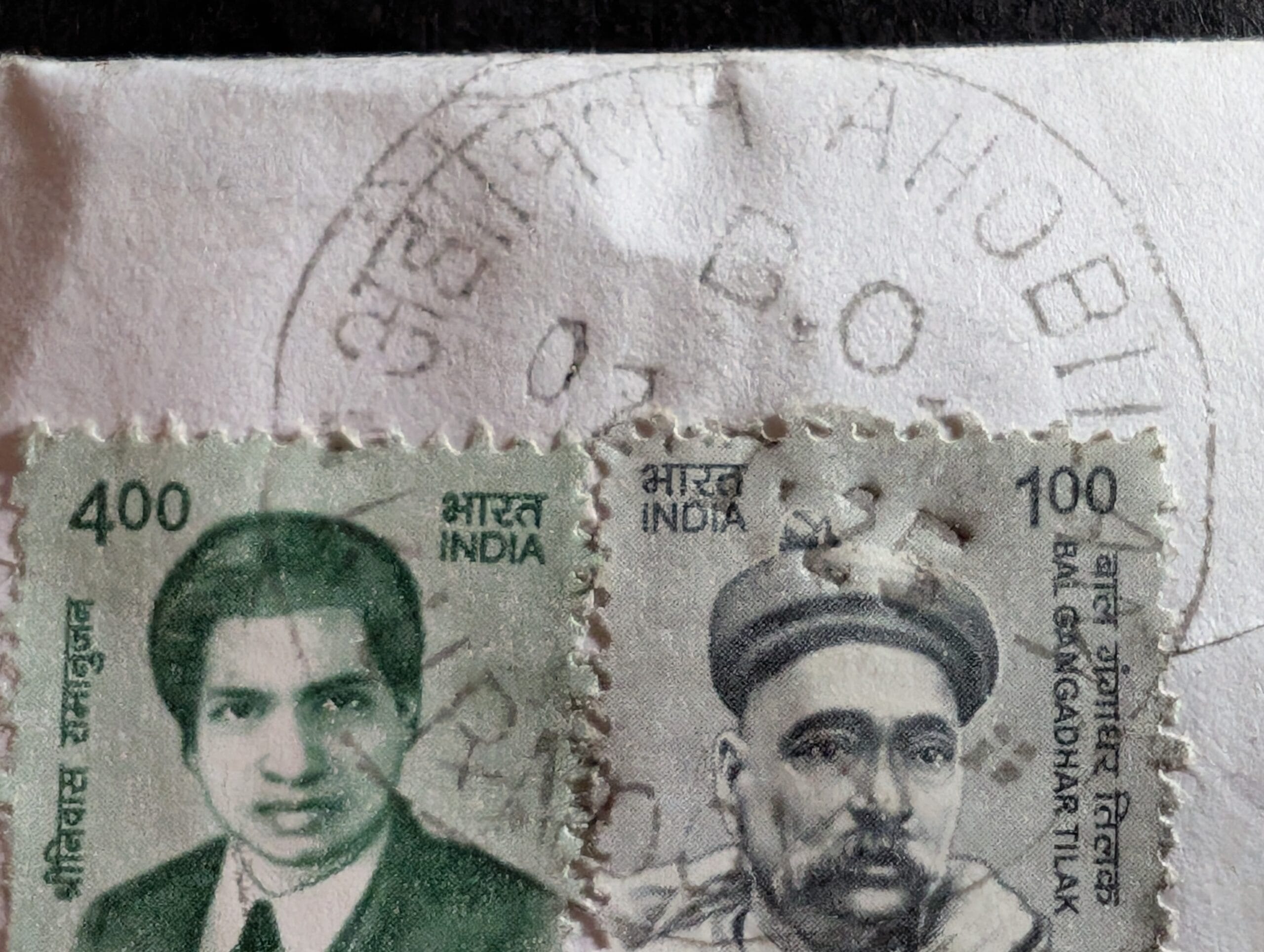
So consider where the postage finally put them. A Tamil mathematician from Kumbakonam and a Marathi nationalist from Ratnagiri, cancelled together at a Telugu temple town in the Rayalaseema hills. The Srinivasa Ramanujan stamp did not travel to Ahobilam for its subject; it travelled because a letter did. Neither man’s biography is naturally connected to Ahobilam. Yet their portraits arrived there together in the most ordinary possible way: as postage — carried in a drawer, combined at a counter, and struck once. The postal system produced a meeting that biography and geography never had, and cancelled it in the same motion.
Looking Closer at the Srinivasa Ramanujan stamp
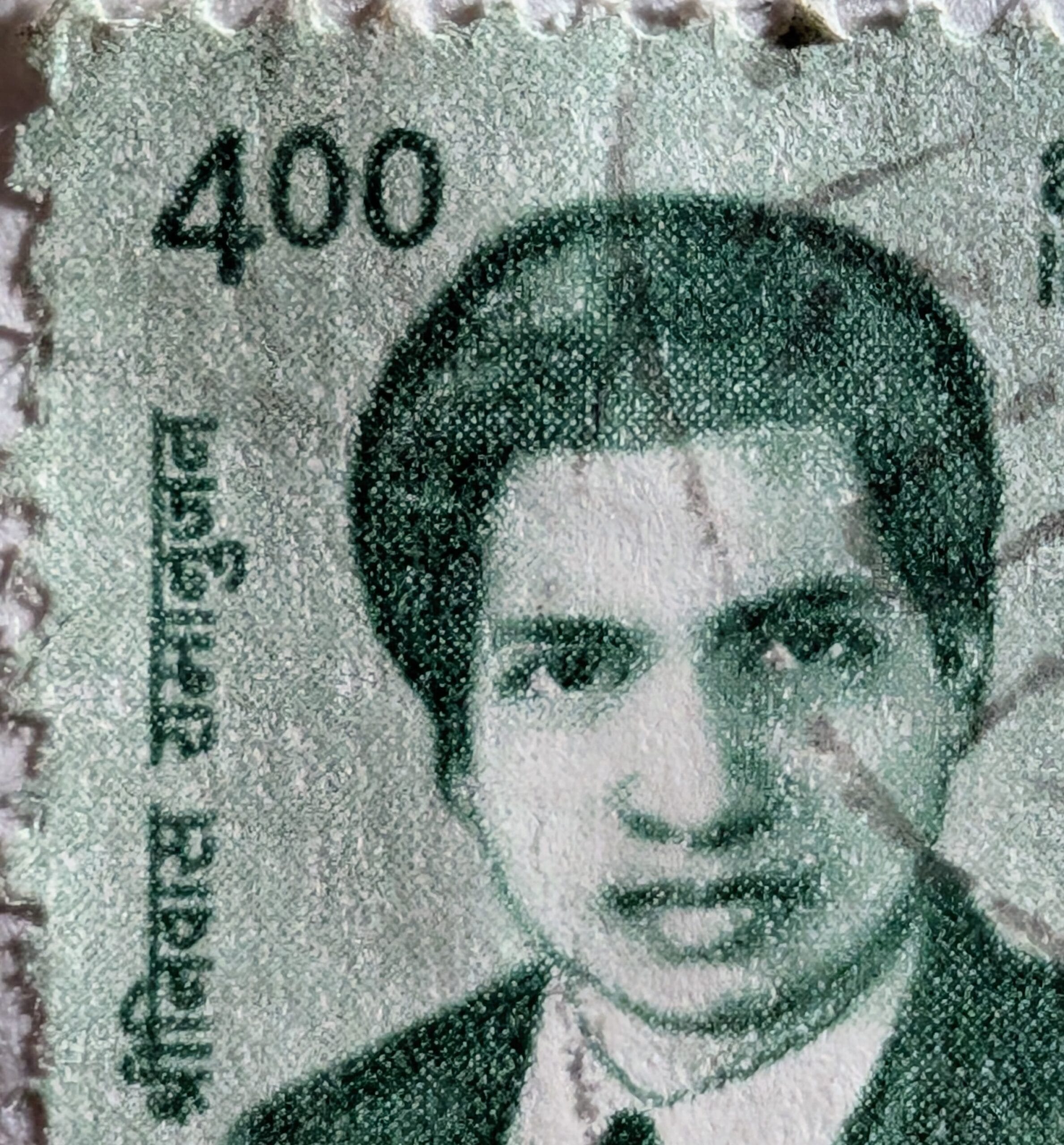
Put a macro lens on the four-rupee green of the Srinivasa Ramanujan stamp and the portrait dissolves. There is no painterly modelling here, no shading in the sense a commemorative might attempt — the face is a single ink laid down as a screen of halftone dots, a rosette of green specks that only resolves into Ramanujan when you hold it at arm’s length. This is what reproducing a human face cheaply and repeatedly, through photogravure, actually looks like up close: not a portrait, a pattern.
The two stamps are built from the same template, and that is the second thing worth seeing. Denomination in the outer top corner, भारत / INDIA in the inner top corner, the name set once in Devanagari and once in Latin, a bust filling the middle. Ramanujan in green, Tilak in grey; otherwise interchangeable frames. The design does not distinguish between a mathematician and a political agitator. It gives them identical slots, because a definitive is a form to be filled, not a tribute to be composed.
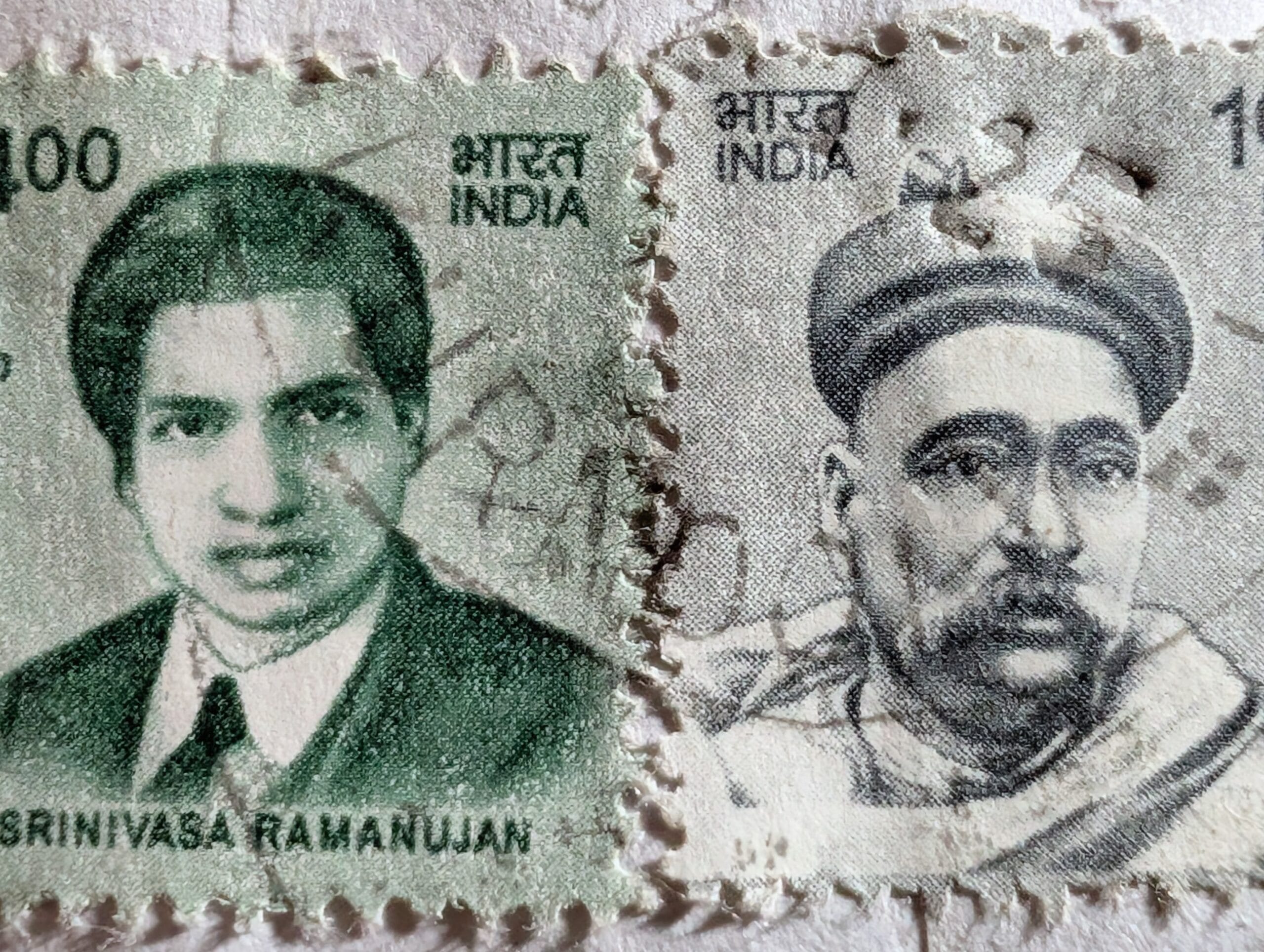
And then the cancellation. It does not sit politely within one stamp. It is a smear of killer lines and a circular date-hammer dragged across both faces at once and on into the envelope paper, heaviest over the worn Tilak. The strike treats the pair as a single surface to be voided, which is what they were to the person behind the counter: five rupees of postage to be marked used, not two portraits to be respected. The heavier wear on the Tilak value is consistent with a stamp that has seen hard postal handling.
Closing
The round hammer of the Ahobilam datestamp falls across both faces at once, binding the mathematician and the agitator inside one smudged circle of ink. It is the only thing they ever shared. The cancellation does not know which man is which. It knows only that both stamps have been used.
Further Reading & Links
On StampTales
- The 1988 Tilak Swaraj stamp — the same man given the full commemorative treatment: designed for him, issued once, for a moment. Beside this one, it is the clearest picture of the difference between a stamp that honours and a stamp that is spent.
- The ₹1 Gandhi stamp that shows him three ways — another study in how a state renders its heroes on postage: one stamp giving Gandhi three faces, where this envelope gives two men a single cancellation.
- Children’s Day 1984 — the state at its least ceremonial; a companion to a piece about the state at its most utilitarian.
External
- Ahobilam — location, temple complex, district.
- Srinivasa Ramanujan — life and work
- Bal Gangadhar Tilak — life and the sedition trials.