The year football changed hands
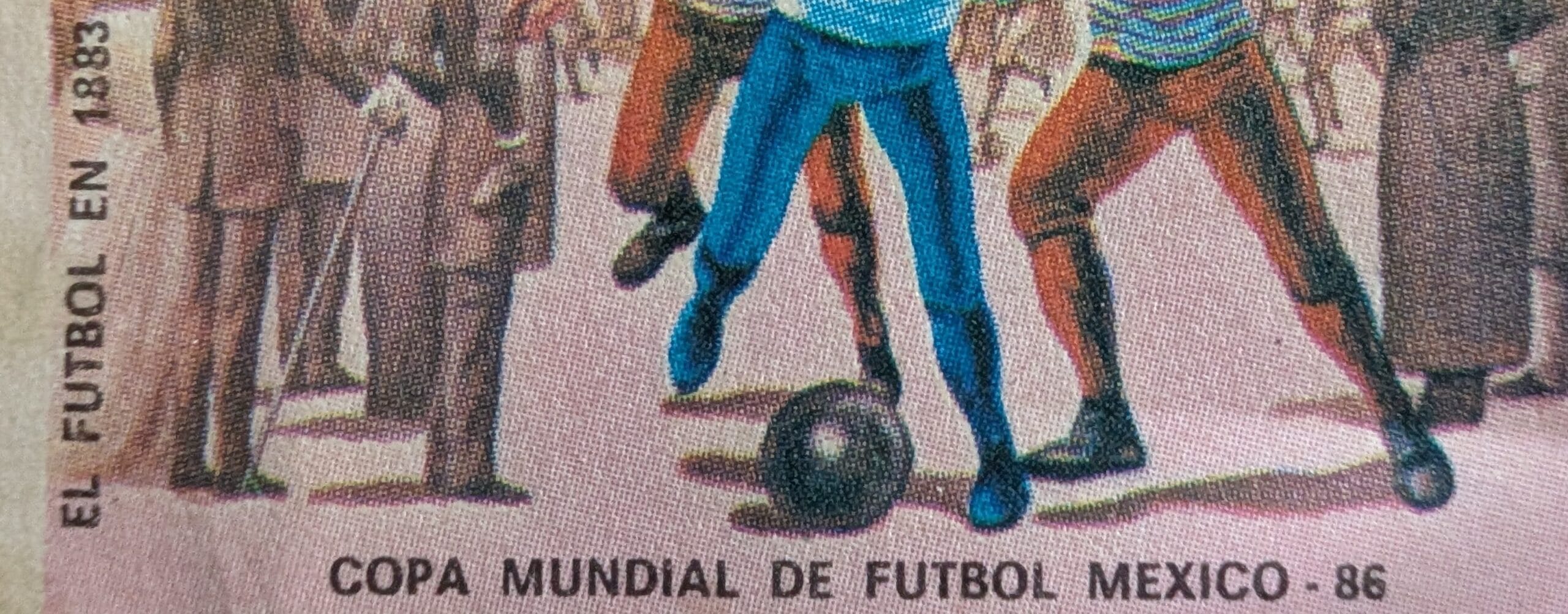
The stamp puts football in 1883. It does not put its birth there — the game was decades old by then — and that gap is the story. What 1883 marks is not the beginning of football but the moment it changed hands, and the moment has a date: the 1883 FA Cup Final, the day the working men of the north broke the gentlemen’s grip on the game the gentlemen had codified.
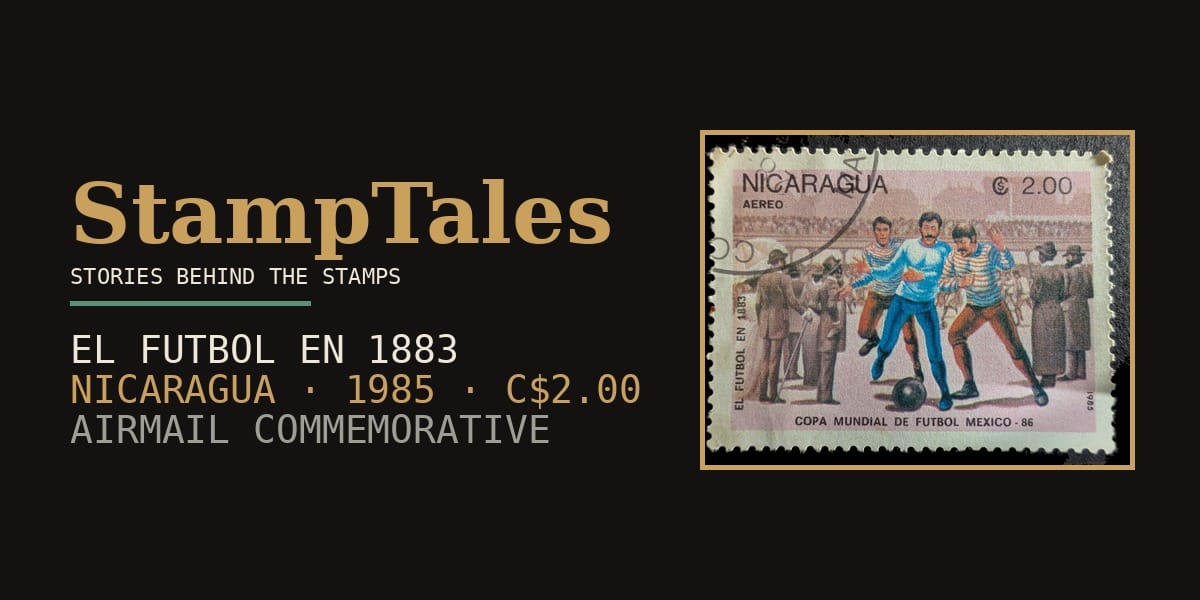
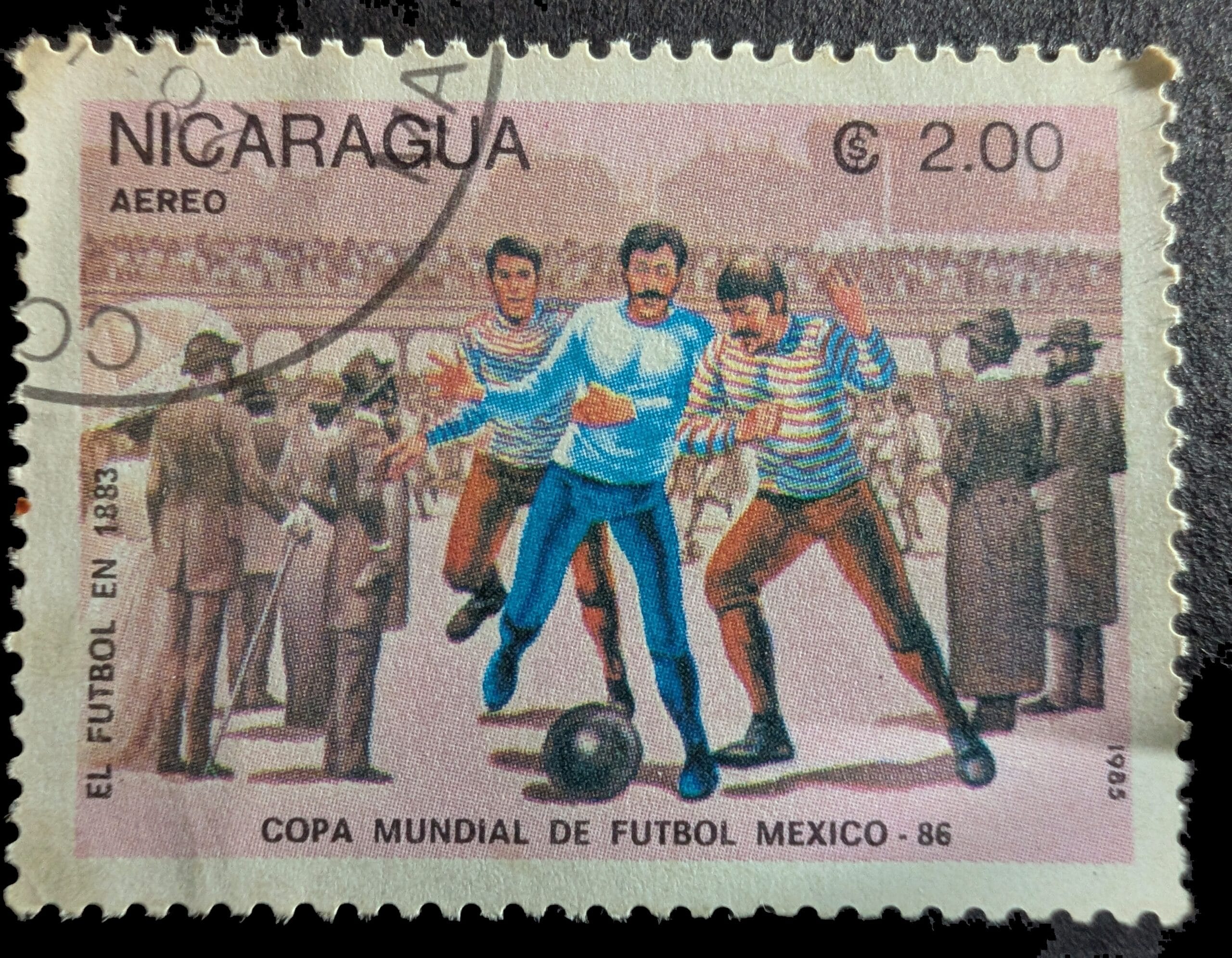
Nicaragua printed this scene, captioned El Futbol en 1883, in 1985: one of eight airmail values in a set that walks football from the year 1314 up to a modern floodlit stadium, all of it timed for the World Cup that Mexico would host the following summer. Look at what the artist put around the players. Three men in collared jerseys and long trousers are fighting for a heavy dark ball; behind them, watching, stands a row of figures in top hats and full-length coats. The crowd is dressed for the opera. The players are dressed for work.
| Issue | El Futbol en 1883 (Evolution of Football series) |
|---|---|
| Issued | 20 January 1985 |
| Denomination | 2 córdobas (airmail — AEREO) |
| Country | Nicaragua |
| Occasion | 1986 FIFA World Cup, Mexico |
| Series | Eight values, football through the ages (1314–1985) |
| Process | Offset lithography, 44 × 34 mm |
| Catalogue | Michel 2557 (set Mi 2553–2560) |
Why the 1883 FA Cup Final is the year that matters
That contrast between the coats and the kit is the whole point of the picture, whether the designer knew the date’s exact significance or not. In the 1870s football in England was still the property of the public schools and the old universities — Old Etonians, Oxford men, the sort who had learned the game on manicured fields and played it as a test of character. The FA Cup, first contested in 1871, was theirs to win, and for a decade they duly won it.
Then the game travelled north, into the mill towns of Lancashire, and the mills produced a different kind of player. A weaver or a foundryman worked six days a week. If he was any good, and the town wanted a winning side, someone had to make up the wages he lost by training and playing on the seventh. That simple arithmetic is what cracked the amateur game open, because the men who could afford to play for nothing and the men who could not were about to meet on the same field.
In the 1883 FA Cup Final they met. Blackburn Olympic, a team drawn from the weaving sheds and iron works of a Lancashire cotton town, beat the Old Etonians two goals to one after extra time. It was the first time the cup had left the hands of the southern amateurs, and the first time it went to a club from the industrial north. Old Etonians reached the final again the next year, lost, and never won the cup again; the southern amateur clubs that had owned the competition faded from it within a few seasons.
Blackburn Olympic were not, on paper, professionals — paying players was still against the rules, and would stay banned until the FA gave way and legalised it in July 1885. But the club had bent those rules to breaking. Its players had been sent to Blackpool for a week of special training before the final, their lost wages quietly covered, in a manner no genuine amateur side could have afforded or would have stooped to.
Within a year Preston North End were investigated for doing the same thing. Their chairman, William Sudell, admitted the payments openly and argued the practice was universal. He was right, and the FA knew it: rather than expel half the northern game, it legalised professionalism in 1885. The 1883 final is the hinge the whole game turns on — not the day professionals were allowed, but the day the amateur monopoly visibly failed.
What the 1883 FA Cup Final scene shows, and what it leaves out
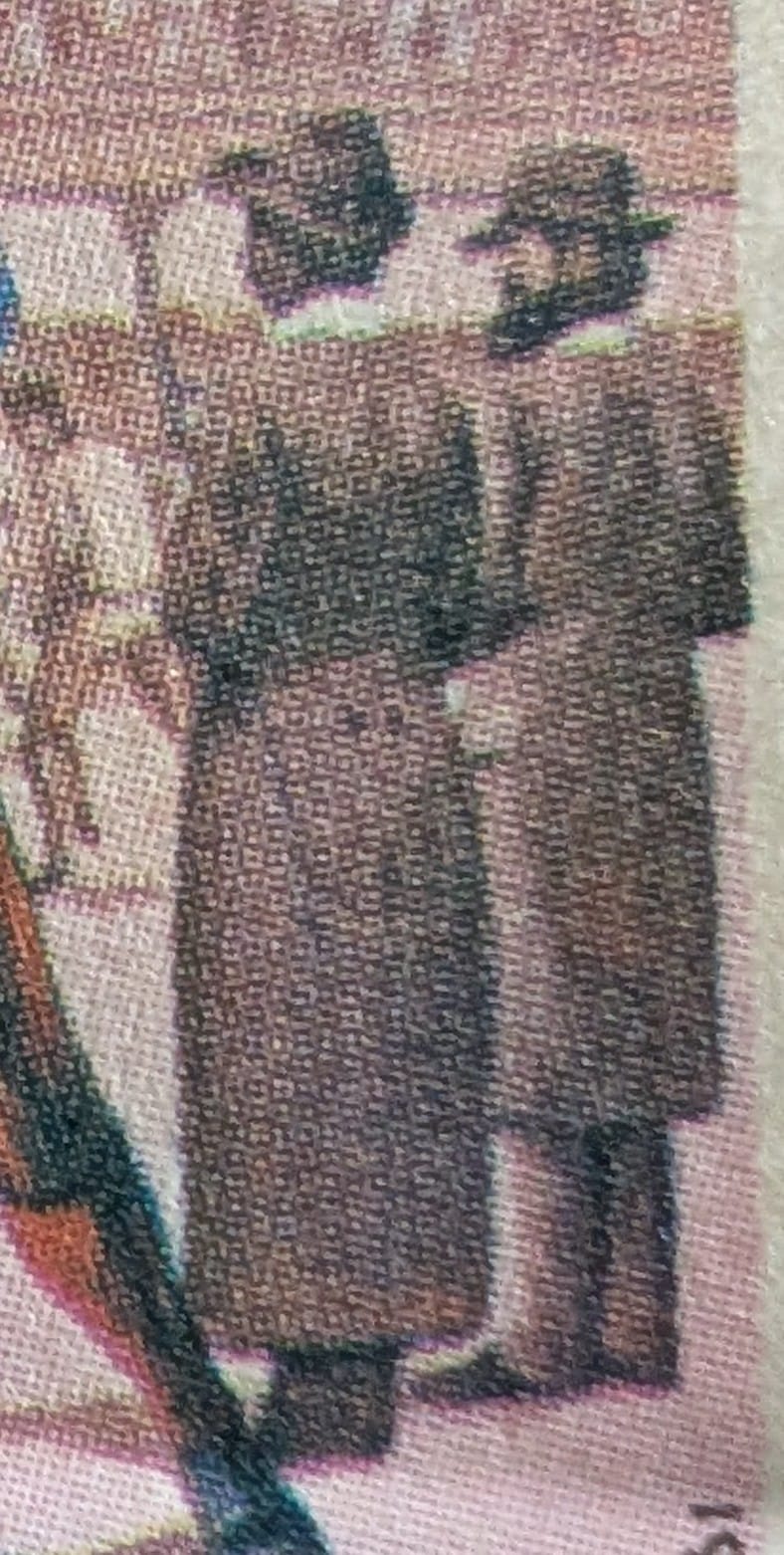
The men in top hats are the losing side of that history, and the artist has posed them with some sympathy. They line the pitch in their coats and canes like witnesses at a ceremony they do not yet know is a funeral — the funeral of their own claim on the game. A caution is due here: nobody on this stamp is a specific person, and the scene is plainly a composite, a costume drama of Victorian football rather than a record of any single match. Reading a particular fixture into it — Blackburn against the Etonians, or anyone else — would be inventing a precision the picture does not offer.
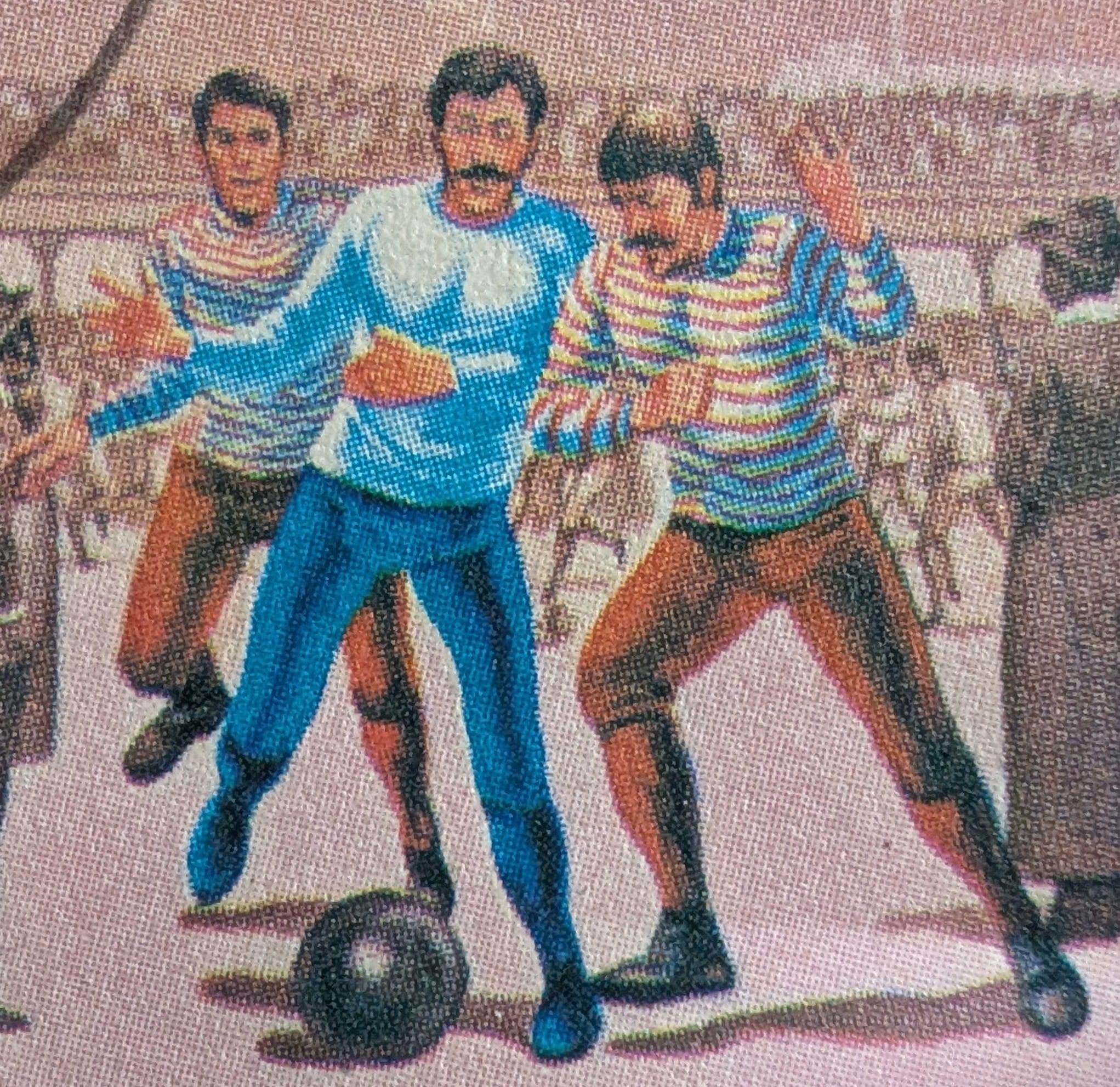
The kit, though, is doing honest historical work. The players wear the long trousers and heavy laced boots of the period, and the ball is the dark, seam-heavy leather sphere of the 1880s, nothing like the panelled white ball a 1985 viewer would picture. The costume details are close enough to period photographs to make the image feel researched rather than generic. That care is what makes the rounded-off date forgivable: the image is trying to show a true moment in the game’s past, even where the caption flattens two decades of upheaval into one convenient year.
A football stamp from a country that plays baseball
Here is the second oddity, and it is the larger one. Nicaragua’s sporting culture has long been dominated by baseball rather than football — a legacy of heavy American involvement in the country across the early twentieth century — and its footballers have never reached a World Cup. So why would Managua issue eight separate stamps tracing the history of a sport it does not especially play, for a tournament it stood no chance of qualifying for, staged in another country altogether?
The answer lies in what Sandinista-era Nicaragua used its stamps for. Through the 1980s the government was fighting a US-backed insurgency and running an economy hollowed out by war and embargo, and its philatelic programme leaned heavily on bright thematic issues — football, dinosaurs, spacecraft, wildlife — of the kind that sell to collectors abroad rather than circulate on domestic mail. Produced in large thematic sets and marketed internationally, such stamps were a modest but welcome earner of foreign currency. A World Cup was exactly the sort of subject that market rewarded, and 1985, eighteen months before the tournament, was the moment to print it.
That reframes the whole object. A stamp ostensibly about English football history, drawn for a Mexican World Cup, was issued by a Central American revolutionary state largely to earn hard currency from collectors in the very countries it was politically at war with. The romance in the picture — the weavers taking the field from the aristocrats — rides on top of a piece of commerce every bit as clear-eyed as anything Blackburn Olympic did to win in 1883. The stamp honours the moment money entered football. It was itself printed to make money.
Further Reading & Links
- Another stamp that says one thing and means another: our piece on the XI Asian Games running figures of 1990, where India printed athletes with no nation on them for a Games it was not hosting.
- On sport as postal statecraft: the IX Asian Games Delhi 1982 cycling stamp, issued for a federation that had ceased to exist three days earlier.
- 1883 FA Cup Final (Wikipedia) — Blackburn Olympic 2, Old Etonians 1: the first cup won by a northern, working-class side.
- The 1883 F.A. Cup Final: working-class representation and professionalism (Soccer & Society) — the academic case for reading 1883 as football’s class turning point.
- From Evil to Expedient: the legalisation of professionalism, 1884–85 (Springer) — how the amateur rule collapsed two years after this final.
- Evolution of Football set — El Futbol en 1883, catalogue detail (Colnect) — the eight-value 1985 airmail series and its issue data.