The gateway India chose to be its front door
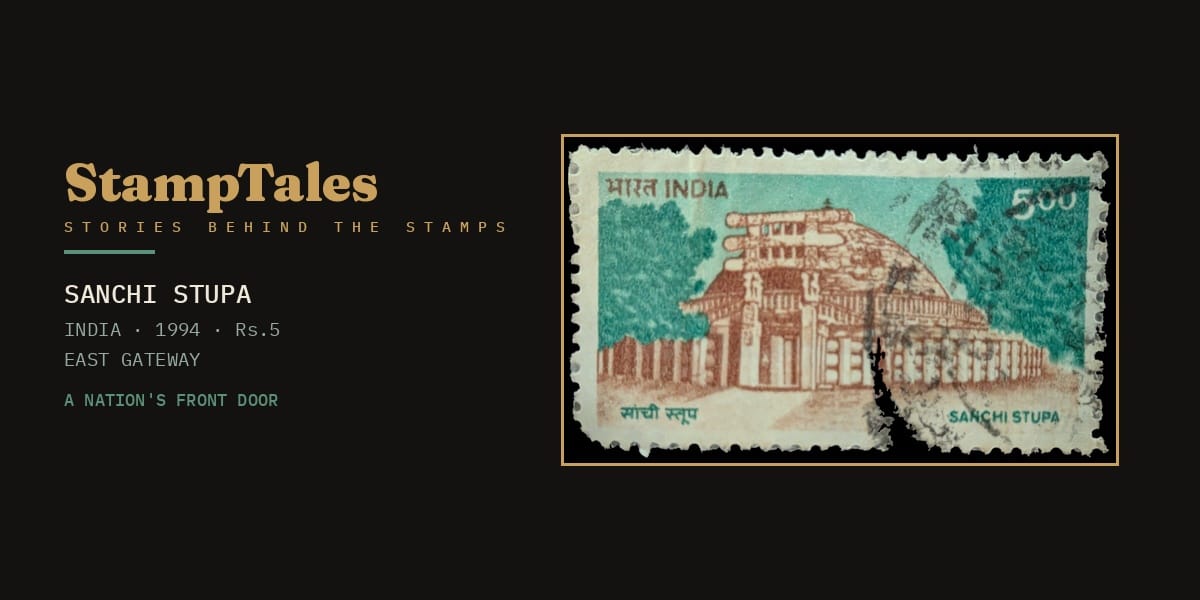
When independent India introduced its first definitive stamps in 1949, it did not put a politician on them. It put India’s ancient monuments on the nation’s everyday mail, among them the East Gateway at Sanchi, in Madhya Pradesh.
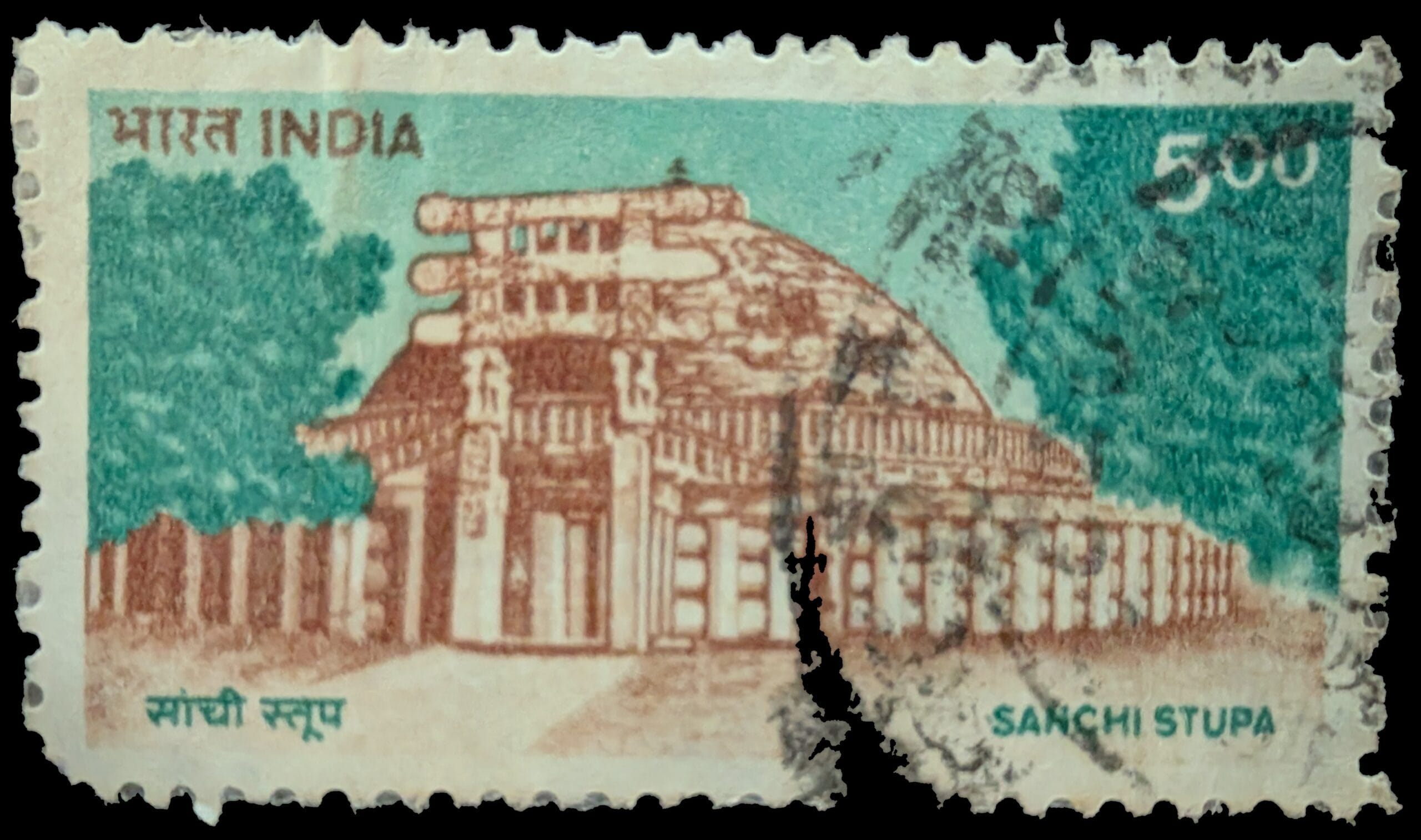
Forty-five years later, Sanchi Stupa returned on the ₹5 stamp here. Twenty-three years after that, the monument appeared again, on the reverse of India’s ₹200 note. The image outlived the governments that first chose it — and to see why India kept reaching for it, you have to start with what the country was deciding in 1949, because what a state puts on its first stamps is a statement about who it thinks it is.
| Issue | Sanchi Stupa (definitive) |
|---|---|
| Issued | 4 April 1994 |
| Denomination | ₹5 |
| Country | India |
| Depicts | East Gateway (torana) and dome of the Great Stupa, Sanchi |
| Colours | Reddish-brown and turquoise-green |
| Watermark | Ashokan (large multiple) |
| Printer | India Security Press, Nashik |
What a new nation puts on its first stamps
A definitive series is not a commemorative. Commemoratives mark an event and vanish; definitives are the stamps a country actually runs on for years, the ones a clerk reaches for without thinking. Whatever a nation prints on them, it is saying: this is us, at the everyday scale.
In 1949 the new Indian state could have led with its founders. It did not. The whole first definitive series was given over to archaeological and historical monuments — the East Gate of Sanchi at three annas, the Ajanta caves, the Mahabodhi temple at Bodh Gaya, a Bijapur tomb, temples Hindu and Buddhist and Jain, a Muslim mausoleum. The series presented India’s antiquity through monuments drawn from several religious traditions at once.
That selection was doing work. India in 1949 was a year out from Partition, still settling what kind of state it would be and what secularism would mean in a country emerging from communal bloodletting. Historians have read the series as a small exercise in secular nation-building: Buddhist, Muslim, Hindu and Jain monuments side by side on the nation’s daily mail, presenting the past as a shared inheritance rather than the property of one community. That is a historical reading of the choice, not a surviving record of what the designers intended.
Sanchi was a pointed thing to lead with. The Great Stupa is Buddhist, at a site that had been a major centre of Buddhism in India for centuries before its eventual decline. Its most famous patron, the emperor Ashoka, had already been chosen as the state’s other founding symbol — the lion capital of his pillar at Sarnath became the national emblem, and his wheel went to the centre of the flag. The stamp reached back to the emperor whose post-Kalinga reign became associated with Dhamma rather than the triumph of conquest.
Why the gate, and not the dome
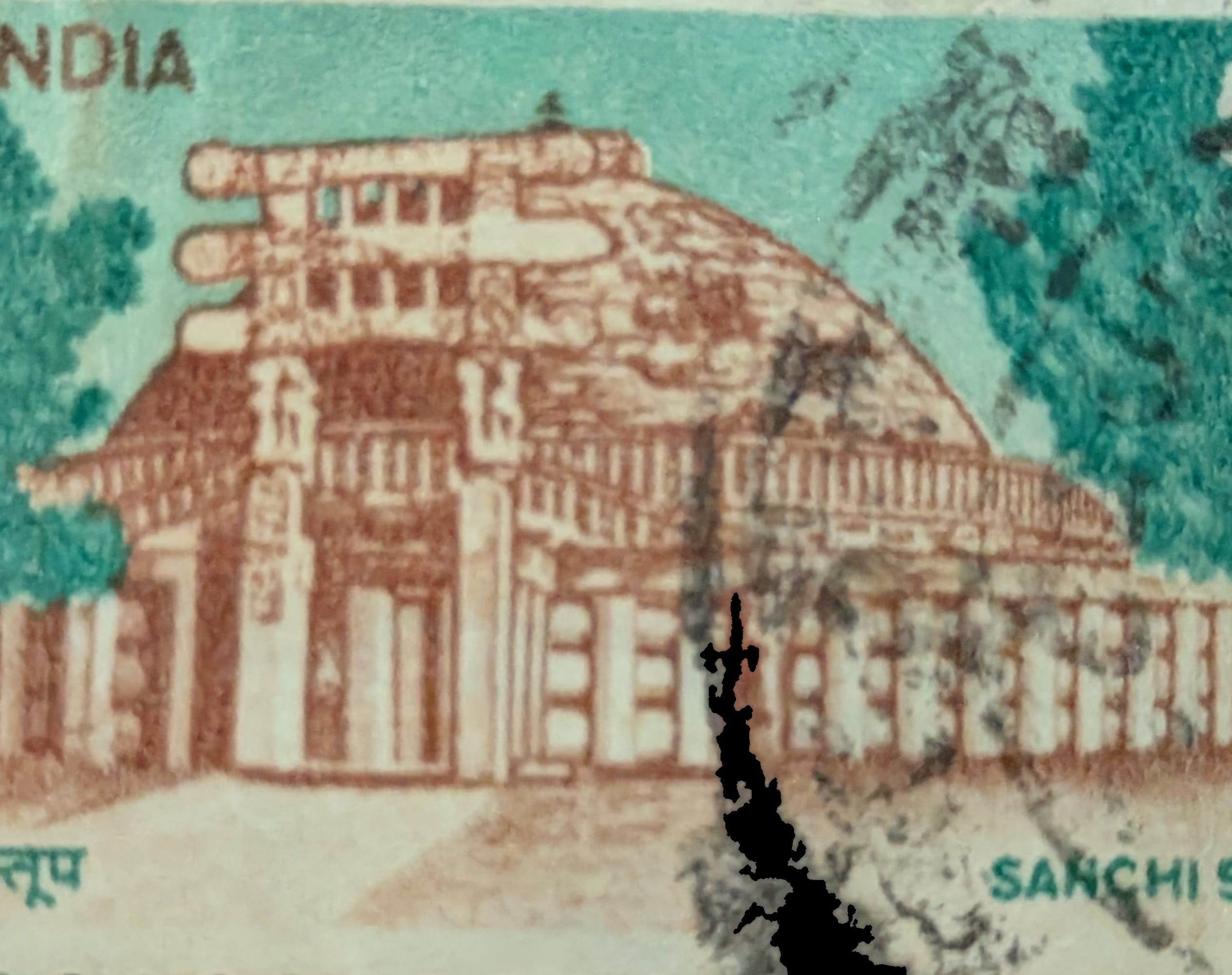
The stamp does not show the stupa the way a tourist photograph would — the great hemisphere filling the frame. It puts the East Gateway in front and lets the dome sit behind it.
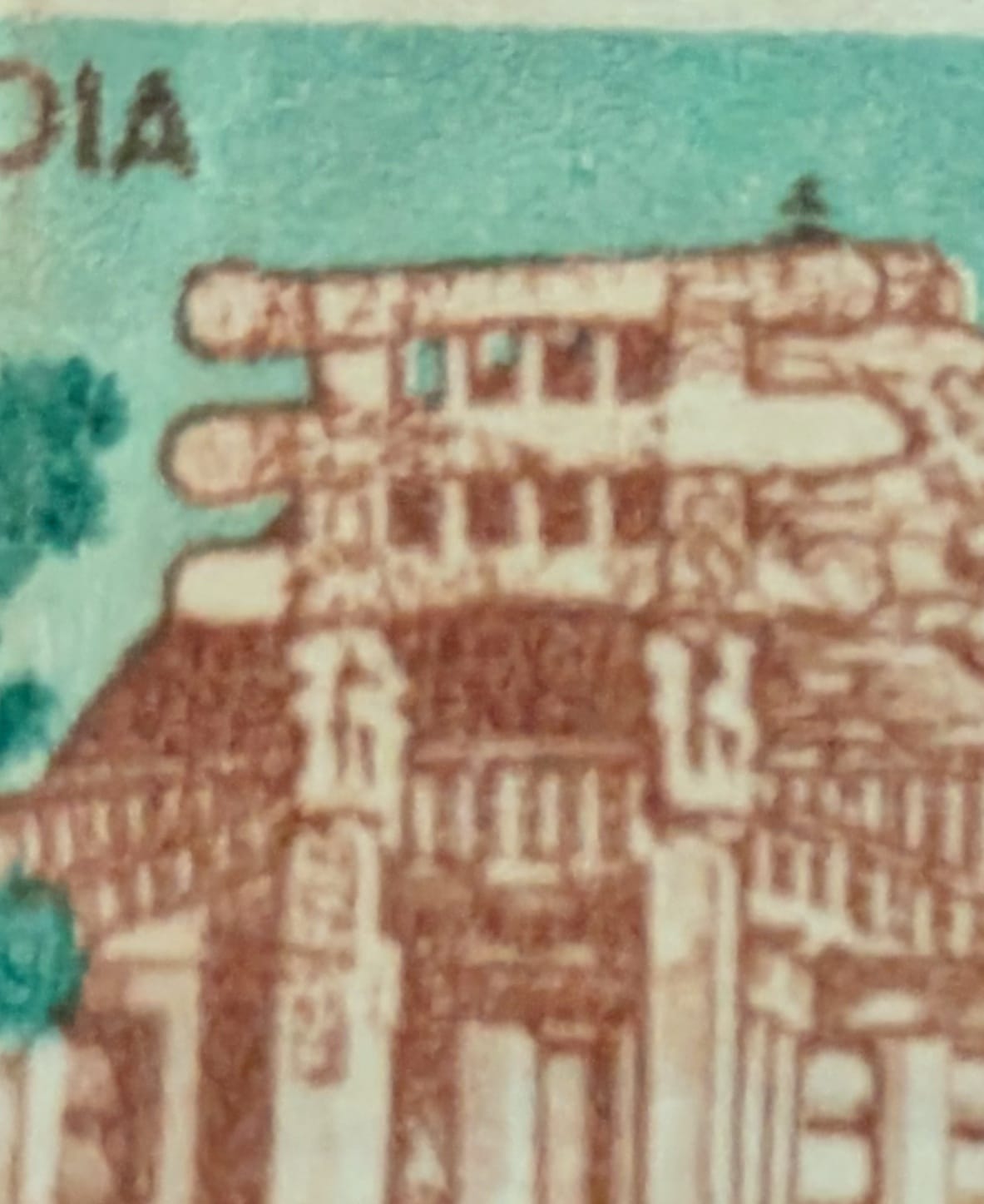
The dome is the older thing: a plain brick mound raised over relics of the Buddha in the third century BCE, under Ashoka, later cased in stone. It is visually austere — no carved narrative scenes, no face, nothing for the eye to follow. The four gateways came almost two centuries later, around the first century BCE, and they are the opposite: every surface is worked with crowded scenes, animals, guardian figures, the whole visual language of early Indian sculpture packed onto four stone frames. The torana is where a wordless monument learned to tell stories.
So the carved gateway is the part that speaks, and it is the part the stamp — itself a small carrier of national stories — chooses to stand in. The storytelling surface goes in the foreground; the relic mound sits behind it. Whether the designer reasoned it that way or simply drew the most legible view, the composition lands on the more articulate half of the monument.
The image India kept coming back to
Sanchi’s East Gate appeared in the 1949 definitive series. The Great Stupa returned as this ₹5 definitive in 1994, deep into a very different India — liberalising, television-lit, and far removed from the political world that had produced the 1949 series. And in 2017, when the Reserve Bank designed a new ₹200 note, it put the Sanchi Stupa on the reverse. A monument the country had chosen to introduce itself with in 1949 was, seventy years on, in the wallet of anyone who broke a note.
Postage and currency are among the most ordinary forms of state-issued imagery a citizen encounters. That India kept routing both back to Sanchi is not an accident of taste. It is a government returning, in these moments of self-portrayal, to an image of the country as ancient, plural and shared — the version of the past the 1949 series first put in the post. The same year this ₹5 stamp appeared, India also put Gandhi’s face on a ₹11 commemorative stamp; the country could picture itself through a leader or through a monument, and in 1994 it did both.
What the record shows is simpler than a thesis about belief. Across seven decades, India returned to Sanchi when it needed an image of the country itself. The monument began on the nation’s everyday mail and, in the end, found its way into the wallet.
Further Reading & Links
- Definitive stamps of India, 1st Series 1949 — Archaeological Monuments — the 1949 monument series, confirming the East Gate of Sanchi at 3 annas led it.
- Sanchi (Wikipedia) — the Great Stupa’s dating: 3rd-century-BCE dome under Ashoka, 1st-century-BCE carved gateways, UNESCO World Heritage since 1989.
- Torana (Wikipedia) — the gateway form the stamp foregrounds and its place in early Indian architecture.
- Indian 200-rupee note (Wikipedia) — the Sanchi Stupa on the reverse of the 2017 note.