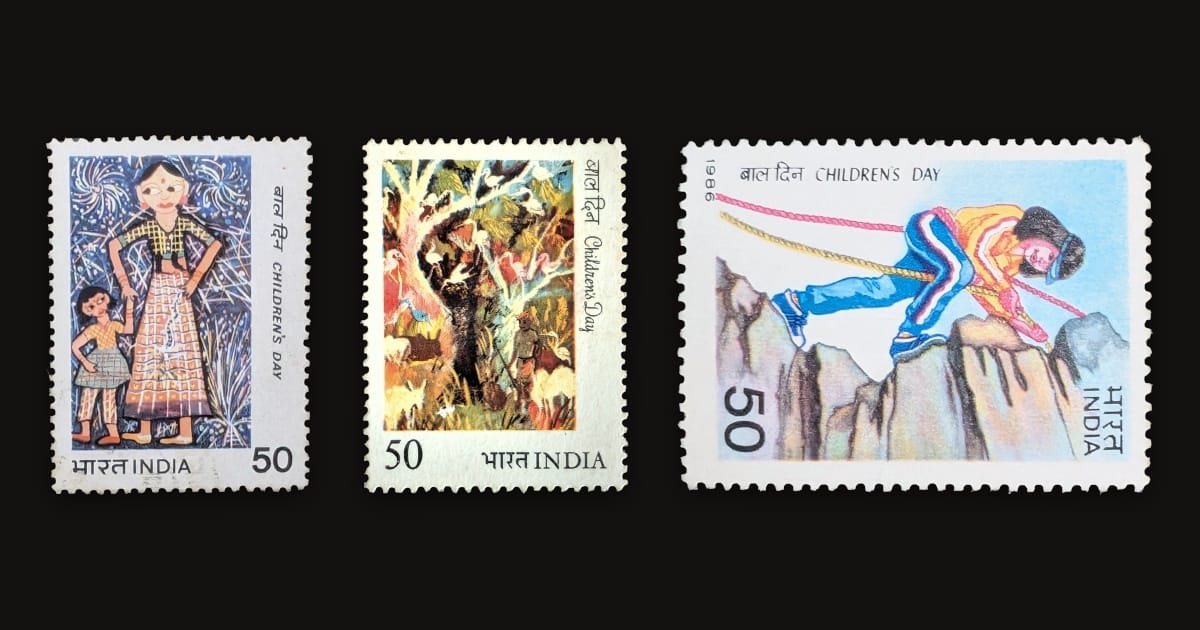
What Three Children’s Day Stamps Reveal Together
The Children’s Day stamps are the only Indian stamps a child designs. Three times running, the child looked somewhere the occasion never asked them to.
Three stamps. Three children’s paintings. On three Children’s Day stamps the Department of Posts stepped back and let a schoolchild decide what a national stamp would show — and each time the child aimed somewhere other than the obvious.
The Children’s Day stamps of 1983, 1984 and 1986 were not commissioned from staff artists. India Post has run a national painting competition for its 14 November issue since 1971, and the winning entry is printed substantially as the child submitted it. Read on their own, each is a small curiosity. Read together, the three Children’s Day stamps show the same thing happening three times: an occasion named for children, handed to a child, who then points the picture at something else entirely.
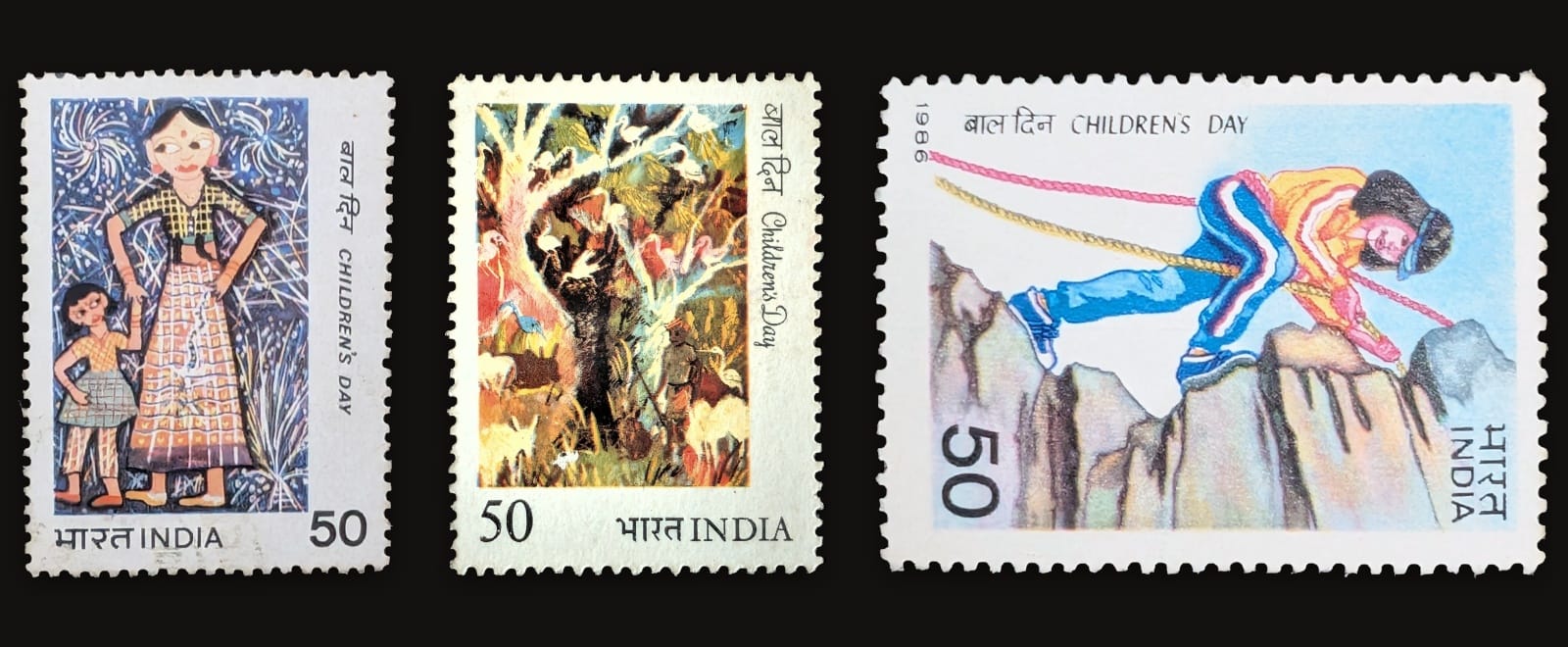
| Year | What the child painted | What the occasion asked for |
|---|---|---|
| 1983 | A grown woman and a small child among festival fireworks | A picture of childhood |
| 1984 | A herdsman and cattle in a forest — no child anywhere in the frame | A picture of childhood |
| 1986 | A lone girl on a rock face, roped to nothing, drawn larger than the mountain | A picture of childhood |
How the Children’s Day Stamps Handed Over Control
Start with the arrangement, because it is genuinely unusual. On almost every Indian commemorative, the image is made inside the system — a staff artist, a commissioned designer, an official photograph. The Children’s Day issue is the one exception on the calendar. For one stamp a year, the department runs a competition, picks a child’s painting, and reproduces it at 50 paise on gummed paper with the national wording set around it.
That is a real transfer of authority, and it produces results no design office would have signed off. A commissioned illustrator handed the brief “Children’s Day” would reasonably be expected to draw children — playing, reading, waving flags. That is what the occasion appears to invite. It is not, three years running, what the department got.
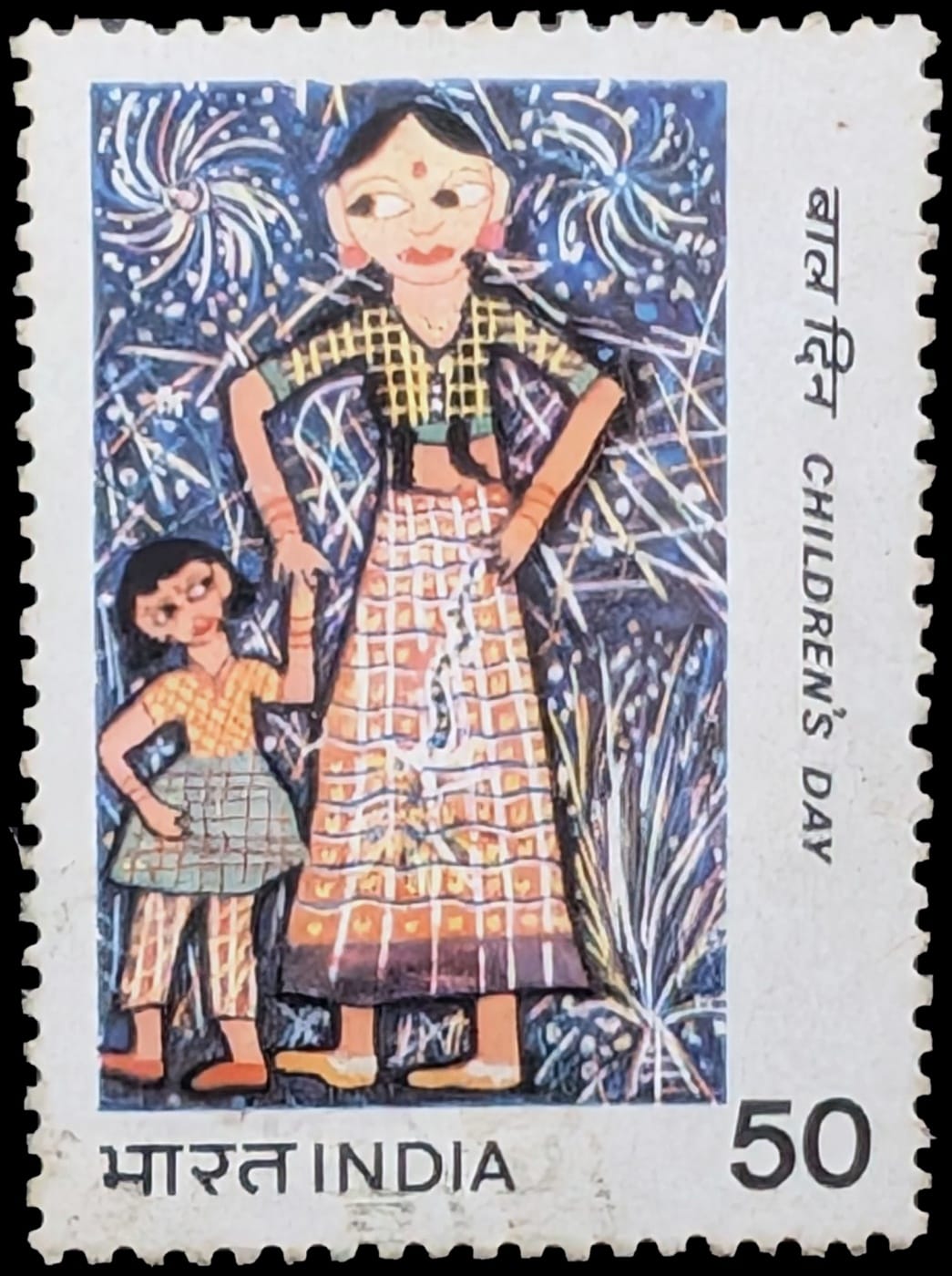
In 1983 the winning painting was a festival scene: a woman and a small child beneath bursting fireworks, the two hands meeting at hip height, which is as high as the child in the picture reaches. The subject a child chose to paint was an adult, and their own place in the frame was small and low. @@IMAGE:04@@
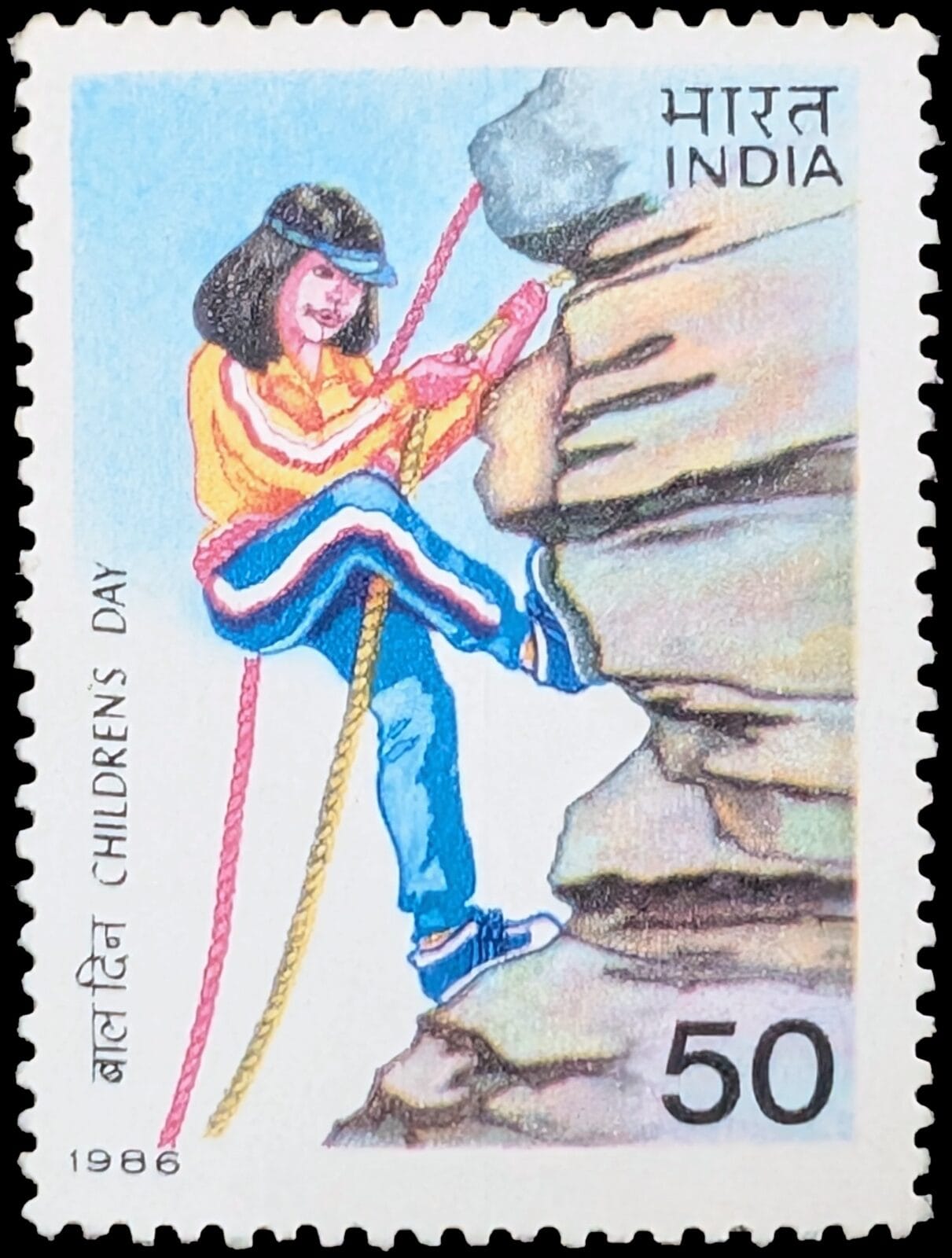
In 1984 the painting was a herdsman driving cattle through forest — a Children’s Day stamp, printed into the worst fortnight the country had had in years, with no child anywhere on it. In 1986 the painting was a girl climbing a rock, drawn bigger than the mountain she stands on, roped to nothing at either end. Across all three Children’s Day stamps the winning child ignored the obvious picture of childhood entirely.
Three commissions the department did not write, and three answers it did not expect.
What the Children’s Day Stamps Leave Off
Then there is the omission the three Children’s Day stamps share, and it is not in the pictures. It is in the credits.
Look at any of the three and count the printed words. The year, the occasion, the value, the country. That is the whole text. What is never printed is the one thing these stamps exist to celebrate: the child who made the picture. The 1983 painting is credited in collectors’ catalogues to Kashyap Premsawala, the 1984 to H. Kassam, the 1986 to Sujasha Dasgupta — names that survive in a thematic index compiled afterwards, and nowhere on the stamps themselves. The department built a whole series around the fact that a child made the artwork, then printed each one in a form that keeps the child anonymous.
The pattern holds even where the record is thin. For H. Kassam, the 1984 painter, the catalogues carry an initial and a surname and nothing more — no age, no city, no school. For a series whose entire premise is that these are children’s paintings, the children are the part that was allowed to disappear.
It would be easy to call this a failure of the stamps. It is closer to the opposite. A commissioned design would have given the occasion exactly what it asked for — a tidy picture of childhood, forgotten by December. What these three children handed back was stranger and more honest: an adult, an empty forest, a girl roped to nothing. The department printed all three without smoothing them into house style, and only left off the one detail that would have told you whose eye you were looking through.
Hand a national stamp to a child three years running, and three times the child shows you something the grown-ups naming the day would never have chosen. Apart, the three Children’s Day stamps are three odd little pictures. Together, they are a record of what happens when an institution stops drawing and lets the subject hold the pencil.
Further Reading & Links
On StampTales
- The 1983 Children’s Day stamp — given free choice, the child painted an adult.
- The 1984 Children’s Day stamp — the Children’s Day stamp with no children on it.
- The 1986 Children’s Day stamp — a girl roped to nothing, and a painter the stamp never names.
- More from Time Capsule
Elsewhere
- Children’s Day stamps of India, thematic listing — Vijaya & Venkat Tata’s catalogue, and the source of the child-artist attributions.
- Children’s Day in India) — origins of the 14 November observance.