The Year a Health Campaign Became a Programme — Hungary’s World Rheumatism Year Stamp
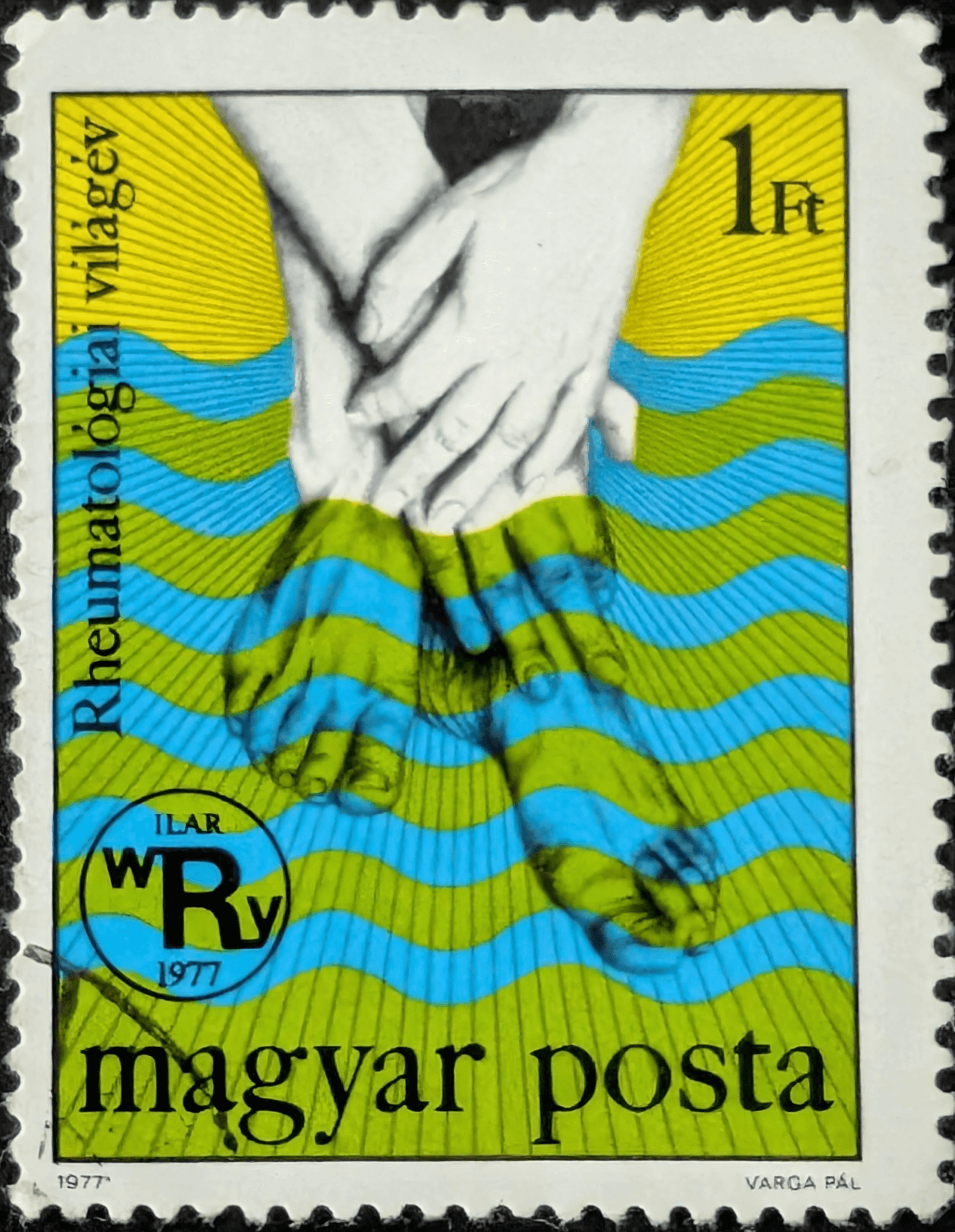
Hungary’s World Rheumatism Year stamp turns a clasped pair of hands into a public-health argument — and marks the year an awareness campaign quietly became a working programme.
The Stamp
| Country | Hungary — Magyar Posta |
|---|---|
| Subject | World Rheumatism Year 1977 (ILAR / WRY) |
| Denomination | 1 Ft |
| Designer | Varga Pál (as signed on the stamp) |
| Issued | 1977 |
| Inscription | “Rheumatológiai világév” (Rheumatology World Year) |
| Emblem | Circular ILAR / WRy / 1977 device |
| Design | Clasped hands over alternating blue-green bands and a yellow radiating field |
| Condition of this copy | Postally used; light cancellation stroke at lower left |

The Story
Hungary’s 1977 World Rheumatism Year stamp does something unusual: it puts a disease on postage. Most commemoratives celebrate people, places or achievements; this one gives a postage-sized platform to an illness. The phrase Rheumatológiai világév — “Rheumatology World Year” — announces the campaign the stamp was printed to carry.
That phrase is not decoration. In 1977 the World Health Organization designated the year World Rheumatism Year, and this stamp is one small national contribution to a coordinated international observance. The premise of such a year is itself an argument: that a group of conditions dismissed for generations as ordinary aches and the inevitable stiffness of age deserved to be named as a public-health concern at all.
Rheumatic and musculoskeletal disorders number in the hundreds and are among the leading causes of disability worldwide, yet their burden is felt quietly and rarely counted. An awareness year exists to make a silent problem visible — and a postage stamp, seen by everyone who receives a letter, is one of the cheapest ways a state ever had to do exactly that.
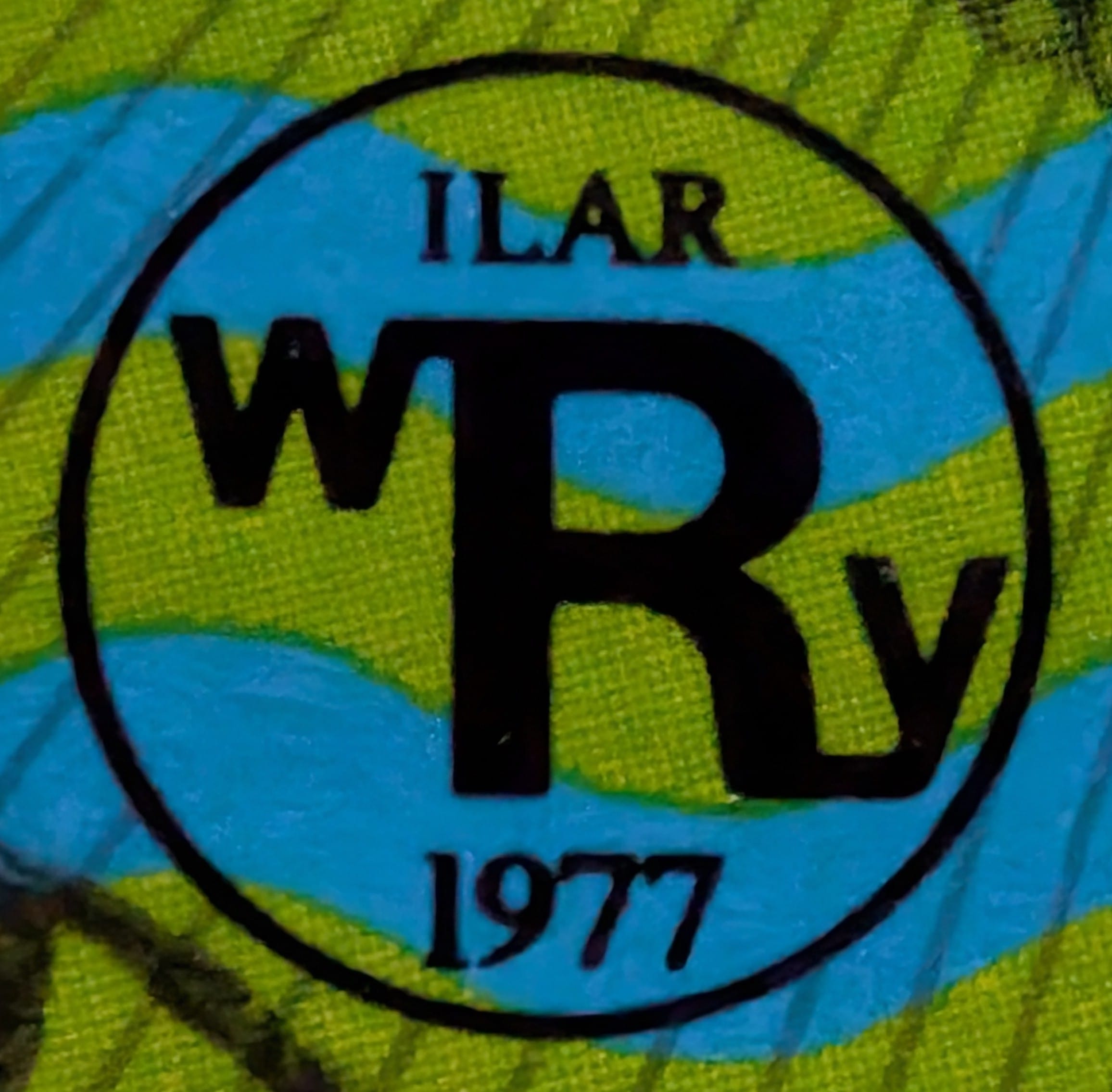
The circular badge in the lower corner connects the stamp to that campaign: ILAR, the International League of Associations for Rheumatology, alongside the initials WRy and the date 1977. At 1 forint, a Hungarian postage stamp was carrying an international public-health campaign into ordinary correspondence, in the same graphic idiom Magyar Posta used for its other public-information issues of the decade.
What the World Rheumatism Year stamp set in motion
Here is where the World Rheumatism Year stamp stops being a curiosity and becomes worth the paper. The awareness year was not an end in itself. It also became an important point of connection between ILAR and the WHO, and out of that collaboration, a few years later, came COPCORD — the Community Oriented Program for Control of Rheumatic Diseases, launched at the start of the 1980s to generate low-cost epidemiological evidence in communities where such data were scarce. Its stage-one surveys eventually reached more than twenty developing countries and produced over a hundred peer-reviewed papers. An awareness campaign became a standing programme. The stamp marks the hinge.
What made COPCORD worth remembering is the kind of medicine it was. Much of the evidence on rheumatic disease had come from the people who reached a clinic — which meant the count began only where medical services already existed. COPCORD inverted that model. It went house to house, into communities that had never been surveyed, and looked for pain where hospital records could not reach: the ache that was endured rather than reported, in populations no register had ever counted.
The design of the programme reflected that ambition. It was built in three stages — first a community survey of who actually hurt and where, then education for local health workers and patients, then the harder search for the risk factors behind the most common disorders. Crucially, it was cheap by design: it used regional resources and non-specialist surveyors so that a country with almost no rheumatologists could still produce usable data. That frugality is the whole reason it worked in places the discipline had never studied — the surveys ran through Indonesia and the Philippines, through rural India and Iran, exactly the “data-poor regions” the record politely names.
That is why the developing-country focus matters. Rheumatic disease is not a killer that makes headlines; it is a slow tax on hands and joints, most of it invisible, most of it borne quietly and never recorded. Treating it as a public-health question rather than only a clinical one — something to be counted at the level of a whole community — was the campaign’s real argument, and the stamp is that argument in miniature.
That reframes what the design has to do. A campaign for an invisible, chronic condition cannot lean on a dramatic image, because there is nothing dramatic to show. Varga Pál’s answer was to show almost nothing: two hands, one holding the other. No patient, no doctor, no clinic. Just the hands, where pain, mobility and everyday function become visible, made the whole subject.
For an Indian collector the World Rheumatism Year stamp lands differently than it might have in Budapest. India ran some of COPCORD’s largest surveys, screening tens of thousands of people across rural and urban sites. The programme that this stamp’s year set in motion was built precisely for places like the ones many of us live near. A 1 forint stamp from a socialist post office in 1977 turns out to be a marker on a map that reaches a long way east.
Looking Closer at the World Rheumatism Year stamp
The design creates the effect of a double exposure, and the trick is easy to miss until you look for the seam. The upper hands are rendered as a clean black-and-white photograph — clasped, gentle, one thumb resting over the other’s knuckles. Below a wavy horizon they dissolve into a second, ghosted pair, broken up by bands of blue and yellow-green so that the fingers seem to sink into striped water. The stamp makes the same hands simultaneously visible and interrupted — solid above, fragmented below.
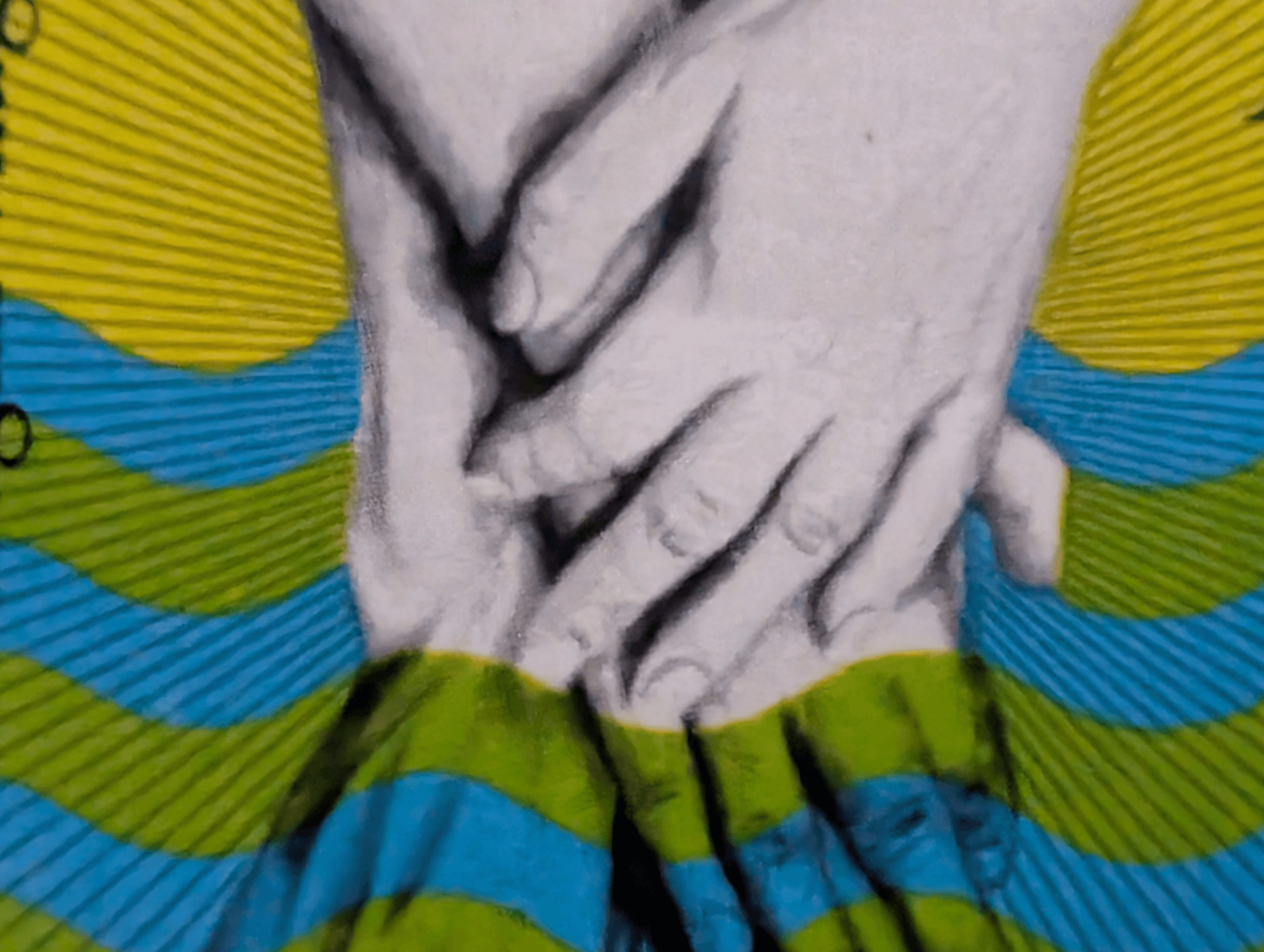
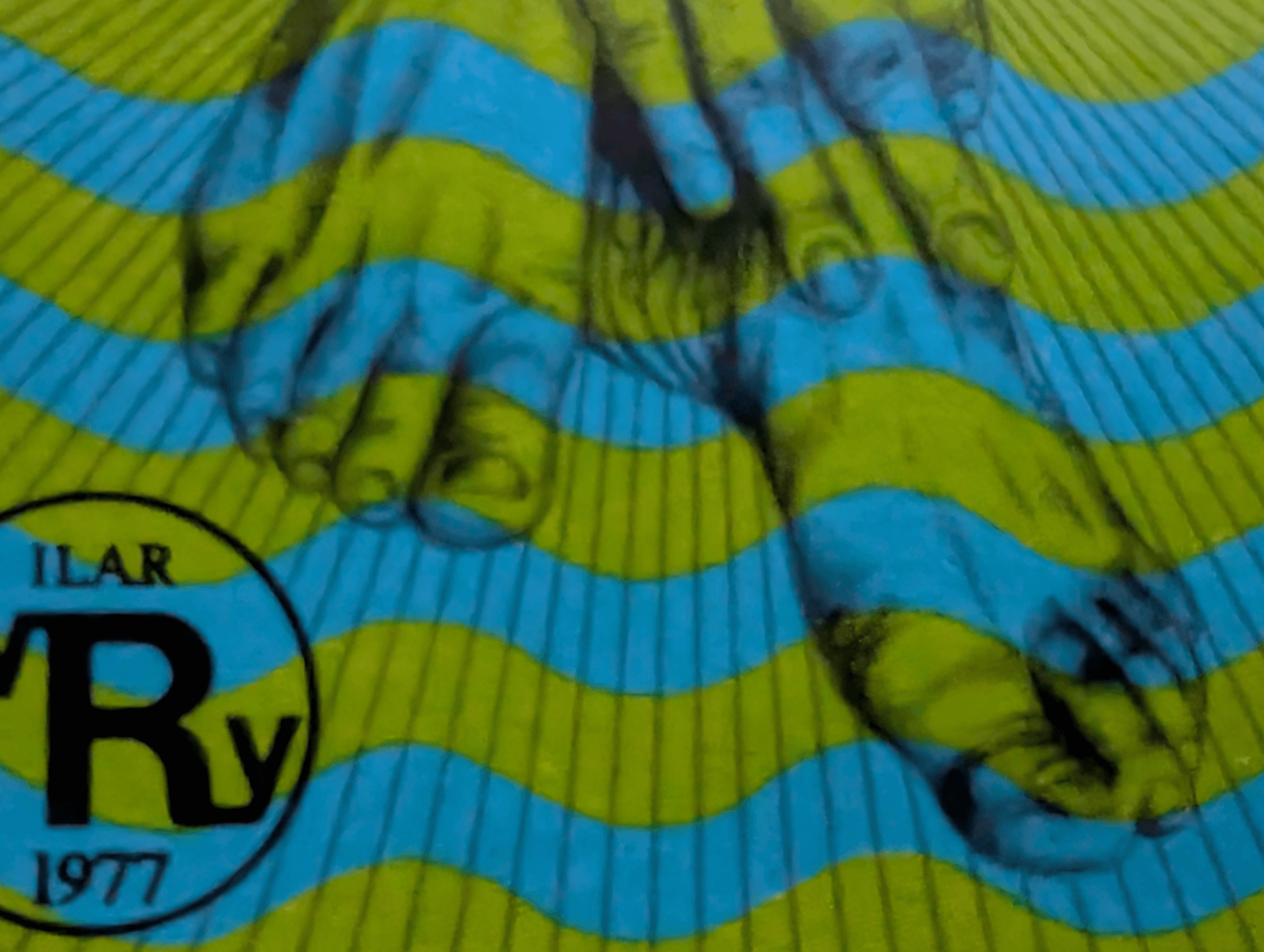
It is tempting to over-read this, so hold to what the picture supports. The rayed yellow field behind the upper hands and the alternating blue-green bands below create a striking visual split. What the composition earns is the reading that the hands are the entire argument. There is no sufferer and no healer in the frame — just the joint itself, isolated and made monumental. For a subject centred on joints and mobility, the choice is economical: the hands carry the message without needing a patient, doctor or clinic.
The typography does the institutional work the image refuses to, in the confident modern lettering Magyar Posta shared with issues like its 1972 stained-glass series. The disease name runs vertically up the left edge in a plain sans-serif, deliberately unglamorous. The denomination sits top-right in a heavy slab. And along the bottom, in a fat serif that belongs on a very different kind of stamp, sits magyar posta — the post office signing its own name larger than the cause it is promoting. It is a small hierarchy worth noticing: the state is louder than the illness.
The ILAR badge is the one element that ties the World Rheumatism Year stamp to the global campaign, and Varga Pál gives it real weight — a bold circular seal dropped into the wave bands like a stamp within the stamp. Read it closely and it encodes the whole enterprise: the sponsoring body, the campaign name, the year. Even without knowing anything about rheumatology, a reader can reconstruct the basic architecture of the campaign from that one device: an organisation, a named international year, and a date.

Closing
The hands do not tell you whether they are being comforted or examined, given or held. That ambiguity is the design’s quiet intelligence: a disease of the joints, argued entirely through the hands that make the condition visible. The year printed inside the badge ended decades ago. The work associated with that moment travelled far beyond it — into communities its designer could never have seen.
Further Reading & Links
- International League of Associations for Rheumatology (ILAR) — Wikipedia
- Arvind Chopra, “The COPCORD world of musculoskeletal pain and arthritis,” Rheumatology (Oxford University Press, 2013) — Oxford Academic
- Darmawan, Ferraz, Muirden & Tugwell, “WHO-ILAR COPCORD in Indonesia and Brazil” — Cambridge University Press