How India Put Family Planning on Every Letterbox — And Then Quietly Stopped Saying So
The Stamps
| 5 Paise | 35 Paise | 75 Paise | |
|---|---|---|---|
| Issued | 16 October 1967 | Sixth definitive series, dated to 1980 | Eighth definitive series, 1994 |
| Type | Definitive | Definitive | Definitive |
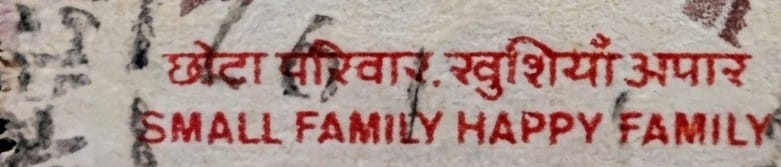
| Caption | FAMILY PLANNING / परिवार नियोजन | None | SMALL FAMILY HAPPY FAMILY / छोटा परिवार, खुशियाँ अपार |
| Family shown | Two adults, two children | Two adults, two children | Two adults, one child |
| Red triangle | Present — the family stands on it | Present — reduced to a corner motif | Absent |
| Condition | Used, machine cancelled | Used, machine cancelled | Used, cancelled |
The Story
Between 1967 and 1994, the family on India’s postage stamps quietly lost a child.
That single subtraction is the whole argument of India’s family planning stamps — a run of definitive issues that carried government population policy into every post office, every letterbox and every household in the country, without ever being read as an argument at all.
The distinction matters. A commemorative stamp is an event: printed in limited quantity, announced with a brochure, bought by collectors, gone. A definitive is furniture. It sits in the drawer at the post office counter for years, and it goes onto the electricity bill, the money order, the exam form, the letter home. A commemorative asks to be noticed. A definitive asks only to be used.
India had reason to want a message that travelled that way. The country launched the world’s first national family planning program in 1952. By the mid-1960s, with television and radio reaching only a fraction of the population, the Posts and Telegraphs Department had become one of the few communication channels that genuinely reached everywhere — and it was pressed into service accordingly, through stamps, slogan postmarks, and printed advertisements on postal stationery.
Why stamps? Because a postage stamp carries an authority that advertising cannot. A poster asks to persuade. A stamp, by existing, states. You trust the government enough to let it frank your mail; you trust what it prints on the stamp. That is the psychology of definitives — so mundane they become invisible, and in that invisibility lies their power. The state does not announce its message on a definitive. It assumes it.
1967: The state says the word

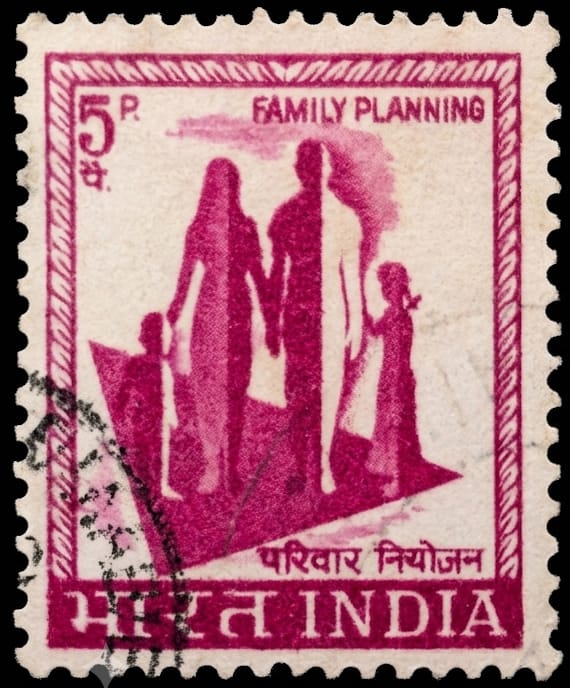
The first of the three is the smallest and the plainest. Five paise, cerise, issued on 16 October 1967: four silhouettes standing on a solid inverted triangle, with the words FAMILY PLANNING and परिवार नियोजन set into a rope border.
Look at what it is willing to state outright. The policy is named, in both languages, in capitals. There is no metaphor and no reassurance. The figures have no faces — they are a diagram of a household, not a portrait of one.
Two design decisions here became fixed grammar for everything that followed. The girl is shown as the elder sibling, a deliberate corrective in a country with a documented preference for sons. And the inverted red triangle appears as the ground the family stands on, rather than as a badge beside them.
That triangle went on to become one of the most recognized public health symbols in the world, appearing on clinics, vehicles, and contraceptive packaging across South Asia and Africa. For many Indians who grew up in the 1960s and 70s, the inverted red triangle became synonymous with family planning itself — a visual shorthand so widespread that older Indians still recognize it instantly.
Accounts of its origin differ; some credit Indian family planning official D. K. Tyagi, others a Ford Foundation consultant who introduced it formally in December 1968. Whichever is right, the 1967 stamp was already printing it, reaching into households that had no clinics nearby and no other visual reference for what family planning looked like.
For younger readers who never saw it in circulation, the symbol has largely faded. But on these three stamps, printed across three decades, you can watch an entire generation’s visual language for a national policy being slowly unmade.
The Emergency, and the year the language changed
Nine years later, India’s family planning programme collided with the darkest episode in its administrative history, and the stamps have never quite been read the same way since.
During the Emergency declared in June 1975, sterilization targets were escalated far beyond what had ever been attempted. Procedures that numbered in the hundreds of thousands became millions — more than 1.07 crore over two years — and the Shah Commission, established to investigate what followed, recorded 1,774 deaths linked to sterilization and hundreds of complaints of coercion. When the government fell in 1977, the incoming Janata administration issued a new population policy explicitly rejecting compulsion and renamed the entire department: no longer Family Planning, but Family Welfare.
That renaming is the hinge of this entire story.
A government that has to change the name of a policy has already conceded something about the policy.
And the stamps changed with it.
1980: A house, some flowers, and a triangle in the corner
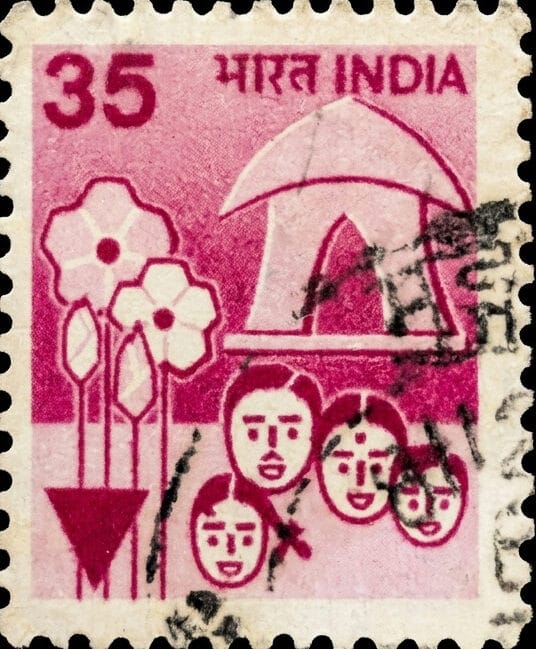
The sixth definitive series 35-paise stamp is the one that shows what the correction looked like on paper.
The rope border is gone. In its place: a hut with a curved roof, two flowering plants with buds, and four faces — no longer silhouettes but drawn features, eyes and mouths and a bindi. The family has been moved indoors, given a home and a garden, and allowed to look back at you.
Most tellingly, the caption has vanished. Nowhere on this stamp does the phrase “family planning” appear. The inverted triangle survives, but it has been demoted to a small solid wedge in the lower left corner, sitting beside the flower stems like a manufacturer’s mark.
The message has not disappeared. It has become implicit. Anyone glancing at this stamp sees a house and a family; only someone who already knows the symbol reads it as policy.
1994: The triangle goes, and so does a child
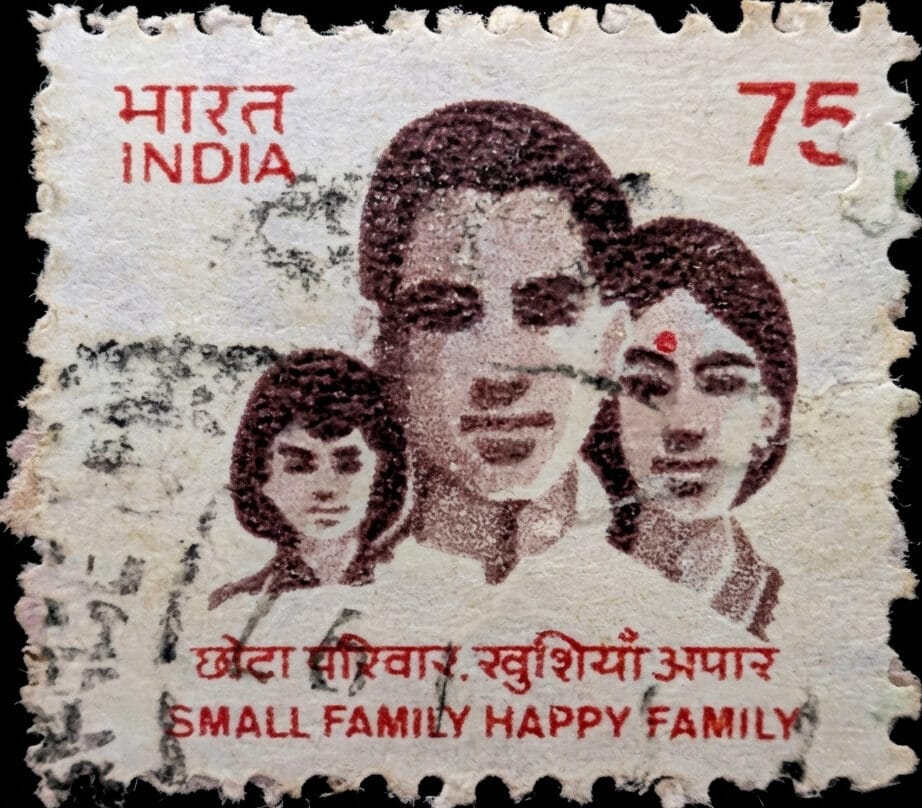
The third stamp abandons the symbol entirely.
Issued in the eighth definitive series in 1994, printed in brown and vermilion, it shows three faces rendered almost as portraiture — a man at centerCount the heads. Two adults, one child. The 1967 stamp advocated a family of four; this one advocates a family of three. The arithmetic of the ideal Indian household had been revised downward, and the revision was published on the postage without a single word of explanation., a woman with a bindi to his right, a child to his left. There is no triangle anywhere on the design. There is no policy word. There is only a promise: छोटा परिवार, खुशियाँ अपार, and beneath it, SMALL FAMILY HAPPY FAMILY.
This was the last time family planning featured in an Indian definitive series. After the mid-1990s the theme faded from Indian stamps almost entirely, as the birth rate India had chased since the 1960s was finally approached in the early 2000s — decades after the deadline the government had originally set itself.
Looking Closer
The design grammar of India’s family planning stamps
Place the three side by side and a clear progression emerges — not of style, but of nerve.
The vanishing of the symbol. In 1967 the triangle is structural: the family physically stands on it, which makes the policy the foundation of the household rather than a comment on it. By 1980 it is decorative, tucked into a corner. By 1994 it is gone. The triangle did not fall out of fashion. It fell out of favour — because after 1976 it had acquired a second meaning the government could not control.
The arrival of faces. The 1967 figures are deliberately anonymous, and anonymity is what makes a diagram feel like an instruction. Giving the 1980 family features, expressions and a bindi converts an instruction into an invitation. It is the same shift a public-health campaign makes when it stops issuing directives and starts telling stories.
The retreat from naming. Read the three captions in sequence and you can watch a government lose its voice. 1967 names the policy. 1980 says nothing at all. 1994 speaks only of happiness — छोटा परिवार, खुशियाँ अपार — and lets the reader supply the policy themselves. A once-contested policy ended up advertised as a mood.
Two smaller details reward attention. The 1980 hut is a genuine departure — a house in the background reads naturally as a claim about resources, about what a household of a given size can afford to shelter and feed. And in 1994 the child is a single child, which quietly resolved a tension the earlier designs had managed by making the girl the elder of two. When there is only one child left to depict, the choice of whom to depict becomes the entire statement.
The rendering itself marks the progression. The 1967 design is flat and graphic — solid shapes, hard edges, no gradation anywhere. The 1980 stamp is softer, with tonal variation in the faces and the sky behind the hut. By 1994 the faces carry modelled shading, with light and shadow describing cheekbones and hair. That shift, from graphic simplicity to naturalistic rendering, tracks the shift in government voice: from mandate to narrative.
Across these three designs, India was not simply changing its stamps. It was changing the language through which it asked citizens to imagine the ideal family.
Closing
There is a particular kind of power in being boring. The Emergency speeches faded; the posters came down. But for three decades the family planning argument kept arriving with the morning mail — on letters home, on electricity bills, on exam forms — too ordinary to notice, too persistent to escape. Look at the three together and you are not looking at philately. You are looking at a government printing one of independent India’s most contentious policies onto its most invisible medium. By 1994 the child was gone, the triangle was gone, and all that remained was a whisper: small family, happy family. When a government can only whisper what it once demanded, something fundamental has changed.
Series Context: The Family Planning Stamps in India’s Definitive Series
Family planning ran through India’s definitive stamps for roughly three decades, appearing in the fourth series (1967), the fifth, the sixth, the seventh and finally the eighth. The 1967 five-paise design was the most widely used of them all and was reissued several times. The design featured here as the 35-paise stamp was later revalued and reissued at 75 paise in the seventh series. The eighth series, in the mid-1990s, carried the last two — a 75-paise and a 100-paise stamp, both without the triangle and both showing a family of three.
Further Reading & Links
On StampTales
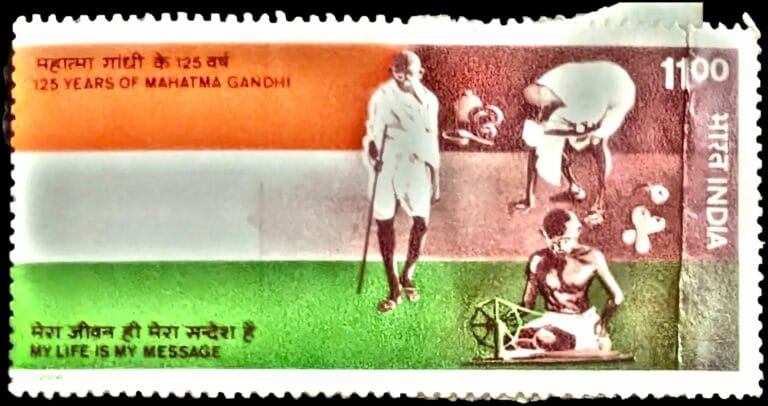
- My Life Is My Message — The ₹11 Gandhi Stamp That Showed Him Three Ways — issued the same year as the 75-paise stamp above, and a study in how differently India Post handles a person and a policy. – 1994 Gandhi Stamp
- The 1988 Tilak Swaraj Stamp – another case of the Indian state choosing what to say about itself on gummed paper. – 1998 Tilak Swarak Stamp
- 75 Years of Indian Cinema — The 1989 Raja Harishchandra Stamp — national narrative, printed and posted. – 75 Years of Indian Cinema
- The 1989 Fleet Review Stamp — 1989 Fleet Review Stamp
External references
- Vikas Kumar, “Population control messages on Indian stamps from 1966 to 2005,” ThePrint, 15 August 2022 — https://theprint.in/opinion/population-control-messages-on-indian-stamps-from-1966-to-2005-how-postal-dept-played-key-role/1078345/
- National Health Mission, Government of India — Family Planning — https://nhm.gov.in/index1.php?lang=1&level=2&sublinkid=821&lid=222
- Press Information Bureau, Government of India — Factsheet: The Emergency in India — https://www.pib.gov.in/FactsheetDetails.aspx?Id=149224®=3&lang=2
- Wikipedia — Red triangle (family planning) — https://en.wikipedia.org/wiki/Red_triangle_(family_planning)