Hyderabad Was Built Around One Building. The Charminar Stamp Never Says So.
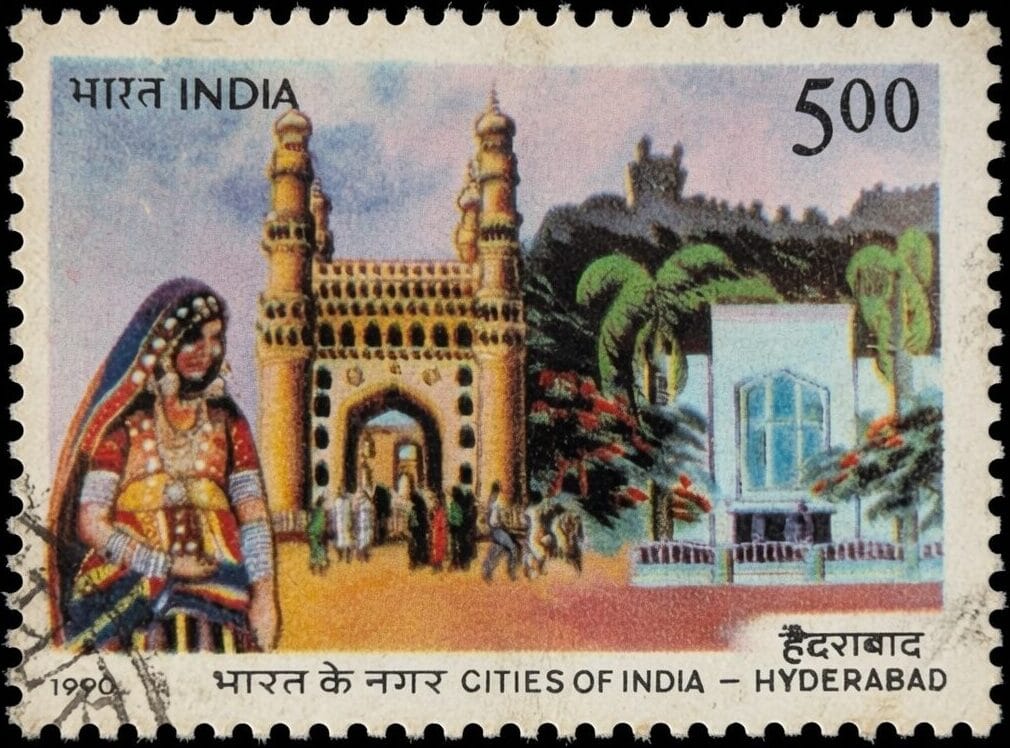
The Stamp
| Issue | Cities of India (first set) |
|---|---|
| Country | India — Department of Posts |
| Subject | Hyderabad — Charminar |
| Issued | 24 December 1990 |
| Denomination | 500 paise (₹5.00) |
| Occasion | Four hundredth year of Hyderabad |
| Designer | R. N. Pasricha |
| Size | 3.91 × 2.90 cm |
| Perforation | 13 × 13 |
| Printing | Photogravure, India Security Press |
| Companion stamps | Bikaner (400p), Cuttack (650p) |
| Condition of this copy | Used; light corner toning |
The Story
Hyderabad did not grow around the Charminar. The Charminar was there first.
The 1990 Charminar stamp does not say this. It shows a monument standing inside a settled streetscape — palms, a white building, a woman in ceremonial dress — as though the city had assembled itself around the tower across four unhurried centuries. The sequence ran the other way.
Why the Charminar Stamp Shows a Planned City
By the 1580s the Qutb Shahi capital at Golconda was failing at the most basic municipal level. Population had been climbing since the reign of Ibrahim Quli Qutb Shah. The fort was crowded, sanitation was poor, and water was short. A capital that cannot supply water to the people inside its walls is a capital with an expiry date.
Muhammad Quli Qutb Shah, the fifth sultan of the dynasty, did not expand Golconda. He abandoned it. Around 1591 he began building an entirely new city on the bank of the Musi, a short distance away — laid out deliberately, on open ground, from nothing.
The Charminar went up at its centre. Britannica records it as, reportedly, the first building of the new capital. So the tower was not a monument added to a city. It was the fixed point the city was measured from —

four arches, four cardinal directions, roads running outward. Mir Mu’min Astarabadi — Muhammad Quli’s Peshwa, and the man credited with the city’s plan — laid the Char Kaman gateways directly south of it the following year on the same logic. The Charminar stamp therefore shows an effect standing in for a cause.
So the 1990 Charminar stamp commemorates something more particular than antiquity. It commemorates a design decision — a sixteenth-century administrative solution to overcrowding, executed as urban planning.
What the 1990 Charminar Stamp Does Not Settle
Why the Charminar was built at all remains open. The Archaeological Survey of India, which maintains the monument, records in its own files that several theories exist, and that the widely accepted one holds the tower was raised at the centre of the city to mark the end of a plague.
A competing account survives in Persian sources: the building marked the opening of Islam’s second millennium, the year 1000 in the Hijri calendar, which fell in the same period.
Neither is settled, and the custodian of the building says so plainly. The Charminar stamp takes no position. Like most commemoratives it presents its subject as a fact rather than an argument, and the most famous building in the Deccan is, at its origin, an argument.
The anniversary is loose in the same way. The Department of Posts brochure declares that Hyderabad completed four hundred years of existence in 1990, then names 1591 as the year the Charminar was built, in the same paragraph. Britannica dates the foundation to 1590–91. Cities rarely open on a fixed date, and a city that was ordered into being opens on whichever date the order is judged to have taken effect.
The City That Outlived Its Own Dynasty
The Charminar stamp compresses all of what follows into a single undated image. Muhammad Quli ruled until 1612 and died in Hyderabad, in a palace inside the city he had ordered into existence. His dynasty did not last much longer. The Qutb Shahis had held the Deccan since 1518; in 1687 Aurangzeb annexed the kingdom, and the line ended ninety-six years after the Charminar was finished.
The city did not end with it. It was absorbed, and then it was promoted. Under the Asaf Jahi Nizams it became the seat of power for the state of Hyderabad — a capital again, under rulers with no connection to the men who had laid it out. The Salar Jung collection, now among the largest single-person museum holdings anywhere, accumulated there under that later regime.
There is a quiet symmetry in what the city did next, and the Charminar stamp inherits it without comment. Muhammad Quli left Golconda because it could not supply water. The Department of Posts brochure, describing Hyderabad four centuries on, lists reservoir after reservoir — Osman Sagar, Himayat Sagar, Hussain Sagar, Mir Alam Tank — as though water were the city’s defining feature rather than the crisis that produced it. The problem became the identity.
What India Post got right is the thing the design argues rather than states. Hyderabad was built to work. It replaced a capital that had stopped working. Within a century it sat at the centre of the Deccan diamond trade, then of pearls, and the nickname it still carries — City of Pearls — describes commerce, not architecture.
Looking Closer at the Charminar Stamp
Pasricha’s composition for the Charminar stamp makes four decisions that are easy to miss at 3.55 centimetres.
The first is the vertical crop, and it is the reason the Charminar stamp still reads at thumbnail size. The Charminar is framed from slightly below and marginally off-axis, and the minarets are allowed to run to the very top of the printed area. On a stamp this small, a building drawn to fit inside the frame reads as a model. A building that appears to exceed the frame reads as a structure. The design gives up headroom to buy height.
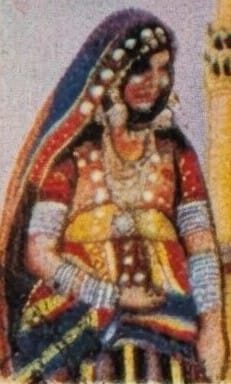
The second decision on the Charminar stamp concerns the sky. Architecture stamps usually treat sky as negative space — a flat wash whose only job is to make the silhouette legible. This one puts a woman in it. She occupies the upper left in ornate dress, at a scale that competes with the monument rather than deferring to it. The composition therefore refuses the obvious hierarchy. A city is not its tallest building.
The third is the jewellery, and it is the quietest claim the Charminar stamp makes. The figure is heavy with pearl strands, rendered as individual white points at a scale where the printer could easily have suggested them with a smear. Hyderabad’s oldest trade identity is pearls. The architecture carries the history; the ornament carries the economy. Only one of them is doing so on purpose.
Colour supports all of this. On the Charminar stamp the palette is doing structural work, not decorative work. The sky graduates from apricot at the left to cool lilac at the right, ambiguous between dawn and dusk, and the monument is lit warm against it. Photogravure suits this — continuous tone, soft transitions, no visible screen at reading distance. Line engraving would have made the same building look like a diagram.
The lettering is handled with unusual discipline. Type placement is the fourth decision. Every word on the Charminar stamp — the bilingual country name, the series line naming Hyderabad in Devanagari and Latin, the year, the denomination — is confined to white margin bands along the top and bottom edges. Nothing is set over the illustration. The picture area is left entirely alone.
That restraint is rarer than it sounds. Commemoratives of this period routinely drop type into sky or water because the margin is the cheapest space to sacrifice. Pasricha instead sacrificed picture width to keep the type out, which is why the composition feels tight at the sides. The 500 sits alone in a corner at a size that reads instantly — a working postal instruction, not decoration, and the only element on the stamp addressed to a clerk rather than a viewer.
Note also what sits at the right edge: palm foliage and the pale facade of a neighbouring building, cropped and unlabelled. Nothing there is a monument. Their only function is to place the Charminar on a street rather than on a plinth, and they are the reason the design reads as a city rather than a landmark.
Series Context
The Charminar stamp did not travel alone. It was issued as part of a set of three on 24 December 1990 — Bikaner at 400 paise, Hyderabad at 500, Cuttack at 650 — under the heading Cities of India.
The three cities share a sheet and almost nothing else, and the Charminar stamp is the middle value of the three in every sense. Cuttack was marking a thousand years. Hyderabad was marking four hundred. Bikaner, founded in 1488 by Rao Bika, was marking no round number at all. The occasion was not an anniversary. It was a category.
The brochure is explicit about the intent: the Department of Posts proposed to issue stamps on historic cities of India from time to time, and described this as the first set. Read now, “from time to time” is doing a great deal of quiet work. It is the phrasing of an institution that wants the option without the obligation — and a reader who goes looking for the second set will want to allow for the possibility that the appetite ran out somewhere between the brochure and the following year’s programme.
Production was uniform across the three. Nothing distinguishes the Charminar stamp technically from its companions. Each stamp was printed in one million copies, thirty-five to a sheet, on imported unwatermarked gravure-coated gummed paper, perforated 13 × 13 at the India Security Press. Pasricha designed Bikaner and Hyderabad; Pulak Biswas designed Cuttack; Alka Sharma designed the cancellation.

Closing
A million copies of the Charminar stamp went into the post. Most were franked and thrown away, which is what a stamp is built to survive. The ones that lasted all carry the same picture: a monument at ease in the middle of a city, palms at its feet, a life going on around it. That picture is true now and it was false at the start. On open ground beside the Musi, the building went up first and stood alone, waiting for streets that had not been laid. Hyderabad is what arrived to meet it.
Further Reading & Links
On StampTales
- https://stamptales.in/my-life-is-my-message-the-%e2%82%b91-gandhi-stamp-that-showed-him-three-ways/]— “My Life Is My Message — The ₹11 Gandhi Stamp That Showed Him Three Ways”: another high-denomination Indian commemorative, and another case of a design arguing something its caption does not say.
- https://stamptales.in/when-india-mailed-its-coastline-the-%e2%82%b96-stamp-that-remembers-a-forgotten-port/ — Kovalam Beach 1997: India Post depicting a specific Indian place for an audience that had mostly never been there.
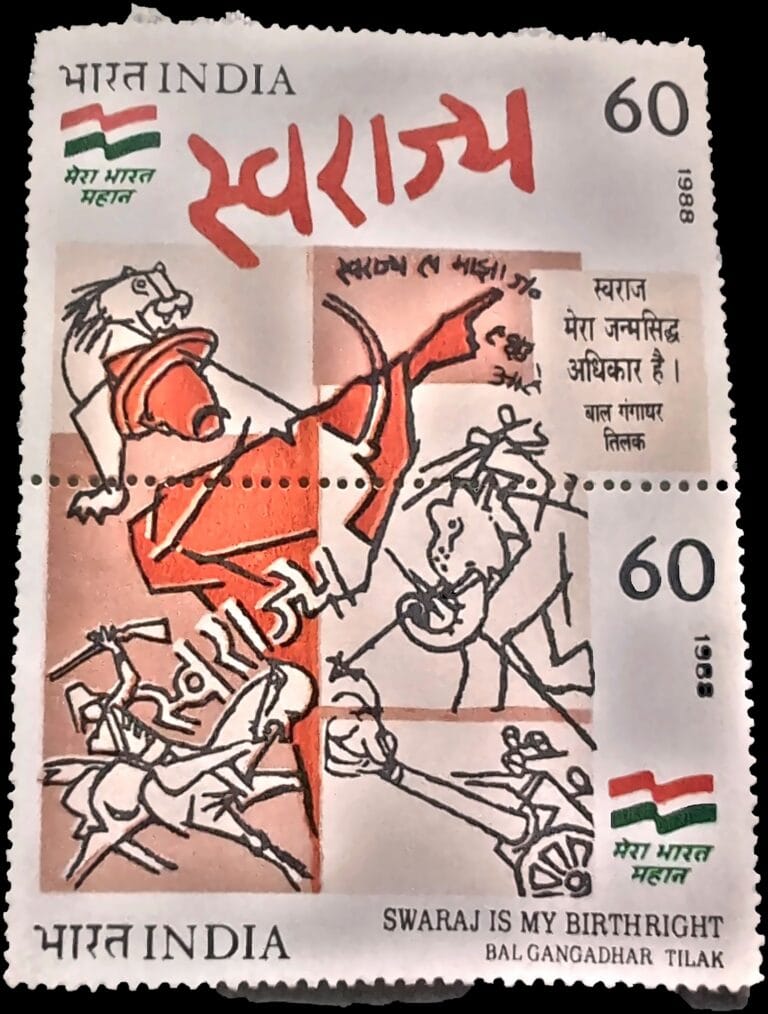
- https://stamptales.in/the-sentence-that-sent-a-man-to-prison/ — Tilak Swaraj 1988: what happens when a commemorative is pegged to an anniversary rather than a subject.
- https://stamptales.in/1989-indian-cinema-stamp/— 1989 Indian Cinema stamp: another round-number anniversary, another approximation printed as a fact.
- A European Owl on an African Stamp — a Through the Lens macro study of a 1970s collector-market issue, and another case of what a nation’s stamps choose to honour.
External sources
- Charminar — Wikipedia (carries the Archaeological Survey of India statement on competing theories)
- Muhammad Quli Qutb Shah — Wikipedia
- Muhammad Quli Qutb Shah — Encyclopaedia Britannica
- Mir Mu’min Astarabadi — Wikipedia
- Cities of India 1990 — iStampGallery (reproduces the Department of Posts issue brochure)



6 Comments
Comments are closed.