The word that made the declaration universal
When the United Nations set down the rights of every person in 1948, the article it placed first began with the words all men are born free and equal. Hansa Mehta, India’s delegate to the drafting commission, would not let men stand. Article 1 reads all human beings today, and the correction is credited to her — which is why, half a century later, India put the anniversary on a stamp and released it on the single date that made the point twice over: 8 March, International Women’s Day.
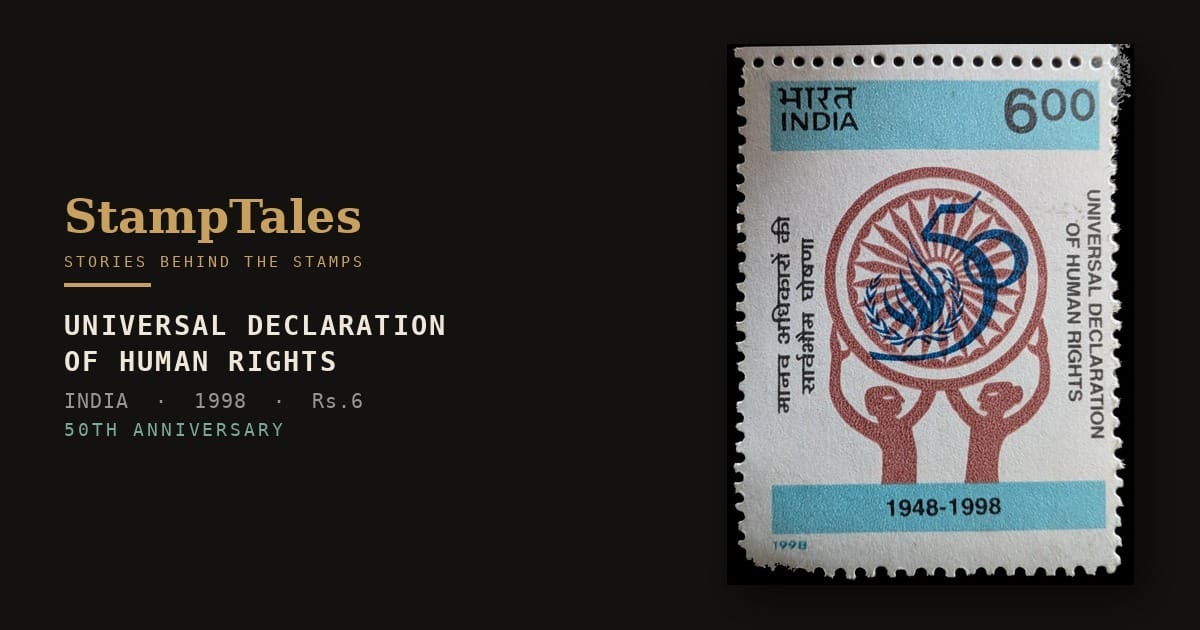
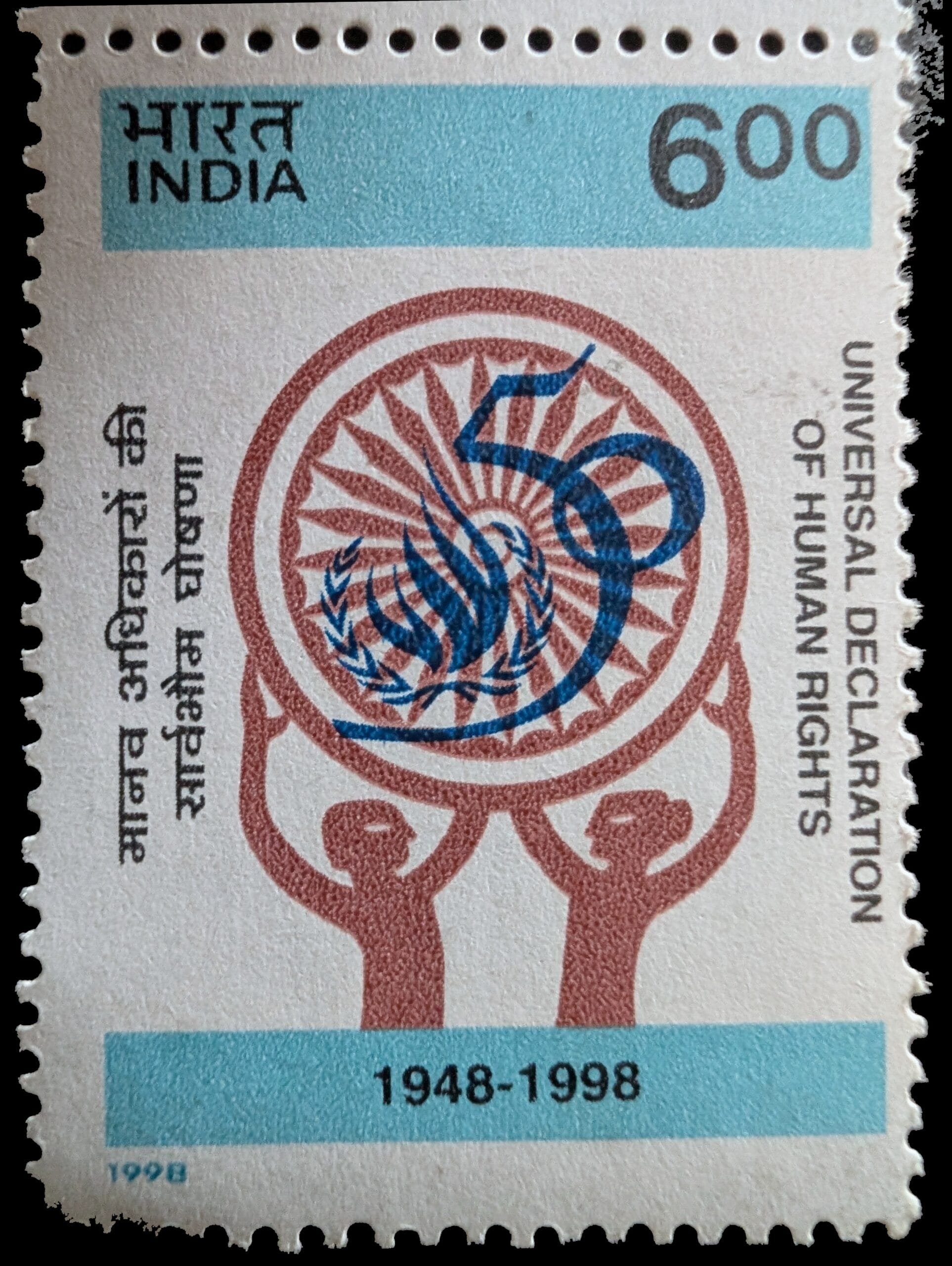
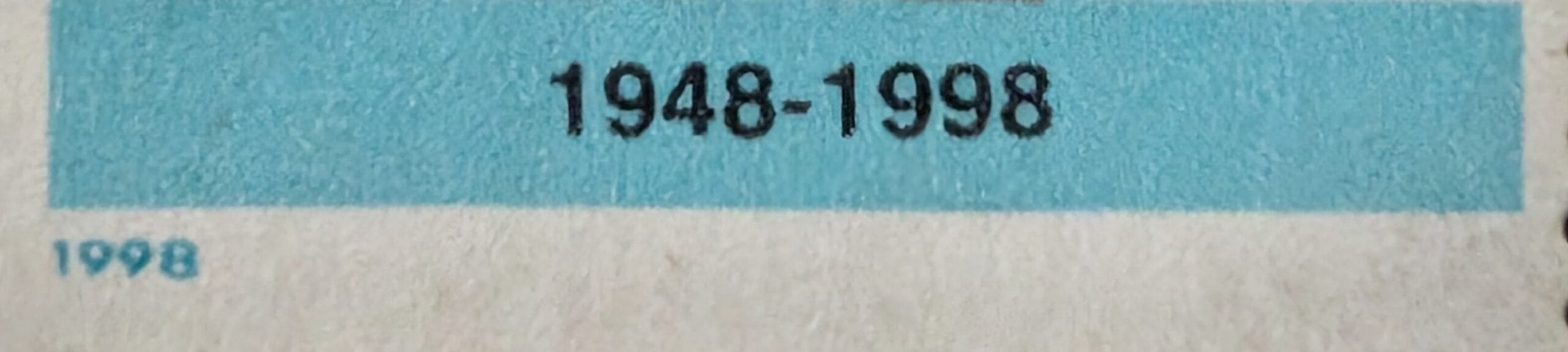
The stamp is worth six rupees and does not, at a glance, look like an argument. Two figures raise a spoked wheel between them; a blue 50 curls through the wheel’s centre around a small emblem; a plain band reads 1948–1998. What sets it apart is that India Post seldom issues a stamp without stating, in the brochure that accompanies it, precisely what the thing is meant to mean. This one names Mehta outright.
| Issue | Universal Declaration of Human Rights — 50th Anniversary |
|---|---|
| Issued | 8 March 1998 (International Women’s Day) |
| Denomination | 600 paise (₹6) |
| Country | India |
| Design | Directorate of Advertising & Visual Publicity, New Delhi |
| Printer | India Security Press, Nashik |
| Process | Photogravure, multicolour |
| Print run | 0.7 million |
| Catalogue | Phila 1613 |
What Hansa Mehta struck out
The Universal Declaration was written across 1947 and 1948 by a commission of the young United Nations, in the shadow of a war that had shown the world what the absence of such a document permitted. It was the first international proclamation of its kind — thirty articles setting what it called a common standard for all peoples and nations. Eleanor Roosevelt, widow of the American president, chaired the drafting committee and became its public face. Mehta sat on the same commission, for that stretch the only other woman among its delegates, and she arrived with a specific objection.
The draft’s first article announced that all men are born free and equal. Mehta refused the reading that men could be trusted to include women, and she would not accept a footnote saying as much in its place. The United Nations itself now credits her with the change that replaced all men with all human beings — the wording Article 1 has carried ever since.
It is a small edit and an enormous one. Men would have left the most quoted sentence in the document quietly ajar, its universality resting on the reader’s goodwill to extend it. Human beings shuts that gap. Everything the Declaration goes on to promise is owed, it says, to human beings as such — and the opening line had to mean exactly that, without an asterisk.
Mehta did not come to the table as a career diplomat. She was an educationist and a Gandhian who had come up through the freedom movement, and while she argued over the phrasing of the world’s declaration abroad she was also a member of the assembly writing India’s own Constitution at home. The two texts were drafted almost in parallel, and India’s Fundamental Rights carry the Declaration’s fingerprints. She was not the only Indian to leave a mark on the international document — M. R. Masani and Lakshmi Menon contributed too, Menon pressing for the equality of men and women in the preamble — but the line the world remembers belongs to Mehta.
Why the stamp names Hansa Mehta
India did not release this stamp on a neutral day. It appeared on 8 March 1998, inside the year the United Nations had set aside — 10 December 1997 to 10 December 1998 — to mark the Declaration’s fiftieth anniversary, a programme with a declared emphasis on the rights of women. Choosing International Women’s Day for the Indian issue folded that emphasis into the date itself.
The brochure India Post printed alongside the stamp says so without hedging. The release, it explains, underlines the priority the country gave women’s rights in its plan for the anniversary, and it is offered as a tribute to two women bound up in the drafting of the Declaration — Eleanor Roosevelt and, in its own words, Dr. Hansa Mehta, a Gandhian and India’s delegate in 1948. That is an unusual thing for a stamp to admit. Most commemoratives honour an event and leave the reader to supply the meaning; India Post prefers to say it plainly, as it did when it priced a 1988 issue at the exact age it was about. Here the plain statement makes the stamp, in effect, an official footnote to Article 1 — the state naming the person it wants in your mind when you look at the wheel.
India lifts the wheel
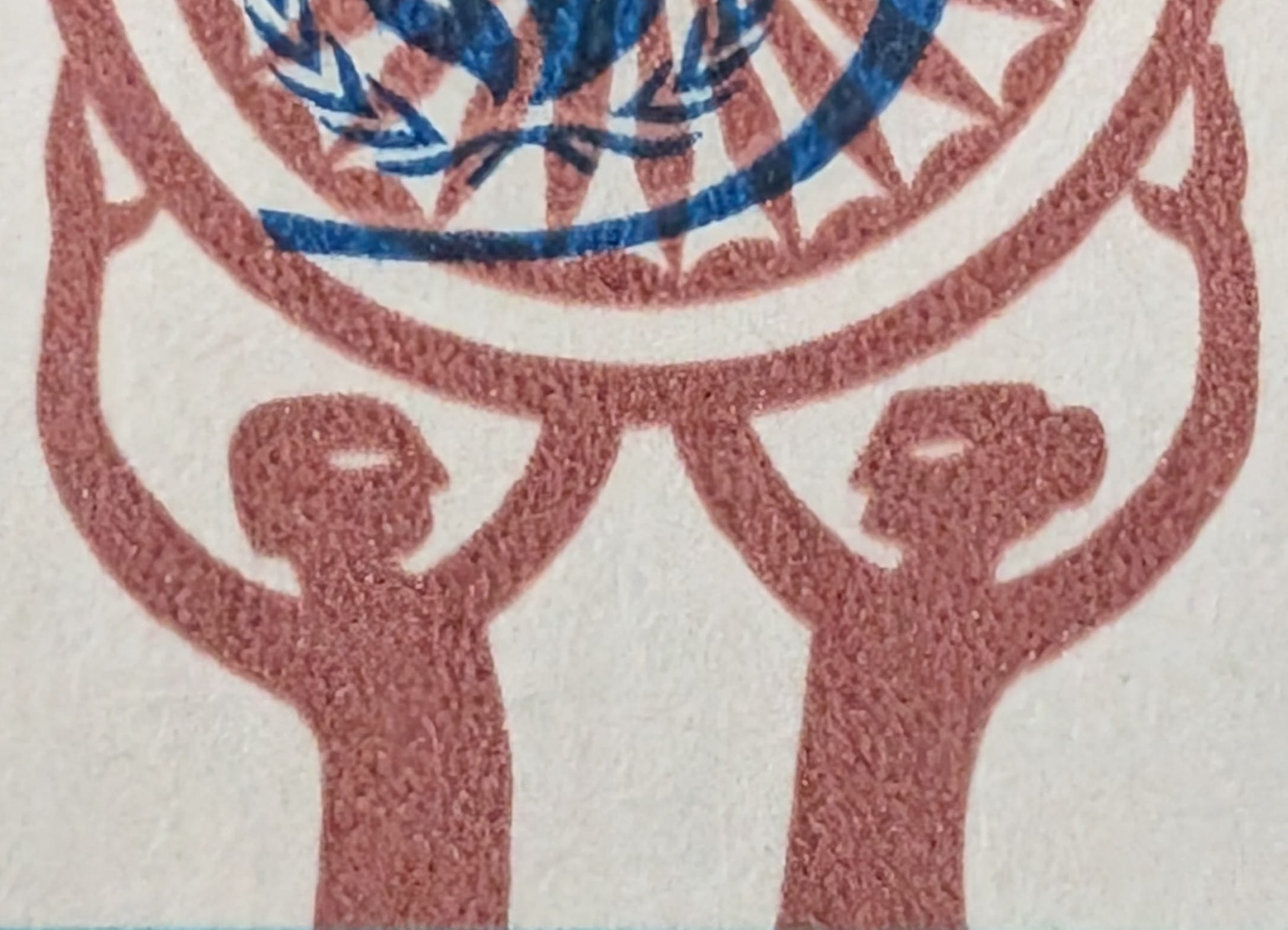
The design carries the same idea without a word of text. Two figures stand at the foot of the stamp and raise a spoked wheel above their heads, arms fully extended, holding it up between them. The wheel reads as a chakra, the spoked wheel that sits at the centre of the national flag, and taking it here as India’s own emblem is hard to resist: a document meant for the whole world, held aloft on the country’s most national symbol. It is the gesture Mehta made in the drafting room, rendered in miniature.
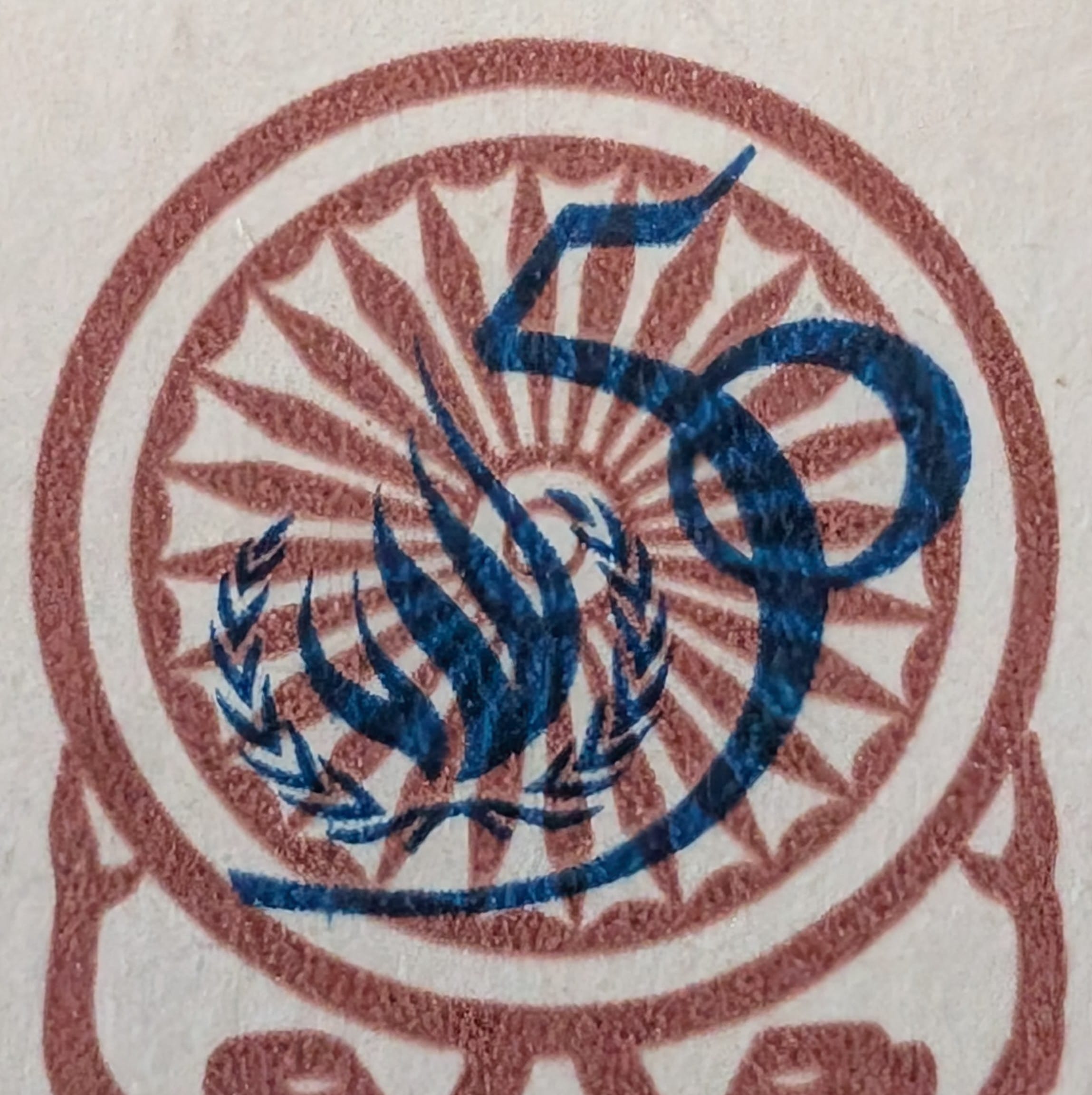
At the wheel’s centre, printed in blue over the red-brown spokes, is a stylised 50 wound around a small emblem of curved, feather-like strokes: the mark of the Declaration’s fiftieth year. Down one flank runs the title in Hindi, down the other in English — the same four words in both scripts, the universal declaration said twice.
India had marked the Declaration on a stamp once before. For the fifteenth anniversary, in 1963, it issued a portrait of Eleanor Roosevelt seated at a charkha — the spinning wheel Gandhi had made the emblem of the freedom struggle — tying the rights of the world to India through Gandhi’s wheel. Thirty-five years later the wheel returns, no longer a spinning wheel but the chakra of the flag, and this time the tribute reaches past Roosevelt to the Indian who sat beside her. The 1963 stamp had looked outward, to an American at an Indian spinning wheel; this one looks inward, to the Indian who edited the world’s document. The motif held; the country had simply grown ready to name its own.
A declaration written for everyone came within one word of saying men. It says human beings because someone at that table insisted the words match the promise, and lost nothing by insisting. India printed her correction into circulation for six rupees, on the day the point is hardest to miss, then said no more about it on the stamp itself — only raised the wheel, marked the fifty years, and trusted whoever held it to know whose sentence they were holding.
Further Reading & Links
- Women who shaped the Universal Declaration (United Nations) — the UN’s own account crediting Mehta with the change to Article 1.
- The role of women in shaping the UDHR (OHCHR) — the scholarship on Mehta, Roosevelt and the fight for inclusive language.
- India on the Universal Declaration of Human Rights 1998 (iStamp Gallery) — the India Post brochure text, production data, and the stamp’s tribute to Mehta and Roosevelt.
- List of commemorative stamps of India (India Post) — confirms the 8 March 1998 issue date and six-rupee denomination.