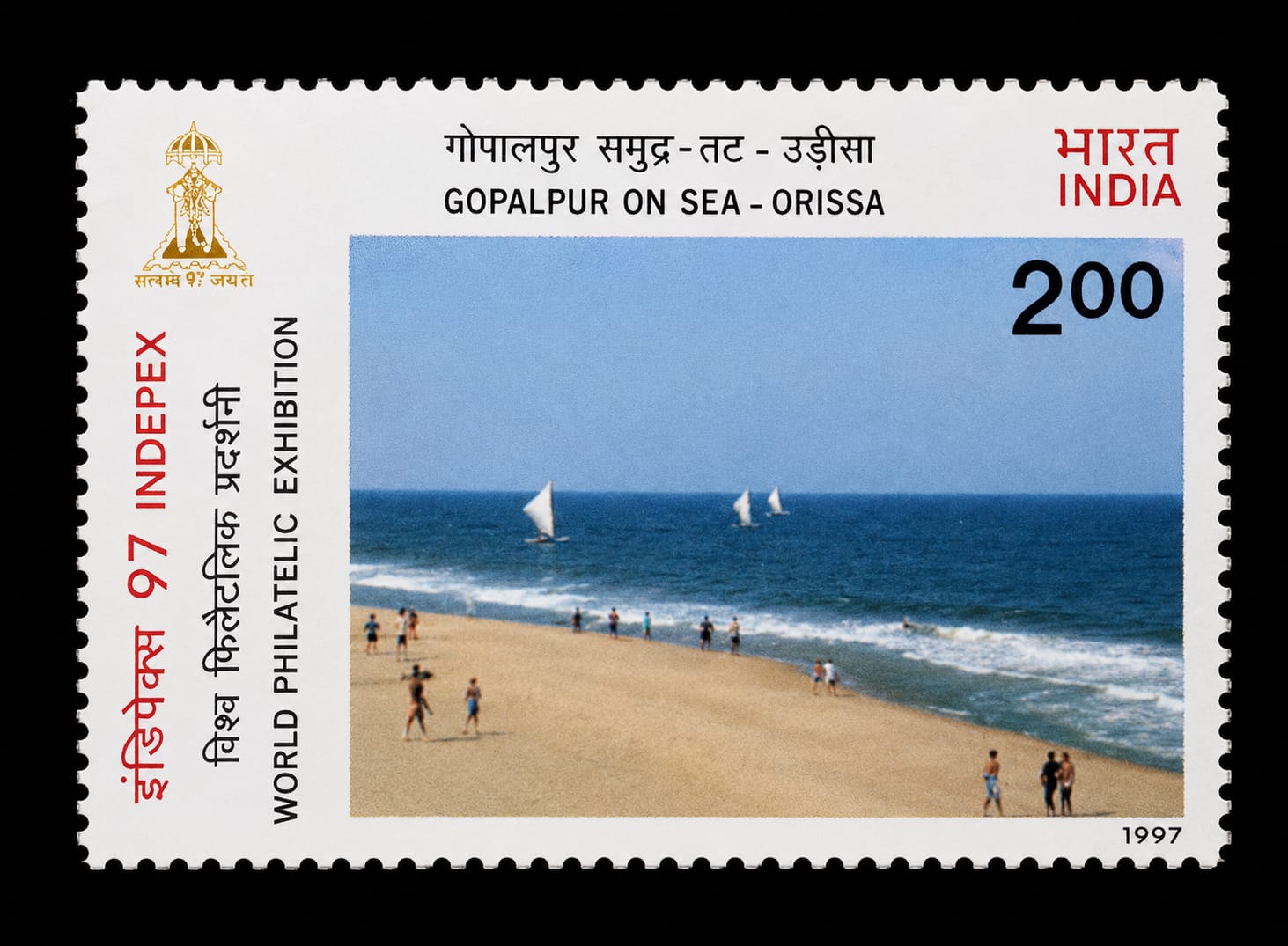
Two Rupees for the Port That Once Fed Burma — The Gopalpur Stamp of 1997
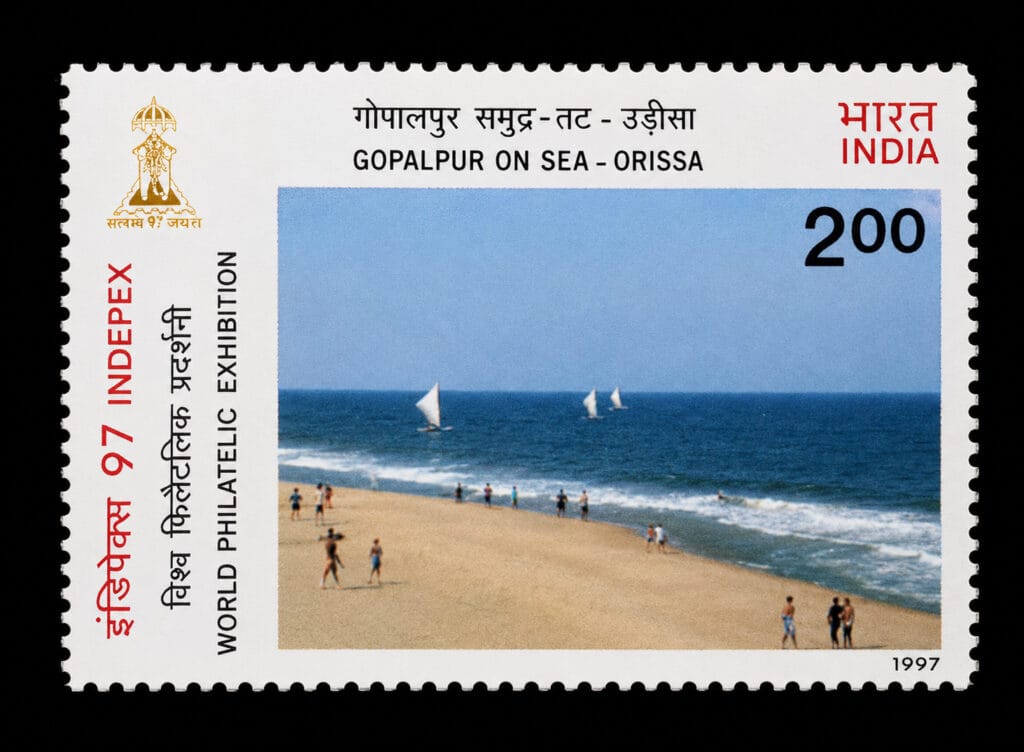
The Gopalpur stamp 1997 carries the lowest denomination in India’s Beaches of India set — and that number tells you exactly how the country ranked its own coastline.
Why does the only Bay of Bengal beach in the INDEPEX ’97 set get the lowest denomination? Two rupees — while Goa’s beaches split ₹10 and ₹11 between them, and Kerala takes ₹6.The answer behind the Gopalpur stamp 1997 has less to do with the beach and more to do with what India thought was worth marketing to the world.
The Stamp
- Issued: 11 August 1997
- Denomination: ₹2 (200 paise)
- Series: Beaches of India — INDEPEX ’97 (Set of 4)
- Occasion: 50th Anniversary of Indian Independence; INDEPEX ’97 World Philatelic Exhibition, New Delhi
- Inscription: गोपालपुर समुद्र-तट — उड़ीसा / GOPALPUR ON SEA — ORISSA
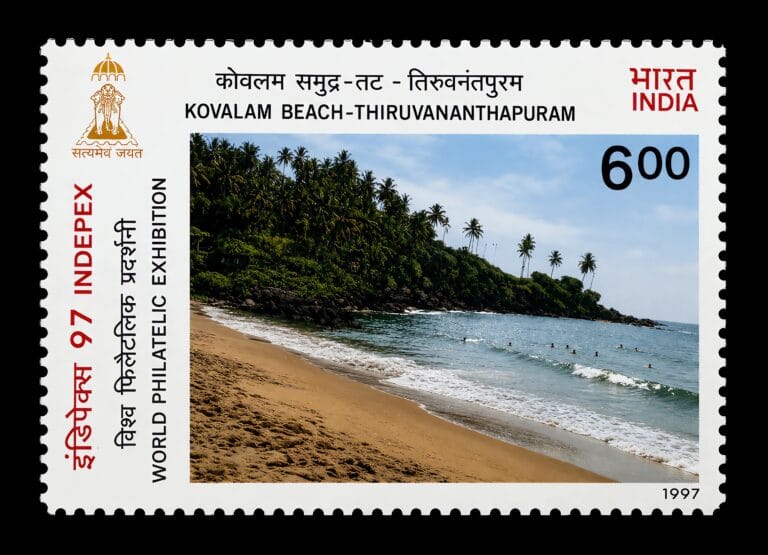
- Other stamps in the set: Kovalam Beach, Thiruvananthapuram (₹6); Anjuna Beach, Goa (₹10); Bogmalo Beach, Goa (₹11)
The Story
In 1997, India turned fifty. The country marked its golden jubilee with a philatelic exhibition in New Delhi — INDEPEX ’97 — and a burst of commemorative stamps. One themed set was called “Beaches of India.” Four stamps. Four coastlines. Four invitations to imagine sand between your toes.
The Gopalpur stamp 1997 carries two rupees. The humblest value. The one designed to actually go on envelopes.
This is fitting, because Gopalpur-on-Sea has always been a place that the world noticed and then forgot.
Sit on that beach today and you see fishing boats, a lighthouse, a handful of tourists from Berhampur, the nearest city. But rewind a century and this was a port — a genuine commercial harbour on the Bay of Bengal, in the Ganjam district of what was then Orissa.
The Soraine family, local landowners, built it up from an obscure fishing village into a trading hub. They constructed the port infrastructure, erected the lighthouse, opened the Albert Hotel for visiting merchants, and established a trade route with Burma.
The East India Company saw the opportunity. They used Gopalpur to ship rice eastward and built large godowns — warehouses — along the shore. They also used the port as a departure point, sending labourers from the region to work in the tea estates of Assam.
For decades, Gopalpur was not a beach destination. It was a working coast — salt air mixed with commerce, ambition, and colonial extraction.
Then came independence. Paradeep port, further north, grew modern and mechanised. Gopalpur’s trade dried up. The godowns emptied. The merchants left. What remained was the sand, the surf, the lighthouse, and a temple to Krishna from which the town takes its name — built in the eighteenth century, before the British arrived, before the rice ships, before any of it.
By 1997, when the Gopalpur stamp 1997 was designed, the town had completed its transformation: from port to postcard.
The photograph shows exactly this. Golden sand. Deep blue water. White sails on traditional fishing craft. Fifteen or twenty people scattered across the shore — no umbrellas, no vendors, no infrastructure. Unlike Kovalam’s intimate cove or Bogmalo’s aerial emptiness, the Gopalpur stamp 1997 is the only one in the set that shows people. It is also the only stamp facing the Bay of Bengal. The other three look west, toward the Arabian Sea. Gopalpur looks east — toward Burma, toward the trade route that no longer exists.
Why the Gopalpur Stamp 1997 Got the Lowest Value
Within the “Beaches of India” set, there is an unspoken hierarchy written in denominations. Goa gets two stamps and the highest values. Kerala gets one at ₹6. Odisha — the longest coastline of any eastern Indian state — gets ₹2.
Two rupees was the standard inland letter rate. Which means this stamp was used. Licked, stuck, postmarked, delivered, discarded. Mint copies are less common than you’d expect for a 1997 issue. The stamp was not designed for albums. It was designed for envelopes. That is either a democratic act — putting Gopalpur into the hands of millions — or a subtle ranking of which coasts India considered prestigious in 1997.
The stamp also preserves two names that no longer exist on official maps. “Orissa” became “Odisha” in 2011. “Gopalpur-on-Sea” remains, but the port — dormant for decades — restarted commercial operations in 2013, shipping ilmenite to South Korea. In 2024, Adani Ports acquired a 95% stake for ₹1,349 crore. The forgotten port is being remembered again, but not as a beach.
There is something melancholic about a country choosing its beaches to represent itself at fifty. Not industry. Not technology. Not monuments. Beaches — places where history has been smoothed over by the tide. Gopalpur’s story is the story of dozens of Indian coastal towns: once essential, now ornamental. The stamp freezes the town at a particular moment — after the port died, before the cyclones came (Phailin in 2013, Hudhud in 2014), before the shipping containers returned.
The denomination on the Gopalpur stamp 1997 tells its own story about which beaches India thought were worth marketing to the world
This Copy
The Gopalpur stamp 1997 photographed for this article is a mint copy, its perforations intact and cleanly separated on all four sides and the photograph panel well centred within the frame, with no toning or creasing. It is held here as part of the complete four-stamp Beaches of India set, alongside Kovalam (₹6), Anjuna (₹10), and Bogmalo (₹11).
Further Reading & Links
This stamp is part of StampTales coverage of the 1997 INDEPEX beaches set, alongside the Bogmalo Beach stamp, Kovalam Beach stamp, and Anjuna Beach stamp, all explored elsewhere on this site, and sits within StampTales’ The World in a Stamp collection. All four are seen together in What Four Indian Beach Stamps Reveal Together.
The port’s colonial history — the East India Company warehouses, the Soraine family who built the harbour, and the Krishna temple the town is named for — is documented in Gopalpur, Odisha on Wikipedia.
The forgotten port’s second life is a story in itself: Gopalpur Port restarted commercial operations in 2013, shipped ilmenite to South Korea, and was acquired 95% by Adani Ports in 2024.
For the deeper past — Gopalpur as a Kalinga-era harbour trading with Southeast Asia long before the British arrived — see the maritime history of Odisha.



4 Comments
Comments are closed.