When India Mailed Its Coastline — The ₹6 Stamp That Remembers a Forgotten Port
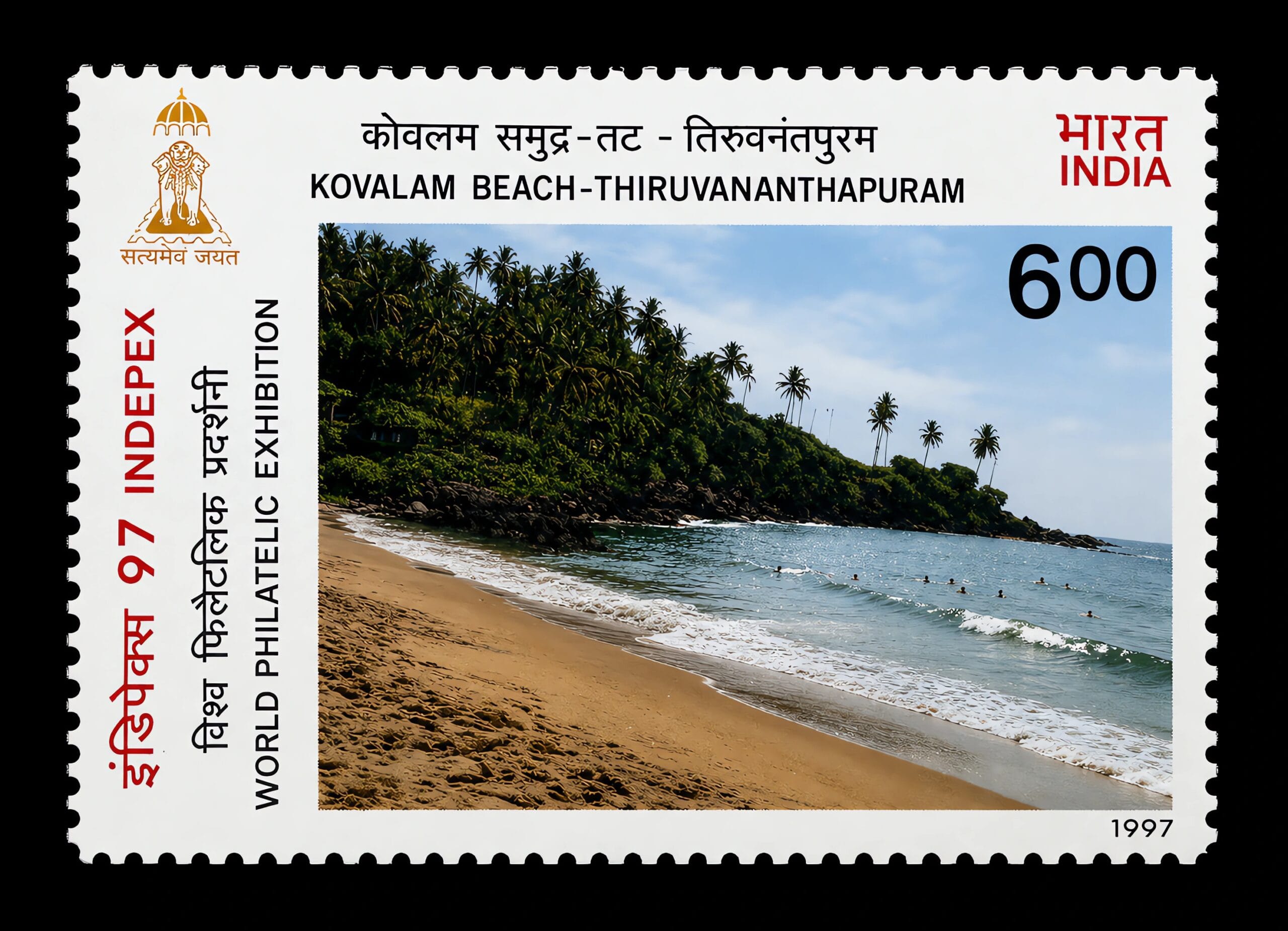
The Kovalam Beach stamp 1997 shows a shoreline that no longer exists quite this way — no hotels, no shacks, just a headland and a handful of swimmers.
The Stamp
- Issued: 1997, India Post
- Denomination: ₹6 (600 paise)
- Occasion: INDEPEX ’97 — World Philatelic Exhibition, New Delhi, 15–22 December 1997
- Subject: Kovalam Beach, Thiruvananthapuram, Kerala
- Inscription (English): KOVALAM BEACH – THIRUVANANTHAPURAM / INDEPEX 97 / WORLD PHILATELIC EXHIBITION
- Inscription (Hindi): कोवलम समुद्र-तट – तिरुवनंतपुरम / इंडिपेक्स 97 / विश्व फिलैटेलिक प्रदर्शनी
- Design: Ground-level photograph — golden sand, coconut palms crowning a rocky headland, swimmers in calm turquoise water
- National emblem: Lion Capital of Ashoka with सत्यमेव जयते
The Story
Kovalam was not discovered by tourists. It was discovered by a queen.
Toward the end of the 1920s, Regent Maharani Sethu Lakshmi Bayi of Travancore built Halcyon Castle on the headland overlooking these coves — a private retreat, 16 kilometres south of her capital. Her nephew, the last Maharaja, entertained European guests there through the 1930s. They swam. They talked. They told others.
Then, four decades later, the hippies arrived.
Kovalam sat on the overland trail between Goa and Ceylon. Backpackers in the early 1970s found three crescent-shaped beaches separated by rocky outcroppings, palm trees thick as walls, and a fishing village that asked no questions. They stayed. Word spread. By 1979, Kerala was receiving 29,000 overseas tourists annually. By 2000, that number had risen to 225,000 — and a significant percentage of them washed up at Kovalam.
The stamp photograph ignores all of this. It is taken at beach level, looking along the shore toward the rocky headland. Dense coconut palms cascade down the cliff. The sea is calm, turquoise, almost Mediterranean. A handful of swimmers dot the shallows. No hotels. No shack restaurants. No signboards advertising Ayurvedic massage.
India Post chose the Kovalam that existed before the guidebooks — or the one that still existed if you turned your camera at exactly the right angle.
The beach in the frame appears to be Hawa Beach — the middle cove — with its characteristic palm-covered promontory dividing it from Lighthouse Beach to the south. The 36-metre Vizhinjam Lighthouse on Kurumkal hillock is not visible, but its presence is implied by the geography. You are looking at the quieter stretch, not the popular one.
Why the Kovalam Beach Stamp 1997 Chose That Name
The question this stamp raises is simple: why did India Post use the full name Thiruvananthapuram — not Trivandrum, which most Indians still said casually in 1997?
On a stamp celebrating fifty years of independence, issued for an international philatelic exhibition, that choice is deliberate. The beach may have been popularised by Europeans, named in guidebooks by Westerners, and developed by hotel chains — but the land belongs to Thiruvananthapuram, and the stamp says so in both scripts. It is a quiet act of reclamation printed on gummed paper.
There is also the matter of denomination. The INDEPEX ’97 beaches set ranged from ₹2 to ₹11. Kovalam got ₹6 — the middle ground. Not the prestige denomination (that went to Bogmalo), not the workhorse value for everyday postage. Six rupees: the price of sending a letter to someone and making them wish they were here. A denomination designed for actual use, which means this stamp — unlike its ₹11 sibling — was licked, stuck, postmarked, and delivered. Most surviving copies carry cancellation marks. Mint copies are less common than you might expect for a 1997 issue.
Kovalam’s story is the story of Indian tourism compressed into a single shoreline. Royal retreat becomes hippie colony becomes package-holiday destination becomes a name on a government stamp. Each transformation erases the previous one. The fishermen who launched catamarans from this sand before Halcyon Castle was built are absent from the frame entirely — replaced by swimmers.
This Copy
Mint and unhinged, with perforations clean on all four sides. The colours remain strong — the green of the palms is dense and saturated, and the sand holds its warmth. It is kept paired with the ₹11 Bogmalo stamp as part of an INDEPEX ’97 sub-collection: two ends of India’s western coastline, two approaches to the same sea.
Further Reading & Links
This stamp is part of the same 1997 INDEPEX set as StampTales’ Bogmalo Beach stamp, Gopalpur-on-Sea stamp, and Anjuna Beach stamp pieces, all explored elsewhere on this site, and sits within StampTales’ The World in a Stamp collection. All four are seen together in What Four Indian Beach Stamps Reveal Together. The Vizhinjam Lighthouse implied just beyond this stamp’s frame has its own history — Wikipedia’s entry on the Vizhinjam Lighthouse notes it became operational in 1972, decades after the fishing village and royal retreat this article describes.

6 Comments
Comments are closed.