A Hundred Paise for a Navy That Preferred Silence — The Fleet Review Stamp of 1984
A submarine surfaces on a one-rupee 1984 Fleet Review stamp — while India’s real submarines were surfacing into a Cold War arms race that would reshape the Indian Ocean.
The Stamp
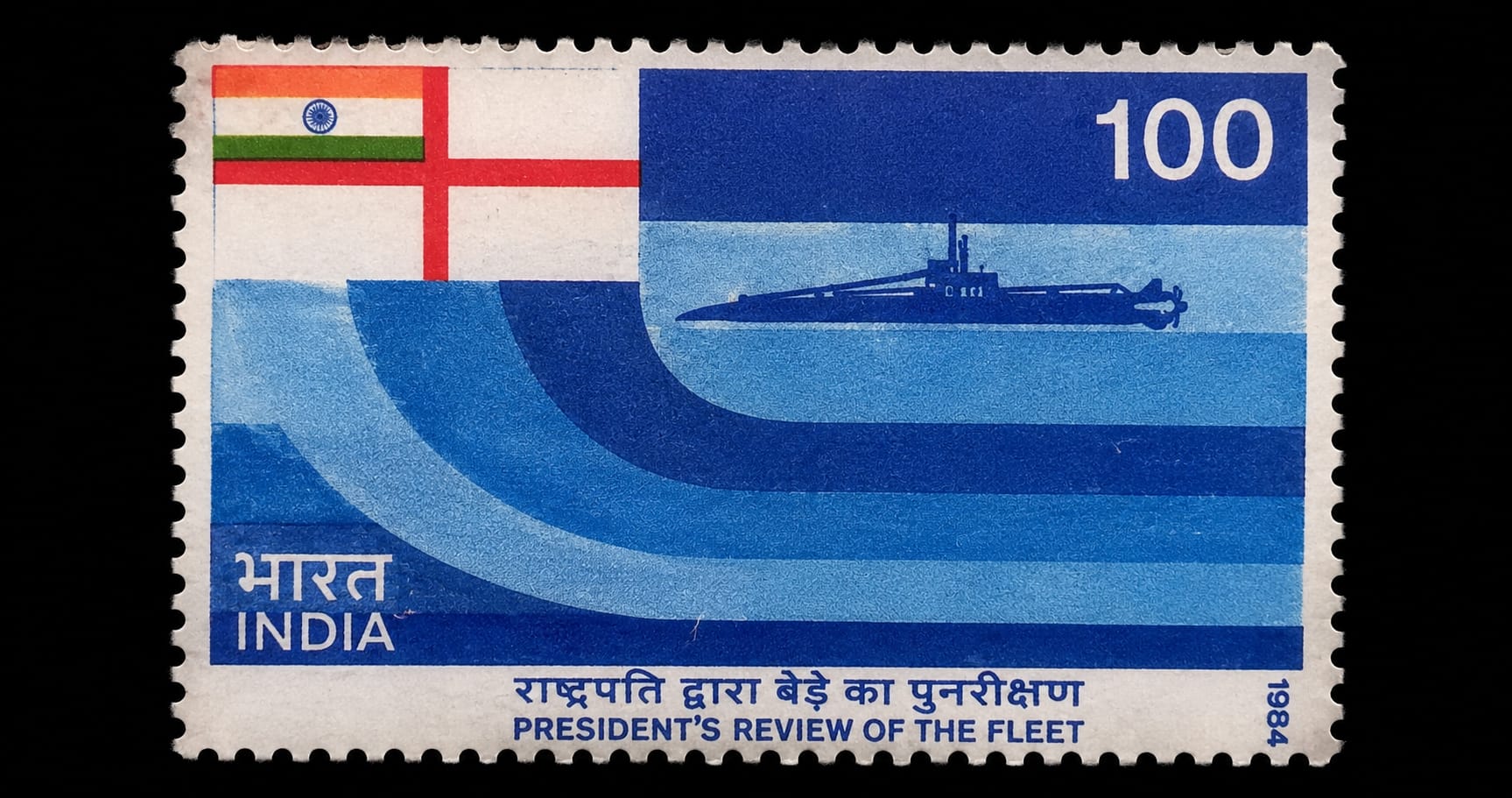
Denomination: ₹1 (100 paise) Date of Issue: February 1984 Occasion: President’s Review of the Fleet Catalogue: India Post commemorative Design: Modernist graphic — Naval Ensign, submarine silhouette, stylized ocean waves Colour palette: Royal blue, sky blue, white, saffron, red, green Printing: Photogravure, India Security Press
The Story
“The 1984 Fleet Review stamp India issued in February shows something unexpected: not the Navy’s new fighter jets, but a submarine.”
Sixty-Five Ships for One Man
On 12 February 1984, sixty-five ships dropped anchor off Bombay harbour in precise formation. Forty-five warships. Three submarines. Nine merchant vessels. Seven yard craft. Two Coast Guard cutters. All of them waiting for one man on a yacht.
President Giani Zail Singh — Sikh preacher turned politician, a man more associated with Punjab’s wheat fields than the open ocean — stood aboard the Presidential Yacht as it threaded between columns of grey steel. Each ship’s company lined the rails, caps off, delivering three resounding Jais as the yacht passed. A 21-gun salute echoed across the water.
This was the fifth President’s Fleet Review since Independence. In ceremonial significance, it ranked second only to the Republic Day Parade.
Why the 1984 Fleet Review Stamp Matters
The timing tells you everything.
In 1983 — just months before this review — the Indian Navy had taken delivery of its first British Aerospace Sea Harriers. Jump jets. Vertical-takeoff fighters that could operate from INS Vikrant’s flight deck without a catapult. Thirty-two naval aircraft thundered overhead in formation that February morning, the Sea Harriers among them, making their fleet review debut.
But the stamp doesn’t show a Harrier. It shows a submarine.
By 1984, India operated eight submarines — four Foxtrot-class boats acquired from the Soviet Union starting with INS Kalvari in 1967, and four improved variants of the Vela class. The submarine arm was seventeen years old but still growing. The first HDW submarines from Germany were already being negotiated. Five years later, the Navy would lease its first nuclear submarine, INS Chakra, from the Soviet Union.
The designer chose to put a submarine on a one-rupee stamp because in 1984, the submarine was the symbol of where India’s navy was headed — below the surface, into blue-water capability, away from being a coastal defense force.
Reading the Design
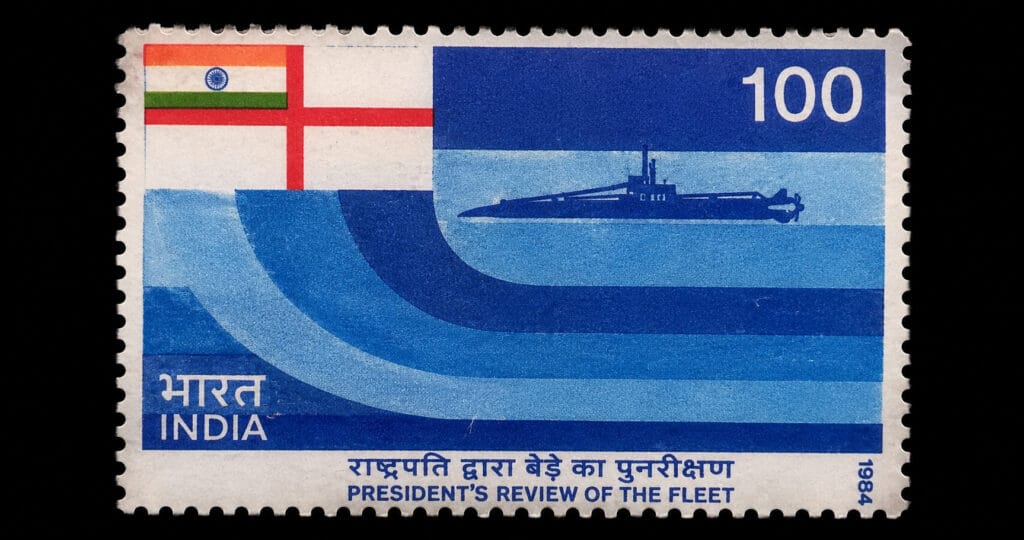
The stamp’s composition is sharply divided. Upper left: the Indian Naval Ensign — white field, red St. George’s Cross, the tricolour sitting in the canton. This was the ensign India inherited from the Royal Indian Navy and retained until 2001 (and then again replaced in 2022 with a new design removing the colonial cross entirely — but that’s another story).
The rest of the stamp belongs to the sea. Bold concentric wave bands sweep diagonally across the frame — dark navy, medium blue, light blue — a graphic representation of the ocean rendered in a modernist style that owes more to poster design than to realism. Against this, the submarine silhouette sits low in the water. Dark. Quiet. Facing right — moving forward.
No ship name. No class identification. It could be any of the eight boats in service. That anonymity is the point. A submarine’s value lies in its invisibility.
The Political Backdrop
This stamp landed in letterboxes during one of the most turbulent years in modern Indian history. Within months of the fleet review:
- June 1984: Operation Blue Star
- October 1984: Indira Gandhi’s assassination
- November 1984: Anti-Sikh riots across northern India
Zail Singh — the man on the yacht, the man whose office this stamp commemorates — was a Sikh president navigating the worst sectarian crisis since Partition. The fleet review was one of the last moments of ceremonial normalcy before 1984 tore itself apart.
The stamp, of course, says none of this. It sits in its quiet blues, showing a navy at peace, a submarine on patrol, a flag in the wind. Stamps are time capsules, but they only preserve what the issuing authority wanted remembered.
One Rupee
The denomination is worth noting. One rupee. The standard inland letter rate in 1984. This wasn’t a high-value commemorative meant for collectors — it was designed to actually travel on mail. Millions of these crossed post office counters. For most Indians, it may have been the only time they saw a submarine rendered in any form.
A navy that most citizens would never visit, compressed into a 3.5 × 2.5 cm rectangle, stuck to an envelope, cancelled, delivered. That’s what stamps do — they carry a nation’s self-image to its own people, one letter at a time.
Series Context
This isn’t a standalone commemorative — it’s the first in a series that continues five years later with the 1989 Fleet Review stamp, which puts an even more complicated vessel front and center. Fleet Review stamps are issued irregularly, only when the review itself takes place (roughly once per presidential term). India has issued fleet review stamps in 1984, 1989, 2001, 2006, 2011 and 2016.
This stamp sits alongside other historical moments explored in StampTales’ Time Capsule collection, where India’s postal history intersects with the events that shaped it.
Commemoratives like this one are catalogued and issued through India Post’s own Philately division, which still manages special covers and first-day cancellations for events of national significance today.

6 Comments
Comments are closed.