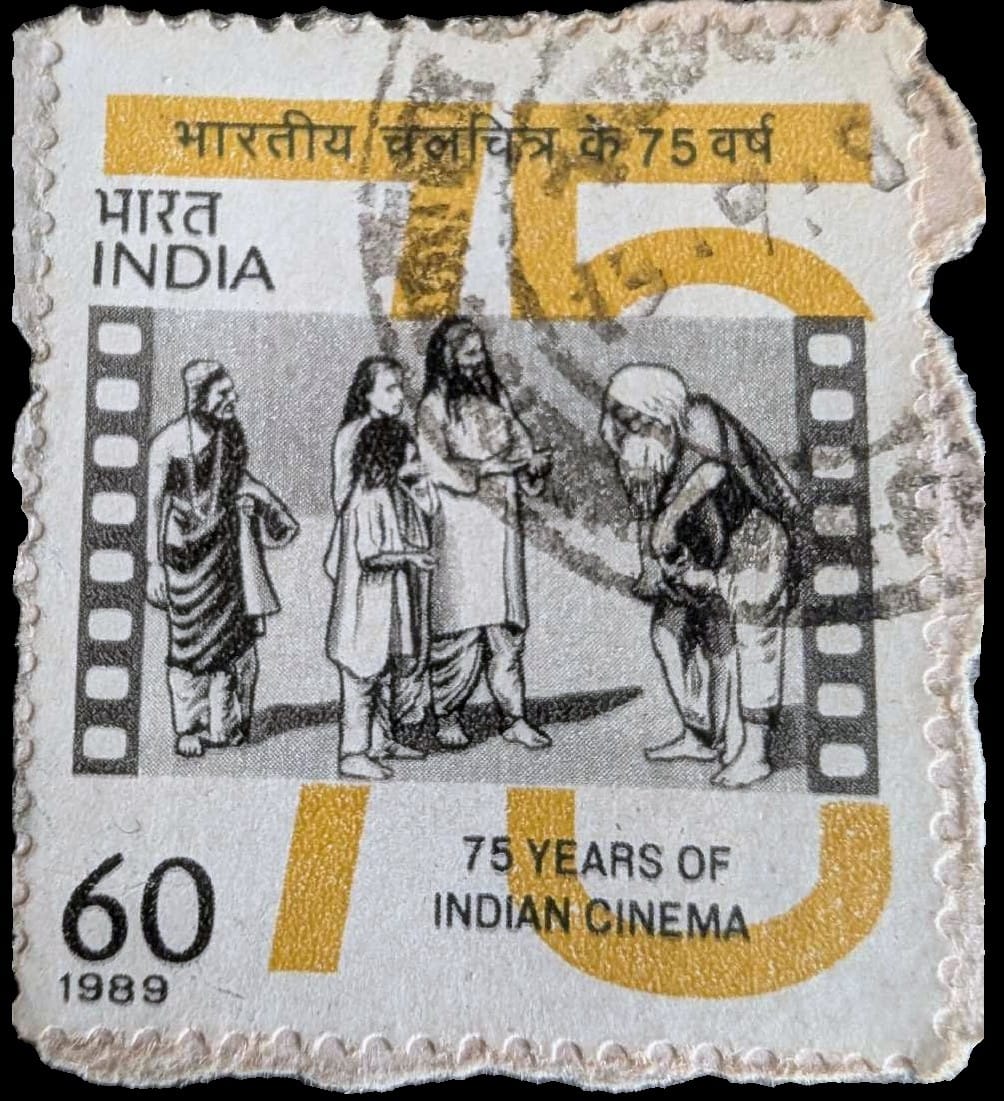
India’s First Heroine Wasn’t a Woman. The Stamp Never Says So.
The Stamp
- Country: India
- Year of Issue: 1989
- Issue Date: 30 May 1989
- Denomination: 60 paise
- Occasion: Platinum jubilee (75 years) of Indian cinema, marking the 1913 release of Raja Harishchandra
- Format: Single stamp
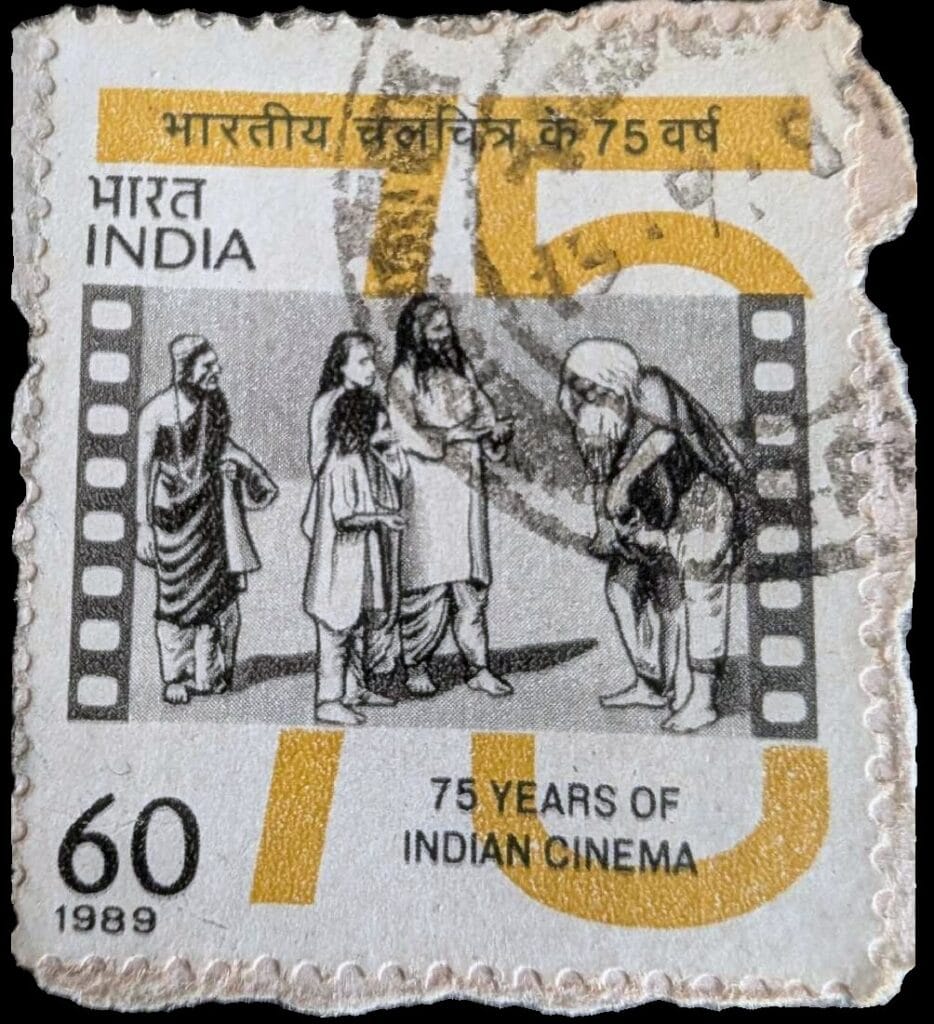
- Design: Illustrated scene inspired by Raja Harishchandra (1913), framed by a film-strip border and the numeral “75” in gold
The Story
India’s first heroine was a cook. This 1989 Indian cinema stamp remembers her only as an illustrated scene, decades later. Not a metaphor — an actual cook, at a Grant Road eatery in Bombay, who agreed to put on a sari for five extra rupees a month.
In 1913, Dhundiraj Govind Phalke wanted to make India’s first feature film. He had the camera, imported from London. He had a script, drawn from the legend of King Harishchandra, a ruler so devoted to truth that he gives up his throne, his wife, and his son rather than break a promise. What he did not have was a woman willing to play the queen.
Phalke advertised. Prostitutes auditioned and were turned away for not looking the part. A young woman was cast, rehearsed for four days, and then pulled out by the man who kept her, on the fifth. Acting on camera was, in 1913 Bombay, a disgrace no respectable woman would risk — and the women willing to risk it weren’t, by Phalke’s judgement, presentable enough for a queen. Even his own wife, already working on costumes and continuity, refused the role outright.
This is the crisis the 1989 stamp compresses into four illustrated figures and a gold numeral, with none of it visible. Look closely at the stamp: nothing in the frame hints that its cast was assembled this way, or that the production nearly stalled before it began.
Phalke found his queen in a restaurant. Anna Salunke, a waiter with slender hands and a soft, unweathered face, agreed to the part for a raise he couldn’t say no to. He shaved his moustache, put on a sari, and became Taramati — the first woman ever to appear in an Indian feature film, played entirely by a man.
Raja Harishchandra opened at Bombay’s Coronation Cinematograph and Variety Hall on 3 May 1913. It ran for twenty-three days straight, an unheard-of run for a silent picture, and a special half-price show was arranged for women and children only — the very audience the film’s own production had found impossible to cast. The irony wasn’t lost on anyone at the time; it just wasn’t the kind of thing a launch is built to advertise, then or in 1989.
Seventy-five years after that release, India Post issued this 60-paise stamp to mark the anniversary. It reaches for one illustrated scene to stand in for the whole story — the figures wrapped in a film-strip border, a gold numeral “75” announcing the jubilee. Of everything Phalke’s production went through to get to opening night, the design chose to show only the calm result: a scene, a number, a border. Why India Post chose an illustrated tableau rather than foregrounding the extraordinary casting story is worth considering, and it’s the question the next section takes up directly.
By 1989, that question had a broader backdrop. Indian cinema was no longer a fragile experiment — it had grown into the country’s most-watched form of storytelling, and its stars carried a cultural weight Phalke could never have imagined for his cast of reluctant amateurs. India Post had long used commemorative stamps to define national memory — freedom fighters, scientists, institutions, public figures. By 1989, cinema had earned a place in that same lineage: something the state now considered part of India’s public heritage, worth putting in every letterbox in the country. The stamp isn’t only commemorating one 1913 film; it’s marking the moment the government judged cinema itself worth commemorating on the national mail.
That’s the quieter story a stamp collector can find underneath this one: India’s national cinema opened for business by improvising its way around a rule that said women couldn’t be seen doing this at all — and the object commemorating that has nothing on its face to say so.
Looking Closer
The stamp’s most interesting decision is what it borrows and what it invents. The central scene is illustrated, not photographed — a genuine choice, since production stills and a publicity poster from Raja Harishchandra do survive and are catalogued in film archives today. India Post chose illustration over one of those documentary images: monochrome figures, simple linework, a staged tableau that reads as “old cinema” the way a sepia tone reads as “old photograph,” regardless of what the film stock actually looked like. A surviving still would have tied the stamp to one specific, verifiable frame of the production; the illustration instead lets it claim something bigger and vaguer — not this film, but Indian cinema itself, remembered rather than documented.
That monochrome scene sits inside a very modern frame. The film-strip border — perforated edges, rectangular sprocket holes — is a piece of 1980s design vocabulary for “movies,” borrowed from reels that Phalke’s own 1913 camera would have used, but stylised in a way no 1913 audience would have recognised as a symbol. It’s the stamp explaining cinema to itself, using an icon the medium hadn’t yet standardised when this particular film was made — a 1989 shorthand pasted onto a 1913 memory.
Then there’s the gold “75,” and this is where the design tips its hand. On the stamp’s own terms, the anniversary has grown larger than the film that caused it — measure the numeral against the illustrated scene beneath it and it’s nearly as tall as the tableau itself, rendered in the same saturated ochre used across many of India Post’s commemorative issues of the period. Strip the gold away and what’s left is a modest, theatrical vignette — four staged figures, nothing that shouts for attention on its own. It’s the numeral doing all the emotional work. The design encourages the viewer to celebrate the anniversary more than to study the film itself.
On the copy in this collection, one further detail earns its place: the postal cancellation crosses directly over the gold “75,” partly obscuring the very numeral the design built its whole statement around. It’s a small, unplanned irony — the postmark doing exactly what postmarks are for, marking the stamp as used, while quietly undercutting the one element engineered to be the loudest thing on the page. The stamp completed the job it was printed for — carrying a letter — even as that job blurred its own celebration.
Nowhere in that illustrated scene is there any indication that the cast includes no women at all. That absence isn’t a flaw in the design — it’s simply outside the brief a commemorative stamp is built to fulfil. But it’s exactly the kind of detail a stamp collector’s magnifying glass, and a hundred years of hindsight, can surface that the 1989 buying public at the post office counter never had reason to ask about.
Closing
Every national cinema likes to tell its origin story as a triumph, and this stamp is built to do exactly that — a gold “75,” a confident border, seventy-five years compressed into one calm illustrated frame. But the object was never going to carry the part of the story that mattered most: a cook in a borrowed sari, shaving off his moustache for five extra rupees, standing in for every woman Bombay wouldn’t let near a camera. Every letter this stamp ever franked carried that memory too, whether the sender knew it or not.
For more on India Post’s 1980s commemoratives and the stories behind them, see our piece on the Gandhi 1994 stamp, issued around another single defining moment in the national story, and the Fleet Review 1984 stamp, another illustrated rather than photographed 1980s commemorative. You can also read more about how this collection is built, and the equipment behind it, on the About page.
For the fuller history of Raja Harishchandra and Dadasaheb Phalke’s founding production, Wikipedia’s entry on the film is thoroughly sourced against academic biographies, and The Public Domain Review’s essay and surviving footage offers a closer look at what remains of the original film itself.
8 Comments
Comments are closed.